
Forwarded from Daily Science to all
ScienceAlert - Latest
NASA Finally Makes Contact With Voyager 2 After Longest Radio Silence in 30 Years
➖ @sciencetoall ➖
NASA Finally Makes Contact With Voyager 2 After Longest Radio Silence in 30 Years
➖ @sciencetoall ➖
ScienceAlert
NASA Finally Makes Contact With Voyager 2 After Longest Radio Silence in 30 Years
There's never been a radio silence quite like this one. After long months with no way of making contact with Voyager 2, NASA has finally reestablished communications with the record-setting interstellar spacecraft.
Our sponsor, ISS Corporation, in addition to revolutionized Under Vehicle Scanning System (UVSS) presented recently, is launching a new product – high-tech solution for pedestrian’s safety - SOFFIT. Product video for your information:https://youtu.be/zhUX5CnHVm8
Contact ISS: @bigfarang
Contact ISS: @bigfarang
Forwarded from Daily Science to all
ScienceAlert - Latest
This Weird Rock Naturally Glows in The Dark, And Now Scientists Have Figured Out How
➖ @sciencetoall ➖
This Weird Rock Naturally Glows in The Dark, And Now Scientists Have Figured Out How
➖ @sciencetoall ➖
ScienceAlert
This Weird Rock Naturally Glows in The Dark, And Now Scientists Have Figured Out How
The afterglow of the mineral hackmanite (or tenebrescent sodalite) is a fascinating natural phenomenon that has long been a mystery to scientists – even if we're now able to engineer synthetic materials that glow in the dark more effectively than
NASA Rocket Engines May Include Large-Scale 3D Printing
NASA’s Rapid Analysis and Manufacturing Propulsion Technology project, or RAMPT, is advancing development of an additive manufacturing technique to 3D print rocket engine parts using metal powder and lasers. The method, called blown powder directed energy deposition, could bring down costs and lead times for producing large, complex engine components like nozzles and combustion chambers.
Watch Video here
Read Article here
NASA’s Rapid Analysis and Manufacturing Propulsion Technology project, or RAMPT, is advancing development of an additive manufacturing technique to 3D print rocket engine parts using metal powder and lasers. The method, called blown powder directed energy deposition, could bring down costs and lead times for producing large, complex engine components like nozzles and combustion chambers.
Watch Video here
Read Article here
Forwarded from Daily Science to all
ScienceAlert - Latest
First-Ever Flu Vaccine Derived From Tobacco Plants Just Smashed Clinical Trials
➖ @sciencetoall ➖
First-Ever Flu Vaccine Derived From Tobacco Plants Just Smashed Clinical Trials
➖ @sciencetoall ➖
ScienceAlert
First-Ever Flu Vaccine Derived From Tobacco Plants Just Smashed Clinical Trials
A new flu vaccine grown in plants has been put to the test in two large-scale clinical trials, a first for vaccine research.
Forwarded from Daily Science to all
ScienceAlert - Latest
Ancient Lake Discovered Under Greenland May Be Millions of Years Old, Scientists Say
➖ @sciencetoall ➖
Ancient Lake Discovered Under Greenland May Be Millions of Years Old, Scientists Say
➖ @sciencetoall ➖
ScienceAlert
Ancient Lake Discovered Under Greenland May Be Millions of Years Old, Scientists Say
The remains of a giant, ancient lake have been discovered under Greenland, buried deep below the ice sheet in the northwest of the country and estimated to be hundreds of thousands of years old, if not millions, scientists say.
Physicists Pin Down Nuclear Reaction From Moments After the Big Bang
Read on Quanta
The newly-measured rate of a key nuclear fusion process from the Big Bang matches the picture of the universe 380,000 years later.The reaction involves deuterium, a form of hydrogen consisting of one proton and one neutron that fused within the cosmos’s first three minutes. Most of the deuterium quickly fused into heavier, stabler elements like helium and lithium. But some survived to the present day.
Read on Quanta
Forwarded from Daily Science to all
ScienceAlert - Latest
Computer Chip With Atomically Thin Layers Works Like The Neurons in Our Brains
➖ @sciencetoall ➖
Computer Chip With Atomically Thin Layers Works Like The Neurons in Our Brains
➖ @sciencetoall ➖
ScienceAlert
Computer Chip With Atomically Thin Layers Works Like The Neurons in Our Brains
Traditional computer chips use separate areas for calculations and data storage, but new research has shown how these areas can be combined together on a 2D material for the first time – which should lead to smaller, more powerful, more energy-ef
Forwarded from Daily Science to all
ScienceAlert - Latest
Astronomers Discover Binary Black Holes That Have Their Own 'Electron'
➖ @sciencetoall ➖
Astronomers Discover Binary Black Holes That Have Their Own 'Electron'
➖ @sciencetoall ➖
ScienceAlert
Astronomers Discover Binary Black Holes That Have Their Own 'Electron'
Black holes are notable for many things, especially their simplicity. They're just … holes. That are 'black.' This simplicity allows us to draw surprising parallels between black holes and other branches of physics.
Forwarded from Daily Science to all
ScienceAlert - Latest
There Was a Special, Extra Crew Member Onboard Yesterday's SpaceX Launch - Baby Yoda
➖ @sciencetoall ➖
There Was a Special, Extra Crew Member Onboard Yesterday's SpaceX Launch - Baby Yoda
➖ @sciencetoall ➖
ScienceAlert
There Was a Special, Extra Crew Member Onboard Yesterday's SpaceX Launch - Baby Yoda
SpaceX rocketed four astronauts into orbit Sunday night, along with a stowaway: Baby Yoda.
👍2
Forwarded from Daily Science to all
ScienceAlert - Latest
No, Elon Musk Is Not About to Blow This COVID-19 Testing Thing Wide Open
➖ @sciencetoall ➖
No, Elon Musk Is Not About to Blow This COVID-19 Testing Thing Wide Open
➖ @sciencetoall ➖
ScienceAlert
No, Elon Musk Is Not About to Blow This COVID-19 Testing Thing Wide Open
On Friday 13th November, Elon Musk took four rapid antigen tests for COVID-19. When the results came back two were negative and two were positive. Musk was alarmed. He took to Twitter complaining "Something extremely bogus is going on."
This media is not supported in your browser
VIEW IN TELEGRAM
It has been thought of as many things: a pointlike object, an excitation of a field, a speck of pure math that has cut into reality. But never has physicists’ conception of a particle changed more than it is changing now.
Given that everything in the universe reduces to particles, a question presents itself: What are particles
Given that everything in the universe reduces to particles, a question presents itself: What are particles
Forwarded from Daily Science to all
ScienceAlert - Latest
Asteroid-Hunting Telescope Is Being Urgently Taken Down to Avoid 'Catastrophic' Collapse
➖ @sciencetoall ➖
Asteroid-Hunting Telescope Is Being Urgently Taken Down to Avoid 'Catastrophic' Collapse
➖ @sciencetoall ➖
ScienceAlert
Asteroid-Hunting Telescope Is Being Urgently Taken Down to Avoid 'Catastrophic' Collapse
One of the world's most iconic astronomical observatories has fallen apart beyond repair. Now it threatens to collapse entirely.
Forwarded from Daily Science to all
ScienceAlert - Latest
For The First Time Ever, Scientists Have Created Diamonds in The Lab Without Heat
➖ @sciencetoall ➖
For The First Time Ever, Scientists Have Created Diamonds in The Lab Without Heat
➖ @sciencetoall ➖
ScienceAlert
For The First Time Ever, Scientists Have Created Diamonds in The Lab Without Heat
In nature, diamonds form deep in the Earth over billions of years. This process requires environments with exceptionally high pressure and temperatures exceeding 1,000℃.
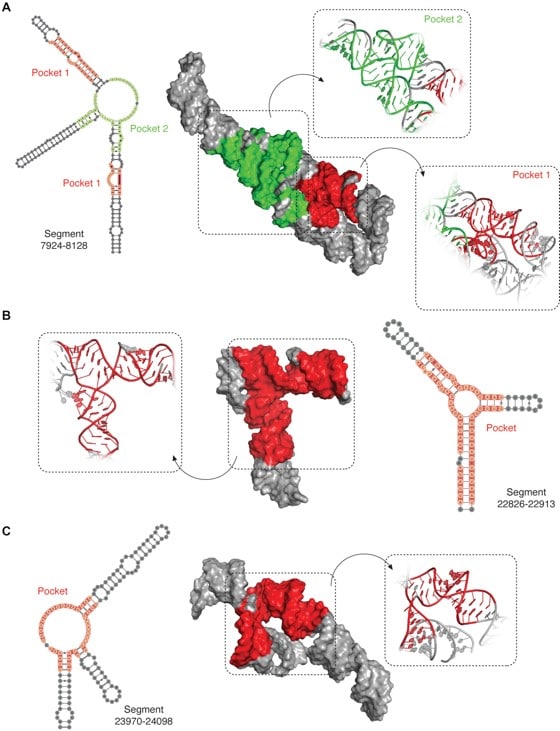
SARS-CoV-2 genomic RNA
Infectious diseases caused by bacteria and viruses have been around for a long time. Over the past 18 years, there have been numerous deaths worldwide due to acute respiratory illnesses caused by coronaviruses, including SARS and MERS. The COVID-19 pandemic has already claimed more than 1.35 million lives. This emphasizes the urgent need for new ways to combat coronavirus infections.
Researchers at the International Institute of Molecular and Cell Biology in Warsaw (in Poland), the University of Groningen, and the University of Leiden (both in the Netherlands) have analyzed the structure of genomic RNA of SARS-CoV-2 using a variety of advanced technologies. This is the first time that the structure of the entire coronavirus RNA has been determined.
The researchers have modeled the three-dimensional structure of the regions with well-defined compact structure. The study presents one thousand best-scored models for each of the regions modeled, representing the conformational space with probable alternative 3D-configurations. Also, pockets were identified in the RNA structures that could be targeted by small molecules to hamper the function of the viral RNA.
This research was published as a Breakthrough Article in Nucleic Acids Research.
Infectious diseases caused by bacteria and viruses have been around for a long time. Over the past 18 years, there have been numerous deaths worldwide due to acute respiratory illnesses caused by coronaviruses, including SARS and MERS. The COVID-19 pandemic has already claimed more than 1.35 million lives. This emphasizes the urgent need for new ways to combat coronavirus infections.
Researchers at the International Institute of Molecular and Cell Biology in Warsaw (in Poland), the University of Groningen, and the University of Leiden (both in the Netherlands) have analyzed the structure of genomic RNA of SARS-CoV-2 using a variety of advanced technologies. This is the first time that the structure of the entire coronavirus RNA has been determined.
The researchers have modeled the three-dimensional structure of the regions with well-defined compact structure. The study presents one thousand best-scored models for each of the regions modeled, representing the conformational space with probable alternative 3D-configurations. Also, pockets were identified in the RNA structures that could be targeted by small molecules to hamper the function of the viral RNA.
This research was published as a Breakthrough Article in Nucleic Acids Research.
👍1
Forwarded from Daily Science to all
ScienceAlert - Latest
We're About to Witness a Super-Rare Planetary Alignment Not Seen in 800 Years
➖ @sciencetoall ➖
We're About to Witness a Super-Rare Planetary Alignment Not Seen in 800 Years
➖ @sciencetoall ➖
ScienceAlert
We're About to Witness a Super-Rare Planetary Alignment Not Seen in 800 Years
Star-gazers are in for a treat over Christmas, as Jupiter and Saturn will get closer to each other in Earth's night sky than they have been for nearly 800 years. Set up your telescope, hope for a clear night, and get ready.
Forwarded from Daily Science to all
ScienceAlert - Latest
China Launches 'Audacious' Mission to Obtain First New Lunar Samples in Decades
➖ @sciencetoall ➖
China Launches 'Audacious' Mission to Obtain First New Lunar Samples in Decades
➖ @sciencetoall ➖
ScienceAlert
China Launches 'Audacious' Mission to Obtain First New Lunar Samples in Decades
For decades, planetary geologists have studied tiny chunks of lunar rock to unravel the Moon's mysteries. The rocks have revealed how old the Moon is, helped scientists estimate the age of other planets, and offered insight into how turbulent our
👍1
Dark matter could be made up of particles with a vast range of possible masses.
Physicists plan to leave no stone unturned, checking whether dark matter tickles different types of detectors, nudges starlight, warms planetary cores or even lodges in rocks.
Ever since astronomers reached a consensus in the 1980s that most of the mass in the universe is invisible — that “dark matter” must glue galaxies together and gravitationally sculpt the cosmos as a whole — experimentalists have hunted for the nonluminous particles.
Very interesting article on Quanta
Physicists plan to leave no stone unturned, checking whether dark matter tickles different types of detectors, nudges starlight, warms planetary cores or even lodges in rocks.
Ever since astronomers reached a consensus in the 1980s that most of the mass in the universe is invisible — that “dark matter” must glue galaxies together and gravitationally sculpt the cosmos as a whole — experimentalists have hunted for the nonluminous particles.
Very interesting article on Quanta
Forwarded from Daily Science to all
ScienceAlert - Latest
Artificial Intelligence Is Now Smart Enough to Know When It Can't Be Trusted
➖ @sciencetoall ➖
Artificial Intelligence Is Now Smart Enough to Know When It Can't Be Trusted
➖ @sciencetoall ➖
ScienceAlert
Artificial Intelligence Is Now Smart Enough to Know When It Can't Be Trusted
How might The Terminator have played out if Skynet had decided it probably wasn't responsible enough to hold the keys to the entire US nuclear arsenal? As it turns out, scientists may just have saved us from such a future AI-led apocalypse, by crea
👍1
Forwarded from Daily Science to all
ScienceAlert - Latest
Scientists Figured Out How Much Exercise You Need to 'Offset' a Day of Sitting
➖ @sciencetoall ➖
Scientists Figured Out How Much Exercise You Need to 'Offset' a Day of Sitting
➖ @sciencetoall ➖
ScienceAlert
Scientists Figured Out How Much Exercise You Need to 'Offset' a Day of Sitting
We know that spending hour after hour sitting down isn't good for us, but just how much exercise is needed to counteract the negative health impact of a day at a desk? A new study suggests about 30-40 minutes per day of building up a sweat should d