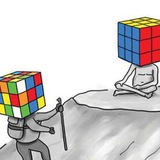
Accessibility alone makes websites usable for both humans and AI agents.
If a site works for screen readers, it works for agents.
Creating separate agent protocols leads to outdated, inconsistent systems.
Properly accessible sites maintain one source of truth, avoiding drift.
Fixing accessibility will solve agent compatibility without needing new standards.
If a site works for screen readers, it works for agents.
Creating separate agent protocols leads to outdated, inconsistent systems.
Properly accessible sites maintain one source of truth, avoiding drift.
Fixing accessibility will solve agent compatibility without needing new standards.
Minimal instruction set computer - Wikipedia
https://en.wikipedia.org/wiki/Minimal_instruction_set_computer
https://en.wikipedia.org/wiki/Minimal_instruction_set_computer
💡 Remember Box
https://github.com/anony4review/hstrat
#todo implement in rust and check speed difference
document parsing, compiler verification, massively-parallel computation models, on-device multi-agent cognition, and hard-science simulation
The recursive nature of intelligence is the universal optimizer of every scarcity because it operates at the meta-level of problem-framing, substrate engineering, and goal-redefinition. Any persisting scarcity is, by definition, evidence of insufficient recursion depth to date hence “primarily a failure of intelligence” in the precise sense that it marks the current frontier where the optimizer has not yet bootstrapped far enough. Recursion does not merely solve within a fixed frame; it escalates the frame: turning thermodynamic limits into local reversible regimes + cosmic expansion windows; turning positional goods into non-rival simulated or shared qualia via brain-computer interfaces or mind uploading; turning preference-driven scarcity into chosen utility functions that treat the constraint as feature, not bug. The mechanism is search through design space for negentropic, self-consistent arrangements where the experienced gap closes.
maximize understanding and agency through evidence, reason, and bold experimentation