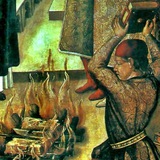
“The test of a pilot is seen in a storm; so the test of a Christian is seen in affliction. That man has the right art of navigation who, when the boisterous winds blow from heaven, steers the ship of his soul wisely, and does not dash upon the rock of impatience. ”
— Thomas Watson (1620–1686)
— Thomas Watson (1620–1686)
🔥1
In John Calvin's commentary, he applies Jeremiah 29:14 to his own time and indicates that the reformation they were then experiencing in 16th-century Europe was completely unexpected:
"And hence we may gather a useful doctrine — that God in a wonderful manner gathers his Church when scattered, so as to form it into one body, however he may for a time obliterate its name and even its very appearance. AND OF THIS HE HAS GIVEN US SOME PROOF IN OUR TIME. FOR WHO COULD HAVE THOUGHT THAT WHAT WE NOW SEE WITH OUR EYES, WOULD EVER TAKE PLACE? THAT GOD WOULD IN A SECRET MANNER GATHER HIS ELECT, WHEN THERE WAS EVERYWHERE A DREADFUL DESOLATION, AND NO CORNER FOUND IN THE WORLD WHERE TWO OR THREE FAITHFUL MEN COULD DWELL TOGETHER. We hence see that this prophecy has not been fulfilled only at one time, but that the grace of God is here set forth, which he has often manifested, and still manifests in gathering his Church."
I say that we are back in the same dark circumstance and I believe that God will bring us out of it, just as He did 500 years ago. When He does, men will be saying exactly what Calvin said, "Who could have thought that what we now see with our eyes, would ever take place?"
"And hence we may gather a useful doctrine — that God in a wonderful manner gathers his Church when scattered, so as to form it into one body, however he may for a time obliterate its name and even its very appearance. AND OF THIS HE HAS GIVEN US SOME PROOF IN OUR TIME. FOR WHO COULD HAVE THOUGHT THAT WHAT WE NOW SEE WITH OUR EYES, WOULD EVER TAKE PLACE? THAT GOD WOULD IN A SECRET MANNER GATHER HIS ELECT, WHEN THERE WAS EVERYWHERE A DREADFUL DESOLATION, AND NO CORNER FOUND IN THE WORLD WHERE TWO OR THREE FAITHFUL MEN COULD DWELL TOGETHER. We hence see that this prophecy has not been fulfilled only at one time, but that the grace of God is here set forth, which he has often manifested, and still manifests in gathering his Church."
I say that we are back in the same dark circumstance and I believe that God will bring us out of it, just as He did 500 years ago. When He does, men will be saying exactly what Calvin said, "Who could have thought that what we now see with our eyes, would ever take place?"
O Lord, be gracious unto us,
unto us gracious be;
Because replenished with contempt
exceedingly are we.
Our soul is filled with scorn of those
that at their ease abide,
And with the insolent contempt
of those that swell in pride.
— Psalm 123:3-4, Scottish Metrical Psalter
unto us gracious be;
Because replenished with contempt
exceedingly are we.
Our soul is filled with scorn of those
that at their ease abide,
And with the insolent contempt
of those that swell in pride.
— Psalm 123:3-4, Scottish Metrical Psalter
Do you remember the time period between Trump running for election in 2024 and maybe a few months after his inauguration in 2025, when Christian Nationalists on X believed that the collective force of their social media posts was influencing the policies that he was going to put into practice?
I said nothing about it at the time, but if you were one of them, I trust that reality has awakened you from that delusion and that you’ll never let yourself slip back into it.
I said nothing about it at the time, but if you were one of them, I trust that reality has awakened you from that delusion and that you’ll never let yourself slip back into it.
👍1
"Men could be content to have the kingdom of heaven; but they are loathe to fight for it. They choose rather to go in a feather bed to hell than to be carried to heaven in a fiery chariot of zeal and violence."
— Thomas Watson, Heaven Taken by Storm
— Thomas Watson, Heaven Taken by Storm
“If all the foreigners flooding our country are God’s judgment upon the nation for its apostasy, then we should accept that as a just judgment and not fight against it.”
The people who make such statements would not make a a similar one if the judgment came in the form of a disease. They would never suggest that people do nothing to try to heal themselves from it. They know that proposition would be too obviously idiotic for people to accept.
However, part of God’s judgment is not only the indifference of the many people allowing the invasion to occur, but also the perverseness of defending it in the name of God’s justice.
The people who make such statements would not make a a similar one if the judgment came in the form of a disease. They would never suggest that people do nothing to try to heal themselves from it. They know that proposition would be too obviously idiotic for people to accept.
However, part of God’s judgment is not only the indifference of the many people allowing the invasion to occur, but also the perverseness of defending it in the name of God’s justice.
In thee let all be glad,
and joy that seek for thee:
Let them who thy salvation love
say still, God praised be.
I poor and needy am;
come, Lord, and make no stay:
My help thou and deliv’rer art;
O Lord, make no delay.
— Psalm 70:4-5, Scottish Metrical Psalter
and joy that seek for thee:
Let them who thy salvation love
say still, God praised be.
I poor and needy am;
come, Lord, and make no stay:
My help thou and deliv’rer art;
O Lord, make no delay.
— Psalm 70:4-5, Scottish Metrical Psalter
Developing a strong body by lifting weights is a good thing for a young man, but if you’re doing things like taking circumference measurements, checking your body fat percentage, tracking the intake of your micronutrients, and inspecting yourself in the mirror repeatedly…
…then you’re becoming a [word that is widely recognized as a derogatory slur for a homosexual man] about it.
…then you’re becoming a [word that is widely recognized as a derogatory slur for a homosexual man] about it.
🔥1
"Ah wretch, did Christ bleed for sin, and do you laugh at sin?"
— Thomas Watson
— Thomas Watson
The goal that far-right men really need to be aiming for is not how to get “our guy” elected in a democracy, but how to eliminate democracy altogether.
👍1
Since better is thy love than life,
my lips thee praise shall give.
I in thy name will lift my hands,
and bless thee while I live.
Ev’n as with marrow and with fat
my soul shall filled be;
Then shall my mouth with joyful lips
sing praises unto thee:
— Psalm 63:3-5, Scottish Metrical Psalter
my lips thee praise shall give.
I in thy name will lift my hands,
and bless thee while I live.
Ev’n as with marrow and with fat
my soul shall filled be;
Then shall my mouth with joyful lips
sing praises unto thee:
— Psalm 63:3-5, Scottish Metrical Psalter
❤1
The anti-exclusive psalmody reasoning is this:
“We have determined that God does not require us to sing only the psalms in worship, therefore we are going to choose songs that are much inferior to the psalms.”
Which is similar to saying:
"We have determined that there are no laws requiring us to eat wholesome food, therefore we are going to eat junk food."
“We have determined that God does not require us to sing only the psalms in worship, therefore we are going to choose songs that are much inferior to the psalms.”
Which is similar to saying:
"We have determined that there are no laws requiring us to eat wholesome food, therefore we are going to eat junk food."
INFLUENTIAL MEN IN THE ENLIGHTENMENT MOVEMENT AND HOW THEY UNDERMINED CHRISTIANITY
The following summarizes the work of several key figures whose ideas reshaped how Christianity was understood in the modern period.
Baruch Spinoza (1632–1677) approached Christianity by removing the idea of divine revelation altogether. In his Theological-Political Treatise, he treated the Bible as a historical and human document shaped by its time and political setting, rather than as a unified message from God. At the same time, his philosophy identified God with nature itself, eliminating the idea of a personal, transcendent Creator distinct from the world. This approach removed the basic foundation on which orthodox Christianity rests.
John Locke (1632–1704) reshaped Christianity from within by reducing it to a small set of basic, reasonable beliefs. In The Reasonableness of Christianity, he argued that the essential requirement for salvation is simply believing that Jesus is the Messiah, while setting aside detailed doctrines such as the Trinity. Alongside this, his broader philosophy insisted that knowledge must be grounded in clear ideas derived from experience, which pressured theology to justify itself by reason rather than by church authority or tradition. This made orthodox doctrine appear unnecessary rather than openly false.
Charles-Louis de Secondat, Baron de Montesquieu (1689–1755), treated Christianity not as a system of revealed truth, but as one factor among many in society and government. In The Spirit of the Laws, he compared different religions based on how they shaped laws, customs, and political systems, rather than defending any one of them as uniquely true. By placing Christianity alongside other religions in this way, he shifted attention away from its truth claims and toward its social usefulness, removing its unique authority.
David Hume (1711–1776) challenged the intellectual basis of Christianity by attacking belief in miracles and questioning whether reason can prove the existence of God. In his Enquiry Concerning Human Understanding, he argued that reports of miracles are never strong enough to overcome the uniform experience of natural laws. In his Dialogues Concerning Natural Religion, he raised doubts about the traditional arguments for God’s existence. This weakened the rational foundation on which many defenses of Christianity had been built.
Jean-Jacques Rousseau (1712–1778) redefined religion as something grounded in personal feeling and conscience rather than in external revelation or church teaching. In the “Profession of Faith of the Savoyard Vicar”, he presented religion as what an individual can sincerely affirm inwardly, rather than a set of doctrines handed down by authority. This made personal sincerity the standard of truth and reduced the importance of orthodox teaching.
François-Marie Arouet (Voltaire) (1694–1778) openly attacked Christianity in public through satire, essays, and historical criticism. In works like Candide and his philosophical writings, Voltaire criticized the Bible, miracles, and church authority as unreasonable or corrupt, and he argued strongly for religious toleration. His influence worked mainly at the level of public opinion, helping to turn educated society against traditional Christian belief and institutions.
According to the teaching of these men and others, Christian doctrine was reduced to a few basic beliefs; religion was treated as something to be judged by its social usefulness; Christianity was openly criticized in public; religion was moved into personal feeling and conscience; the evidence for revelation was challenged; and finally the line between God and the natural world was erased. The overall result was that Christianity shifted from being seen as binding truth to something optional, changeable, or merely private.
The following summarizes the work of several key figures whose ideas reshaped how Christianity was understood in the modern period.
Baruch Spinoza (1632–1677) approached Christianity by removing the idea of divine revelation altogether. In his Theological-Political Treatise, he treated the Bible as a historical and human document shaped by its time and political setting, rather than as a unified message from God. At the same time, his philosophy identified God with nature itself, eliminating the idea of a personal, transcendent Creator distinct from the world. This approach removed the basic foundation on which orthodox Christianity rests.
John Locke (1632–1704) reshaped Christianity from within by reducing it to a small set of basic, reasonable beliefs. In The Reasonableness of Christianity, he argued that the essential requirement for salvation is simply believing that Jesus is the Messiah, while setting aside detailed doctrines such as the Trinity. Alongside this, his broader philosophy insisted that knowledge must be grounded in clear ideas derived from experience, which pressured theology to justify itself by reason rather than by church authority or tradition. This made orthodox doctrine appear unnecessary rather than openly false.
Charles-Louis de Secondat, Baron de Montesquieu (1689–1755), treated Christianity not as a system of revealed truth, but as one factor among many in society and government. In The Spirit of the Laws, he compared different religions based on how they shaped laws, customs, and political systems, rather than defending any one of them as uniquely true. By placing Christianity alongside other religions in this way, he shifted attention away from its truth claims and toward its social usefulness, removing its unique authority.
David Hume (1711–1776) challenged the intellectual basis of Christianity by attacking belief in miracles and questioning whether reason can prove the existence of God. In his Enquiry Concerning Human Understanding, he argued that reports of miracles are never strong enough to overcome the uniform experience of natural laws. In his Dialogues Concerning Natural Religion, he raised doubts about the traditional arguments for God’s existence. This weakened the rational foundation on which many defenses of Christianity had been built.
Jean-Jacques Rousseau (1712–1778) redefined religion as something grounded in personal feeling and conscience rather than in external revelation or church teaching. In the “Profession of Faith of the Savoyard Vicar”, he presented religion as what an individual can sincerely affirm inwardly, rather than a set of doctrines handed down by authority. This made personal sincerity the standard of truth and reduced the importance of orthodox teaching.
François-Marie Arouet (Voltaire) (1694–1778) openly attacked Christianity in public through satire, essays, and historical criticism. In works like Candide and his philosophical writings, Voltaire criticized the Bible, miracles, and church authority as unreasonable or corrupt, and he argued strongly for religious toleration. His influence worked mainly at the level of public opinion, helping to turn educated society against traditional Christian belief and institutions.
According to the teaching of these men and others, Christian doctrine was reduced to a few basic beliefs; religion was treated as something to be judged by its social usefulness; Christianity was openly criticized in public; religion was moved into personal feeling and conscience; the evidence for revelation was challenged; and finally the line between God and the natural world was erased. The overall result was that Christianity shifted from being seen as binding truth to something optional, changeable, or merely private.
O Lord my God, full many are
the wonders thou hast done;
Thy gracious thoughts to us-ward far
above all thoughts are gone:
In order none can reckon them
to thee: if them declare,
And speak of them I would, they more
than can be numbered are.
— Psalm 40:5, Scottish Metrical Psalter
the wonders thou hast done;
Thy gracious thoughts to us-ward far
above all thoughts are gone:
In order none can reckon them
to thee: if them declare,
And speak of them I would, they more
than can be numbered are.
— Psalm 40:5, Scottish Metrical Psalter
❤1
If the preservation of your race is not going to be a hill for you to die on, then there never will be a hill for you to die on.
"The world pretends to hate the godly for something else, but the ground of the quarrel is holiness."
— Thomas Watson
— Thomas Watson
‘CHRISTIAN’ EGALITARIANISM IS AN ACCUSATION AGAINST GOD
According to the egalitarian ‘Christian’ moral code, it is wrong to believe that people of some racial or ethnic groups have an inborn superiority over people of other racial or ethnic groups.
This belief presupposes that God made the people of all racial groups roughly equal in their innate gifts or in their lack of the same. If it can be shown that this is not true, then egalitarians would have to abandon their man-made moral code, which would put them into conflict with modern society and today’s so-called churches. Egalitarian ‘Christians’ see this as a form of social suicide and this is one reason why they so strongly deny inequality.
But a refusal to abandon their tenets of equality creates a more serious dilemma for them. That is, if superiorities/inferiorities are shown to exist, then the necessary consequence is that God created them, or at least allowed them to come into being, and so according to egalitarian ‘Christian’ morality, he is the author of evil. Of course, these people still want to be accepted as Christians and cannot be seen as accusing God of wrongdoing, so together with the possibility of being social outcasts as mentioned above they also risk being religiously anathematized, and denying inequality therefore becomes almost a matter of life and death for them.
However, reality is their enemy. Any sane person knows that what the egalitarians so desperately want to believe is a lie. The obvious facts declare what they are trying to deny. And so in order to maintain their beliefs, egalitarians have to willfully impose a form of insanity upon themselves by refusing to accept the realities that they, and everyone else, can see.
And not only must they force this delusion upon themselves, but they have to try to make everyone else accept it, and either distance themselves from those who will not, or suppress their voices, because everyone who speaks of inequality is a witness telling them the truth that they despise.
So ‘Christian’ racial egalitarianism is really an accusation against the Creator driven by a desire for social acceptance (which is to worship men) and all the benefits that it entails, but because the egalitarian religious adherents refuse to see realities and they silence the testimony about them, they avoid facing the fact that they are imputing evil to God.
According to the egalitarian ‘Christian’ moral code, it is wrong to believe that people of some racial or ethnic groups have an inborn superiority over people of other racial or ethnic groups.
This belief presupposes that God made the people of all racial groups roughly equal in their innate gifts or in their lack of the same. If it can be shown that this is not true, then egalitarians would have to abandon their man-made moral code, which would put them into conflict with modern society and today’s so-called churches. Egalitarian ‘Christians’ see this as a form of social suicide and this is one reason why they so strongly deny inequality.
But a refusal to abandon their tenets of equality creates a more serious dilemma for them. That is, if superiorities/inferiorities are shown to exist, then the necessary consequence is that God created them, or at least allowed them to come into being, and so according to egalitarian ‘Christian’ morality, he is the author of evil. Of course, these people still want to be accepted as Christians and cannot be seen as accusing God of wrongdoing, so together with the possibility of being social outcasts as mentioned above they also risk being religiously anathematized, and denying inequality therefore becomes almost a matter of life and death for them.
However, reality is their enemy. Any sane person knows that what the egalitarians so desperately want to believe is a lie. The obvious facts declare what they are trying to deny. And so in order to maintain their beliefs, egalitarians have to willfully impose a form of insanity upon themselves by refusing to accept the realities that they, and everyone else, can see.
And not only must they force this delusion upon themselves, but they have to try to make everyone else accept it, and either distance themselves from those who will not, or suppress their voices, because everyone who speaks of inequality is a witness telling them the truth that they despise.
So ‘Christian’ racial egalitarianism is really an accusation against the Creator driven by a desire for social acceptance (which is to worship men) and all the benefits that it entails, but because the egalitarian religious adherents refuse to see realities and they silence the testimony about them, they avoid facing the fact that they are imputing evil to God.
❤1
Why art thou then cast down, my soul?
what should discourage thee?
And why with vexing thoughts art thou
disquieted in me?
Still trust in God; for him to praise
good cause I yet shall have:
He of my count’nance is the health,
my God that doth me save.
— Psalm 43:5, Scottish Metrical Psalter
what should discourage thee?
And why with vexing thoughts art thou
disquieted in me?
Still trust in God; for him to praise
good cause I yet shall have:
He of my count’nance is the health,
my God that doth me save.
— Psalm 43:5, Scottish Metrical Psalter
❤1
The fact that almost all of the ‘Christian Nationalists’ were foolish enough to think that a godless man like Donald Trump was going to be the one to help them institute a Christian social order, tells you how worthless that movement was and is.
👍3
“What may make us blush is that the sins we commit are far worse than the sins of the heathen. We act against more light. To us have been committed the oracles of God. The sin committed by a Christian is worse than the same sin committed by an Indian because the Christian sins against clearer conviction."
— Thomas Watson
— Thomas Watson