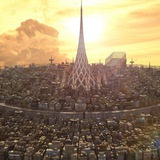
Concept Art Make In Houdini | Houdini 19.5
https://youtu.be/dQnGYuVmQtU
https://redd.it/150ed54
@proceduralgeneration
https://youtu.be/dQnGYuVmQtU
https://redd.it/150ed54
@proceduralgeneration
YouTube
Concept Art Make In Houdini | Houdini 19.5
Hello Friends, In This Video I talk about the process of making the concept art, how to make it and collect the sources, and all other things.
Thanks for watching. Hope you like the video.
Concept Art submits on this email - fxcreative2@gmail.com
#conceptart…
Thanks for watching. Hope you like the video.
Concept Art submits on this email - fxcreative2@gmail.com
#conceptart…
Need help with understanding the math of Noise texture
I'm watching this video explaining the math of Blender's Noise texture.
I have a few questions related to that video, please help me. Thank you.
Question 1:
At 1:41, he says:
>The detail parameter controls how many of these noises are generated and overlaid.
What is the math of the overlaying process? Performing lerp (Linear Interpolation) of the existing layers? Is there any other formula for overlay?
\--------
Question 2:
At 1:50, he says:
>Each layer has a scale parameter that is twice of the previous layer
Is it specifically implemented that way or is it because the detail parameter in the video was set to 2 therefore the scale of each upper layer also is 2 times the scale of the lower layer?
\--------
Question 3:
At 1:58, he says:
>When gradually increasing the detail, between integer values, the next level of detail gets gradually stronger, from no influence to its full influence when reaching the next integer value.
What does stronger and influence mean in this context? More impact on the look of the Noise texture?
In order for a layer to take part in changing the look of the Noise texture, that layer must have amplitude > 0, then "influence" here means amplitude, right?
\--------
Question 4:
At 2:34, he says:
>Setting this (Roughness parameter) higher gives more and more influence to the smaller noise levels, until reaching one, where all levels have the same influence.
All layers having the same influence means having the same amplitude, doesn’t it?
But when I screenshotted his visualization and analyzed it, the top layer clearly has the largest amplitude and progressively decreases at lower layers, they don’t have the same amplitude at all.
\--------
https://redd.it/150ucpw
@proceduralgeneration
I'm watching this video explaining the math of Blender's Noise texture.
I have a few questions related to that video, please help me. Thank you.
Question 1:
At 1:41, he says:
>The detail parameter controls how many of these noises are generated and overlaid.
What is the math of the overlaying process? Performing lerp (Linear Interpolation) of the existing layers? Is there any other formula for overlay?
\--------
Question 2:
At 1:50, he says:
>Each layer has a scale parameter that is twice of the previous layer
Is it specifically implemented that way or is it because the detail parameter in the video was set to 2 therefore the scale of each upper layer also is 2 times the scale of the lower layer?
\--------
Question 3:
At 1:58, he says:
>When gradually increasing the detail, between integer values, the next level of detail gets gradually stronger, from no influence to its full influence when reaching the next integer value.
What does stronger and influence mean in this context? More impact on the look of the Noise texture?
In order for a layer to take part in changing the look of the Noise texture, that layer must have amplitude > 0, then "influence" here means amplitude, right?
\--------
Question 4:
At 2:34, he says:
>Setting this (Roughness parameter) higher gives more and more influence to the smaller noise levels, until reaching one, where all levels have the same influence.
All layers having the same influence means having the same amplitude, doesn’t it?
But when I screenshotted his visualization and analyzed it, the top layer clearly has the largest amplitude and progressively decreases at lower layers, they don’t have the same amplitude at all.
\--------
https://redd.it/150ucpw
@proceduralgeneration
YouTube
Understanding the Noise Node in Blender
https://blendermarket.com/products/procedural-texturing-blender
Learn how the Noise Node actually works in Blender and build your understanding of each parameter. The tutorial by Luca Rood.
https://creativeshrimp.gumroad.com/l/Procedural-Texturing-Blender…
Learn how the Noise Node actually works in Blender and build your understanding of each parameter. The tutorial by Luca Rood.
https://creativeshrimp.gumroad.com/l/Procedural-Texturing-Blender…
perlin noise procedural terrain - instancing optimizations
https://youtu.be/0xvrId00G44
https://redd.it/1512o4v
@proceduralgeneration
https://youtu.be/0xvrId00G44
https://redd.it/1512o4v
@proceduralgeneration
YouTube
OpenGL | C++ | Procedural terrain - performance improvements
after some code cleaning, optimizations and additional performance improvements, my renderer is finally able to render scenes like this with good framerate (60+FPS), although there is still a big margin for additional possible optimizations.
models from…
models from…
This media is not supported in your browser
VIEW IN TELEGRAM
Generative scribble drawings: image to stylized vector graphic
https://redd.it/1517sno
@proceduralgeneration
https://redd.it/1517sno
@proceduralgeneration