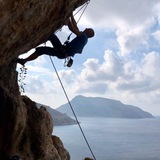
Today I decided to share with you my list of books connected with Kalymnos. There are, of course, quite a few books by Kalymnians, but I selected international bestsellers.
1. The Iliad by Homer (IY century BC)
Catalogue of ships, Song 2, lines 676–680:
And Nisyros, and Crapathos, and Casos, and Cos, the city of Eurypylus, and the Calydnian isles, these were commanded by Pheidippus and Antiphus, the two sons of Thessalus the son of Heracles. In their command were ranged thirty hollow ships⛵️.
2. Guns of Navarone by Alistair MacLean (1957)
This novel is set during World War II and follows a group of Allied saboteurs, world-class mountain climbers tasked with destroying a huge Nazi gun on the fictional island of Navarone, which threatens the British Navy's operations.
They startwith a winter mountain accent on the steep island wall.
Leros and Kalymnos are the prototypes of Keros and Navarone (Andrey and me cannot agree which one is which)
There is a 1961 screen adaptation of the same name with amazing cast of Gregory Peck and Anthony Quinn. The film aged a lot thought, so we did not finish it. For climbers it is amusing to observe how the accent is depicted – nothing to do with reality, even with mid-of-last-century climbing reality.
3. Mermaids Singing by Charmian Clift (1959)
Set in post-WW2 Kalymnos, the novel explores the lives of an Australian writers’ family with children, who move to the island to find creative inspiration. The story navigates their adaptation to island life, with themes of displacement, isolation, and cultural clashes.
4. The Sea and the Stone by George Johnston (1959)
The novel delves into the hard lives of the Kalymnian sponge divers and their families. It portrays the dangers of the profession and the island's grim future, where the decline of the sponge diving industry looms, and the community struggles to find a way forward (and overseas).
In both books the future of Kalymnos is portrayed as grim and hopeless, island is claimed as dying. The Australian authors Clift and Johnson (husband and wife by the way) had no vision of the upcoming international tourism and then the climbing⛰🧗♀️ boom)
5. The Jealousy Man by Jo Nesbo (2021)
In this dark and compelling thriller the author explores the psychological consequences of jealousy. The plot centers around the destructive obsession of a character who is deeply consumed by jealousy, which leads to a series of dramatic and tense events. Kalymnos serves as a haunting backdrop in some of the narrative, highlighting the contrast between the island's serene beauty and the dark emotions unfolding (C) ChatGPT
(I have not read the story yet, I am afraid of murder stories😨. But our eight-year-old son Misha did, in Greek)
6. Bitter Sea: The Real Story of Greek Sponge Diving by Faith Warn.
I don't own this one but it is still available and is a very clear history of the industry on Kalymnos.
Enjoy📖
#biggerthankalymnos
1. The Iliad by Homer (IY century BC)
Catalogue of ships, Song 2, lines 676–680:
And Nisyros, and Crapathos, and Casos, and Cos, the city of Eurypylus, and the Calydnian isles, these were commanded by Pheidippus and Antiphus, the two sons of Thessalus the son of Heracles. In their command were ranged thirty hollow ships⛵️.
2. Guns of Navarone by Alistair MacLean (1957)
This novel is set during World War II and follows a group of Allied saboteurs, world-class mountain climbers tasked with destroying a huge Nazi gun on the fictional island of Navarone, which threatens the British Navy's operations.
They startwith a winter mountain accent on the steep island wall.
Leros and Kalymnos are the prototypes of Keros and Navarone (Andrey and me cannot agree which one is which)
There is a 1961 screen adaptation of the same name with amazing cast of Gregory Peck and Anthony Quinn. The film aged a lot thought, so we did not finish it. For climbers it is amusing to observe how the accent is depicted – nothing to do with reality, even with mid-of-last-century climbing reality.
3. Mermaids Singing by Charmian Clift (1959)
Set in post-WW2 Kalymnos, the novel explores the lives of an Australian writers’ family with children, who move to the island to find creative inspiration. The story navigates their adaptation to island life, with themes of displacement, isolation, and cultural clashes.
4. The Sea and the Stone by George Johnston (1959)
The novel delves into the hard lives of the Kalymnian sponge divers and their families. It portrays the dangers of the profession and the island's grim future, where the decline of the sponge diving industry looms, and the community struggles to find a way forward (and overseas).
In both books the future of Kalymnos is portrayed as grim and hopeless, island is claimed as dying. The Australian authors Clift and Johnson (husband and wife by the way) had no vision of the upcoming international tourism and then the climbing⛰🧗♀️ boom)
5. The Jealousy Man by Jo Nesbo (2021)
In this dark and compelling thriller the author explores the psychological consequences of jealousy. The plot centers around the destructive obsession of a character who is deeply consumed by jealousy, which leads to a series of dramatic and tense events. Kalymnos serves as a haunting backdrop in some of the narrative, highlighting the contrast between the island's serene beauty and the dark emotions unfolding (C) ChatGPT
(I have not read the story yet, I am afraid of murder stories😨. But our eight-year-old son Misha did, in Greek)
6. Bitter Sea: The Real Story of Greek Sponge Diving by Faith Warn.
I don't own this one but it is still available and is a very clear history of the industry on Kalymnos.
Enjoy
#biggerthankalymnos
Please open Telegram to view this post
VIEW IN TELEGRAM
🔥2
Kalymnos has an excellent albeit small Archaeological Museum with many of its masterpieces discovered underwater by sponge divers as a byproduct of their main trade. The Kalymnian lady is one of these underwater findings
Source: https://www.facebook.com/100066451333610/posts/pfbid028fGk26yt7QBZUt24zY1zPZ3qHLx8kiAtkX3muBKmafpa4TG51HR4ZX86p8Y3UTVol/?app=fbl
Source: https://www.facebook.com/100066451333610/posts/pfbid028fGk26yt7QBZUt24zY1zPZ3qHLx8kiAtkX3muBKmafpa4TG51HR4ZX86p8Y3UTVol/?app=fbl
👍1
Looks like there is a new multipitch in Kalymnos. Mine. Five pitches, about 120 m (right topo on the picture with yellow dots).
I spent more than a year looking for the right line. First I tried left of the easy 3 STRIPES (left topo on the picture), but the good line turned out to be on the right. The wall stays in the shade and has great pockets. It also came with dirt on the ledges, dry branches, and the occasional live rock. Lots of cleaning. More to come.
I tried to work only in bad weather so no one would be standing below. Sometimes goats were grazing under me. I had to politely encourage them to move with a few small stones. They (goats) listened.
I hoped the route would be around 6a. After today’s ascent with Dasha, her reaction made it clear the third pitch is more honestly about 6c.
Bolting is checked. In a few places it ended up a bit gangster-style alpine. I’ll add a couple more bolts.
The route is called Machombo, after the route on Morcheka in Crimea by Odessa alpinists Vladimir Mogila and Shura Lavrinenko. The name is quite telling: from the Russian slang mochit’ — to go hard, smash it. 🧗♂️
I spent more than a year looking for the right line. First I tried left of the easy 3 STRIPES (left topo on the picture), but the good line turned out to be on the right. The wall stays in the shade and has great pockets. It also came with dirt on the ledges, dry branches, and the occasional live rock. Lots of cleaning. More to come.
I tried to work only in bad weather so no one would be standing below. Sometimes goats were grazing under me. I had to politely encourage them to move with a few small stones. They (goats) listened.
I hoped the route would be around 6a. After today’s ascent with Dasha, her reaction made it clear the third pitch is more honestly about 6c.
Bolting is checked. In a few places it ended up a bit gangster-style alpine. I’ll add a couple more bolts.
The route is called Machombo, after the route on Morcheka in Crimea by Odessa alpinists Vladimir Mogila and Shura Lavrinenko. The name is quite telling: from the Russian slang mochit’ — to go hard, smash it. 🧗♂️
❤4🔥3
Our neighbours in Sesame Street are people of diverse nationalities and professions: an Australian architect, a Norwegian writer, a Canadian customs officer, a French pharmacist, an Italian engineer, a Greek jeweler, a Swedish hairdresser. The photo is exactly a neighborly haircut session. Just look at the views from our home hairdressing studio!
Hard to believe, but sometimes we do leave our climbing paradise for other parts of Greece, climbing and otherwise. Crete, for example, we keep coming back to. And on Crete you have to do the Samaria Gorge hike. Our boys are finally old enough for this 14-kilometre trek.
The hike starts on the Omalos plateau and ends in Agia Roumeli, a tiny village facing Africa. Greeks call that stretch of water the Libyan Sea. From Agia Roumeli most tourists take the evening ferry back the same day. We know how our boys walk, so we decided in advance not to rush and to sleep in the village.
Kolya set the pace right away. The park rangers were watching us closely and warned early on that we wouldn't make it anywhere. But we weren't rushing anywhere. We were heading to our hotel.
Halfway through, the rangers insisted Kolya continue on horseback. The park closes at seven, they're people too, they need to get home. Family, TV, dinner. This is how our multi-day adventures usually go, and honestly, nobody complains. He had to share the horse with a Canadian girl who had blisters and was late for the ferry.
We made it to early dinner at our hotel taverna. Not quite fresh vegetables (no ferry for three days due to weather) and very fresh goat. The taverna owner looked like a pirate, puffy lumpy face, red eyes. I even imagined that if we'd chosen a different place for dinner, he might have murdered us in our sleep.
Agia Roumeli has fifteen houses, two big beaches, and a ferry pier. The feeling that you're at the edge of the known world is hard to shake. Behind you, the impassable White Mountains. In front, the Libyan Sea swings wide.
If you ever fancy the romantic route between Kalymnos and Crete, that's two ferries (Heraklion to Rhodes, Rhodes to Kalymnos) and about 24 hours in transit.
P.S. Samaria only opens in summer because of high altitude conditions, flash floods, and rockfall risk. It opens in about a week and stays open until mid-October.
The hike starts on the Omalos plateau and ends in Agia Roumeli, a tiny village facing Africa. Greeks call that stretch of water the Libyan Sea. From Agia Roumeli most tourists take the evening ferry back the same day. We know how our boys walk, so we decided in advance not to rush and to sleep in the village.
Kolya set the pace right away. The park rangers were watching us closely and warned early on that we wouldn't make it anywhere. But we weren't rushing anywhere. We were heading to our hotel.
Halfway through, the rangers insisted Kolya continue on horseback. The park closes at seven, they're people too, they need to get home. Family, TV, dinner. This is how our multi-day adventures usually go, and honestly, nobody complains. He had to share the horse with a Canadian girl who had blisters and was late for the ferry.
We made it to early dinner at our hotel taverna. Not quite fresh vegetables (no ferry for three days due to weather) and very fresh goat. The taverna owner looked like a pirate, puffy lumpy face, red eyes. I even imagined that if we'd chosen a different place for dinner, he might have murdered us in our sleep.
Agia Roumeli has fifteen houses, two big beaches, and a ferry pier. The feeling that you're at the edge of the known world is hard to shake. Behind you, the impassable White Mountains. In front, the Libyan Sea swings wide.
If you ever fancy the romantic route between Kalymnos and Crete, that's two ferries (Heraklion to Rhodes, Rhodes to Kalymnos) and about 24 hours in transit.
P.S. Samaria only opens in summer because of high altitude conditions, flash floods, and rockfall risk. It opens in about a week and stays open until mid-October.
In early May, the UIAA (International Climbing and Mountaineering Federation) held an off-site seminar on route bolting and re-bolting on Kalymnos.
I was lucky to participate together with 39 route bolters from around the world: a professor from the University of Tokyo; an official from the UAE Federation of Mountaineering and Climbing; colleagues from Australia, Canada, the USA, Peru, Syria, and Greece.
The "teachers" were expert and adequate. Mark Beverley, a member of the UIAA Safety Commission: "We are one of you".
Instead of the usual Kalymnos heat in May, participants were met with cold and a storm. The sector chosen for practice was the most shaded (because of the expected heat), so we warmed ourselves with tea.
The sessions were extremely realistic: on the first day, we installed many anchors, both glue-in and expansion. On the second, we tried all methods of their safe removal and conducted tensile pull-out tests with loads exceeding calculated standards. The test convincingly demonstrated the advantages of glue-in anchors.
I also had something to test: with my weak English, I used a portable translator "Timekettle". It worked well, until we got to talking about "bolts and holes". In English, as is known, there are very many salty jokes on the theme.Only my Timekettle did not laugh😂.
Below are my major I takeaways
1. Anchor service life: minimum 50 years until the next repair. The UIAA, apparently, do not believe in the imminent end of the world🙂 This means the fifth re-bolting will happen in 250 years. The cliffs will remain the same by that time, but the bolt installation sites will look sad if a new hole is drilled next to the old one every time.
2. Important: "new bolt in old hole". The process is more labor-intensive, but it holds the future. The rock remains intact, the route too. For this, there are separate techniques: careful removal of the old anchor without destroying the rock, expanding the existing hole for glue-in, etc.Technical details are on the UIAA website, I will give the link below.
3. Materials: stainless steel, and not just any.
Basic minimum: steel A4 / AISI 316L. This is the modern UIAA standard 123.
By the sea (and Kalymnos is by the sea, just as many crags in my home Crimea) only titanium or high-alloy alloys of class HRC: 6% molybdenum, grade 1.4529 / 254SMO.
All anchor elements must be of the same material. Otherwise, galvanic corrosion will eat it faster than you can hang a sling
4. Strength, which the anchor must hold.Pull-out (axial): 15 kN.\n• Shear (radial): 25 kN.
At these values, the anchor must not break or tear.
Why glue wins: Less internal stress in the metal during installation, meaning less risk of stress-corrosion cracking, no crevice and galvanic corrosion. For a long service life, the UIAA unequivocally recommends glue-in anchors.
6. SCC. Stress-corrosion cracking. The main "silent killer" of anchors by the sea. Depends on acidity, temperature, humidity, minerals in the rock. It is not visually assessable: a bolt can look like new and break from a finger tap. Therefore, in coastal zones, the approach "looks fine" is not an argument. You always need to evaluate the material and the age.
I liked being a student at a school where the topic of the lessons was cliffs, sea, nature, and bolts with holes.
For those who want to dive into the topic, the original source https://www.theuiaa.org/safety/rockanchors/
I was lucky to participate together with 39 route bolters from around the world: a professor from the University of Tokyo; an official from the UAE Federation of Mountaineering and Climbing; colleagues from Australia, Canada, the USA, Peru, Syria, and Greece.
The "teachers" were expert and adequate. Mark Beverley, a member of the UIAA Safety Commission: "We are one of you".
Instead of the usual Kalymnos heat in May, participants were met with cold and a storm. The sector chosen for practice was the most shaded (because of the expected heat), so we warmed ourselves with tea.
The sessions were extremely realistic: on the first day, we installed many anchors, both glue-in and expansion. On the second, we tried all methods of their safe removal and conducted tensile pull-out tests with loads exceeding calculated standards. The test convincingly demonstrated the advantages of glue-in anchors.
I also had something to test: with my weak English, I used a portable translator "Timekettle". It worked well, until we got to talking about "bolts and holes". In English, as is known, there are very many salty jokes on the theme.Only my Timekettle did not laugh😂.
Below are my major I takeaways
1. Anchor service life: minimum 50 years until the next repair. The UIAA, apparently, do not believe in the imminent end of the world
2. Important: "new bolt in old hole". The process is more labor-intensive, but it holds the future. The rock remains intact, the route too. For this, there are separate techniques: careful removal of the old anchor without destroying the rock, expanding the existing hole for glue-in, etc.Technical details are on the UIAA website, I will give the link below.
3. Materials: stainless steel, and not just any.
Basic minimum: steel A4 / AISI 316L. This is the modern UIAA standard 123.
By the sea (and Kalymnos is by the sea, just as many crags in my home Crimea) only titanium or high-alloy alloys of class HRC: 6% molybdenum, grade 1.4529 / 254SMO.
All anchor elements must be of the same material. Otherwise, galvanic corrosion will eat it faster than you can hang a sling
4. Strength, which the anchor must hold.Pull-out (axial): 15 kN.\n• Shear (radial): 25 kN.
At these values, the anchor must not break or tear.
Why glue wins: Less internal stress in the metal during installation, meaning less risk of stress-corrosion cracking, no crevice and galvanic corrosion. For a long service life, the UIAA unequivocally recommends glue-in anchors.
6. SCC. Stress-corrosion cracking. The main "silent killer" of anchors by the sea. Depends on acidity, temperature, humidity, minerals in the rock. It is not visually assessable: a bolt can look like new and break from a finger tap. Therefore, in coastal zones, the approach "looks fine" is not an argument. You always need to evaluate the material and the age.
I liked being a student at a school where the topic of the lessons was cliffs, sea, nature, and bolts with holes.
For those who want to dive into the topic, the original source https://www.theuiaa.org/safety/rockanchors/
Please open Telegram to view this post
VIEW IN TELEGRAM
🔥1