Illustratum—a showcase of creativity, resilience and the art of communication—provides a platform for school students to turn abstract scientific concepts into lively demonstrations, models, and storytelling. The heart of the contest lies in its emphasis on science communication, retelling complex physics in a way that could be easily understood. What began as a modest event in 2022 with just 55 teams from 15 schools has now blossomed into a celebration of science storytelling, with participation from 82 teams representing 25 schools this year. Read here for more: https://www.physics.nus.edu.sg/illustratum-2025/
Assistant Professor Alexey Berdyugin tuning the cryostat to explore electron mobility in graphene.
Research carried out by scientists from NUS and international collaborators achieved new records for electron mobility in graphene, matching or even surpassing gallium arsenide in both transport and quantum mobility. One study led by Assistant Professor Alexey Berdyugin from NUS Physics uses two graphene layers stacked with a large relative twist angle. Another led by Sir Professor Andre Geim from the University of Manchester placed graphene less than one nanometre away from a metallic graphite gate, separated by an ultrathin dielectric. Both approaches enabled quantum behaviour to be observed at ultra-low magnetic fields. Read here for more: https://www.science.nus.edu.sg/blog/2025/08/graphene-reaches-ultimate-electronic-quality/
Research carried out by scientists from NUS and international collaborators achieved new records for electron mobility in graphene, matching or even surpassing gallium arsenide in both transport and quantum mobility. One study led by Assistant Professor Alexey Berdyugin from NUS Physics uses two graphene layers stacked with a large relative twist angle. Another led by Sir Professor Andre Geim from the University of Manchester placed graphene less than one nanometre away from a metallic graphite gate, separated by an ultrathin dielectric. Both approaches enabled quantum behaviour to be observed at ultra-low magnetic fields. Read here for more: https://www.science.nus.edu.sg/blog/2025/08/graphene-reaches-ultimate-electronic-quality/
Photo taken by Mr Tan Jyh Harng from NUS Physics at 1.38 am, 8 Sept @ the Grand Lawn, West Coast Park using a Celestron C5 telescope
Moon lovers in Singapore were resolute about capturing the first total lunar eclipse in three years on 7 Sept even as cloudy conditions posed a challenge to them. Elsewhere across parts of Asia, Africa, Europe, Australia and New Zealand, the Moon also made its appearance taking on a reddish hue, a phenomenon known as a blood moon. During a total lunar eclipse, the Earth lines up between the Moon and the Sun, and the only light that reaches the Moon’s surface is from the edges of the Earth’s atmosphere. The atmosphere scatters the shorter wavelengths of light like blue, leaving longer wavelengths like red to reach the Moon's surface. The Moon thus inherits a reddish glow. The next total lunar eclipse is expected to fall on 3 March 2026. For more pictures of the blood moon, click here: https://www.straitstimes.com/multimedia/photos/in-pictures-blood-moon-lights-up-night-sky
Moon lovers in Singapore were resolute about capturing the first total lunar eclipse in three years on 7 Sept even as cloudy conditions posed a challenge to them. Elsewhere across parts of Asia, Africa, Europe, Australia and New Zealand, the Moon also made its appearance taking on a reddish hue, a phenomenon known as a blood moon. During a total lunar eclipse, the Earth lines up between the Moon and the Sun, and the only light that reaches the Moon’s surface is from the edges of the Earth’s atmosphere. The atmosphere scatters the shorter wavelengths of light like blue, leaving longer wavelengths like red to reach the Moon's surface. The Moon thus inherits a reddish glow. The next total lunar eclipse is expected to fall on 3 March 2026. For more pictures of the blood moon, click here: https://www.straitstimes.com/multimedia/photos/in-pictures-blood-moon-lights-up-night-sky
What is the formula for taming chaos?
Amidst the whirlwind of lectures, labs, tutorials, and impending deadlines, students and faculty from NUS Physics are kicking back first of all with some footwork ⚽. And who says physicists can't bend it like Beckham? Prof Valerio led the charge with a spirited game of futsal with students during a brief respite from the relentless downpour in the days leading to the game. In another event, students and faculty gathered for a relaxing, aromatic Mookata evening lovingly organised by the NUS Physics Society. Nothing brings people together like grilling gourmet food and exchanging stories over hot stove and bubbling soup🍜.
Back to the question, the best formula seems to be just some wholesome fun—friends, food, and futsal!
Amidst the whirlwind of lectures, labs, tutorials, and impending deadlines, students and faculty from NUS Physics are kicking back first of all with some footwork ⚽. And who says physicists can't bend it like Beckham? Prof Valerio led the charge with a spirited game of futsal with students during a brief respite from the relentless downpour in the days leading to the game. In another event, students and faculty gathered for a relaxing, aromatic Mookata evening lovingly organised by the NUS Physics Society. Nothing brings people together like grilling gourmet food and exchanging stories over hot stove and bubbling soup🍜.
Back to the question, the best formula seems to be just some wholesome fun—friends, food, and futsal!
The 2025 Nobel Prize in Physics will be announced on 7 October. Prior to that, the Ig Nobel Prize was announced recently. It honours research that first makes people laugh, then makes them think. This year, the physics award is making people's mouths water as well. It was given for "discoveries about the physics of pasta sauce, especially the phase transition that can lead to clumping, which can be a cause of unpleasantness." Read here for more: https://phys.org/news/2025-09-ig-physics-nobel-prize-pasta.html
phys.org
2025 Ig Physics Nobel Prize goes to perfect pasta sauce
The Ig Nobel Prize honors research that first makes people laugh, then makes them think. Its 35th award ceremony possibly also makes people hungry: ISTA physicist Fabrizio Olmeda and colleagues researched ...
As a surprise to many, the Nobel Prize in Physics 2024 went to the pioneers of AI. Keen to predict which field will win the 2025 award (to be announced on 7 Oct)? Cast your vote by joining our poll here.
Final Results
40%
foundations of quantum computing
10%
cosmology
9%
slow light
10%
metamaterials
7%
twisted bilayer graphene
7%
atomic force microscope
4%
AB effect and geometric phase
13%
none of the above
The Nobel Prize in Physics 2025 was awarded jointly to John Clarke, Michel H. Devoret and John M. Martinis "for the discovery of macroscopic quantum mechanical tunnelling and energy quantisation in an electric circuit". To find out about the works of the Nobel laureates, read here for more:
https://phys.org/news/2025-10-nobel-prize-physics-scientists-discoveries.html
https://phys.org/news/2025-10-nobel-prize-physics-scientists-discoveries.html
phys.org
Nobel Prize in physics goes to 3 scientists whose work advanced quantum technology
Three scientists won the Nobel Prize in physics Tuesday for research on the strange behavior of subatomic particles called quantum tunneling that enabled the ultra-sensitive measurements achieved by MRI ...
NUS Physics alumnus Dr Goh Koon Tong co-founded Squareroot8 Technologies and is now its chief technology officer. Assembling a team with diverse academic backgrounds ranging from quantum physics, software engineering to business development, the start-up is now ready to launch its encryption services using quantum cryptography technology. Read here for more: https://www.straitstimes.com/tech/spore-quantum-start-up-aims-to-make-critical-systems-unhackable
The Straits Times
Singapore quantum tech start-up aims to make critical systems unhackable
A Singaporean start-up launches quantum cryptography to make critical infrastructure data unhackable, leveraging quantum randomness for superior encryption. Read more at straitstimes.com. Read more at straitstimes.com.
What does quantum cryptography entail? What kinds of problems can quantum technologies solve that current technologies cannot? Prof Lo Hoi Kwong from NUS Physics, also Provost’s Chair Professor, addresses these questions and more in an interview where he shares about his motivation, research interests and works in the field of quantum information science: https://www.physics.nus.edu.sg/an-interview-with-prof-lo-hoi-kwong/
Scientists have developed a "fingerprint matrix" technique that uses an object’s unique wave-scattering signature to locate it even when buried in opaque materials like sand. Tested on metal spheres and in medical imaging, this method could reveal hidden objects and monitor medical markers for the diagnosis of medical conditions. Read here for more: https://phys.org/news/2025-10-treasures-physics-fingerprint-matrix-method.html
phys.org
Finding buried treasures with physics: 'Fingerprint matrix' method uncovers what lies beneath the sand
Can we reveal objects that are hidden in environments completely opaque to the human eye? With conventional imaging techniques, the answer is no: a dense cloud or layer of material blocks light so completely ...
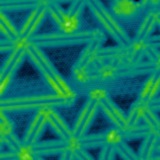
Figure a shows a schematic diagram of the scanning tunneling measurement (STM) on 2D chromium (III) selenide. Figure b shows a high resolution STM image revealing the granular charge density wave pattern.
A research team led by Professor Chen Wei from NUS Physics synthesised single-layer semiconducting chromium (III) selenide and demonstrated the charge density wave electronic patterns widely observed in metallic 2D transition metal chalcogenides. The wave pattern in the semiconducting layer can be tuned via surface charge transfer doping without introducing foreign impurities. Being antiferromagnetic opens a platform to understand the interplay between magnetism, charge order, and electron correlation. Read here for more: https://www.science.nus.edu.sg/blog/2025/09/doping-induces-charge-density-wave-in-two-dimensional-semiconductor/
A research team led by Professor Chen Wei from NUS Physics synthesised single-layer semiconducting chromium (III) selenide and demonstrated the charge density wave electronic patterns widely observed in metallic 2D transition metal chalcogenides. The wave pattern in the semiconducting layer can be tuned via surface charge transfer doping without introducing foreign impurities. Being antiferromagnetic opens a platform to understand the interplay between magnetism, charge order, and electron correlation. Read here for more: https://www.science.nus.edu.sg/blog/2025/09/doping-induces-charge-density-wave-in-two-dimensional-semiconductor/
Singapore is stepping up its quantum race with the National Quantum Office’s announcement of a strategic partnership with tech firm Quantinuum to accelerate quantum technology development. Under the deal, Singapore will host Helios, its first state-of-the-art general-purpose quantum computer—the first of its kind outside the US. Watch video here for more: https://www.channelnewsasia.com/watch/singapore-be-first-country-outside-us-host-quantinuums-helios-quantum-computer-5451196
CNA
Singapore to be first country outside US to host Quantinuum's Helios quantum computer
Singapore is set to host its most advanced quantum computer yet. Under a new deal, tech firm Quantinuum will set up R&D in the country, work with local industry and roll out talent programmes. Singapore will be the first country to host Quantinuum's Helios…
Astronomers have captured the earliest moments of a supernova in a nearby galaxy, revealing that the blast was elongated rather than spherical. The intrinsic shape of the shock breakout tells a lot of how it was triggered at the heart of the star in the first place. The observations support the theory that the shock wave is initiated by subatomic particles called neutrinos being energised deep in the stellar interior. Read here for more: https://www.sciencenews.org/article/supernova-first-moments-lopsided-blast
Science News
Early views of a supernova’s first moments reveal a lopsided blast
Some of the earliest images ever taken in the wake of massive star’s death give astronomers important clues about what triggers a supernova.
Team members from The Incomputents & Co. (Yugam is second from the left)
A multidisciplinary team of five led by physics and engineering science undergraduate Vora Yugam Jinesh edged out competitors to emerge the winner of the Credit Risk Counterparty challenge at the Quantum Finance Hackathon 2025.
"When the competition presented a direct challenge in computational finance that explicitly called for the kind of first-principles, analytical approach I’ve developed through my coursework, it was an opportunity I could not pass up. The chance to apply advanced concepts from both classical and quantum computation to a high-stakes financial problem was irresistible," Yugam said in an interview.
Read here for more: https://www.science.nus.edu.sg/blog/2025/11/when-science-meets-finance-a-winning-solution-that-reimagines-how-banks-measure-risk/
A multidisciplinary team of five led by physics and engineering science undergraduate Vora Yugam Jinesh edged out competitors to emerge the winner of the Credit Risk Counterparty challenge at the Quantum Finance Hackathon 2025.
"When the competition presented a direct challenge in computational finance that explicitly called for the kind of first-principles, analytical approach I’ve developed through my coursework, it was an opportunity I could not pass up. The chance to apply advanced concepts from both classical and quantum computation to a high-stakes financial problem was irresistible," Yugam said in an interview.
Read here for more: https://www.science.nus.edu.sg/blog/2025/11/when-science-meets-finance-a-winning-solution-that-reimagines-how-banks-measure-risk/
For graduate student Zuo Enpu, AI is not just a subject but a versatile tool that unlocks new possibilities in scientific research. This led him to sign up for the first run of MSc (AI for Science) programme offered by NUS Physics, where he gains practical insights into applying AI for prediction and analysis across scientific fields. The new programme is built on the idea of the “bilingual” scientists—fluent in both scientific rigour and algorithmic reasoning. It reflects how science now advances: discoveries depend as much on making sense of noisy datasets as on testing hypotheses. For more on the MSc (AI in Science) curriculum, click on this link: https://www.physics.nus.edu.sg/student/msc-ai-for-science/
Germany Immersion Trip is a yearly programme organised by NUS Physics that offers physics undergraduates a good opportunity to experience both the culture and physics research environment in Germany. This year, the trip promised to be another eye-opening experience for the 18 physics undergraduates who signed up. Hear from student Arushi Sachan what the trip meant to her: https://www.science.nus.edu.sg/blog/2025/12/in-the-path-of-pioneers/
Fascinated by space but do not know where to start? What kinds of discoveries do scientists hope to make with data from missions such as the NASA’s Kepler or the James Webb Space Telescope? Asst Prof Marc Hon from NUS Physics, also NUS Presidential Young Professor, addresses these questions and more in an interview where he shares about his research interests and works in the field of astrophysics: https://www.physics.nus.edu.sg/an-interview-with-asst-prof-marc-hon/
Quantum Fall Fest is an extension of IBM Quantum’s global Qiskit Fall Fest initiative, which partners with student bodies worldwide to host campus-level events promoting quantum computing. The 2025 edition held in Singapore, which was also the inaugural session, was designed primarily for beginners and those curious about the field, with the goal of demystifying and democratising quantum computing. Read here for more: https://www.physics.nus.edu.sg/quantum-fall-fest-singapore-2025/
From delivering the first clinical treatments using proton arc therapy, developing a new type of hollow-core optical fibre that increases transmission speeds by 45% to capturing the highest-resolution images of individual atoms in the material known as moiré phasons, 2025 has witnessed significant advancement in the knowledge and understanding of the different fields in physics as well as the development of real-world applications. Here are some top picks by Physics World: https://physicsworld.com/a/top-10-breakthroughs-of-the-year-in-physics-for-2025-revealed/
Physics World
Top 10 Breakthroughs of the Year in physics for 2025 revealed – Physics World
A molecular superfluid, high-resolution microscope and a protein qubit are on our list