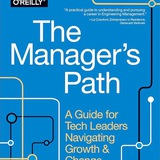
A good manager:
• Cares about you as a person
• Helps you grow in your career
• Teaches you important skills
• Gives you valuable feedback
• Helps you navigate difficult situations
• Helps you figure out what you need to learn
• Wants you to take their job someday
• Helps you understand what is important to focus on and enables you to have that focus
• Cares about you as a person
• Helps you grow in your career
• Teaches you important skills
• Gives you valuable feedback
• Helps you navigate difficult situations
• Helps you figure out what you need to learn
• Wants you to take their job someday
• Helps you understand what is important to focus on and enables you to have that focus
Forwarded from How to Land Your Dream Job
Top K (Heavy Hitters) is one of my favorite interview problems.
It starts simple: find the K most frequent items in a stream.
For junior engineers, it tests fundamentals:
• hash maps, heaps, sorting, and complexity analysis.
For mid-level engineers, you introduce constraints:
• streaming input, time windows, and memory limits.
For senior engineers, it becomes a distributed systems problem:
• partitioning, aggregation, stream processing, retries, and failure recovery.
For staff engineers, it turns into a platform question:
• SLOs, cost, correctness guarantees, and reusable abstractions.
There is an important caveat: the scope must match the level.
If you ask everything at once, the interview becomes unfair.
If you reveal constraints progressively, it becomes a powerful signal.
Progression:
List -> Stream -> Time windows -> Distributed processing -> Approximation -> Failure modes
It starts simple: find the K most frequent items in a stream.
For junior engineers, it tests fundamentals:
• hash maps, heaps, sorting, and complexity analysis.
For mid-level engineers, you introduce constraints:
• streaming input, time windows, and memory limits.
For senior engineers, it becomes a distributed systems problem:
• partitioning, aggregation, stream processing, retries, and failure recovery.
For staff engineers, it turns into a platform question:
• SLOs, cost, correctness guarantees, and reusable abstractions.
There is an important caveat: the scope must match the level.
If you ask everything at once, the interview becomes unfair.
If you reveal constraints progressively, it becomes a powerful signal.
Progression:
List -> Stream -> Time windows -> Distributed processing -> Approximation -> Failure modes
❤1