Birth rates of China, Japan, South Korea, & Taiwan are now all below 6.0 per 1,000 (with Taiwan even below 5.0!). Their fertility rates are ~0.72 Taiwan, ~0.80 for South Korea, ~0.95 for China, & ~1.12 for Japan. So much policy has been focused on turning this around & failed.
😱32😢21🔥11❤4👍4🥰3🌭1
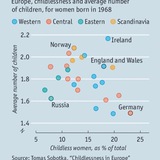
Childlessness is on the rise in the U.S. & most countries globally. Higher childlessness rates make demographic recovery much more difficult as a considerable number of those who do have kids would need to have more than 2 just to avoid demographic collapse long term.
Once millennials become a post‑reproductive cohort it is possible that up to a fourth will be childless. Gen Z is on track to be even worse & could see childlessness go as high as 30% for that cohort in the U.S.
Once millennials become a post‑reproductive cohort it is possible that up to a fourth will be childless. Gen Z is on track to be even worse & could see childlessness go as high as 30% for that cohort in the U.S.
😭46🤯13😨6🥰5✍3🔥3😁3🤔3😢3🤷♂1🌭1
While South Korea & Japan will continue to attract Asian immigrants Thailand in for more of a struggle. Conflict with Cambodia has severely disrupted labor flow & general relations, future migration flow of Burmese uncertain, & Laos just does not have that many migrants to give.
Honestly think most Burmese migrants will be choosing higher pay and better opportunities in South Korea & Japan by the 2030s. Laotians will mostly be staying put (small numbers anyways), & Cambodians will also overwhelmingly choose developed Asian economies for migration.
The enormous demand for labor in ultra low fertility Thailand may be largely unfulfilled by 2035, exactly when massive numbers of Thais from the gigantic 1963-1983 cohort (which saw 1M+ births a year) start leaving the labor market & workers are needed the most.
Honestly think most Burmese migrants will be choosing higher pay and better opportunities in South Korea & Japan by the 2030s. Laotians will mostly be staying put (small numbers anyways), & Cambodians will also overwhelmingly choose developed Asian economies for migration.
The enormous demand for labor in ultra low fertility Thailand may be largely unfulfilled by 2035, exactly when massive numbers of Thais from the gigantic 1963-1983 cohort (which saw 1M+ births a year) start leaving the labor market & workers are needed the most.
💯18😱11🔥6🍾5🤔3❤1🤣1
Demographics Now and Then
While South Korea & Japan will continue to attract Asian immigrants Thailand in for more of a struggle. Conflict with Cambodia has severely disrupted labor flow & general relations, future migration flow of Burmese uncertain, & Laos just does not have that…
South Korea, Taiwan, Japan, & Singapore will also likely absorb an annual 250,000 Indonesian migrants collectively by 2030 (just as Indonesian fertility collapses). China will try and suck up labor where they can & automate at a ferocious pace as well.
🔥30👀14👏5💯3🤮1
At the height of the Southern European/Mediterranean economic crisis (when unemployment was almost 20%) fertility rate in Spain was ~1.3, in Italy was close to 1.4, Greece 1.3, & Portugal 1.2. Today Spain is on ~1.1, Italy 1.13, Greece 1.23, PT 1.4. Unemployment today is near an all time low.
The TFR of the SNIFD countries has similarly declined. Thus it seems clear that falling TFR in Europe is independent of the unemployment rate. Culture across the world has shifted decisively away from one in which people view having a family as an essential part of life.
The TFR of the SNIFD countries has similarly declined. Thus it seems clear that falling TFR in Europe is independent of the unemployment rate. Culture across the world has shifted decisively away from one in which people view having a family as an essential part of life.
💯40😱20🤔5👍3❤1
Let’s look at the average Italian mother’s age at first birth as well as birth order. As you can see the average mother has her first child at almost 32 but only 8% of all Italian births are to women 40+. So women have a small window. No wonder only ~7.5% of births 3rd child+.
👍30😡13🤬10😢7❤2😭2🔥1😁1🤡1
Quite a few people think if South Korea were less conservative about out of wedlock births TFR would dramatically increase. As @andyd10 shows below,out of wedlock births more than doubled between 2019 and 2024 yet TFR went from 0.92 in 2019 to 0.75 in 2024. So don’t think so.
✍38💯17👍8🔥6❤1👎1🤣1
The average farmer in Malaysia is 60; in the Philippines 56. Taking South-East Asia as a whole, a third of all farm workers are 55 or older, up from less than a fifth a decade ago. As fertility rates crash & young move to cities the problem is growing.
https://www.economist.com/asia/2026/01/22/ageing-farmers-threaten-south-east-asias-growth
https://www.economist.com/asia/2026/01/22/ageing-farmers-threaten-south-east-asias-growth
The Economist
Ageing farmers threaten South-East Asia’s growth
Few parents want their offspring to end up working in the fields
😨24🎉8👍4🔥3🥰3👏1🍌1
Population of India world’s largest & growing by 12-13 million people annually. India has more people than every country in sub Saharan Africa combined despite being less than 1/7th its size. India’s population will remain biggest on earth from here on out almost certainly.
Some of the most crowded Indian States & Union Territories are also those that will see the most population growth going forward. Particularly Delhi (22 million people & more than 12,000 per sq km), Bihar (127 million & 1,000+ per sq km), & Uttar Pradesh (240M & 900 per sq km).
https://x.com/andyd10/status/2015017659247517929
Some of the most crowded Indian States & Union Territories are also those that will see the most population growth going forward. Particularly Delhi (22 million people & more than 12,000 per sq km), Bihar (127 million & 1,000+ per sq km), & Uttar Pradesh (240M & 900 per sq km).
https://x.com/andyd10/status/2015017659247517929
X (formerly Twitter)
andyd (@andyd10) on X
Population - latest official data
India - 1,421 mn (2025/26)
China - 1,404.89 mn (2025)
USA - 342,912,518 (12.2025)
Indonesia - 284,438,782 (06.2025)
Pakistan - 241,499,431 (2023)
Nigeria - 223,800,000 (2023)
Brazil - 213,421,037 (07.2025)
Bangladesh - 172.92…
India - 1,421 mn (2025/26)
China - 1,404.89 mn (2025)
USA - 342,912,518 (12.2025)
Indonesia - 284,438,782 (06.2025)
Pakistan - 241,499,431 (2023)
Nigeria - 223,800,000 (2023)
Brazil - 213,421,037 (07.2025)
Bangladesh - 172.92…
🤮91💩26🙊7👌5🥴4❤3👍1
This is becoming an unmitigated disaster for Thailand. Almost 15% decline in births in January 2026 compared to the same month last year. If this trend holds Thai TFR will be ~0.75-0.80 in 2026, so at South Korean & Taiwanese levels (thus amongst the very lowest on earth). This despite being far far less wealthy or developed than either South Korea or Taiwan.
https://x.com/andyd10/status/2018396489349820920
https://x.com/andyd10/status/2018396489349820920
X (formerly Twitter)
andyd (@andyd10) on X
Thailand
😢34🔥10😱8👍4✍2🥰1
CBO projecting US to see natural decline by 2030. As deaths will probably be around 3.3 million that year they are expecting roughly a 300,000 annual decline in births from 2025-2030. Considering births have averaged ~3.6M since 2020 I’m not entirely convinced of such a drop.
Why? Because the number of U.S. mothers in their 30s will grow massively throughout the 2030s as gigantic 2000-2009 cohort (the largest cohort since the 1950s-1960s in America which saw 4M+ births every year of it) starts hitting age 30. Think it’s an even bet total births can stabilize ⬆️ 3.4M.
Why? Because the number of U.S. mothers in their 30s will grow massively throughout the 2030s as gigantic 2000-2009 cohort (the largest cohort since the 1950s-1960s in America which saw 4M+ births every year of it) starts hitting age 30. Think it’s an even bet total births can stabilize ⬆️ 3.4M.
🤔26🔥5✍3👍3❤2👎1🙏1
Levels of immigration to Spain truly massive. Bear in mind every single year from 2022 to 2025 Spain witnessed natural decline in excess of 115,000 & a fertility rate that never exceeded 1.16. In just that period Spain increased its total population by 1.6 million people despite posting a natural decline of close to half a million.
https://x.com/datadicto_es/status/2017498331652542577
https://x.com/datadicto_es/status/2017498331652542577
X (formerly Twitter)
Datadicto📊 (@datadicto_es) on X
🇪🇺La UE creció en 4,4 millones de habitantes entre 2022 y 2025:
🇪🇸+1,6 M
🇫🇷+0,5 M
🇳🇱+0,5 M
🇨🇿+0,4 M
🇩🇪+0,3 M
🇵🇹+0,3 M
🇮🇪+0,3 M
🇧🇪+0,3 M
🇦🇹+0,2 M
🇸🇪+0,1 M
🇩🇰+0,1 M
🇫🇮+0,1 M
🇱🇹+0,1 M
🇲🇹+0,1 M
🇨🇾+0,1 M
🇪🇪=
🇱🇺=
🇸🇮=
🇭🇷=
🇷🇴=
🇸🇰=
🇱🇻=
🇧🇬=
🇬🇷−0,1 M
🇭🇺−0,1 M
🇮🇹−0…
🇪🇸+1,6 M
🇫🇷+0,5 M
🇳🇱+0,5 M
🇨🇿+0,4 M
🇩🇪+0,3 M
🇵🇹+0,3 M
🇮🇪+0,3 M
🇧🇪+0,3 M
🇦🇹+0,2 M
🇸🇪+0,1 M
🇩🇰+0,1 M
🇫🇮+0,1 M
🇱🇹+0,1 M
🇲🇹+0,1 M
🇨🇾+0,1 M
🇪🇪=
🇱🇺=
🇸🇮=
🇭🇷=
🇷🇴=
🇸🇰=
🇱🇻=
🇧🇬=
🇬🇷−0,1 M
🇭🇺−0,1 M
🇮🇹−0…
🤬64😱13🔥9🤮6😢3
There are many inaccurate estimates of Germany’s Muslim population but this account (@ar_demografie) is one of the best out there regarding German demographics and its estimate of 9.5% of Germany being Muslim as of the end of 2025 is one of the most sound I’ve seen.
https://x.com/ar_demografie/status/2017658742465065230
https://x.com/ar_demografie/status/2017658742465065230
X (formerly Twitter)
Mærstemgau-Rübe (@AR_Demografie) on X
I recalculated my estimate of the yearly muslim population share for Germany since 1963:
It stood at 9.5% at the end of 2025
We can clearly see the phases of immigration:
-Guest workers arriving until the mid 70s
-Family reunification around 1980
-Balkan…
It stood at 9.5% at the end of 2025
We can clearly see the phases of immigration:
-Guest workers arriving until the mid 70s
-Family reunification around 1980
-Balkan…
👎29💩16🔥9😱7🤣6😭6👍2😁1🤮1
My account on X was hacked. Any messages from the Twitter/X account from 10AM EST today onward should be disregarded.
This TG account is unaffected.
This TG account is unaffected.
😱40👌12🫡10😨4😢2❤1😁1🤬1
Poor showing for PPLE likely result of young Thais seeing their vote does not matter as every party they vote for gets banned post election. Hard to see things getting dramatically worse as Thai youth already pushing TFR⬇️0.90 but they could give South Korea a run for its money.
Wouldn’t be surprised if this put many Millennial+Zoomer Thais further into doomer thinking about future. The banning of Future Forward & Move Forward parties (both heavily supported by young Thais) in 2020 & 2024 by the govt made many youth despondent, possibly impacting births.
Having children is obviously a sign of optimism. When politics & society rob youth of all hope for the future then having children will be the last thing on their mind. For its level of development Thai fertility rates are astoundingly low. This is why.
Wouldn’t be surprised if this put many Millennial+Zoomer Thais further into doomer thinking about future. The banning of Future Forward & Move Forward parties (both heavily supported by young Thais) in 2020 & 2024 by the govt made many youth despondent, possibly impacting births.
Having children is obviously a sign of optimism. When politics & society rob youth of all hope for the future then having children will be the last thing on their mind. For its level of development Thai fertility rates are astoundingly low. This is why.
💯37❤5👎2😢2💩1