Greece had a very rough 2023 with by far the lowest number of births ever recorded. Just 72,244 births were reported preliminarily. There is good news however. January 2024 saw a 4% year on year⬆️in births. This may be a positive sign for other EU countries. https://www.ypes.gr/politikes-kai-draseis/statistika/statistika-2
👍16👎3😁1
This obviously impacts new family formation. I’ve talked to many people in their late 20s who say they don’t want to start a family until they can buy at least a two bedroom house/townhouse with a small yard. Mortgage rates 6.5%+, average house prices higher than ever.
X (formerly Twitter)
The Spectator Index (@spectatorindex) on X
Housing affordability in the 🇺🇸United States in 2023 reached its lowest level in almost four decades, according to Bloomberg.
😢15👍8
Interesting. The PRC has(by far)the highest level of millennial home ownership. Yet it has the lowest TFR of the countries listed (~1.02). France has the highest national TFR of the four developed countries listed & the highest millennial homeownership rate of the four as well.
🤔22👍2
Demographics Now and Then
Interesting. The PRC has(by far)the highest level of millennial home ownership. Yet it has the lowest TFR of the countries listed (~1.02). France has the highest national TFR of the four developed countries listed & the highest millennial homeownership rate…
It looks like there’s a clearer correlation btwn millennial homeownership rates and TFR in developed countries. France has the highest (1.68),followed by the US (1.625),UK(~1.45),UAE interesting as total population millennial homeownership & TFR is low but citizen high for both homeownership and TFR.
👍14
Projections show the percentage of childless women age 44 & older in the US may rise close to, or even exceed, the all time high reached by women born in the early 1900s, who faced numerous headwinds (coming of age as the did during World War I & the Spanish Flu pandemic, & going through their late 20s/early 30s during the Great Depression). The cohort born in the late 1980s is giving them a run for their money.
👍13
Demographics Now and Then
Projections show the percentage of childless women age 44 & older in the US may rise close to, or even exceed, the all time high reached by women born in the early 1900s, who faced numerous headwinds (coming of age as the did during World War I & the Spanish…
Yet another indication that the world’s largest economy may reach lowest low (sub 1.3) fertility by 2030. If that happens the economic, political and strategic ramifications will be enormous. Potential solutions to this crisis will reshape America one way or another.
👍14😍4❤1🔥1
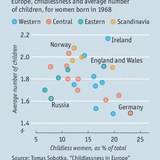
It is critical to distinguish between so called “childfree women” & “childless women”. “Childfree women” are women age 40+ who don’t have kids & report having a zero-child ideal (or believe it’s not ideal to have children). They represent only 1-2% of American women.
Many on the right love to focus on “childfree” women as they think they are selfish & somehow behind the demographic crisis in many countries. This is simply not the case. The numbers of such women are very small in number compared to “childless”.
Many on the right love to focus on “childfree” women as they think they are selfish & somehow behind the demographic crisis in many countries. This is simply not the case. The numbers of such women are very small in number compared to “childless”.
👏21👎2🔥1🥴1
Demographics Now and Then
It is critical to distinguish between so called “childfree women” & “childless women”. “Childfree women” are women age 40+ who don’t have kids & report having a zero-child ideal (or believe it’s not ideal to have children). They represent only 1-2% of American…
“Childless” are defined by the Institute of Family Studies as women 40+ who have zero children & report an above-zero fertility ideal. These are women who would have had kids but various factors hindered their ability to do so. “Childless” women make up a large 14%+ of American women over age 40.
👏15
Demographics Now and Then
“Childless” are defined by the Institute of Family Studies as women 40+ who have zero children & report an above-zero fertility ideal. These are women who would have had kids but various factors hindered their ability to do so. “Childless” women make up…
Thus instead of wasting time focusing on the small number of women who wish to be “childfree”, commentators would be better served focusing on solutions to help women who don’t have (but want) children to actualize their goal. Unless the commentators desire is to drive clicks instead.
💯30👍6🤔3👏2💩1🫡1
Well that’s something… When you create a culture that leads to poll results like this (where careerism decisively overtakes parenting in importance) it is incredibly hard to be demographically bullish in future outlook.
😱26👍4❤1🔥1💯1
Situation in Spain, Greece, Romania, Italy completely untenable. All their populations currently in natural decline & this youth unemployment will do two things: keep the fertility rate low, encourage further emigration for young people. https://x.com/spectatorindex/status/1754079137135022355?s=46&t=4B1VZvcCmqy_LsZnd1cuig
X (formerly Twitter)
The Spectator Index (@spectatorindex) on X
Youth unemployment rate
🇿🇦 South Africa: 58%
🇪🇸 Spain: 28.6%
🇱🇰 Sri Lanka: 25.8%
🇸🇪 Sweden: 24%
🇵🇹 Portugal: 23.1%
🇬🇷 Greece: 22.3%
🇷🇴 Romania: 21.1%
🇮🇷 Iran: 20.6%
🇮🇹 Italy: 20.1%
🇧🇪 Belgium: 20%
🇱🇺 Luxembourg: 19.4%
🇭🇷 Croatia: 18.8%
🇫🇷 France: 17.4%
🇹🇷…
🇿🇦 South Africa: 58%
🇪🇸 Spain: 28.6%
🇱🇰 Sri Lanka: 25.8%
🇸🇪 Sweden: 24%
🇵🇹 Portugal: 23.1%
🇬🇷 Greece: 22.3%
🇷🇴 Romania: 21.1%
🇮🇷 Iran: 20.6%
🇮🇹 Italy: 20.1%
🇧🇪 Belgium: 20%
🇱🇺 Luxembourg: 19.4%
🇭🇷 Croatia: 18.8%
🇫🇷 France: 17.4%
🇹🇷…
😢27💔2🔥1👏1😱1
Ghana TFR probably ~3.5. It was ~5.0 in 2000, ~4.0 in 2015 & ~3.75 in 2018. By 2030 it will be ~2.75 at this rate & replacement before 2040 if smartphone proliferation+education improvement trends continue. Well ahead of all forecasts. Anyone saying Africa immune was foolish.
🔗 Link
🔗 Link
X (formerly Twitter)
Neolithic HVAC Technician (@AccurateCaption) on X
Ghana reports 663,223 registered births for 2023, which when adjusted for a registration rate of "over 70 percent" implies total 2023 births of no more than 950,000. https://t.co/cxFVfVpqJN
❤29👍7🤔4😢3🙏2🔥1💯1🤣1
Demographics Now and Then
Ghana TFR probably ~3.5. It was ~5.0 in 2000, ~4.0 in 2015 & ~3.75 in 2018. By 2030 it will be ~2.75 at this rate & replacement before 2040 if smartphone proliferation+education improvement trends continue. Well ahead of all forecasts. Anyone saying Africa…
No regions will be spared obviously. By 2050 the only countries with TFR ~3.0 or higher will be Niger (maybe), Mali, Israel, Somalia, Afghanistan (maybe), & maybe 4-5 others.
🤔22❤4👎4💩2🌚1🤣1
Demographics Now and Then
France in 2023, despite its substantial fall in births and fertility rate, still enjoyed a higher TFR than the United States. France was on 1.675 while the US will probably end up on ~1.63. Immigrant birthrates are an equal factor in both countries.
High immigrant fertility (particularly amongst undocumented Latam immigrants)in the US is similar to high TFRs of immigrants to France from North Africa. & both France and the US see children of immigrants have their TFR levels converge rapidly with the non immigrant population.
🤬26👍3🔥3
The Year of the Dragon 🐉began on February 10th 2024. If February, March & April birth numbers are not at least 7% above those of the same months of 2023 then I think we can obviously begin to conclude that the Dragon Year has lost a lot of cultural resonance for births compared to 2012 year when births⬆️10%+.
❤16🤔4🔥3🤣3