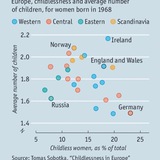
The perceived and real loss of status associated with becoming a parent in many Western countries sums up much of the fall in fertility we have seen. In much of the West & East Asia childbearing and raising is associated with losing status & falling behind in one’s career and personal goals. Changing this culture would be the challenge of a lifetime.
🔥38👀2
The curse of high expectations. Social media puts extremely high relationship standards out there. Many now expect a potential partner to have a very high salary, have the same political beliefs they do, similar habits, etc. As a consequence will leave many unhappy.
https://t.co/fkeqaMf0Bi
https://t.co/fkeqaMf0Bi
👍21💯11
South Korea’s statistics office predicts that the country’s fertility rate will fall to just 0.65 in 2025. While there is likely to be a brief respite(with a modest year on year increase in births)in 2024 the demographic carnage is set to resume next year. https://t.co/Qf70XgKsWl
TIME
South Korea Expects Its Already-World’s-Lowest Fertility Rate to Keep Falling
Low fertility threatens to undermine South Korea’s economic future by shrinking its workforce and slowing consumption.
😢16👍5❤1🎉1
Demographics Now and Then
South Korea’s statistics office predicts that the country’s fertility rate will fall to just 0.65 in 2025. While there is likely to be a brief respite(with a modest year on year increase in births)in 2024 the demographic carnage is set to resume next year.…
South Korea looks set to squander their last chance cohort (born 1991-1995). The youngest from this group are turning 29 this year with the oldest 33. There is really not the time needed for a significant cultural turnaround. Such shifts often take years to fully materialize.
👍15😢10🎉3❤2
Many are looking for“the next China”. Sorry folks it doesn’t exist. Vietnam, Bangladesh, Indonesia, the Philippines & maybe India (big maybe as layers of bureaucracy & protectionism imperil a China type rise) will pick up only part of the slack. All are also at, below or near replacement fertility.
😁26🤔5👍2😢1😨1
Several Australian States posting big declines and Australian national TFR may have fallen to an all time low of sub 1.55 for the first time in history. The Anglosphere (long an over performer in developed world TFR) is now experiencing demographic crisis.
🔗 Link
🔗 Link
X (formerly Twitter)
Global Demographics (@nonebusinesshey) on X
Queensland, Australia registered 58, 959 births in 2023, 6.03% less than the registered births in 2022.
The TFR of Queensland declined to ~ 1.57 in 2023, down from 1.71 in 2022.
Australia will likely record its lowest recorded TFR in 2023 (~1.54).
The TFR of Queensland declined to ~ 1.57 in 2023, down from 1.71 in 2022.
Australia will likely record its lowest recorded TFR in 2023 (~1.54).
😢16😁9❤2🎉2🗿2
Provisional births for the US for 2023 point to suboptimal levels. Final births will almost certainly hit their lowest level since 1980 (if not earlier). TFR likely to be 1.62 which is the lowest level ever recorded in American history.
🔗 Link
🔗 Link
X (formerly Twitter)
Charlie Smirkley (@charliesmirkley) on X
2023 provisional births for the US. 3,588,013 (-2.2%). That will shrink as not all December births have been recorded. Births down 1.6% for Asian NH mothers, 3.2% for white NH , 4.2% for black NH, 4.9% for NA NH. Birth were up 0.6% for Hispanics. @BirthGauge
👍5🎉2
Pretty substantial (& increasingly rare) demographic turnaround for Bangladesh. They are now back above replacement TFR and both urban and rural TFR have increased. Bangladesh has the same area as the US state of Iowa (population 3.2M) but has up to 170M people:
TFR increased in Bangladesh in 2022 according to SVRS 2022.
TFR 2022 (2021 in Brackets):
Urban: 1.71 (1.67)
Rural: 2.37 (2.18)
Overall: 2.20 (2.05)
TFR increased in Bangladesh in 2022 according to SVRS 2022.
TFR 2022 (2021 in Brackets):
Urban: 1.71 (1.67)
Rural: 2.37 (2.18)
Overall: 2.20 (2.05)
💩39❤6👎4😢4🤣2
Demographics Now and Then
Pretty substantial (& increasingly rare) demographic turnaround for Bangladesh. They are now back above replacement TFR and both urban and rural TFR have increased. Bangladesh has the same area as the US state of Iowa (population 3.2M) but has up to 170M…
If Bangladesh can keep TFR between 1.8-2.2 then they largely can likely maintain their population while avoiding rapid aging before getting rich as well as rapid depopulation, a major feat. However, expect emigration to continue apace until nominal GDP per capita ⬆️ $5,000.
🤮34👍6💩1😍1
Demographic decline often creates a cycle where the births of less children causes the infrastructure that supports future children to collapse. The Korea Institute of Child Care & Education reports that by 2028 a third of daycare centers & kindergartens will close due to the country’s low birthrate. https://t.co/zBoZxHjT1N
koreatimes
One-third of daycare centers, kindergartens to close by 2028 due to low birthrate
The sharply declining birthrate in Korea is projected to result in the closures of approximately one-third of daycare centers and kindergartens in the country by 2028, a report showed Tuesday.
😢23😁10👍2😱2
Greece had a very rough 2023 with by far the lowest number of births ever recorded. Just 72,244 births were reported preliminarily. There is good news however. January 2024 saw a 4% year on year⬆️in births. This may be a positive sign for other EU countries. https://www.ypes.gr/politikes-kai-draseis/statistika/statistika-2
👍16👎3😁1
This obviously impacts new family formation. I’ve talked to many people in their late 20s who say they don’t want to start a family until they can buy at least a two bedroom house/townhouse with a small yard. Mortgage rates 6.5%+, average house prices higher than ever.
X (formerly Twitter)
The Spectator Index (@spectatorindex) on X
Housing affordability in the 🇺🇸United States in 2023 reached its lowest level in almost four decades, according to Bloomberg.
😢15👍8
Interesting. The PRC has(by far)the highest level of millennial home ownership. Yet it has the lowest TFR of the countries listed (~1.02). France has the highest national TFR of the four developed countries listed & the highest millennial homeownership rate of the four as well.
🤔22👍2
Demographics Now and Then
Interesting. The PRC has(by far)the highest level of millennial home ownership. Yet it has the lowest TFR of the countries listed (~1.02). France has the highest national TFR of the four developed countries listed & the highest millennial homeownership rate…
It looks like there’s a clearer correlation btwn millennial homeownership rates and TFR in developed countries. France has the highest (1.68),followed by the US (1.625),UK(~1.45),UAE interesting as total population millennial homeownership & TFR is low but citizen high for both homeownership and TFR.
👍14
Projections show the percentage of childless women age 44 & older in the US may rise close to, or even exceed, the all time high reached by women born in the early 1900s, who faced numerous headwinds (coming of age as the did during World War I & the Spanish Flu pandemic, & going through their late 20s/early 30s during the Great Depression). The cohort born in the late 1980s is giving them a run for their money.
👍13
Demographics Now and Then
Projections show the percentage of childless women age 44 & older in the US may rise close to, or even exceed, the all time high reached by women born in the early 1900s, who faced numerous headwinds (coming of age as the did during World War I & the Spanish…
Yet another indication that the world’s largest economy may reach lowest low (sub 1.3) fertility by 2030. If that happens the economic, political and strategic ramifications will be enormous. Potential solutions to this crisis will reshape America one way or another.
👍14😍4❤1🔥1