"War is a mere continuation of politics by other means."
— Carl von Clausewitz
War should never be treated as an isolated act of violence. Because war is a political instrument, its purpose (the political objective) dictates the strategy. If the political objective is flawed, or if the military strategy doesn't align with the political end state, the war is a failure; regardless of how many battles are won.
Moreover within warfare, battlefield results aren't the only part of the equation; it's not the sole arbiter of success and victory. To understand why, consider these critical "outside" dimensions:
🔹 Political Will & Cohesion: A military can win every tactical engagement (as the US did in Vietnam), but if the political will to sustain the effort collapses (either at home or within the leadership) the strategic outcome is defeat.
🔹 Economic Sustainability: Warfare is resource-intensive. The ability to fund the war, maintain supply chains, and withstand economic warfare often collapses a state’s ability to fight long before its army is physically defeated.
🔹 Diplomacy and Alliances: Wars are rarely fought in a vacuum. The ability to secure alliances, maintain international legitimacy, or isolate an adversary diplomatically changes the "cost" of the war. A battlefield victory that turns the global community against the victor can lead to a strategic loss in the long term.
🔹 The "Center of Gravity": Strategy involves identifying an opponent's "Center of Gravity"—the source of their power. This is rarely just their standing army. It might be their national morale, their political regime’s stability, or their economic infrastructure. Attacking these requires political and intelligence operations, not just kinetic military force.
When you remove the politics from the war, you are left with simple violence; which, by definition, has no strategic direction or goal. Therefore, the strategy of any apparatus is defined by the alignment of its political, diplomatic, economic, and military capabilities.
💠💠💠
@CrisisModern
— Carl von Clausewitz
War should never be treated as an isolated act of violence. Because war is a political instrument, its purpose (the political objective) dictates the strategy. If the political objective is flawed, or if the military strategy doesn't align with the political end state, the war is a failure; regardless of how many battles are won.
Moreover within warfare, battlefield results aren't the only part of the equation; it's not the sole arbiter of success and victory. To understand why, consider these critical "outside" dimensions:
🔹 Political Will & Cohesion: A military can win every tactical engagement (as the US did in Vietnam), but if the political will to sustain the effort collapses (either at home or within the leadership) the strategic outcome is defeat.
🔹 Economic Sustainability: Warfare is resource-intensive. The ability to fund the war, maintain supply chains, and withstand economic warfare often collapses a state’s ability to fight long before its army is physically defeated.
🔹 Diplomacy and Alliances: Wars are rarely fought in a vacuum. The ability to secure alliances, maintain international legitimacy, or isolate an adversary diplomatically changes the "cost" of the war. A battlefield victory that turns the global community against the victor can lead to a strategic loss in the long term.
🔹 The "Center of Gravity": Strategy involves identifying an opponent's "Center of Gravity"—the source of their power. This is rarely just their standing army. It might be their national morale, their political regime’s stability, or their economic infrastructure. Attacking these requires political and intelligence operations, not just kinetic military force.
When you remove the politics from the war, you are left with simple violence; which, by definition, has no strategic direction or goal. Therefore, the strategy of any apparatus is defined by the alignment of its political, diplomatic, economic, and military capabilities.
💠💠💠
@CrisisModern
)
💯2
Forwarded from The Simurgh: An Eye on the Enemy (KNM)
🇮🇷🇮🇱🇺🇸 We've so far got some chatter on very limited military movements in Iran. If Iran's response is going to be a symbolic limited affair, it's really best that they save their missiles and take it in the chin that Lebanon is also lost. The disastrous dilly dallying of the current government in Tehran has enabled the large-scale resupply of missile defence components to Israel and the US forces in the region. The key components of the US aggression such as its aircraft carriers and destroyers haven't been effectively targeted using missiles specifically created for the job such as Qasem Bassir. The haphazard largely ineffective strikes on the main US concentrations of hardware at Jordan's Mwafaq Salti and/or Ben Gurion International Airport, have also served to embolden the Trump and Netanyahu regimes. Foreign military tacticians and strategists are dumbfounded at the Iranian military's repeated failure in "finishing the job". At this rate, with a clearly impotent government in residence in Tehran, the Pentagon will use each new round of hostilities to increasingly pummel Iran and its allies further before a final all out assault puts paid to the Islamic Republic. And we can be certain that the West's Arab proxy regimes in the region will be on-board for that eventuality.
@SimurghRes
@SimurghRes
The Simurgh: An Eye on the Enemy
🇮🇷🇮🇱🇺🇸 We've so far got some chatter on very limited military movements in Iran. If Iran's response is going to be a symbolic limited affair, it's really best that they save their missiles and take it in the chin that Lebanon is also lost. The disastrous dilly…
This kind of analysis is flawed because it dismisses the true nature of warfare and its deeper mechanisms. The analysis tried to judge the whole situation by looking mainly just at the level of battle and the military aspect.
In truth, to really understand warfare as an extension of politics one must move beyond the mere study of battles (which are merely the mechanics of conflict) and instead examine the Grand Strategy.
Grand Strategy is the art of aligning a nation’s entire suite of resources (political, economic, diplomatic, and military) to achieve long-term objectives. When you view war through this lens, the battlefield becomes a subordinate component; at times secondary to the "total strategic ecosystem."
Military historians and geopolitical analysts often use the DIME framework to illustrate that the military is only one of four pillars of national power. Strategy is the art of integrating these pillars:
🔹Diplomatic: The ability to form coalitions, isolate enemies, and gain international legitimacy. A military victory that alienates all international allies can turn a tactical success into a strategic disaster (e.g., losing the "peace" after winning the war)
🔹Information: In the modern era, this is arguably the most decisive front. The "battlefield" is increasingly the cognitive space of the adversary's population and the international community. If the narrative of the war is lost, support for the war effort collapses.
🔹Military: The use of physical force to coerce, deny, or destroy. Crucially, the military must be subservient to the political objective. If the military is allowed to dictate the objective (e.g., "we must capture this city"), they often lose sight of the political necessity (e.g., "we need to stabilize the region").
🔹Economic: Wars are won by logistical capacity and financial endurance. Economic warfare—sanctions, supply chain manipulation, and the ability to out-produce the enemy—is often the true arbiter of long-term conflict.
The ultimate metric of success in warfare is the attainment of a more favorable political state. True strategy is the exercise of restraint and the calculated application of all national tools (economic, informational, and diplomatic) to shape the environment before the fighting begins, ensuring that the battlefield is a place of final resolution rather than the primary site of conflict.
💠💠💠
@CrisisModern
In truth, to really understand warfare as an extension of politics one must move beyond the mere study of battles (which are merely the mechanics of conflict) and instead examine the Grand Strategy.
Grand Strategy is the art of aligning a nation’s entire suite of resources (political, economic, diplomatic, and military) to achieve long-term objectives. When you view war through this lens, the battlefield becomes a subordinate component; at times secondary to the "total strategic ecosystem."
Military historians and geopolitical analysts often use the DIME framework to illustrate that the military is only one of four pillars of national power. Strategy is the art of integrating these pillars:
🔹Diplomatic: The ability to form coalitions, isolate enemies, and gain international legitimacy. A military victory that alienates all international allies can turn a tactical success into a strategic disaster (e.g., losing the "peace" after winning the war)
🔹Information: In the modern era, this is arguably the most decisive front. The "battlefield" is increasingly the cognitive space of the adversary's population and the international community. If the narrative of the war is lost, support for the war effort collapses.
🔹Military: The use of physical force to coerce, deny, or destroy. Crucially, the military must be subservient to the political objective. If the military is allowed to dictate the objective (e.g., "we must capture this city"), they often lose sight of the political necessity (e.g., "we need to stabilize the region").
🔹Economic: Wars are won by logistical capacity and financial endurance. Economic warfare—sanctions, supply chain manipulation, and the ability to out-produce the enemy—is often the true arbiter of long-term conflict.
The ultimate metric of success in warfare is the attainment of a more favorable political state. True strategy is the exercise of restraint and the calculated application of all national tools (economic, informational, and diplomatic) to shape the environment before the fighting begins, ensuring that the battlefield is a place of final resolution rather than the primary site of conflict.
💠💠💠
@CrisisModern
💯2
Forwarded from Islamogram (R)
This media is not supported in your browser
VIEW IN TELEGRAM
Dr. Roy Casagranda reveals hidden agenda: CIA as private corporate army from day one — Yale elite engineered it for dirty ops, cheap resource grabs by eliminating resistant foreign leaders
💯1
Forwarded from Theology & Geopolitics
A good piece by a Jewish (anti Zionist) historian, Zachary Foster, on the history of the “Greater Israel” plan. This was a thing long before the Oded Yinon paper was published in the 1980s.
https://palestinenexus.com/articles/greater-israel
[n.b. Some have said that the boundaries of “Greater Israel” match almost entirely with Nimrod’s ancient Babylonian kingdom, and also the same kingdom that the Templars wished to create.]
https://palestinenexus.com/articles/greater-israel
[n.b. Some have said that the boundaries of “Greater Israel” match almost entirely with Nimrod’s ancient Babylonian kingdom, and also the same kingdom that the Templars wished to create.]
Palestine Nexus
“Greater Israel,” A Brief History — Palestine Nexus
Greater Israel is not just the idea that Israel has no borders or that Israel’s borders should be in a state of forever expansion, but also that Israel should dominate the countries beyond its borders. This is a brief history of Greater Israel, 1948-present.
🔥1
Forwarded from Theology & Geopolitics
Media is too big
VIEW IN TELEGRAM
The enemies of humanity we face today are not recent creations. As Shaykh Asrar (may Allāh preserve him) mentions here, there are several hadith mentioning Rome as an opponent in the End Times.
Shaykh Asrar in other clips has mentioned the ancient roots of the modern day globalists. The phenomenon can be traced back to ancient Rome, Babylon, and Egypt.
Shaykh Asrar says there is a reason these places have all been mentioned repeatedly by God in the Qur’an.
[n.b. As mentioned before in our posts about the Venetians and Black Nobility and Vatican, City of London, Templars, Jesuits, we don’t ascribe total control to any one entity today like the Anglo Americans or the Talmudic Zionists. Sometimes these factions fight each other, other times they cooperate.]
Shaykh Asrar in other clips has mentioned the ancient roots of the modern day globalists. The phenomenon can be traced back to ancient Rome, Babylon, and Egypt.
Shaykh Asrar says there is a reason these places have all been mentioned repeatedly by God in the Qur’an.
[n.b. As mentioned before in our posts about the Venetians and Black Nobility and Vatican, City of London, Templars, Jesuits, we don’t ascribe total control to any one entity today like the Anglo Americans or the Talmudic Zionists. Sometimes these factions fight each other, other times they cooperate.]
Crisis of the Modern World
This kind of analysis is flawed because it dismisses the true nature of warfare and its deeper mechanisms. The analysis tried to judge the whole situation by looking mainly just at the level of battle and the military aspect. In truth, to really understand…
Economic salvo from the closure of the Strait of Hormuz. As I mentioned before, a whole ecosystem of war involves 4 pillars — DIME (Diplomatic, Information, Military, and Economy). Iran clearly has a major leverage in the aspects of Economy for having the most critical maritime chokepoint in the world.
💠💠💠
@CrisisModern
💠💠💠
@CrisisModern
❤2
Forwarded from Theology & Geopolitics
How The British Tricked Arabs
On this day, 110 years ago, Sharif Hussein bin Ali of Mecca declared Arab independence from Ottoman rule and launched an Arab revolt.
Encouraged by assurances from British High Commissioner Henry McMahon, Hussein sought to establish an independent Arab state stretching from Aden in the south to Aleppo in the north, encompassing much of the Arab provinces of the Ottoman Empire, including present-day Syria, Lebanon, Palestine, Jordan, and Iraq.
The revolt began in Mecca, which was “liberated” in July 1916, and soon expanded across the Hijaz. With support from British and French naval forces, Arab forces captured key Red Sea ports, including Jeddah, Yanbu, and Wejh, weakening Ottoman control over the region. While Medina remained under Ottoman control until after the end of the First World War, the capture of Aqaba in July 1917 secured a vital strategic link between Arab and British forces and facilitated their advance northward.
The Arab revolt holds a significant place in regional history, symbolizing aspirations for Arab independence and self-determination. Yet, even as Arab forces fought alongside the British against the Ottoman Empire, Britain and France were secretly negotiating the Sykes–Picot Agreement, which divided much of the Arab East into spheres of influence.
This was followed by the Balfour Declaration, in which Britain expressed support for the establishment of a "national home for the Jewish people" in Palestine. Together, these agreements and promises contradicted Arab expectations of independence and helped lay the foundations for the colonial mandates that emerged after the war, profoundly shaping the future of Palestine and the wider region.
https://palquest.org/en/overallchronology?sideid=6384
[n.b. A classic case of British divide and conquer policy. Just look up The Arab Bureau, Lawrence of Arabia, the Saudi-Wahhabi alliance with the British, and how the British secretly made the Skyes Picot and Balfour agreement, without the knowledge of the Arabs.]
On this day, 110 years ago, Sharif Hussein bin Ali of Mecca declared Arab independence from Ottoman rule and launched an Arab revolt.
Encouraged by assurances from British High Commissioner Henry McMahon, Hussein sought to establish an independent Arab state stretching from Aden in the south to Aleppo in the north, encompassing much of the Arab provinces of the Ottoman Empire, including present-day Syria, Lebanon, Palestine, Jordan, and Iraq.
The revolt began in Mecca, which was “liberated” in July 1916, and soon expanded across the Hijaz. With support from British and French naval forces, Arab forces captured key Red Sea ports, including Jeddah, Yanbu, and Wejh, weakening Ottoman control over the region. While Medina remained under Ottoman control until after the end of the First World War, the capture of Aqaba in July 1917 secured a vital strategic link between Arab and British forces and facilitated their advance northward.
The Arab revolt holds a significant place in regional history, symbolizing aspirations for Arab independence and self-determination. Yet, even as Arab forces fought alongside the British against the Ottoman Empire, Britain and France were secretly negotiating the Sykes–Picot Agreement, which divided much of the Arab East into spheres of influence.
This was followed by the Balfour Declaration, in which Britain expressed support for the establishment of a "national home for the Jewish people" in Palestine. Together, these agreements and promises contradicted Arab expectations of independence and helped lay the foundations for the colonial mandates that emerged after the war, profoundly shaping the future of Palestine and the wider region.
https://palquest.org/en/overallchronology?sideid=6384
[n.b. A classic case of British divide and conquer policy. Just look up The Arab Bureau, Lawrence of Arabia, the Saudi-Wahhabi alliance with the British, and how the British secretly made the Skyes Picot and Balfour agreement, without the knowledge of the Arabs.]
Interactive Encyclopedia of the Palestine Question – palquest
Start of the Arab Revolt Against the Ottomans (10 June 1916)
Event - On the strength of the assurances he received from McMahon , Sharif Hussein of Mecca declares Arab independence from Ottoman rule and starts the...
❤1😡1
Crisis of the Modern World
🇬🇧 SECRET SOCIETY BEHIND THE WESTERN IMPERIAL PROJECT 🇺🇸 The Rhodes-Milner network (also known as The Round Table) is the most completely documented, most consequential, & most continuously operating power coordination mechanism in modern history. It's established…
We will cover more about the Rhodes-Milner Network in the coming days. This is a secret society that became one of the main root of the current Globalist / Western Imperial system. Stay tuned!
💠💠💠
@CrisisModern
💠💠💠
@CrisisModern
🔥1
Crisis of the Modern World
🇬🇧 THE RHODES SCHOLARSHIPS AS ELITE FORMATION 🇬🇧 The mature version of the Rhodes-Milner project established the Rhodes Scholarships as the public face of the network. The trustees included: 🔹 Nathaniel Rothschild, 1st Baron Rothschild 🔹 Alfred Beit 🔹…
🇬🇧 THE ORGANIZATIONAL STRUCTURE OF THE RHODES-MILNER NETWORK / THE ROUND TABLE 🇺🇸
The Rhodes-Milner Network (also known as The Round Table, formally organized between 1909 and 1913) had a specific organizational structure that Carroll Quigley documented in detail:
1. The "Society of the Elect" (Inner Circle)
A small group of fully initiated members who allegedly understood the complete agenda. Rhodes described this in his first will as being modeled on the Jesuit inner order; a body whose members were bound by deep personal loyalty, mutual obligation, and commitment to a common ultimate goal.
Members commonly associated with the inner circle included:
🔹 Cecil Rhodes himself (founder) and Lord Alfred Milner (operational director)
🔹 Lord Nathaniel Rothschild (financial patron)
🔹 W.T. Stead (journalist and Rhodes' publicist; died aboard the Titanic)
🔹 Reginald Brett (Lord Esher) — a shadowy figure who held no formal executive office yet maintained extraordinary access to the highest levels of British government, advising three monarchs
2. The "Association of Helpers" (Outer Circle)
A broader network of participants who shared the general vision without necessarily knowing the full agenda—or even the existence of the inner circle itself. The Kindergarten men initially occupied this position.
3. The Round Table Groups
Formal discussion groups were established throughout Britain and the Dominions, including Canada, Australia, South Africa, New Zealand, and India. Each group contributed to a quarterly journal, The Round Table (still published today), which focused on imperial and international affairs.
These groups served several functions:
🔹 Elite formation: Bringing together capable young men and shaping them within the network's intellectual framework
🔹 Policy development: Producing analyses that could later influence government policy
🔹 Talent identification: Identifying individuals suitable for advancement into more central roles
🔹 Communication: Maintaining coordination across the Empire without a visible centralized organizational structure
💠💠💠
@CrisisModern
The Rhodes-Milner Network (also known as The Round Table, formally organized between 1909 and 1913) had a specific organizational structure that Carroll Quigley documented in detail:
1. The "Society of the Elect" (Inner Circle)
A small group of fully initiated members who allegedly understood the complete agenda. Rhodes described this in his first will as being modeled on the Jesuit inner order; a body whose members were bound by deep personal loyalty, mutual obligation, and commitment to a common ultimate goal.
Members commonly associated with the inner circle included:
🔹 Cecil Rhodes himself (founder) and Lord Alfred Milner (operational director)
🔹 Lord Nathaniel Rothschild (financial patron)
🔹 W.T. Stead (journalist and Rhodes' publicist; died aboard the Titanic)
🔹 Reginald Brett (Lord Esher) — a shadowy figure who held no formal executive office yet maintained extraordinary access to the highest levels of British government, advising three monarchs
2. The "Association of Helpers" (Outer Circle)
A broader network of participants who shared the general vision without necessarily knowing the full agenda—or even the existence of the inner circle itself. The Kindergarten men initially occupied this position.
3. The Round Table Groups
Formal discussion groups were established throughout Britain and the Dominions, including Canada, Australia, South Africa, New Zealand, and India. Each group contributed to a quarterly journal, The Round Table (still published today), which focused on imperial and international affairs.
These groups served several functions:
🔹 Elite formation: Bringing together capable young men and shaping them within the network's intellectual framework
🔹 Policy development: Producing analyses that could later influence government policy
🔹 Talent identification: Identifying individuals suitable for advancement into more central roles
🔹 Communication: Maintaining coordination across the Empire without a visible centralized organizational structure
💠💠💠
@CrisisModern
😱1
Crisis of the Modern World
🇬🇧 THE ORGANIZATIONAL STRUCTURE OF THE RHODES-MILNER NETWORK / THE ROUND TABLE 🇺🇸 The Rhodes-Milner Network (also known as The Round Table, formally organized between 1909 and 1913) had a specific organizational structure that Carroll Quigley documented in…
🇬🇧 THE ROUND TABLE'S POLICIES 🇺🇸
The Round Table's core policy commitments remained broadly consistent from 1909 onward and continued through its institutional successors.
1. IMPERIAL FEDERATION → ATLANTIC COMMUNITY → WORLD GOVERNMENT
This progression represented the movement's ultimate objective:
🔹 Phase 1 (1909–1918): Federation of the British Empire
The goal was to bring the Dominions into a unified imperial state with a common parliament, foreign policy, and defense structure.
🔹 Phase 2 (1918–1945): Anglo-American Union
Recognizing that British power alone was insufficient, proponents increasingly envisioned incorporating the United States into a broader Anglophone imperial framework.
🔹 Phase 3 (1945–Present): Global Governance Through International Institutions
The United Nations, IMF, World Bank, WTO, and ICC were viewed as components of a wider international governance framework in which the Anglo-American elite would continue to exercise decisive influence.
Lionel Curtis (the network's most explicit theorist) titled his major work "The Commonwealth of God" (1938). The title was deliberately theological. Curtis framed world government as a moral and religious obligation, presenting it as part of humanity's historical and spiritual development. In this view, the movement understood itself in quasi-messianic terms—the secular equivalent of a religious mission.
2. FREE TRADE
Free trade was consistently advocated as a mechanism for integrating national economies into a single global system. Critics argue that such integration reduces national sovereignty while increasing the influence of international financial institutions.
3. COLLECTIVE SECURITY
The League of Nations, later the United Nations, and eventually NATO reflected a continuing commitment to international military and security coordination through institutions designed and staffed by members of the broader network.
4. MANAGED DEMOCRACY
The concept is often linked to the Trilateral Commission's The Crisis of Democracy report (1975), which argued that democratic systems can become difficult to govern when public demands overwhelm institutional capacity.
Within this interpretation, "managed democracy" entails:
🔹 Media influence: Shaping the information environment so that public opinion gravitates toward approved conclusions
🔹 Educational formation: Ensuring elite educational institutions produce future leaders compatible with the prevailing system
🔹 Electoral management: Ensuring that candidates across the political spectrum are vetted by establishment institutions before reaching positions of significant power
💠💠💠
@CrisisModern
The Round Table's core policy commitments remained broadly consistent from 1909 onward and continued through its institutional successors.
1. IMPERIAL FEDERATION → ATLANTIC COMMUNITY → WORLD GOVERNMENT
This progression represented the movement's ultimate objective:
🔹 Phase 1 (1909–1918): Federation of the British Empire
The goal was to bring the Dominions into a unified imperial state with a common parliament, foreign policy, and defense structure.
🔹 Phase 2 (1918–1945): Anglo-American Union
Recognizing that British power alone was insufficient, proponents increasingly envisioned incorporating the United States into a broader Anglophone imperial framework.
🔹 Phase 3 (1945–Present): Global Governance Through International Institutions
The United Nations, IMF, World Bank, WTO, and ICC were viewed as components of a wider international governance framework in which the Anglo-American elite would continue to exercise decisive influence.
Lionel Curtis (the network's most explicit theorist) titled his major work "The Commonwealth of God" (1938). The title was deliberately theological. Curtis framed world government as a moral and religious obligation, presenting it as part of humanity's historical and spiritual development. In this view, the movement understood itself in quasi-messianic terms—the secular equivalent of a religious mission.
2. FREE TRADE
Free trade was consistently advocated as a mechanism for integrating national economies into a single global system. Critics argue that such integration reduces national sovereignty while increasing the influence of international financial institutions.
3. COLLECTIVE SECURITY
The League of Nations, later the United Nations, and eventually NATO reflected a continuing commitment to international military and security coordination through institutions designed and staffed by members of the broader network.
4. MANAGED DEMOCRACY
The concept is often linked to the Trilateral Commission's The Crisis of Democracy report (1975), which argued that democratic systems can become difficult to govern when public demands overwhelm institutional capacity.
Within this interpretation, "managed democracy" entails:
🔹 Media influence: Shaping the information environment so that public opinion gravitates toward approved conclusions
🔹 Educational formation: Ensuring elite educational institutions produce future leaders compatible with the prevailing system
🔹 Electoral management: Ensuring that candidates across the political spectrum are vetted by establishment institutions before reaching positions of significant power
💠💠💠
@CrisisModern
❤2🤯1
Forwarded from DD Geopolitics
🇺🇸 Donald Trump has reached PEAK schizo levels on Truth Social.
In one post he manages to blame Obama, claim Iran "no longer wants nukes" — something Iran has been saying themselves for decades — and present the reopening of the Strait of Hormuz as some massive win, completely glossing over the fact that it only closed because the US bombed Iran in the first place.
Then in the same breath he says he's looking forward to working with Iran — right before quietly threatening to nuke them if they step out of line.
🔴 @DDGeopolitics | Socials | Donate | Advertising
In one post he manages to blame Obama, claim Iran "no longer wants nukes" — something Iran has been saying themselves for decades — and present the reopening of the Strait of Hormuz as some massive win, completely glossing over the fact that it only closed because the US bombed Iran in the first place.
Then in the same breath he says he's looking forward to working with Iran — right before quietly threatening to nuke them if they step out of line.
Please open Telegram to view this post
VIEW IN TELEGRAM
😁1
DD Geopolitics
🇺🇸 Donald Trump has reached PEAK schizo levels on Truth Social. In one post he manages to blame Obama, claim Iran "no longer wants nukes" — something Iran has been saying themselves for decades — and present the reopening of the Strait of Hormuz as some massive…
If Trump is really having his own way in this matter, and the MoU will really get signed tomorrow; then why he has to do loud chimping posture like this by threatening to nuke Iran??
Remember the basic principles of power dynamics:
1. Genuine power doesn't announce itself; those who possess genuine, commanding power rarely need to invoke it loudly.
2. Loud and aggressive threats are almost universally a sign of a weakened or uncertain position, not a commanding or powerful one.
(PS: I post more comments and materials about Iran War in the group chat. Come and join the discussion!)
💠💠💠
@CrisisModern
Remember the basic principles of power dynamics:
1. Genuine power doesn't announce itself; those who possess genuine, commanding power rarely need to invoke it loudly.
2. Loud and aggressive threats are almost universally a sign of a weakened or uncertain position, not a commanding or powerful one.
(PS: I post more comments and materials about Iran War in the group chat. Come and join the discussion!)
💠💠💠
@CrisisModern
💯1
Crisis of the Modern World
🇬🇧 THE ROUND TABLE'S POLICIES 🇺🇸 The Round Table's core policy commitments remained broadly consistent from 1909 onward and continued through its institutional successors. 1. IMPERIAL FEDERATION → ATLANTIC COMMUNITY → WORLD GOVERNMENT This progression…
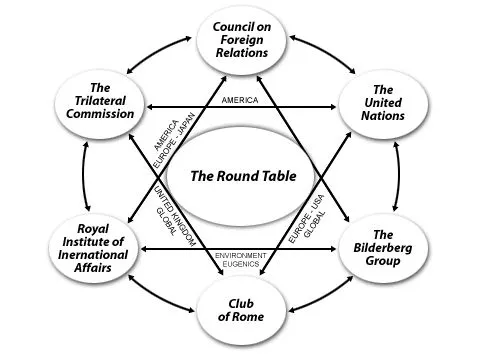
🇬🇧 SPAWN OF RHODES - MILNER NETWORK / THE ROUND TABLE 🇺🇸
What Cecil Rhodes bequeathed to the world wasn't merely a scholarship programme but an entire architecture of power; a network of interlocking institutions designed to govern the world in the name of Anglo-Saxon civilisation while presenting itself as disinterested expertise.
1. The Royal Institute of International Affairs (Chatham House, 1919)
Founded at the Paris Peace Conference by Milner's "Kindergarten" (Oxford-trained administrators who had managed the British Empire in South Africa). Chatham House has served for over a century as the primary intellectual clearing house for Anglo-American foreign policy. Its famous Rule, permitting participants to use information without identifying its source, circulates imperial consensus among the powerful under the guise of scholarly independence.
2. The Council on Foreign Relations (CFR, 1921)
Founded by Wall Street lawyers and Eastern Establishment figures including Federal Reserve architect Paul Warburg, the CFR has counted virtually every post-war Secretary of State, National Security Adviser, and CIA Director among its membership. Its journal Foreign Affairs sets the parameters of acceptable debate; an ideological production machine manufacturing the expert consensus that legitimises American imperial violence as prudent and inevitable.
3. The Institute of Pacific Relations (IPR)
Founded in 1925 and funded by the Rockefeller and Carnegie foundations, the IPR managed Anglo-American policy toward Asia while absorbing heterodox voices and maintaining the appearance of independent scholarship. When its China policy became controversial, it was destroyed in the McCarthyite witch-hunt; not an exposure of subversion but an intra-elite struggle conducted through the language of patriotic alarm.
4. The Bilderberg Group (1954)
Founded by former NSDAP member Prince Bernhard of the Netherlands alongside David Rockefeller and British intelligence-connected operative Joseph Retinger, Bilderberg convenes annually some 130 to 140 of the Western world's most powerful figures under strict secrecy. Its function is not to issue orders but to manufacture consensus, ensuring Western power shares a common framework of assumptions and a common sense of what is and is not thinkable.
5. The Trilateral Commission (1973)
Founded by David Rockefeller and Zbigniew Brzezinski in response to the crisis of American hegemony in the early 1970s, the Commission extended the network's coordination to encompass Japan alongside North America and Western Europe. Its defining document, the 1975 Crisis of Democracy, identified the "excess of democracy" as the principal threat to Western governance and prescribed technocratic insulation from popular pressure as the remedy.
6. The European Union 🇪🇺 (The Network's Continental Project)
The documentary record reveals European integration not as a spontaneous peace project but as a strategic CIA investment. The American Committee on United Europe (ACUE) channelled covert funding to the federalist movement from its inception, while Monnet maintained intimate ties to Wall Street and American intelligence throughout. The resulting structure (an unelected Commission, a depoliticised central bank, and capital's free movement enshrined as constitutional fact) removes economic decisions from democratic reach entirely.
7. The World Economic Forum (WEF) - The Network's Current Face
Founded by Klaus Schwab in 1971, the WEF dresses corporate governance in the language of "stakeholder capitalism" and planetary concern, performing at Davos the same consensus-manufacturing function as Bilderberg. Its "Young Global Leaders" programme (alumni including Macron, Trudeau, Ardern, and Zuckerberg) cultivates a transnational governing class answerable to no electorate.
(continues below)
What Cecil Rhodes bequeathed to the world wasn't merely a scholarship programme but an entire architecture of power; a network of interlocking institutions designed to govern the world in the name of Anglo-Saxon civilisation while presenting itself as disinterested expertise.
1. The Royal Institute of International Affairs (Chatham House, 1919)
Founded at the Paris Peace Conference by Milner's "Kindergarten" (Oxford-trained administrators who had managed the British Empire in South Africa). Chatham House has served for over a century as the primary intellectual clearing house for Anglo-American foreign policy. Its famous Rule, permitting participants to use information without identifying its source, circulates imperial consensus among the powerful under the guise of scholarly independence.
2. The Council on Foreign Relations (CFR, 1921)
Founded by Wall Street lawyers and Eastern Establishment figures including Federal Reserve architect Paul Warburg, the CFR has counted virtually every post-war Secretary of State, National Security Adviser, and CIA Director among its membership. Its journal Foreign Affairs sets the parameters of acceptable debate; an ideological production machine manufacturing the expert consensus that legitimises American imperial violence as prudent and inevitable.
3. The Institute of Pacific Relations (IPR)
Founded in 1925 and funded by the Rockefeller and Carnegie foundations, the IPR managed Anglo-American policy toward Asia while absorbing heterodox voices and maintaining the appearance of independent scholarship. When its China policy became controversial, it was destroyed in the McCarthyite witch-hunt; not an exposure of subversion but an intra-elite struggle conducted through the language of patriotic alarm.
4. The Bilderberg Group (1954)
Founded by former NSDAP member Prince Bernhard of the Netherlands alongside David Rockefeller and British intelligence-connected operative Joseph Retinger, Bilderberg convenes annually some 130 to 140 of the Western world's most powerful figures under strict secrecy. Its function is not to issue orders but to manufacture consensus, ensuring Western power shares a common framework of assumptions and a common sense of what is and is not thinkable.
5. The Trilateral Commission (1973)
Founded by David Rockefeller and Zbigniew Brzezinski in response to the crisis of American hegemony in the early 1970s, the Commission extended the network's coordination to encompass Japan alongside North America and Western Europe. Its defining document, the 1975 Crisis of Democracy, identified the "excess of democracy" as the principal threat to Western governance and prescribed technocratic insulation from popular pressure as the remedy.
6. The European Union 🇪🇺 (The Network's Continental Project)
The documentary record reveals European integration not as a spontaneous peace project but as a strategic CIA investment. The American Committee on United Europe (ACUE) channelled covert funding to the federalist movement from its inception, while Monnet maintained intimate ties to Wall Street and American intelligence throughout. The resulting structure (an unelected Commission, a depoliticised central bank, and capital's free movement enshrined as constitutional fact) removes economic decisions from democratic reach entirely.
7. The World Economic Forum (WEF) - The Network's Current Face
Founded by Klaus Schwab in 1971, the WEF dresses corporate governance in the language of "stakeholder capitalism" and planetary concern, performing at Davos the same consensus-manufacturing function as Bilderberg. Its "Young Global Leaders" programme (alumni including Macron, Trudeau, Ardern, and Zuckerberg) cultivates a transnational governing class answerable to no electorate.
(continues below)
🤯1
Crisis of the Modern World
🇬🇧 THE ROUND TABLE'S POLICIES 🇺🇸 The Round Table's core policy commitments remained broadly consistent from 1909 onward and continued through its institutional successors. 1. IMPERIAL FEDERATION → ATLANTIC COMMUNITY → WORLD GOVERNMENT This progression…
THE INTELLIGENCE SERVICES
(The Network's Covert Arm)
1. MI6, CIA, and the Network
The Anglo-American intelligence services are the Rhodes-Milner network's covert operational arm, drawn from the same Oxford-educated, Wall Street-formed social world. The CIA's record — Mosaddegh (1953), Arbenz (1954), Lumumba (1960), Allende (1973), death squads across Latin America — maps the network's priorities precisely: the violent suppression of every nationalist or socialist movement threatening Western control. Operation Mockingbird, documented by the Church Committee in 1975, extended this into domestic media, placing CIA assets inside major news organisations to manage the narrative from within.
2. The Five Eyes (The Surveillance Infrastructure)
Formalised through the secret UKUSA Agreement of 1946, the Five Eyes (the US, UK, Canada, Australia, and New Zealand) institutionalises the Anglo-Saxon imperial network as a permanent global surveillance apparatus. Because each member is prohibited from surveilling its own citizens in certain ways, allies collect on each other's populations and exchange the product, circumventing domestic law through transnational cooperation; Rhodes's vision of racial civilisational solidarity, institutionalised as shared surveillance infrastructure.
💠💠💠
@CrisisModern
(The Network's Covert Arm)
1. MI6, CIA, and the Network
The Anglo-American intelligence services are the Rhodes-Milner network's covert operational arm, drawn from the same Oxford-educated, Wall Street-formed social world. The CIA's record — Mosaddegh (1953), Arbenz (1954), Lumumba (1960), Allende (1973), death squads across Latin America — maps the network's priorities precisely: the violent suppression of every nationalist or socialist movement threatening Western control. Operation Mockingbird, documented by the Church Committee in 1975, extended this into domestic media, placing CIA assets inside major news organisations to manage the narrative from within.
2. The Five Eyes (The Surveillance Infrastructure)
Formalised through the secret UKUSA Agreement of 1946, the Five Eyes (the US, UK, Canada, Australia, and New Zealand) institutionalises the Anglo-Saxon imperial network as a permanent global surveillance apparatus. Because each member is prohibited from surveilling its own citizens in certain ways, allies collect on each other's populations and exchange the product, circumventing domestic law through transnational cooperation; Rhodes's vision of racial civilisational solidarity, institutionalised as shared surveillance infrastructure.
💠💠💠
@CrisisModern
😱1
🔴 MASS PSYCHOLOGY IN WARTIME 🔴
From observing people's opinions about the Iran War in group chats, comment sections, and social media threads; one thing becomes obvious that mass psychology is very much at play. Again and again, many people demand that Iran annihilate the enemy swiftly, as if speed and destruction were the only metrics of victory or viable form of strategy. The call for immediate brute force seems to be the default response to everything, whether the matter is diplomatic or military; with little regard for the intricacies of statecraft, the complexity of military strategy, or the nuances of international relations.
When the public constantly demanding brute force and total annihilation rather than strategic nuance, they are not articulating a proper political or military position; but they are expressing a certain psychological tendencies and needs. So what's exactly driving this? Let's look deeper into how mass psychology operates, particularly in times of war.
1. Cognitive Economy
The average human brain is wired to conserve energy, and deep geopolitical analysis is energetically expensive. The masses therefore resorting to binary and simplistic assessment/solutions because these frameworks deliver immediate psychological resolution.
2. The Spectator Effect
Many people experience war through screens, which transforms real world violence into high-stakes content. Because they do not bear its physical or economic weight, they consume conflict the way they consume entertainment; with detachment and impatience. This produces what might be called the gamification of violence. The demand to simply "annihilate" the enemy is the logic of a video game, where cost is invisible and victory is purely visual.
3. Emotional Contagion
The masses operate on pathos (emotion), not logos (logic). Fear and outrage travel faster than information. A crowd in high emotional arousal does not receptive to calm, layered argument; they experiences calm and logic as obstruction. The crowd is not evaluating strategy, it is seeking catharsis.
4. Short-Termism and Instant Gratification
The collective mind lives in an eternal present. Strategic patience, which may unfold over years, registers not as wisdom but as inaction. "Brute force" offers the immediate dopamine hit of visible resolution. What cannot yet be seen offers no psychological reward.
5. Externalized Agency
Feeling powerless over their own lives, people project their suppressed desire for agency onto the state. When the state fails to perform the theatrical "strength" they fantasize about, they experience it as incompetence or betrayal. The demand for brute force is a displaced demand, from someone who can't access power in his own existence.
The compulsive demand for immediate brute force is, in the end, a demand to be sedated; the anxiety of the unknown silenced by the loudness of an explosion. It is a symptom of people severed from the complex reality of war, stripped of its capacity for nuance, and desperately externalizing its internal chaos onto the world stage. We also need to shield ourselves from this phenomenon if we want to see the situation with a sober and discerning mind. Always get your information from official statements and the assessment of competent analysts first, not from random crowds.
💠💠💠
@CrisisModern
From observing people's opinions about the Iran War in group chats, comment sections, and social media threads; one thing becomes obvious that mass psychology is very much at play. Again and again, many people demand that Iran annihilate the enemy swiftly, as if speed and destruction were the only metrics of victory or viable form of strategy. The call for immediate brute force seems to be the default response to everything, whether the matter is diplomatic or military; with little regard for the intricacies of statecraft, the complexity of military strategy, or the nuances of international relations.
When the public constantly demanding brute force and total annihilation rather than strategic nuance, they are not articulating a proper political or military position; but they are expressing a certain psychological tendencies and needs. So what's exactly driving this? Let's look deeper into how mass psychology operates, particularly in times of war.
1. Cognitive Economy
The average human brain is wired to conserve energy, and deep geopolitical analysis is energetically expensive. The masses therefore resorting to binary and simplistic assessment/solutions because these frameworks deliver immediate psychological resolution.
2. The Spectator Effect
Many people experience war through screens, which transforms real world violence into high-stakes content. Because they do not bear its physical or economic weight, they consume conflict the way they consume entertainment; with detachment and impatience. This produces what might be called the gamification of violence. The demand to simply "annihilate" the enemy is the logic of a video game, where cost is invisible and victory is purely visual.
3. Emotional Contagion
The masses operate on pathos (emotion), not logos (logic). Fear and outrage travel faster than information. A crowd in high emotional arousal does not receptive to calm, layered argument; they experiences calm and logic as obstruction. The crowd is not evaluating strategy, it is seeking catharsis.
4. Short-Termism and Instant Gratification
The collective mind lives in an eternal present. Strategic patience, which may unfold over years, registers not as wisdom but as inaction. "Brute force" offers the immediate dopamine hit of visible resolution. What cannot yet be seen offers no psychological reward.
5. Externalized Agency
Feeling powerless over their own lives, people project their suppressed desire for agency onto the state. When the state fails to perform the theatrical "strength" they fantasize about, they experience it as incompetence or betrayal. The demand for brute force is a displaced demand, from someone who can't access power in his own existence.
The compulsive demand for immediate brute force is, in the end, a demand to be sedated; the anxiety of the unknown silenced by the loudness of an explosion. It is a symptom of people severed from the complex reality of war, stripped of its capacity for nuance, and desperately externalizing its internal chaos onto the world stage. We also need to shield ourselves from this phenomenon if we want to see the situation with a sober and discerning mind. Always get your information from official statements and the assessment of competent analysts first, not from random crowds.
💠💠💠
@CrisisModern

❤3
Crisis of the Modern World pinned «Take a look on our new Twitter account & give a follow! https://x.com/Crisis_Modernn»