
🔰 Useful and Motivational Reading time 👌
✳️ Today's reading passage is about Michael Faraday (22 September 1791 – 25 August 1867) who was an English scientist who contributed to the study of electromagnetism and electrochemistry.
The son of a blacksmith, born in England in 1791, Michael Faraday was a self-educated genius with a passion for science and invention.
The great genius Albert Einstein used to keep three photographs on his desk: one of Sir Isaac Newton (who discovered gravity); one of James Maxwell (who proved how electricity, magnetism, and light are all related)’ and one of Michael Faraday.
That’s pretty good company for the son of a blacksmith who had virtually no education.
Michael didn’t have much hope of a decent schooling: boys from the lower classes in England in the 1700s went to work, not school. But bright young Michael caught a lucky break when he was apprenticed to a book dealer, and was allowed to read as much as he wanted.
Even though he was self-educated, it was obvious that Michael was highly intelligent. He started going to lectures by a famous chemist, Humphry Davy, and wrote a 300-page book based on Davy’s ideas!
The great scientist was flattered and ended up hiring Faraday as an assistant. In those days, a lower-class person like Michael Faraday was not considered a “gentleman” - on a trip to Europe, he had to act as Davy’s valet and live with the servants.
Although the odds were against him, and he was often treated unfairly by his social superiors, Faraday kept working hard and earning his way up the ladder of success. In fact, he worked so hard and so brilliantly that his lower-class roots were eventually forgotten, and he became a giant of English science.
His discoveries about the nature of gases, how electricity and light interact, and other fundamental rules of chemistry and physics literally changed the world. The electric motors used around the world today were made possible by Michael Faraday’s work. The Bunsen burners you still find in modern laboratories were just one of his inventions.
But Faraday was also a dedicated public servant, and used his great intelligence to help build a better world. He became an expert in preventing explosions in coal mines, in building lighthouses to keep ships safe, and in fighting the industrial pollution ruining England’s environment.
The only time he failed to help his country was when he was asked to help invent chemical weapons: the very religious Faraday refused to use his genius for war.
In old age, Michael Faraday was a national hero. A grateful government gave him a free house and income for the rest of his life.
No wonder Albert Einstein looked up to him!
✳️ 10 words to learn
✅ a blacksmith - temirchi
✅ decent – yaxshi, namunali
✅ to be apprenticed – shogirdlikka olmoq
✅ obvious – yaqqol, ochiq-oydin
✅ to be flattered – (matnda) hursand bo’lmoq
✅ valet – xizmatkor, qarol
✅ the odds were against – (matnda) vaziyatlar qarshi
✅ social superiors – yuqori tabaqadagilar
✅ grateful - minnatdor
✅ to look up to sb – hurmat qilmoq
✳️ Today's reading passage is about Michael Faraday (22 September 1791 – 25 August 1867) who was an English scientist who contributed to the study of electromagnetism and electrochemistry.
The son of a blacksmith, born in England in 1791, Michael Faraday was a self-educated genius with a passion for science and invention.
The great genius Albert Einstein used to keep three photographs on his desk: one of Sir Isaac Newton (who discovered gravity); one of James Maxwell (who proved how electricity, magnetism, and light are all related)’ and one of Michael Faraday.
That’s pretty good company for the son of a blacksmith who had virtually no education.
Michael didn’t have much hope of a decent schooling: boys from the lower classes in England in the 1700s went to work, not school. But bright young Michael caught a lucky break when he was apprenticed to a book dealer, and was allowed to read as much as he wanted.
Even though he was self-educated, it was obvious that Michael was highly intelligent. He started going to lectures by a famous chemist, Humphry Davy, and wrote a 300-page book based on Davy’s ideas!
The great scientist was flattered and ended up hiring Faraday as an assistant. In those days, a lower-class person like Michael Faraday was not considered a “gentleman” - on a trip to Europe, he had to act as Davy’s valet and live with the servants.
Although the odds were against him, and he was often treated unfairly by his social superiors, Faraday kept working hard and earning his way up the ladder of success. In fact, he worked so hard and so brilliantly that his lower-class roots were eventually forgotten, and he became a giant of English science.
His discoveries about the nature of gases, how electricity and light interact, and other fundamental rules of chemistry and physics literally changed the world. The electric motors used around the world today were made possible by Michael Faraday’s work. The Bunsen burners you still find in modern laboratories were just one of his inventions.
But Faraday was also a dedicated public servant, and used his great intelligence to help build a better world. He became an expert in preventing explosions in coal mines, in building lighthouses to keep ships safe, and in fighting the industrial pollution ruining England’s environment.
The only time he failed to help his country was when he was asked to help invent chemical weapons: the very religious Faraday refused to use his genius for war.
In old age, Michael Faraday was a national hero. A grateful government gave him a free house and income for the rest of his life.
No wonder Albert Einstein looked up to him!
✳️ 10 words to learn
✅ a blacksmith - temirchi
✅ decent – yaxshi, namunali
✅ to be apprenticed – shogirdlikka olmoq
✅ obvious – yaqqol, ochiq-oydin
✅ to be flattered – (matnda) hursand bo’lmoq
✅ valet – xizmatkor, qarol
✅ the odds were against – (matnda) vaziyatlar qarshi
✅ social superiors – yuqori tabaqadagilar
✅ grateful - minnatdor
✅ to look up to sb – hurmat qilmoq
💡Collocations of the day 👌
✳️ Bugungi postimizda 'influence' (ta'sir, ta'sir qilmoq, ta'sir (bosim) o'tkazmoq) so'zi bilan bog'liq collocationlarni o'rganamiz.
✅ considerable/great/major/profound influence - sezilarli/ulkan/katta ta'sir
🔸He had a profound influence on modern poets. (U zamonamiz shoirlariga katta ta'sir o'tkazgan)
✅ undue influence - g'ayriqonuniy ta'sir, bosim
🔸The President has been criticized for exercising undue influence over the judiciary and parliament. (Prezident sud hokimiyati va parlamentga bosim o'tkazgan deb tanqid qilindi)
✅ to exert/have/exercise (an) influence - ta'sir/bosim o'tkazmoq
🔸He is close enough to the President to exert influence. (U Prezidentga ta'sir o'tkazish uchun yetarlicha yaqin)
✅ under the influence of (alcohol/drink) - alkogol/spirtli ichimlik ta'siri ostida
🔸He was arrested for driving under the influence. (U spirtli ichimlik ostida mashina haydagani uchun hibsga olindi)
✅ a sphere of influence - ta'sir doirasi
🔸Rome's sphere of influence extended across Europe. (Rim imperiyasining ta'sir doirasi butun Yevropa bo'ylab tarqalgan edi)
✳️ Bugungi postimizda 'influence' (ta'sir, ta'sir qilmoq, ta'sir (bosim) o'tkazmoq) so'zi bilan bog'liq collocationlarni o'rganamiz.
✅ considerable/great/major/profound influence - sezilarli/ulkan/katta ta'sir
🔸He had a profound influence on modern poets. (U zamonamiz shoirlariga katta ta'sir o'tkazgan)
✅ undue influence - g'ayriqonuniy ta'sir, bosim
🔸The President has been criticized for exercising undue influence over the judiciary and parliament. (Prezident sud hokimiyati va parlamentga bosim o'tkazgan deb tanqid qilindi)
✅ to exert/have/exercise (an) influence - ta'sir/bosim o'tkazmoq
🔸He is close enough to the President to exert influence. (U Prezidentga ta'sir o'tkazish uchun yetarlicha yaqin)
✅ under the influence of (alcohol/drink) - alkogol/spirtli ichimlik ta'siri ostida
🔸He was arrested for driving under the influence. (U spirtli ichimlik ostida mashina haydagani uchun hibsga olindi)
✅ a sphere of influence - ta'sir doirasi
🔸Rome's sphere of influence extended across Europe. (Rim imperiyasining ta'sir doirasi butun Yevropa bo'ylab tarqalgan edi)
✳️ Bilib qo'ygan yaxshi 👌
✳️ time soʻzi ingliz tilida 3 xil ma’noda qoʻllaniladi.
1️⃣ vaqt (sanalmaydigan ot) – bu vaziyatda bu soʻz oldidan faqat much/little/a little/a lot of soʻzlari qoʻllaniladi.
🔸We couldn't do all the work. We had very little time.
2️⃣ davr, payt (sanaladigan ot) – bu ma’noda to have a good/bad time va boshqa birikmasida ishlatiladi.
🔸Did you have a good time in Spain?
3️⃣ marotaba, marta, barobar (sanaladigan ot) – bu ma’noda ish-harakatning qancha marta sodir boʻlishini bildiradi va many/few/a few/ a lot of soʻzlari bilan qoʻllaniladi.
🔸It was her job to make tea a few times a day.
🔸Its profits are rising four times faster than the average company.
✳️ time soʻzi ingliz tilida 3 xil ma’noda qoʻllaniladi.
1️⃣ vaqt (sanalmaydigan ot) – bu vaziyatda bu soʻz oldidan faqat much/little/a little/a lot of soʻzlari qoʻllaniladi.
🔸We couldn't do all the work. We had very little time.
2️⃣ davr, payt (sanaladigan ot) – bu ma’noda to have a good/bad time va boshqa birikmasida ishlatiladi.
🔸Did you have a good time in Spain?
3️⃣ marotaba, marta, barobar (sanaladigan ot) – bu ma’noda ish-harakatning qancha marta sodir boʻlishini bildiradi va many/few/a few/ a lot of soʻzlari bilan qoʻllaniladi.
🔸It was her job to make tea a few times a day.
🔸Its profits are rising four times faster than the average company.
💡Collocations of the day 👌
✳️ Bugungi postimizda 'information' (axborot, ma'lumot) so'zi bilan bog'liq collocationlarni o'rganamiz.
✅ accurate/correct/false information - aniq/to'g'ri/yolg'on ma'lumot
🔸It is alleged that he gave false information to tax authorities. (Gumon qilishlaricha, u soliq idoralariga yolg'on ma'lumot bergan)
✅ valuable/further/up-to-date/latest information - qimmatli/qo'shimcha/yangi/so'nggi ma'lumot
🔸Please contact our agent in Spain for further information. (Iltimos, qo'shimcha ma'lumot uchun bizning Ispaniyadagi agentimizga murojaat qiling)
✅ to gather/get/obtain information - ma'lumot yig'moq/olmoq/qo'lga kiritmoq
🔸Can you tell me where I can obtain further information? (Menga qayerdan qo'shimcha ma'lumot olishim mumkinligini ayta olmaysizmi?)
✅ to ask for/request/demand information - ma'lumot so'ramoq/talab qilmoq
🔸I wrote requesting information on how revenue statistics were compiled. (Men daromad statistikasi qanday shakllantirilganligi haqida ma'lumot so'rab yozdim)
✅ to give/provide/share information - ma'lumot bermoq/ma'lumot bilan ta'minlamoq/ma'lumotni bo'lishmoq
🔸The research company provides information in a timely way. (Tadqiqot kompaniyasi ma'lumot bilan o'z vaqtida ta'minlaydi)
✅ access to information - ma'lumotga ruxsat
✅ the exchange of information - ma'lumotlarni almashish
✅ the flow of information - ma'lumotlar oqimi
✅ a lack of information - ma'lumotlar yetishmovchiligi
✅ a source of information - ma'lumotlar manbasi
✳️ Bugungi postimizda 'information' (axborot, ma'lumot) so'zi bilan bog'liq collocationlarni o'rganamiz.
✅ accurate/correct/false information - aniq/to'g'ri/yolg'on ma'lumot
🔸It is alleged that he gave false information to tax authorities. (Gumon qilishlaricha, u soliq idoralariga yolg'on ma'lumot bergan)
✅ valuable/further/up-to-date/latest information - qimmatli/qo'shimcha/yangi/so'nggi ma'lumot
🔸Please contact our agent in Spain for further information. (Iltimos, qo'shimcha ma'lumot uchun bizning Ispaniyadagi agentimizga murojaat qiling)
✅ to gather/get/obtain information - ma'lumot yig'moq/olmoq/qo'lga kiritmoq
🔸Can you tell me where I can obtain further information? (Menga qayerdan qo'shimcha ma'lumot olishim mumkinligini ayta olmaysizmi?)
✅ to ask for/request/demand information - ma'lumot so'ramoq/talab qilmoq
🔸I wrote requesting information on how revenue statistics were compiled. (Men daromad statistikasi qanday shakllantirilganligi haqida ma'lumot so'rab yozdim)
✅ to give/provide/share information - ma'lumot bermoq/ma'lumot bilan ta'minlamoq/ma'lumotni bo'lishmoq
🔸The research company provides information in a timely way. (Tadqiqot kompaniyasi ma'lumot bilan o'z vaqtida ta'minlaydi)
✅ access to information - ma'lumotga ruxsat
✅ the exchange of information - ma'lumotlarni almashish
✅ the flow of information - ma'lumotlar oqimi
✅ a lack of information - ma'lumotlar yetishmovchiligi
✅ a source of information - ma'lumotlar manbasi
📖Dars All so'zining qo'llanishi
✳️ all - hamma olmoshi ot bilan qoʻllaniladi.
✳️ all olmoshidan keyingi ot koʻplikdagi sanaladigan yoki sanalmaydigan ot boʻlishi ham mumkin.
✳️ all + noun - all olmoshi toʻg'ridan-toʻgri ot bilan biriksa, umumiy ma'noda qoʻllaniladi.
🔸All plants need water. (Hamma oʻsimliklar suvga ehtiyoj sezadi)
🔸All matter is made up of atoms. (Hamma materiya atomlardan tashkil topgan)
✳️ all of+(my / the / these ) + noun qurilmasida all olmoshi muayyan bir guruh yoki cheklangan miqdordagi predmetlarning hammasi degan ma'noda qoʻllaniladi.
🔸All of the children in our street like playing football. (Bizning koʻchadagi hamma bolalar futbol oʻynashni yoqtirishadi)
🔸All of the advice you gave me was useless. (Siz menga bergan hamma maslahatingiz foydasiz edi)
⚠️ Qiyoslaymiz:
🔸All children like playing football. (Hamma bolalar futbol oʻynashni yoqtirishadi...umumiy ma'no)
🔸All of the children in the class like playing football. (Sinfdagi hamma bolalar futbol oʻynashni yoqtirishadi... faqat sinfimizdagi)
⚠️ Yuqoridagi holatda all olmoshidan keyin of soʻzini tushirib qoldirish mumkin.
▪️all of the children = all the children
🔸All the children in the class like playing football.
⚠️ Lekin ot oʻrnida toʻldiruvchi olmosh (personal pronoun) qoʻllanilganda of qatnashishi lozim:
▪️ all of them/us/it etc.
🔸All of them must be ready for the exams. (all them emas)
✳️ all olmoshini gap oʻrtasida fe'llardan oldin yoki keyin qoʻllash mumkin.
🔸These cups are all dirty. (=All the cups are dirty.)
🔸These guests have all gone now. (=All the guests have gone now)
✳️ all olmoshi yolg'iz oʻzi everybody/everyone (hamma) degan ma'noda qoʻllanilmaydi.
🔸Everyone wanted Mary Lin's autograph. (all wanted emas)
⚠️ Ammo boshqa soʻzlar, olmoshlar bilan qoʻllanilib, all olmoshi hamma (odam) ma'nosini berishi mumkin.
🔸All of us (=We all) agreed to sign the contract. (=everybody agreed)
✳️ all soʻzini biror birikma bilan qoʻllab, hamma narsa (everything), faqatgina (the only thing) ma'nolarida ifodalash mumkin.
🔸Tell me all about your new work. (Yangi ishing haqida hamma bilganlaringni aytib ber)
🔸All I had for breakfast was a sandwich. (=the only thing I had was...Nonushtaga faqatgina sendvich yedim)
✳️ all olmoshi yolg'iz oʻzi hamma narsa (everything) degan ma'noda qoʻllanilmaydi. Bu holatda everything olmoshini qoʻllash lozim.
🔸He thinks he knows everything. (he knows all emas)
⚠️ Ammo ba'zibir iboralarda (maqollarda) all olmoshi yolg'iz oʻzi ham qoʻllanadi.
🔸All is not gold that glitters. (Yaltiraydigan hamma narsa oltin emas)
✳️ Ingliz tilida hammasi/butun bir ma'nosini beruvchi whole soʻzi ham mavjud.
🔸Did you read the whole book? (=all the book...Sen butun kitobni oʻqib chiqdingmi?)
✳️ Lekin bu soʻz faqat birlikdagi sanaladigan otlar oldidan qoʻllaniladi.
🔸He ate a whole loaf of bread. (the whole bread emas.)
🔸The whole film was boring. (the whole films emas.)
✳️ Lekin ba'zibir otlar, ya'ni koʻplikdagi yoki sanalmaydigan otlar faqat all olmoshi bilan birikadi.
🔸He spent all the money. (the whole money emas.)
🔸She is 90 and she is still got all her teeth. (her whole teeth emas.)
✳️ Ba'zi otlar all yoki whole bilan ham birika oladi.
🔸She has lived all her life in London. (U butun umr Londonda yashagan)
🔸She has lived her whole life in London. (U butun umr Londonda yashagan)
⚠️ Yuqoridagi vaziyatlarda artikl va boshqa aniqlovchi soʻzlar whole soʻzidan oldin, all olmoshidan keyin qoʻllanishini ham e'tiborga olish kerak.
▪️her whole life - all her life
▪️the whole time - all the time
✳️ all - hamma olmoshi ot bilan qoʻllaniladi.
✳️ all olmoshidan keyingi ot koʻplikdagi sanaladigan yoki sanalmaydigan ot boʻlishi ham mumkin.
✳️ all + noun - all olmoshi toʻg'ridan-toʻgri ot bilan biriksa, umumiy ma'noda qoʻllaniladi.
🔸All plants need water. (Hamma oʻsimliklar suvga ehtiyoj sezadi)
🔸All matter is made up of atoms. (Hamma materiya atomlardan tashkil topgan)
✳️ all of+(my / the / these ) + noun qurilmasida all olmoshi muayyan bir guruh yoki cheklangan miqdordagi predmetlarning hammasi degan ma'noda qoʻllaniladi.
🔸All of the children in our street like playing football. (Bizning koʻchadagi hamma bolalar futbol oʻynashni yoqtirishadi)
🔸All of the advice you gave me was useless. (Siz menga bergan hamma maslahatingiz foydasiz edi)
⚠️ Qiyoslaymiz:
🔸All children like playing football. (Hamma bolalar futbol oʻynashni yoqtirishadi...umumiy ma'no)
🔸All of the children in the class like playing football. (Sinfdagi hamma bolalar futbol oʻynashni yoqtirishadi... faqat sinfimizdagi)
⚠️ Yuqoridagi holatda all olmoshidan keyin of soʻzini tushirib qoldirish mumkin.
▪️all of the children = all the children
🔸All the children in the class like playing football.
⚠️ Lekin ot oʻrnida toʻldiruvchi olmosh (personal pronoun) qoʻllanilganda of qatnashishi lozim:
▪️ all of them/us/it etc.
🔸All of them must be ready for the exams. (all them emas)
✳️ all olmoshini gap oʻrtasida fe'llardan oldin yoki keyin qoʻllash mumkin.
🔸These cups are all dirty. (=All the cups are dirty.)
🔸These guests have all gone now. (=All the guests have gone now)
✳️ all olmoshi yolg'iz oʻzi everybody/everyone (hamma) degan ma'noda qoʻllanilmaydi.
🔸Everyone wanted Mary Lin's autograph. (all wanted emas)
⚠️ Ammo boshqa soʻzlar, olmoshlar bilan qoʻllanilib, all olmoshi hamma (odam) ma'nosini berishi mumkin.
🔸All of us (=We all) agreed to sign the contract. (=everybody agreed)
✳️ all soʻzini biror birikma bilan qoʻllab, hamma narsa (everything), faqatgina (the only thing) ma'nolarida ifodalash mumkin.
🔸Tell me all about your new work. (Yangi ishing haqida hamma bilganlaringni aytib ber)
🔸All I had for breakfast was a sandwich. (=the only thing I had was...Nonushtaga faqatgina sendvich yedim)
✳️ all olmoshi yolg'iz oʻzi hamma narsa (everything) degan ma'noda qoʻllanilmaydi. Bu holatda everything olmoshini qoʻllash lozim.
🔸He thinks he knows everything. (he knows all emas)
⚠️ Ammo ba'zibir iboralarda (maqollarda) all olmoshi yolg'iz oʻzi ham qoʻllanadi.
🔸All is not gold that glitters. (Yaltiraydigan hamma narsa oltin emas)
✳️ Ingliz tilida hammasi/butun bir ma'nosini beruvchi whole soʻzi ham mavjud.
🔸Did you read the whole book? (=all the book...Sen butun kitobni oʻqib chiqdingmi?)
✳️ Lekin bu soʻz faqat birlikdagi sanaladigan otlar oldidan qoʻllaniladi.
🔸He ate a whole loaf of bread. (the whole bread emas.)
🔸The whole film was boring. (the whole films emas.)
✳️ Lekin ba'zibir otlar, ya'ni koʻplikdagi yoki sanalmaydigan otlar faqat all olmoshi bilan birikadi.
🔸He spent all the money. (the whole money emas.)
🔸She is 90 and she is still got all her teeth. (her whole teeth emas.)
✳️ Ba'zi otlar all yoki whole bilan ham birika oladi.
🔸She has lived all her life in London. (U butun umr Londonda yashagan)
🔸She has lived her whole life in London. (U butun umr Londonda yashagan)
⚠️ Yuqoridagi vaziyatlarda artikl va boshqa aniqlovchi soʻzlar whole soʻzidan oldin, all olmoshidan keyin qoʻllanishini ham e'tiborga olish kerak.
▪️her whole life - all her life
▪️the whole time - all the time
📖Dars most/half so'zlarining qo'llanishi
✳️ most olmoshi koʻpchilik degan ma'noda koʻplikdagi sanaladigan otlar yoki sanalmaydigan otlar oldidan qoʻllaniladi.
🔸Most tourists do not visit this part of the city. (Koʻpchilik turistlar shaharning bu qismini ziyorat qilishmaydi)
🔸Most of the money was stolen. (Pulning koʻpchiligi oʻg'irlangan edi)
✳️ most+of+(my/the/these)+noun qurilmasida qoʻllanilganida most olmoshi cheklangan miqdordagi shaxs yoki narsalarning koʻpchiligi degan ma'noda qoʻllaniladi.
🔸Most of my friends live in Tashkent. (Doʻstlarimning koʻpchiligi Toshkentda yashashadi)
🔸I had 100 pounds and most of it was spent on PC games. (Mening 100 funtim bor edi va uning koʻpchiligi kompyuter oʻyinlariga sarflandi)
⚠️ most olmoshi yolg'iz oʻzi ham qoʻllanishi mumkin.
🔸The band sang a few songs. Most were old songs, but some were new. (Guruh bir necha qoʻshiqni kuyladi. Koʻpchiligi eski qoʻshiqlar edi, lekin ba'zilari yangi edi)
✳️ most - koʻpchilik ma'nosidagi olmoshni sifatning orttirma darajasini yasaydigan the most - eng soʻzidan farqlash lozim. most soʻzi olmosh ma'nosida oldidan hech qanday artikl olmaydi va undan keyin ot keladi.
🔸❌Most people would like to have more money.
the most sifatning darajasini bildirganda sifat + ot bilan qoʻllaniladi.
🔸The most interesting book I've ever read is Tixiy Don by Sholokhov.
✳️ half - yarmi/yarmisi degan manolarda olmosh boʻlib keladi va sanaladigan otlar yoki sanalmaydigan otlar oldidan qoʻllaniladi. half olmoshi half + of (my/the/these )+noun qurilmasida qoʻllanadi.
🔸Half of the money (half the money) was stolen. (Pulning yarmi oʻg'irlandi.)
✳️ most olmoshi koʻpchilik degan ma'noda koʻplikdagi sanaladigan otlar yoki sanalmaydigan otlar oldidan qoʻllaniladi.
🔸Most tourists do not visit this part of the city. (Koʻpchilik turistlar shaharning bu qismini ziyorat qilishmaydi)
🔸Most of the money was stolen. (Pulning koʻpchiligi oʻg'irlangan edi)
✳️ most+of+(my/the/these)+noun qurilmasida qoʻllanilganida most olmoshi cheklangan miqdordagi shaxs yoki narsalarning koʻpchiligi degan ma'noda qoʻllaniladi.
🔸Most of my friends live in Tashkent. (Doʻstlarimning koʻpchiligi Toshkentda yashashadi)
🔸I had 100 pounds and most of it was spent on PC games. (Mening 100 funtim bor edi va uning koʻpchiligi kompyuter oʻyinlariga sarflandi)
⚠️ most olmoshi yolg'iz oʻzi ham qoʻllanishi mumkin.
🔸The band sang a few songs. Most were old songs, but some were new. (Guruh bir necha qoʻshiqni kuyladi. Koʻpchiligi eski qoʻshiqlar edi, lekin ba'zilari yangi edi)
✳️ most - koʻpchilik ma'nosidagi olmoshni sifatning orttirma darajasini yasaydigan the most - eng soʻzidan farqlash lozim. most soʻzi olmosh ma'nosida oldidan hech qanday artikl olmaydi va undan keyin ot keladi.
🔸❌Most people would like to have more money.
the most sifatning darajasini bildirganda sifat + ot bilan qoʻllaniladi.
🔸The most interesting book I've ever read is Tixiy Don by Sholokhov.
✳️ half - yarmi/yarmisi degan manolarda olmosh boʻlib keladi va sanaladigan otlar yoki sanalmaydigan otlar oldidan qoʻllaniladi. half olmoshi half + of (my/the/these )+noun qurilmasida qoʻllanadi.
🔸Half of the money (half the money) was stolen. (Pulning yarmi oʻg'irlandi.)
📖Dars Another/other so'zlarining qo'llanishi
1️⃣ another soʻzi birlikdagi sanaladigan otlar oldidan qoʻllaniladi va quyidagi ma'nolarni anglatadi:
➖ boshqa
🔸Come another day. (Boshqa kuni keling)
➖ yana bir, qoʻshimcha
🔸Give me another example. (Yana bir misol keltiring)
🔸We need another day to complete the work.
⚠️ one after another birikmasi ketma-ket degan ma’noda qoʻllaniladi.
🔸The bills kept coming one after another.
⚠️ another - yana degan ma'noda miqdor/masofa/og'irlikni bildiruvchi koʻplikdagi otlar oldidan qoʻllaniladi:
🔸He gave me another fifty dollars. (U menga yana ellik dollar berdi)
🔸We have to walk another six miles to reach the station. (Biz stansiyaga yetib borishimiz uchun yana olti mil yurishimiz kerak.)
2️⃣ other soʻzi koʻplikdagi sanaladigan otlar va sanalmaydigan otlar oldidan umumiy ma'noda boshqa degan ma'noda qoʻllaniladi.
🔸It is interesting to read about other countries. (Boshqa davlatlar haqida oʻqish maroqli)
⚠️ other sozi otlashib boshqalar degan ma'noni berishi mumkin.
🔸He is very selfish. He doesn't care about others.
⚠️ other olmoshi some (ba'zi) so'zi bilan qoʻllanilganda qarama-qarshi fikrlarni ifodalash uchun qoʻllaniladi.
🔸Some holidays are cheap and other holidays are expensive. (Ba'zi ta'tillar arzon va boshqa ta'tillar esa qimmat)
3️⃣ the other olmoshi narigi/qolgan/ikkinchi degan ma'noda birlikdagi, koʻplikdagi va sanalmaydigan otlar bilan qoʻllaniladi.
🔸This one is mine and the other one is yours. (Bu meniki va narigisi sizniki.)
🔸John went cycling and the other boys went with him. (Jon velosiped haydab ketdi va qolgan bolalar ham u bilan ketishdi)
⚠️ the other/the others olmoshi narigisi/qolgani/narigilari/qolganlari degan ma'nolarda birlikdagi yoki koʻplikdagi otlarni ifodalashi mumkin.
🔸John went cycling and the others went with him. (qolganlar)
🔸I met two strangers on the way to work. One of them greeted me and the other didn't. (ikkinchisi)
✳️ the other day soʻzi bir necha kun oldin degan ma'noda oʻtgan zamonni ifodalaydi.
🔸John came to see me the other day. It was last Friday I think.
1️⃣ another soʻzi birlikdagi sanaladigan otlar oldidan qoʻllaniladi va quyidagi ma'nolarni anglatadi:
➖ boshqa
🔸Come another day. (Boshqa kuni keling)
➖ yana bir, qoʻshimcha
🔸Give me another example. (Yana bir misol keltiring)
🔸We need another day to complete the work.
⚠️ one after another birikmasi ketma-ket degan ma’noda qoʻllaniladi.
🔸The bills kept coming one after another.
⚠️ another - yana degan ma'noda miqdor/masofa/og'irlikni bildiruvchi koʻplikdagi otlar oldidan qoʻllaniladi:
🔸He gave me another fifty dollars. (U menga yana ellik dollar berdi)
🔸We have to walk another six miles to reach the station. (Biz stansiyaga yetib borishimiz uchun yana olti mil yurishimiz kerak.)
2️⃣ other soʻzi koʻplikdagi sanaladigan otlar va sanalmaydigan otlar oldidan umumiy ma'noda boshqa degan ma'noda qoʻllaniladi.
🔸It is interesting to read about other countries. (Boshqa davlatlar haqida oʻqish maroqli)
⚠️ other sozi otlashib boshqalar degan ma'noni berishi mumkin.
🔸He is very selfish. He doesn't care about others.
⚠️ other olmoshi some (ba'zi) so'zi bilan qoʻllanilganda qarama-qarshi fikrlarni ifodalash uchun qoʻllaniladi.
🔸Some holidays are cheap and other holidays are expensive. (Ba'zi ta'tillar arzon va boshqa ta'tillar esa qimmat)
3️⃣ the other olmoshi narigi/qolgan/ikkinchi degan ma'noda birlikdagi, koʻplikdagi va sanalmaydigan otlar bilan qoʻllaniladi.
🔸This one is mine and the other one is yours. (Bu meniki va narigisi sizniki.)
🔸John went cycling and the other boys went with him. (Jon velosiped haydab ketdi va qolgan bolalar ham u bilan ketishdi)
⚠️ the other/the others olmoshi narigisi/qolgani/narigilari/qolganlari degan ma'nolarda birlikdagi yoki koʻplikdagi otlarni ifodalashi mumkin.
🔸John went cycling and the others went with him. (qolganlar)
🔸I met two strangers on the way to work. One of them greeted me and the other didn't. (ikkinchisi)
✳️ the other day soʻzi bir necha kun oldin degan ma'noda oʻtgan zamonni ifodalaydi.
🔸John came to see me the other day. It was last Friday I think.
⚡3-MART: BARCHA ABITURIYENTLAR UCHUN TAKRORLANMAS KUN
"Pro Study" o'quv markazi Respublikamizning barcha abituriyentlarini 3-mart kuni DTM standartlari asosidagi keng qamrovli test sinovlariga taklif etadi.
Yo'nalishlar:
🖥 Iqtisod
🦾 Texnika
👥 Ijtimoiy
🧠 Tabiiy
O'zingizni DTM testlarida bo'lgani kabi his etishingiz uchun ajoyib "atmosfera"ni sizga ta'minlab beramiz! Keling, Testda qatnashing va olgan bilimlaringizni sinovdan o'tkazing!
Murojat uchun: 97 920 94 94
99 620 94 94
"Pro Study" o'quv markazi Respublikamizning barcha abituriyentlarini 3-mart kuni DTM standartlari asosidagi keng qamrovli test sinovlariga taklif etadi.
Yo'nalishlar:
🖥 Iqtisod
🦾 Texnika
👥 Ijtimoiy
🧠 Tabiiy
O'zingizni DTM testlarida bo'lgani kabi his etishingiz uchun ajoyib "atmosfera"ni sizga ta'minlab beramiz! Keling, Testda qatnashing va olgan bilimlaringizni sinovdan o'tkazing!
Murojat uchun: 97 920 94 94
99 620 94 94
Forwarded from Xushnudbek.uz
⚡️Қўшни давлатлардан ўқишни кўчириш бўйича қўшимча маълумотлар
Давлат қабул комиссиясининг 2020 йил 28 февралдаги 13-сон баёнига мувофиқ қуйидагилар белгиланди:
1️⃣ қўшни давлатлардаги ОТМлардан республика ОТМларига ўқиши кўчирилиши рухсат берилган талабалар сони тақсимоти ОТМлар кесимида тасдиқланди;
2️⃣ қўшни давлатларнинг ОТМларида камида бир семестр мобайнида ўқишини давом эттирмасдан, бошқа давлатларнинг (хусусан, Россия Федерацияси ва бошқа давлатлар) ОТМларидан ўқишини ўқув йилининг ярмида кўчириб ўтган талабаларнинг ўқиши кўчирилмайди;
Бу нима дегани?
Қўшни давлатлардан ўқишни имтиҳонсиз кўчириш мумкинлиги ҳақида хабар чиққач, Россия ёки Украинада ўқиётган талабалар уддабуронлик билан ўз ўқишини қўшни давлатга (асосан Қозоғистон) кўчириб ўтишган эди. Аммо улар Қозоғистонда ҳатто 1 семестр ҳам ўқишгани йўқ. Ана шундай талабалар ўқишини Ўзбекистонга кўчира олишмайди.
3️⃣ қўшни давлатларнинг ОТМларида масофавий таълим шакли бўйича ва онлайн тарзда таҳсил олаётган талабаларнинг ўқишини кўчиришга рухсат берилмайди;
4️⃣ қўшни давлатлардаги ОТМлардан республика ОТМларига ўқишини кўчириш фақатгина жорий йилда Давлат қабул комиссияси томонидан белгиланган муддатларда амалга оширилиши қатъиян белгилаб қўйилди.
Бу нима дегани?
Кўпчилик жорий йилдаги каби ўзига хос “амнистия” ҳар йили бўлади, деб ўйлашмоқда ва шу сабабли ёзда қўшни давлатларга олдингидан 10 баробар кўп ёшлар ўқишга кетишни режа қилиб туришибди. Уёққа имтиҳтонсиз ўқишга кирамиз, кейин қишда ўқишини имтиҳонсиз кўчирамиз, деб ўйлашаётганди. Ўшанчун ҳам қарорда аниқ белгиландики, бундай акция фақат жорий йилда бўлади, кейинги йилларда умумий тартибда имтиҳон асосида ўқишни кўчириш мумкин бўлади.
5️⃣ қўшни давлатлардаги ОТМлардан ўқишни кўчириш натижалари уч кун муддатда тегишли ОТМларга етказилади. Олинган маълумотларга кўра, жами 36 минг 400 нафардан кўпроқ талабаларга ўқишини 80 та ОТМга кўчиришга рухсат берилди.
👉 @xushnudbek 👈
Давлат қабул комиссиясининг 2020 йил 28 февралдаги 13-сон баёнига мувофиқ қуйидагилар белгиланди:
1️⃣ қўшни давлатлардаги ОТМлардан республика ОТМларига ўқиши кўчирилиши рухсат берилган талабалар сони тақсимоти ОТМлар кесимида тасдиқланди;
2️⃣ қўшни давлатларнинг ОТМларида камида бир семестр мобайнида ўқишини давом эттирмасдан, бошқа давлатларнинг (хусусан, Россия Федерацияси ва бошқа давлатлар) ОТМларидан ўқишини ўқув йилининг ярмида кўчириб ўтган талабаларнинг ўқиши кўчирилмайди;
Бу нима дегани?
Қўшни давлатлардан ўқишни имтиҳонсиз кўчириш мумкинлиги ҳақида хабар чиққач, Россия ёки Украинада ўқиётган талабалар уддабуронлик билан ўз ўқишини қўшни давлатга (асосан Қозоғистон) кўчириб ўтишган эди. Аммо улар Қозоғистонда ҳатто 1 семестр ҳам ўқишгани йўқ. Ана шундай талабалар ўқишини Ўзбекистонга кўчира олишмайди.
3️⃣ қўшни давлатларнинг ОТМларида масофавий таълим шакли бўйича ва онлайн тарзда таҳсил олаётган талабаларнинг ўқишини кўчиришга рухсат берилмайди;
4️⃣ қўшни давлатлардаги ОТМлардан республика ОТМларига ўқишини кўчириш фақатгина жорий йилда Давлат қабул комиссияси томонидан белгиланган муддатларда амалга оширилиши қатъиян белгилаб қўйилди.
Бу нима дегани?
Кўпчилик жорий йилдаги каби ўзига хос “амнистия” ҳар йили бўлади, деб ўйлашмоқда ва шу сабабли ёзда қўшни давлатларга олдингидан 10 баробар кўп ёшлар ўқишга кетишни режа қилиб туришибди. Уёққа имтиҳтонсиз ўқишга кирамиз, кейин қишда ўқишини имтиҳонсиз кўчирамиз, деб ўйлашаётганди. Ўшанчун ҳам қарорда аниқ белгиландики, бундай акция фақат жорий йилда бўлади, кейинги йилларда умумий тартибда имтиҳон асосида ўқишни кўчириш мумкин бўлади.
5️⃣ қўшни давлатлардаги ОТМлардан ўқишни кўчириш натижалари уч кун муддатда тегишли ОТМларга етказилади. Олинган маълумотларга кўра, жами 36 минг 400 нафардан кўпроқ талабаларга ўқишини 80 та ОТМга кўчиришга рухсат берилди.
👉 @xushnudbek 👈
Forwarded from Xushnudbek.uz
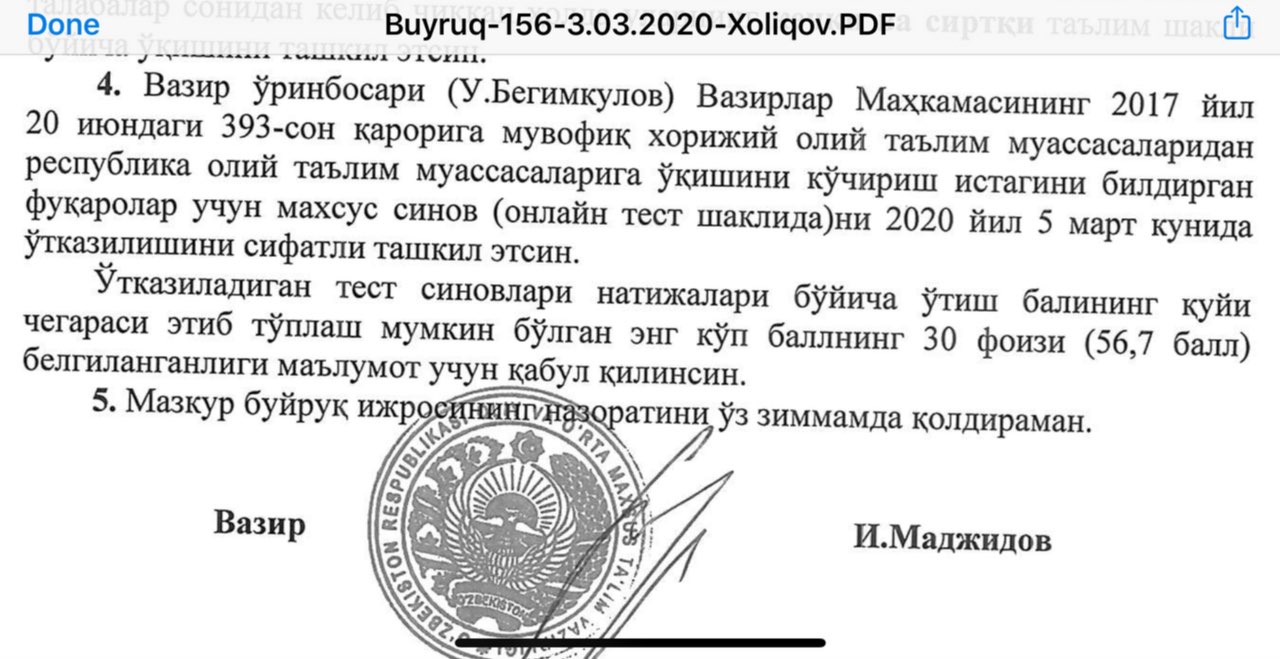
Қўшни давлатлардан ўқишини кўчираётганлар тест топширадими?
Кеча қўшни давлатлардан ўқишни кўчириш бўйича қўшимча маълумотлар берилган эди. Олий ва ўрта махсус таълим вазирининг 3 мартдаги буйруғида тест олиниши ҳақида ҳам банд борлиги кўпчиликни чалғитибди.
Аслида буйруқда қайд этилган тест жараёни қўшни давлатларга тааллуқли эмас. Бу Россия, Украина ёки қўшни бўлмаган бошқа хорижий давлатлардан баҳорги семестрда ўқишини кўчириш учун ариза берганларга тааллуқли. Олинган маълумотларга кўра, бундай ариза берганлар сони жами 11 нафарни ташкил қилади. Ушбу талабалар умумий тартибда тестдан ўтиб, етарли баллни олгачгина, ўқишини кўчириши мумкин.
Қўшни давлатлардан келаётган талабалар эса аввал хабар қилинганидек, имтиҳонсиз ўқишини кўчиради.
👉 @xushnudbek 👈
Кеча қўшни давлатлардан ўқишни кўчириш бўйича қўшимча маълумотлар берилган эди. Олий ва ўрта махсус таълим вазирининг 3 мартдаги буйруғида тест олиниши ҳақида ҳам банд борлиги кўпчиликни чалғитибди.
Аслида буйруқда қайд этилган тест жараёни қўшни давлатларга тааллуқли эмас. Бу Россия, Украина ёки қўшни бўлмаган бошқа хорижий давлатлардан баҳорги семестрда ўқишини кўчириш учун ариза берганларга тааллуқли. Олинган маълумотларга кўра, бундай ариза берганлар сони жами 11 нафарни ташкил қилади. Ушбу талабалар умумий тартибда тестдан ўтиб, етарли баллни олгачгина, ўқишини кўчириши мумкин.
Қўшни давлатлардан келаётган талабалар эса аввал хабар қилинганидек, имтиҳонсиз ўқишини кўчиради.
👉 @xushnudbek 👈
📖Dars One so'zining qo'llanishi
✳️ one olmoshi ingliz tilida otlarni oʻzini qayta takrorlamaslik uchun qoʻllaniladi. Sanaladigan otlar uchun birlikda one, koʻplikda ones shaklida qoʻllaniladi. O'zbek tiliga mazkur so'z birlikda -si, ko'plikda -lari qo'shimchasi sifatida ishlatiladi.
🔸Don't use that cloth. Use this clean one. (Anavi matoni ishlatma. Mana bu yangisini ishlat)
🔸I don't want to wear my old shoes. I want to wear my new ones. (Men eski oyoq kiyimlarimni kiyishni xohlamayman. Men yangilarini kiyishni xohlayman)
🔸Can I take this book ? No, take that one. (that one=that book)
✳️ this/that/these/those/each/another/which olmoshlari yoki orttirma darajadagi sifatdan keyin ones/one soʻzlari tushib qolishi mumkin.
🔸I don't like these sweaters. I prefer those over there. (=those ones)
🔸I tried all these numbers, and each was engaged. (=each one)
🔸The last question is the most difficult. (=the most difficult one)
✳️ Ammo one/ones soʻzlarini the/every yoki oddiy darajadagi sifatlardan keyin ishlatilishi shart.
🔸The film wasn't as good as the one we saw last week.
🔸I rang all the numbers but every one was engaged. (every one = har biri)
⚠️ everyone va every one soʻzlarini farqlay bilish lozim. everyone – hamma, barcha degan ma’nolarda faqat insonlar uchun qoʻllaniladi.
🔸Everyone is ready to begin the test.
every one – har biri(si) degan ma’noda narsalar va insonlar uchun ham qoʻllaniladi va of bilan birikmalarda kela oladi.
🔸Jack is invited to a lot of parties and he goes to every one.
🔸I have read every one of these books. (Men bu kitoblarning har birini o'qib chiqqanman)
✳️ one olmoshini yolg'iz oʻzini noaniq artikl bilan qoʻllab boʻlmaydi, uning oldida sifat boʻlishi yoki hech qanday soʻz boʻlmasligi lozim.
🔸I have been looking for a coat, but I can't find a nice one.
🔸I have been looking for a coat, but I can't find one.
✳️ one olmoshi ega oʻrnida kelib rasmiy uslubda odamlarga nisbatan qoʻllanishi mumkin. Oʻzbek tilida shaxsi noma'lum gaplar sifatida tarjima qilinadi.
🔸One cannot have 30 eggs for breakfast. (Nonushtaga 30 ta tuxum yeb boʻlmaydi)
🔸One mustn't be late for the lesson. (Darsga kech qolmaslik kerak.)
🔸One shouldn't believe what one reads in the newspapers. (Gazetada oʻqiydigan hamma narsalarga ishonavermaslik kerak)
✳️ one+payt so'zi – noaniqlikni bildirish uchun oʻtgan yoki kelasi zamonlarda ishlatilishi mumkin.
🔸One day Robin Hood met a poor peasant.
🔸One day I hope to see flying cars.
✳️ one olmoshi ingliz tilida otlarni oʻzini qayta takrorlamaslik uchun qoʻllaniladi. Sanaladigan otlar uchun birlikda one, koʻplikda ones shaklida qoʻllaniladi. O'zbek tiliga mazkur so'z birlikda -si, ko'plikda -lari qo'shimchasi sifatida ishlatiladi.
🔸Don't use that cloth. Use this clean one. (Anavi matoni ishlatma. Mana bu yangisini ishlat)
🔸I don't want to wear my old shoes. I want to wear my new ones. (Men eski oyoq kiyimlarimni kiyishni xohlamayman. Men yangilarini kiyishni xohlayman)
🔸Can I take this book ? No, take that one. (that one=that book)
✳️ this/that/these/those/each/another/which olmoshlari yoki orttirma darajadagi sifatdan keyin ones/one soʻzlari tushib qolishi mumkin.
🔸I don't like these sweaters. I prefer those over there. (=those ones)
🔸I tried all these numbers, and each was engaged. (=each one)
🔸The last question is the most difficult. (=the most difficult one)
✳️ Ammo one/ones soʻzlarini the/every yoki oddiy darajadagi sifatlardan keyin ishlatilishi shart.
🔸The film wasn't as good as the one we saw last week.
🔸I rang all the numbers but every one was engaged. (every one = har biri)
⚠️ everyone va every one soʻzlarini farqlay bilish lozim. everyone – hamma, barcha degan ma’nolarda faqat insonlar uchun qoʻllaniladi.
🔸Everyone is ready to begin the test.
every one – har biri(si) degan ma’noda narsalar va insonlar uchun ham qoʻllaniladi va of bilan birikmalarda kela oladi.
🔸Jack is invited to a lot of parties and he goes to every one.
🔸I have read every one of these books. (Men bu kitoblarning har birini o'qib chiqqanman)
✳️ one olmoshini yolg'iz oʻzini noaniq artikl bilan qoʻllab boʻlmaydi, uning oldida sifat boʻlishi yoki hech qanday soʻz boʻlmasligi lozim.
🔸I have been looking for a coat, but I can't find a nice one.
🔸I have been looking for a coat, but I can't find one.
✳️ one olmoshi ega oʻrnida kelib rasmiy uslubda odamlarga nisbatan qoʻllanishi mumkin. Oʻzbek tilida shaxsi noma'lum gaplar sifatida tarjima qilinadi.
🔸One cannot have 30 eggs for breakfast. (Nonushtaga 30 ta tuxum yeb boʻlmaydi)
🔸One mustn't be late for the lesson. (Darsga kech qolmaslik kerak.)
🔸One shouldn't believe what one reads in the newspapers. (Gazetada oʻqiydigan hamma narsalarga ishonavermaslik kerak)
✳️ one+payt so'zi – noaniqlikni bildirish uchun oʻtgan yoki kelasi zamonlarda ishlatilishi mumkin.
🔸One day Robin Hood met a poor peasant.
🔸One day I hope to see flying cars.
⚡15-MART: BARCHA ABITURIYENTLAR UCHUN TAKRORLANMAS KUN
"Pro Study" o'quv markazi Respublikamizning barcha abituriyentlarini 15-mart kuni DTM standartlari asosidagi keng qamrovli test sinovlariga taklif etadi.
Yo'nalishlar:
🖥 Iqtisod
🦾 Texnika
👥 Ijtimoiy
🧠 Tabiiy
O'zingizni DTM testlarida bo'lgani kabi his etishingiz uchun ajoyib "atmosfera"ni sizga ta'minlab beramiz! Keling, Testda qatnashing va olgan bilimlaringizni sinovdan o'tkazing!
Murojat uchun: 97 920 94 94
99 620 94 94
"Pro Study" o'quv markazi Respublikamizning barcha abituriyentlarini 15-mart kuni DTM standartlari asosidagi keng qamrovli test sinovlariga taklif etadi.
Yo'nalishlar:
🖥 Iqtisod
🦾 Texnika
👥 Ijtimoiy
🧠 Tabiiy
O'zingizni DTM testlarida bo'lgani kabi his etishingiz uchun ajoyib "atmosfera"ni sizga ta'minlab beramiz! Keling, Testda qatnashing va olgan bilimlaringizni sinovdan o'tkazing!
Murojat uchun: 97 920 94 94
99 620 94 94
Assalomu Alaykum aziz AYOLLAR, OPALAR VA SINGILJONLAR
Sizlarni 8-mart XALQARO XOTIN -QIZLAR BAYRAMI bilan jamoamiz nomidan chin qalbimizdan tabriklaymiz. Shuningdek jamoamizning barcha ayol a'zolarini tabriklaymiz.Ilohim bizni baxtimiz birinchi navbatda sog'-omon bo'ling yuzingizda tabassum arimasin bahor gullaridek ochilib yuring !!!
Sizlarni 8-mart XALQARO XOTIN -QIZLAR BAYRAMI bilan jamoamiz nomidan chin qalbimizdan tabriklaymiz. Shuningdek jamoamizning barcha ayol a'zolarini tabriklaymiz.Ilohim bizni baxtimiz birinchi navbatda sog'-omon bo'ling yuzingizda tabassum arimasin bahor gullaridek ochilib yuring !!!
Forwarded from Pro Study
⚡15-MART: BARCHA ABITURIYENTLAR UCHUN TAKRORLANMAS KUN
"Pro Study" o'quv markazi Respublikamizning barcha abituriyentlarini 15-mart kuni DTM standartlari asosidagi keng qamrovli test sinovlariga taklif etadi.
Yo'nalishlar:
🖥 Iqtisod
🦾 Texnika
👥 Ijtimoiy
🧠 Tabiiy
O'zingizni DTM testlarida bo'lgani kabi his etishingiz uchun ajoyib "atmosfera"ni sizga ta'minlab beramiz! Keling, Testda qatnashing va olgan bilimlaringizni sinovdan o'tkazing!
Murojat uchun: 97 920 94 94
99 620 94 94
"Pro Study" o'quv markazi Respublikamizning barcha abituriyentlarini 15-mart kuni DTM standartlari asosidagi keng qamrovli test sinovlariga taklif etadi.
Yo'nalishlar:
🖥 Iqtisod
🦾 Texnika
👥 Ijtimoiy
🧠 Tabiiy
O'zingizni DTM testlarida bo'lgani kabi his etishingiz uchun ajoyib "atmosfera"ni sizga ta'minlab beramiz! Keling, Testda qatnashing va olgan bilimlaringizni sinovdan o'tkazing!
Murojat uchun: 97 920 94 94
99 620 94 94
📖Dars This/that/these/those kabi ko'rsatish olmoshlarining qo'llanishi
1️⃣ this + birlikdagi ot va these + koʻplikdagi ot qurilmasida koʻrsatish olmoshlari bu, mana shu degan ma'noda yonginamizda, yaqinda turgan shaxs yoki predmetlarni koʻrsatish uchun qoʻllanadi.
🔸This book is mine. (Bu kitob meniki)
🔸These books are mine. (Bu kitoblar meniki)
2️⃣ that+birlikdagi ot va those+ koʻplikdagi ot qurilmasida koʻrsatish olmoshlari u/anavi degan ma'noda uzoqroqda, yaqinimizda boʻlmagan shaxs yoki predmetlarni koʻrsatish uchun qoʻllaniladi.
🔸A: That table is nice, isn't it? (Anavi stol yaxshi, shunday emasmi?)
➖B: But I don't like those chairs. (Lekin menga anavi kursilar yoqmayapti.)
✳️ this/that olmoshlari sanalmaydigan otlar bilan ham qoʻllanadi.
🔸The taste of this soup is bad.
🔸That water is very cold.
✳️ this olmoshi insonlarni tanishtirishda, that olmoshi insonlarni koʻrsatishda qoʻllaniladi.
🔸James, this is my friend Rita.
🔸That's Andrew over there.
✳️ Telefon suhbatida ham this/that olmoshlari qoʻllanishi mumkin.
🔸Hello. This is Laura speaking.
🔸Whoʻs this/that, please?
🔸that/those olmoshlari oldin tilga olingan otlarni qayta takrorlamaslik uchun qoʻllaniladi.
🔸The salary of teachers are higher than that of doctors. (Oʻqituvchilarning maoshi doktorlarnikiga qaraganda balandroq)
🔸The stories written by OʻHenry are as full of life as those written by M.Twain.
✅ Birinchi gapda that of so'zi salary so'zini, ikkinchi gapda those so'zi the stories so'zini qayta takrorlamaslik uchun ishlatilmoqda.
💡 Bu soʻzlar bilan keladigan odatiy iboralar:
✅ that's right/that's it - toʻgri
✅ that will do - toʻg'ri keladi, boʻladi, yetadi
✅ that won't do - toʻg'ri kelmaydi, boʻlmaydi, yetmaydi
1️⃣ this + birlikdagi ot va these + koʻplikdagi ot qurilmasida koʻrsatish olmoshlari bu, mana shu degan ma'noda yonginamizda, yaqinda turgan shaxs yoki predmetlarni koʻrsatish uchun qoʻllanadi.
🔸This book is mine. (Bu kitob meniki)
🔸These books are mine. (Bu kitoblar meniki)
2️⃣ that+birlikdagi ot va those+ koʻplikdagi ot qurilmasida koʻrsatish olmoshlari u/anavi degan ma'noda uzoqroqda, yaqinimizda boʻlmagan shaxs yoki predmetlarni koʻrsatish uchun qoʻllaniladi.
🔸A: That table is nice, isn't it? (Anavi stol yaxshi, shunday emasmi?)
➖B: But I don't like those chairs. (Lekin menga anavi kursilar yoqmayapti.)
✳️ this/that olmoshlari sanalmaydigan otlar bilan ham qoʻllanadi.
🔸The taste of this soup is bad.
🔸That water is very cold.
✳️ this olmoshi insonlarni tanishtirishda, that olmoshi insonlarni koʻrsatishda qoʻllaniladi.
🔸James, this is my friend Rita.
🔸That's Andrew over there.
✳️ Telefon suhbatida ham this/that olmoshlari qoʻllanishi mumkin.
🔸Hello. This is Laura speaking.
🔸Whoʻs this/that, please?
🔸that/those olmoshlari oldin tilga olingan otlarni qayta takrorlamaslik uchun qoʻllaniladi.
🔸The salary of teachers are higher than that of doctors. (Oʻqituvchilarning maoshi doktorlarnikiga qaraganda balandroq)
🔸The stories written by OʻHenry are as full of life as those written by M.Twain.
✅ Birinchi gapda that of so'zi salary so'zini, ikkinchi gapda those so'zi the stories so'zini qayta takrorlamaslik uchun ishlatilmoqda.
💡 Bu soʻzlar bilan keladigan odatiy iboralar:
✅ that's right/that's it - toʻgri
✅ that will do - toʻg'ri keladi, boʻladi, yetadi
✅ that won't do - toʻg'ri kelmaydi, boʻlmaydi, yetmaydi
🔰 Useful and Motivational Reading time 👌
✳️ Today's reading passage is about William Harvey (1 April 1578 – 3 June 1657) who was an English physician who made influential contributions in anatomy and physiology.
Although brilliant William Harvey became the doctor of choice for the wealthy, the nobility, and even the King of England, he never stopped giving free treatments to the poor.
It may seem hard to believe, but until William Harvey came along, even the best doctors in Europe didn’t know that your heart pumps blood around your body. The common wisdom was that blood was created by your liver, and the heart pumped air and heat through your body, along with just some of your blood!
So, you can imagine the uproar in 1628 when William Harvey published a book that explained exactly how the entire circulatory system worked, from your heart to arteries and veins. He was completely right, but his work contradicted the belief that had been around for hundreds of years. Many other doctors refused to believe Dr. Harvey, and said his theories were crazy.
William Harvey was a brilliant physician who had astonished his professors at medical school. Almost straight out of university, he was hired as chief physician at St. Bartholomew’s Hospital in London, where he provided medical treatment to the poor for free.
Harvey’s reputation grew rapidly, and he was chosen to deliver an ongoing series of public lectures to explain anatomy and medicine to the general public. Soon, wealthy people, including members of the nobility, were asking him to be their doctor. He even wound up becoming the personal physician to the King of England!
But when he published his now-famous book on the heart and blood circulation, it looked as if William Harvey might lose everything.
However, Dr. Harvey’s critics hadn’t counted on his brilliance and tenacity. He proved his theories time and again with experiments that showed how the circulation system worked, and with calculations that proved the impossibility of the theory about blood originating in the liver.
In the end, no one could argue with the powerful evidence; William Harvey had clearly made a huge advance in medical science. Not only did people finally understand how the heart really worked, they also were inspired to copy his style of provable, repeatable experiments.
While Dr. Harvey went on to great fame and fortune as the physician of kings and other rich clients, and as the man who opened the eyes of the world to the wonders of the heart, he never stopped working for the poor. Until he was an old man, he served at St. Bartholomew’s Hospital every week, giving free health care to people who could not afford to pay a doctor.
✳️10 Words to learn
✅ nobility - zodagonlar
✅ treatment – (matnda) muolaja
✅ to pump – kuch bilan aylantirmoq
✅ uproar – (matnda) shov-shuv, g’alayon
✅ circulatory system – (qon) aylanish tizimi
✅ to astonish – hayratda qoldirmoq
✅ ongoing - davomli
✅ physician – shifokor, terapevt
✅ tenacity - sabot
✅ evidence – dalil
✳️ Today's reading passage is about William Harvey (1 April 1578 – 3 June 1657) who was an English physician who made influential contributions in anatomy and physiology.
Although brilliant William Harvey became the doctor of choice for the wealthy, the nobility, and even the King of England, he never stopped giving free treatments to the poor.
It may seem hard to believe, but until William Harvey came along, even the best doctors in Europe didn’t know that your heart pumps blood around your body. The common wisdom was that blood was created by your liver, and the heart pumped air and heat through your body, along with just some of your blood!
So, you can imagine the uproar in 1628 when William Harvey published a book that explained exactly how the entire circulatory system worked, from your heart to arteries and veins. He was completely right, but his work contradicted the belief that had been around for hundreds of years. Many other doctors refused to believe Dr. Harvey, and said his theories were crazy.
William Harvey was a brilliant physician who had astonished his professors at medical school. Almost straight out of university, he was hired as chief physician at St. Bartholomew’s Hospital in London, where he provided medical treatment to the poor for free.
Harvey’s reputation grew rapidly, and he was chosen to deliver an ongoing series of public lectures to explain anatomy and medicine to the general public. Soon, wealthy people, including members of the nobility, were asking him to be their doctor. He even wound up becoming the personal physician to the King of England!
But when he published his now-famous book on the heart and blood circulation, it looked as if William Harvey might lose everything.
However, Dr. Harvey’s critics hadn’t counted on his brilliance and tenacity. He proved his theories time and again with experiments that showed how the circulation system worked, and with calculations that proved the impossibility of the theory about blood originating in the liver.
In the end, no one could argue with the powerful evidence; William Harvey had clearly made a huge advance in medical science. Not only did people finally understand how the heart really worked, they also were inspired to copy his style of provable, repeatable experiments.
While Dr. Harvey went on to great fame and fortune as the physician of kings and other rich clients, and as the man who opened the eyes of the world to the wonders of the heart, he never stopped working for the poor. Until he was an old man, he served at St. Bartholomew’s Hospital every week, giving free health care to people who could not afford to pay a doctor.
✳️10 Words to learn
✅ nobility - zodagonlar
✅ treatment – (matnda) muolaja
✅ to pump – kuch bilan aylantirmoq
✅ uproar – (matnda) shov-shuv, g’alayon
✅ circulatory system – (qon) aylanish tizimi
✅ to astonish – hayratda qoldirmoq
✅ ongoing - davomli
✅ physician – shifokor, terapevt
✅ tenacity - sabot
✅ evidence – dalil
✳️ Idiom of the day 👌
✳️ Biz muvaffaqiyatli va boy paytimizda atrofimizda bo'lgan, lekin boylik va omad ketgandan keyin yo'qolib qoladigan 'do'stlarni' ingliz tilida 'a fair-weather friend' deb nomlashadi.
🔸 The rich tend to attract fair-weather friends. (Boylar o'z atrofiga soxta do'stlar yig'ishga moyil bo'ladi)
🔸Solih is looking for a loyal friend, not a fair-weather friend. (Solih sodiq do'st qidirmoqda, soxta do'st emas)
▪️ Cambridge lug'atida mazkur iboraga 'someone who is a good friend when it is easy to be one and who stops being one when you are having problems' deb izoh berilgan.
✳️ Biz muvaffaqiyatli va boy paytimizda atrofimizda bo'lgan, lekin boylik va omad ketgandan keyin yo'qolib qoladigan 'do'stlarni' ingliz tilida 'a fair-weather friend' deb nomlashadi.
🔸 The rich tend to attract fair-weather friends. (Boylar o'z atrofiga soxta do'stlar yig'ishga moyil bo'ladi)
🔸Solih is looking for a loyal friend, not a fair-weather friend. (Solih sodiq do'st qidirmoqda, soxta do'st emas)
▪️ Cambridge lug'atida mazkur iboraga 'someone who is a good friend when it is easy to be one and who stops being one when you are having problems' deb izoh berilgan.