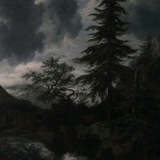
Left to right: Das Irrlicht (1862), Die Heimkehr (1887), Nymphe an einem Brunnen (1855), Im Frühling (1873) — all by Arnold Böcklin.
❤6
Honorius
Left to right: Das Irrlicht (1862), Die Heimkehr (1887), Nymphe an einem Brunnen (1855), Im Frühling (1873) — all by Arnold Böcklin.
«To combine into harmonious unity the ideal of the Antique and the longing for myth and adventure of the Renaissance has ever been the dream of the German.
Thus Greek and German have this in common, that Nature is understood and accepted by both only in the symbolized, personified, and spiritualized form of mythological creation. This is the secret of the influence of a Winkelman and of the paganism of Schiller and Goethe. The second part of Faust is the classic documentation of this dream of a marriage of Greek and German genius. And with Wagner and Goethe, Arnold Böcklin, the robust Swiss with a virile soul, shares the love of myth and the appreciation of antique beauty. The greatest of modern German painters, he is the representative of an antique-romantic Nature-mythology. An upright man, accepting life without quivering or wondering, simple and self-possessed, he adds to the most exquisite expression of the classic spirit, the titanic instinct to realize personal power. . . .
Böcklin is always constructive rather than reproductive. His landscapes are nowhere to be found in reality. They are all imaginative and even visionary. He never painted directly from nature. He carried it in his mind, heart and soul. . . . He received nature with his senses, to be sure, but then it passed through his dreams and appears in his pictures transfigured by the genius of his personality. Böcklin had the ever present sense of «our connection with the power that made things as they are.» This energy is dynamic also in and through the artist's inspiration. A work of true art is always a transfiguration of actuality, where «facts are of divine sending instead of being habitual.» Reality merely served him as a stimulus for an ideal representation of the ideal. He is never painting the material world, but his own conception and the visualization of it. And he is great and powerful enough to make it convincing to others. He looks at the world with the eyes of a Greek and the heart of a Novalis seeking the blue flower of romanticism, while his intellect is thoroughly modern. Standing before his wonderland of color and form, one is overcome by a feeling of joy and peace, a feeling that genuine art always imparts, as if the riddles of the sphinx had all been solved by the artistic interpretation of the mysteries of life and death. . . .
In the future Böcklin's name will remain linked with that of Wagner and Goethe. In painting, music and poetry these three giants revealed to their nation and to the world the life secret of the German soul: the romantic longing for mystery and adventure combined with profound sympathy for classic beauty. What William Watson sings of the sovereign poet is equally true of the sovereign painter:
The glorious riddle of his rhythmic breath,
His might, his spell, we know not what they be:
We only feel, whate'er he uttereth,
This savors not of death,
This hath a relish of eternity.»
—Louis Celestin Monin, Arnold Böcklin: The Painter of Romance.
Thus Greek and German have this in common, that Nature is understood and accepted by both only in the symbolized, personified, and spiritualized form of mythological creation. This is the secret of the influence of a Winkelman and of the paganism of Schiller and Goethe. The second part of Faust is the classic documentation of this dream of a marriage of Greek and German genius. And with Wagner and Goethe, Arnold Böcklin, the robust Swiss with a virile soul, shares the love of myth and the appreciation of antique beauty. The greatest of modern German painters, he is the representative of an antique-romantic Nature-mythology. An upright man, accepting life without quivering or wondering, simple and self-possessed, he adds to the most exquisite expression of the classic spirit, the titanic instinct to realize personal power. . . .
Böcklin is always constructive rather than reproductive. His landscapes are nowhere to be found in reality. They are all imaginative and even visionary. He never painted directly from nature. He carried it in his mind, heart and soul. . . . He received nature with his senses, to be sure, but then it passed through his dreams and appears in his pictures transfigured by the genius of his personality. Böcklin had the ever present sense of «our connection with the power that made things as they are.» This energy is dynamic also in and through the artist's inspiration. A work of true art is always a transfiguration of actuality, where «facts are of divine sending instead of being habitual.» Reality merely served him as a stimulus for an ideal representation of the ideal. He is never painting the material world, but his own conception and the visualization of it. And he is great and powerful enough to make it convincing to others. He looks at the world with the eyes of a Greek and the heart of a Novalis seeking the blue flower of romanticism, while his intellect is thoroughly modern. Standing before his wonderland of color and form, one is overcome by a feeling of joy and peace, a feeling that genuine art always imparts, as if the riddles of the sphinx had all been solved by the artistic interpretation of the mysteries of life and death. . . .
In the future Böcklin's name will remain linked with that of Wagner and Goethe. In painting, music and poetry these three giants revealed to their nation and to the world the life secret of the German soul: the romantic longing for mystery and adventure combined with profound sympathy for classic beauty. What William Watson sings of the sovereign poet is equally true of the sovereign painter:
The glorious riddle of his rhythmic breath,
His might, his spell, we know not what they be:
We only feel, whate'er he uttereth,
This savors not of death,
This hath a relish of eternity.»
—Louis Celestin Monin, Arnold Böcklin: The Painter of Romance.
❤2👍2
«لديَّ ميْلٌ إلى الدين، وتَطَلُّع صادقٌ نَصُوح إلى الكمال بين حينٍ وحين، وهما شيئان يفتقر إليهما من يلتفُّون حولي. ما من ثمرةٍ نَجْنيها إنْ ظَلَّت صُحْبَتنا مِن شَاكِلَتنا، فإنما بهذا يَستَحثُّ واحِدُنا الآخرَ في الضحالة. أن أكون مع رجال يَفْضلونني ويَفُوقونني هو توقِيَ الدائم».
—William Alger, The Solitudes of Nature and of Man (Boston, 1867), 127.
—William Alger, The Solitudes of Nature and of Man (Boston, 1867), 127.
❤12👍4
«In closing these notes upon Books, my last word, as it was my first word, is this: Read again the good old books, and do not cast them aside as stale, for ever looking for the “last thing out,” the very name of which, when it has been scampered through, will be forgotten in a week. To a reader of any brain the great books of the world are ever new; at each reading things strike us which we had never noticed, or perhaps had forgotten, or even had misunderstood. I take up again my Plato, my Shakespeare, my Gibbon, my Scott—and I say, How did I miss that, why did I forget that, did I really never read this before? . . .
As an old man, I stand by the old Books, the old Classics, the old Style.»
—Frederic Harrison, Among My Books (London: Macmillan and Co., Limited, 1912), pp. 109 and 123.
وقد يكون في روحك شيءٌ من ‹الهَرَم› فتأخذ من خِصَال ‹الهَرِم› حتى قبل أن يدرك جسدك حالَ روحِك.
As an old man, I stand by the old Books, the old Classics, the old Style.»
—Frederic Harrison, Among My Books (London: Macmillan and Co., Limited, 1912), pp. 109 and 123.
وقد يكون في روحك شيءٌ من ‹الهَرَم› فتأخذ من خِصَال ‹الهَرِم› حتى قبل أن يدرك جسدك حالَ روحِك.
❤9
«Challenged by Proudhon's thesis that each of our progresses is a victory by which we crush providential divinity, [Juan] Donoso Cortés answered with another Civitas Dei [à la Augustine's].»
الجُملة جميلة بطريقة عجيبة ومَصُوغة بأحسن ما يمكن.
As regards «superstitious», the author quotes W. Blake: «No man was ever truly superstitious who was not truly religious as far as he knew. True superstition [as distinct from hypocrisy] is ignorant honesty and this is beloved of God and man.»
*The meant Civitas Dei of Cortés' is his Ensayo sobre el Catolicismo, el Liberalismo y el Socialismo, considerados en sus Principios fundamentales (1851).
—Karl Löwith, Meaning in History (1949), 200.
الجُملة جميلة بطريقة عجيبة ومَصُوغة بأحسن ما يمكن.
As regards «superstitious», the author quotes W. Blake: «No man was ever truly superstitious who was not truly religious as far as he knew. True superstition [as distinct from hypocrisy] is ignorant honesty and this is beloved of God and man.»
*The meant Civitas Dei of Cortés' is his Ensayo sobre el Catolicismo, el Liberalismo y el Socialismo, considerados en sus Principios fundamentales (1851).
—Karl Löwith, Meaning in History (1949), 200.
❤1
https://www.youtube.com/watch?v=bpZbnUHHwvU
«Listening to Bach, one sees God come into being. His music generates divinity. After a Bach oratorio, cantata, or passion, one feels that God must be. Otherwise, Bach’s music would be only heartrending illusion. Theologians and philosophers wasted so many days and nights searching for proofs of his existence, ignoring the only valid one: Bach.»
—E. M. Cioran, Tears and Saints, tr. Ilinca Zarifopol-Johnston (Chicago: University of Chicago Press, 1995), 66.
«Listening to Bach, one sees God come into being. His music generates divinity. After a Bach oratorio, cantata, or passion, one feels that God must be. Otherwise, Bach’s music would be only heartrending illusion. Theologians and philosophers wasted so many days and nights searching for proofs of his existence, ignoring the only valid one: Bach.»
—E. M. Cioran, Tears and Saints, tr. Ilinca Zarifopol-Johnston (Chicago: University of Chicago Press, 1995), 66.
YouTube
Johann Sebastian Bach-Eduard Artemiev-Solyaris-Torkovskiy
Pieter Bruegel the Elder, Solaris (1972 film), Andrei Tarkovsky (Eduard Artemyev ), Johann Sebastian Bach. Питер Брейгель, Иоганн Себастьян Бах, Солярис(1972 фильм), Тарковский, Андрей Арсеньевич, Эдуа́рд Никола́евич Арте́мьев
❤5
“That alone was beautiful which uttered a sound in unison with the whole, and all was good which had this quality of concord. To be really beautiful was to be an integral part of the world’s symphony, to be developed fully in all parts, without an undue preference for the soul before the body or for passions before reason—to maintain the rhythm and the measure and the balance of those faculties which characterize man, nature’s masterpiece.”
—John Addington Symonds, Studies of the Greek Poets, vol. II (New York: Harper & Brothers, 1880), 380.
—John Addington Symonds, Studies of the Greek Poets, vol. II (New York: Harper & Brothers, 1880), 380.
1❤2