There are those that keep the heilicher brauch to Holle still. Those that can do more “than just eat bread”.
On the night of Hullefraasnacht the table was set for the great dame Fraa Holle and her wild troop who concluded their hunt.
Heele Holle the queen of heaven ❄️
On the night of Hullefraasnacht the table was set for the great dame Fraa Holle and her wild troop who concluded their hunt.
Heele Holle the queen of heaven ❄️
The Elder-Bush of Himmighofen
During the Thirty Years' War, soldiers marched across the country like murderous and robbing bands of marauders . Many small villages were almost completely depopulated and many an epidemic also contributed to this considerably. Many people fled into nearby forests, hoping not to be found there. When then the village Himmighofen was also beset by such soldiers, who were on the search for prey, the inhabitants also fled in the forest. Among them were two brothers who were separated by the pursuit of several soldiers as they fled in different directions. The brothers did not return when the robbers had left, but moved farther and found their way in distant areas. When they finally got homesick, they moved back to their home village and they met at the empty house of their parents. Many of the old houses no longer existed, they had been destroyed in the war, and other residents had built new houses. But the family home of the brothers looked amazingly good, it did not show signs of destruction at all. When they went in, they marveled when they saw in the kitchen a very real elder bush that stretched from the floor along the chimney to almost to the ceiling.
Then the two brothers knew that Frau Holle had held her protective hand over the house.
With great difficulty, they carefully removed the bush and planted it in a vacant spot in the garden. After just a few years, new plantlets sprang up from the ground around the bush of fallen berries and many were planted along the garden border and, of course, also close to both sides of the front door, so that Frau Holle knew that she was always welcome there.
During the Thirty Years' War, soldiers marched across the country like murderous and robbing bands of marauders . Many small villages were almost completely depopulated and many an epidemic also contributed to this considerably. Many people fled into nearby forests, hoping not to be found there. When then the village Himmighofen was also beset by such soldiers, who were on the search for prey, the inhabitants also fled in the forest. Among them were two brothers who were separated by the pursuit of several soldiers as they fled in different directions. The brothers did not return when the robbers had left, but moved farther and found their way in distant areas. When they finally got homesick, they moved back to their home village and they met at the empty house of their parents. Many of the old houses no longer existed, they had been destroyed in the war, and other residents had built new houses. But the family home of the brothers looked amazingly good, it did not show signs of destruction at all. When they went in, they marveled when they saw in the kitchen a very real elder bush that stretched from the floor along the chimney to almost to the ceiling.
Then the two brothers knew that Frau Holle had held her protective hand over the house.
With great difficulty, they carefully removed the bush and planted it in a vacant spot in the garden. After just a few years, new plantlets sprang up from the ground around the bush of fallen berries and many were planted along the garden border and, of course, also close to both sides of the front door, so that Frau Holle knew that she was always welcome there.
The Elderberry
Was ist grüner als der Klee?
Was ist weißer als der Schnee?
Was ist schwärzer als Kohl?
Bist du ein braver Jung, du errätst es wohl.
What's greener than the clover?
What's whiter than the snow?
What's blacker than cabbage?
If you're a good boy, you will guess it right.
This Riddle is ancient and was recorded among the farmers of central Germany. To these farmers the elderberry was an important plant that cured sickness and disease both of the body and soul. Much lore regarding this fine plant has been written and the plant’s relationship to mother Holle is rich.
Black Elder or Schwarzer Holunder, Holunder may perhaps be etymologically related to Holle. "Holunder" comes from Old High German holuntar, holantar, and in turn from Germanic *holana. (Holun = hollow,holy, auspicious, merciful, and'-tar' refers to a tree or shrub).
Throughout the country black elder goes by many different names that vary from region to region, these names include: Holder, Holler, Hollerbusch, Husholder, Schwarzholder and even Hollertree, although it is not a real tree. Other popular names are: Elderbaum, Keilken, Kisseke, Lilac tree and Schwitztree. The name lilac was indeed also used for the elder
before it was transferred to today's lilac (Latin: Syringa). Found in Stone Age settlements from Switzerland and northern Italy it’s proven this plant has been used by ancient man up until modern times.
The black elder grows as a gnarled bush/shrub in rough and rocky crags where little soil is available, however being a versatile shrub the plant can be found planted on either side of a doorway or at the corners of properties or homes the belief of the people was that if planted at the doorway or at the corners (both liminal spaces) the protective and healing powers of the pant wild be at its height.
“It was believed until the early 20th century - that inside the Elder a guardian spirit or a fairy lived. In heathen Prussia it was once believed that the earth god "Pusch-kaitus" lives under this bush, in Denmark it is said that the "Hyldemoer" (Elder-mother) or "Hyldequinde" (Elder-woman), who are spirit-like wood-nymphs, would have lived in the elderberry. In other areas people thought, and still think, that the elder was enspirited by the power of Frau Holle/Perchta, and every elder was a door to her subterranean realm. Woe to those who felled an elder! People were convinced that a terrible revenge would follow on that: the house of the malefactor could burn down to the ground or something else fatal could happen to the man himself.
There are even stories in which a whole family forfeited their lives through such an act.”
Goos also states : “Thus, it was no trivial matter to ridicule, pour scorn on, or to abuse the ensouled elder.
In addition, it was advisable to make small sacrifices to the bush on a regular basis - some milk, a bit of butter and especially the pouring out of a small amount of beer at the Holu-der kept the tree's soul in a good mood. This was, as was assumed in the Harz Mountain region, very important for Sunday children, who were born between eleven and twelve o'clock. Each Sunday in their hour of birth they could see in a blooming Holle-tree/ elder-berry) the spirit of that plant.
The effects of the elderberry bush were manifold. In a folk-tale , its good qualities are directly traced back to Frau Holle. Elder branches on doors and windows kept evil forces at bay and protected the inhabitants from bad diseases. If an elderberry was planted in front of the entrance of the stable, the cattle would be protected against magic, as said by farmers from the periphery of the city of Leipzig, In other areas it was customary to take a hat off when passing by an elder. Since this bush was often planted on graves, it was also considered a tree of death, and the measure of the coffin was often taken with an elderberry stick.”
” The curative effect of the elder also fits to Frau Holle.
Was ist grüner als der Klee?
Was ist weißer als der Schnee?
Was ist schwärzer als Kohl?
Bist du ein braver Jung, du errätst es wohl.
What's greener than the clover?
What's whiter than the snow?
What's blacker than cabbage?
If you're a good boy, you will guess it right.
This Riddle is ancient and was recorded among the farmers of central Germany. To these farmers the elderberry was an important plant that cured sickness and disease both of the body and soul. Much lore regarding this fine plant has been written and the plant’s relationship to mother Holle is rich.
Black Elder or Schwarzer Holunder, Holunder may perhaps be etymologically related to Holle. "Holunder" comes from Old High German holuntar, holantar, and in turn from Germanic *holana. (Holun = hollow,holy, auspicious, merciful, and'-tar' refers to a tree or shrub).
Throughout the country black elder goes by many different names that vary from region to region, these names include: Holder, Holler, Hollerbusch, Husholder, Schwarzholder and even Hollertree, although it is not a real tree. Other popular names are: Elderbaum, Keilken, Kisseke, Lilac tree and Schwitztree. The name lilac was indeed also used for the elder
before it was transferred to today's lilac (Latin: Syringa). Found in Stone Age settlements from Switzerland and northern Italy it’s proven this plant has been used by ancient man up until modern times.
The black elder grows as a gnarled bush/shrub in rough and rocky crags where little soil is available, however being a versatile shrub the plant can be found planted on either side of a doorway or at the corners of properties or homes the belief of the people was that if planted at the doorway or at the corners (both liminal spaces) the protective and healing powers of the pant wild be at its height.
“It was believed until the early 20th century - that inside the Elder a guardian spirit or a fairy lived. In heathen Prussia it was once believed that the earth god "Pusch-kaitus" lives under this bush, in Denmark it is said that the "Hyldemoer" (Elder-mother) or "Hyldequinde" (Elder-woman), who are spirit-like wood-nymphs, would have lived in the elderberry. In other areas people thought, and still think, that the elder was enspirited by the power of Frau Holle/Perchta, and every elder was a door to her subterranean realm. Woe to those who felled an elder! People were convinced that a terrible revenge would follow on that: the house of the malefactor could burn down to the ground or something else fatal could happen to the man himself.
There are even stories in which a whole family forfeited their lives through such an act.”
Goos also states : “Thus, it was no trivial matter to ridicule, pour scorn on, or to abuse the ensouled elder.
In addition, it was advisable to make small sacrifices to the bush on a regular basis - some milk, a bit of butter and especially the pouring out of a small amount of beer at the Holu-der kept the tree's soul in a good mood. This was, as was assumed in the Harz Mountain region, very important for Sunday children, who were born between eleven and twelve o'clock. Each Sunday in their hour of birth they could see in a blooming Holle-tree/ elder-berry) the spirit of that plant.
The effects of the elderberry bush were manifold. In a folk-tale , its good qualities are directly traced back to Frau Holle. Elder branches on doors and windows kept evil forces at bay and protected the inhabitants from bad diseases. If an elderberry was planted in front of the entrance of the stable, the cattle would be protected against magic, as said by farmers from the periphery of the city of Leipzig, In other areas it was customary to take a hat off when passing by an elder. Since this bush was often planted on graves, it was also considered a tree of death, and the measure of the coffin was often taken with an elderberry stick.”
” The curative effect of the elder also fits to Frau Holle.
Dried flowers, fresh fruits and air-dried bark are still used today. Purifying, sweat-inducing, laxative, urinary and soothing are cure hemomhoids, abscesses, cystitis, bronchitis, nosebleeds, gout, nicotine addiction, and insect bites or stings. The well-known and often used Findhorn herbal book calls the elder
a "true medicine cabinet"!
Certain healing or preventive effects, especially in case of cold and flu, are also confirmed by the national German Federal Health Office. Because of their proven effect, parts of the elderberry are used in both naturopathy and homeopathy, and in folk medicine elderflower remedies are still used as home remedies in abundant and versatile ways.
According to popular knowledge (folklore) of old times it would be enough to sleep one night under an elderberry to become healed of an illness, and even a stay in its shadow could bring healing. If the bathwater of a newborn child was poured under an elderberry, then this should contribute to the strengthening of the child. According to Albertus Magnus (1193-1280), downward-scraped elderberry bark acts as laxative/purgative, while upward-scraped bark caused vomiting.
The smell of many of its parts, but especially the bark, is perceived by most people as an objectionable odor, but perhaps that also contributes to a healing, because, as is sometimes said, bad-smelling and tasting drugs work faster because they point blank 'desorb' the disease. In earlier times, a love potion was prepared from its flowers and berries, a peasant rhyme from the Thuringian Forest says:
Auf Johannis blüht der Holler, da wird die Liebe noch toller!
Translated:
At Midsummer elderflowers make you pleased, cause then to love and being loved will get increased “
a "true medicine cabinet"!
Certain healing or preventive effects, especially in case of cold and flu, are also confirmed by the national German Federal Health Office. Because of their proven effect, parts of the elderberry are used in both naturopathy and homeopathy, and in folk medicine elderflower remedies are still used as home remedies in abundant and versatile ways.
According to popular knowledge (folklore) of old times it would be enough to sleep one night under an elderberry to become healed of an illness, and even a stay in its shadow could bring healing. If the bathwater of a newborn child was poured under an elderberry, then this should contribute to the strengthening of the child. According to Albertus Magnus (1193-1280), downward-scraped elderberry bark acts as laxative/purgative, while upward-scraped bark caused vomiting.
The smell of many of its parts, but especially the bark, is perceived by most people as an objectionable odor, but perhaps that also contributes to a healing, because, as is sometimes said, bad-smelling and tasting drugs work faster because they point blank 'desorb' the disease. In earlier times, a love potion was prepared from its flowers and berries, a peasant rhyme from the Thuringian Forest says:
Auf Johannis blüht der Holler, da wird die Liebe noch toller!
Translated:
At Midsummer elderflowers make you pleased, cause then to love and being loved will get increased “
Some of you might have noticed the language I use on this channel isn’t standard German but Pennsylvanisch deitsche. A distinct and regional dialect of German that was uniquely spoken in North America by the coming of multiple German ethnic groups. These groups spoke mainly the Swabian or Allemanisch dialects common in southwestern Germany and Switzerland, in the highlands and Alps or along the Rhine.
Our forefathers under the guidance of the Great Holle came to this new world and established themselves here a place their descendants can prosper, from the eastern highlands through the Appalachian mountains and into the rolling prairies of the Midwest the language of the Deitsch volk are still spoken and not only by the well known Amish but by the fancy Deitsch who preserved the brauch (custom) of the volk.
Some of the important things that make us truly “Heidisch” isn’t the reconstruction of Viking age Nordic culture and customs,the relearning of that great elder language but instead is the revitalization of our own cultures here that have been already localized and established for centuries by our own fathers through the force of arms or by some other means.
The important word here is “revitalization” which is the means of taking the worldview of the ur-heidetum, the orthopraxic practices and applying it locally to the culture we grew up in or since in modern times having become estranged are currently looking to reculturalize oneself too.
I will speak my mind on this and you are welcome to agree or not in regards however putting it frankly my forefathers have never known Norway nor Iceland and Sweden, they never spoke old Norse and never partook in the customs of these nations, not in heathen times or up until then. No, my forefathers knew the myths and folklore of their own nation and race, they knew of Berchta or Holle, of Wudon not of the Nordic Odin they knew of their own beer spirits and mill spirits that followed them to the new world as well as the wichtel and kobold.
I’m of the mind of revitalizating the local culture I already belong to by blood, by means of obligation and duty, that I have no say in such matters but instead have been appointed by my fathers before me to uphold and pass down to my son.
Thank you to a good friend for this Fraktur inscription.
Our forefathers under the guidance of the Great Holle came to this new world and established themselves here a place their descendants can prosper, from the eastern highlands through the Appalachian mountains and into the rolling prairies of the Midwest the language of the Deitsch volk are still spoken and not only by the well known Amish but by the fancy Deitsch who preserved the brauch (custom) of the volk.
Some of the important things that make us truly “Heidisch” isn’t the reconstruction of Viking age Nordic culture and customs,the relearning of that great elder language but instead is the revitalization of our own cultures here that have been already localized and established for centuries by our own fathers through the force of arms or by some other means.
The important word here is “revitalization” which is the means of taking the worldview of the ur-heidetum, the orthopraxic practices and applying it locally to the culture we grew up in or since in modern times having become estranged are currently looking to reculturalize oneself too.
I will speak my mind on this and you are welcome to agree or not in regards however putting it frankly my forefathers have never known Norway nor Iceland and Sweden, they never spoke old Norse and never partook in the customs of these nations, not in heathen times or up until then. No, my forefathers knew the myths and folklore of their own nation and race, they knew of Berchta or Holle, of Wudon not of the Nordic Odin they knew of their own beer spirits and mill spirits that followed them to the new world as well as the wichtel and kobold.
I’m of the mind of revitalizating the local culture I already belong to by blood, by means of obligation and duty, that I have no say in such matters but instead have been appointed by my fathers before me to uphold and pass down to my son.
Thank you to a good friend for this Fraktur inscription.
❤1
This folk song was recorded during the early 19th century Hesse and was reported to have been sung at the Hollenloch (Holles cave)
“ Miameide – stands on the meadow
– wearing a green skirt.
Three young maidens sit there.
One looks ahead,
the other into the wind.
The woman at the well
has many, many children.”
I believe this song is describing the world tree as this is similar to a passage in Fjölsvinnsmál :
“Mimameidir it is called,
but few men know from what roots it springs:
it by that will fall which fewest know.
Neither fire nor iron will harm it.”
“ Miameide – stands on the meadow
– wearing a green skirt.
Three young maidens sit there.
One looks ahead,
the other into the wind.
The woman at the well
has many, many children.”
I believe this song is describing the world tree as this is similar to a passage in Fjölsvinnsmál :
“Mimameidir it is called,
but few men know from what roots it springs:
it by that will fall which fewest know.
Neither fire nor iron will harm it.”
A depiction of one of the turf altars of opfermoor in Germany.
This location was believed to have been an early cult site dating from the Hallstatt period to the early medieval period with offerings as recent as the 16th century conducted by local farmers.
This location was dedicated to an earthly mother whom many believed became Holle.
Credit to Iwobrand
This location was believed to have been an early cult site dating from the Hallstatt period to the early medieval period with offerings as recent as the 16th century conducted by local farmers.
This location was dedicated to an earthly mother whom many believed became Holle.
Credit to Iwobrand
❤4
The “Keenichn auf Himmel” is not without her holy retinue of servants who carry out her will and commands, who punish those that break her laws and reward the others that uphold them.
Among these servants are the saligen/
saligenfrau (blissful ones or blissful woman) who throughout the lands of our ancestors are known by other names such as weissefrau or hollen yet all bearing the same qualities. That is; beautiful ghostly women in white with long golden hair who dwell along rivers and ponds, in caves and certain trees such as the Birch. Under the full moon they dance with such ferocity for anyone who witnesses, madness is sure to abound.
The sailgen/hollen being shy of men however are known to aid farmers in their affairs, they aid the poor and lame and likewise guide the wanderer to his destination.
In the village of Oberinnthal it is said; “In the good old days, when people were still better than they are today, and a handshake was considered of more value than an oath, Queen Hulda often showed up.
She was the queen of "Saligfrauen" and taught people to pull, spin and weave flax.”
The following tales are regards to the hollen of Hessen, Thuringian and Saxon lore:
“At the village Frischborn there is a well named the Frau-Holle-Hole, and the unsuspecting people who pass there can encounter Frau Holle, because this well is the door to her underworld realm, where, as everyone knows, are lush fields and great treasures. Frau Holle herself lives there in a magnificent castle.
Especially around midday, as the villagers of the area know, Frau Holle shows herself to the people. Her appearance can be recognized by the fact that a "Sauzahl" appears, which is a white serpentining whirlwind.
Once when a shepherd from the Lautertal was passing by, this fairy wind suddenly
At the foot of one of the blockfields, consisting of basaltic columns rises this 'ice source'
enveloped him and he heard soft beautiful
music. He was overcome by a blind fear and ran away as fast as he could. His sheep even had trouble keeping up with him. He was gone so fast that he did not even see Frau Holle anymore.
And once, as a farmer once plowed his land, such a fairy-wind suddenly came and when it solidified, two Hollen were standing there. They kindly spoke to the farmer and said, "Our kitchen is under your field, and we are in the process of baking cakes. But because of your plowing, sand is constantly falling down and soiling both the dough and the cakes that are ready. Could you please take a break so that we can bake our cakes?" The farmer thought that this request was fair and agreed. He took his horses into the shade of a tree and went back to his farmyard. When he had taken a longer break, he went back to his field, and found there an oven with fresh, wonderful smelling cake. That was the thanks of the Vogelsberg fairies.
At the village of Seibertenrod Frau Holle has also been seen. Near there is the "Wildholl" hole, which is a deep ravine, and which is one of the doors from Frau Holle's realm into the human world. You can meet her there as a woman completely dressed in white, and she has a friendly word for everyone.
And the same thing has been told at Mulstein, another village nearby.
Once, as a wanderer sat down at the Frau Holle Hole to eat his midday bread, he noticed that he had nothing left to eat in his backpack. As he sat there, hungry, a delicious scent of fresh-baked pancakes rose beside the wellspring. This smell was followed by two golden-yellow baked pancakes and these were laid down on a stone next to the hiker. After the meal, the man, strengthened, could go on his way, but he did not leave before having thanked Frau Holle.
The people of Stockhausen know that, on the new moon, the Hollen meet there at a fountain where a birch grows. There they laugh and play and dance in a circle around the birch. Frau Holle is there too, and she carries a bunch of golden keys in her hand, and she rattles them while dancing.”
Among these servants are the saligen/
saligenfrau (blissful ones or blissful woman) who throughout the lands of our ancestors are known by other names such as weissefrau or hollen yet all bearing the same qualities. That is; beautiful ghostly women in white with long golden hair who dwell along rivers and ponds, in caves and certain trees such as the Birch. Under the full moon they dance with such ferocity for anyone who witnesses, madness is sure to abound.
The sailgen/hollen being shy of men however are known to aid farmers in their affairs, they aid the poor and lame and likewise guide the wanderer to his destination.
In the village of Oberinnthal it is said; “In the good old days, when people were still better than they are today, and a handshake was considered of more value than an oath, Queen Hulda often showed up.
She was the queen of "Saligfrauen" and taught people to pull, spin and weave flax.”
The following tales are regards to the hollen of Hessen, Thuringian and Saxon lore:
“At the village Frischborn there is a well named the Frau-Holle-Hole, and the unsuspecting people who pass there can encounter Frau Holle, because this well is the door to her underworld realm, where, as everyone knows, are lush fields and great treasures. Frau Holle herself lives there in a magnificent castle.
Especially around midday, as the villagers of the area know, Frau Holle shows herself to the people. Her appearance can be recognized by the fact that a "Sauzahl" appears, which is a white serpentining whirlwind.
Once when a shepherd from the Lautertal was passing by, this fairy wind suddenly
At the foot of one of the blockfields, consisting of basaltic columns rises this 'ice source'
enveloped him and he heard soft beautiful
music. He was overcome by a blind fear and ran away as fast as he could. His sheep even had trouble keeping up with him. He was gone so fast that he did not even see Frau Holle anymore.
And once, as a farmer once plowed his land, such a fairy-wind suddenly came and when it solidified, two Hollen were standing there. They kindly spoke to the farmer and said, "Our kitchen is under your field, and we are in the process of baking cakes. But because of your plowing, sand is constantly falling down and soiling both the dough and the cakes that are ready. Could you please take a break so that we can bake our cakes?" The farmer thought that this request was fair and agreed. He took his horses into the shade of a tree and went back to his farmyard. When he had taken a longer break, he went back to his field, and found there an oven with fresh, wonderful smelling cake. That was the thanks of the Vogelsberg fairies.
At the village of Seibertenrod Frau Holle has also been seen. Near there is the "Wildholl" hole, which is a deep ravine, and which is one of the doors from Frau Holle's realm into the human world. You can meet her there as a woman completely dressed in white, and she has a friendly word for everyone.
And the same thing has been told at Mulstein, another village nearby.
Once, as a wanderer sat down at the Frau Holle Hole to eat his midday bread, he noticed that he had nothing left to eat in his backpack. As he sat there, hungry, a delicious scent of fresh-baked pancakes rose beside the wellspring. This smell was followed by two golden-yellow baked pancakes and these were laid down on a stone next to the hiker. After the meal, the man, strengthened, could go on his way, but he did not leave before having thanked Frau Holle.
The people of Stockhausen know that, on the new moon, the Hollen meet there at a fountain where a birch grows. There they laugh and play and dance in a circle around the birch. Frau Holle is there too, and she carries a bunch of golden keys in her hand, and she rattles them while dancing.”
❤5
This next tale comes from the town of Waldeck, located at the "Edersee" lake in the north of the German state of Hesse, Germany. The town was named after the no longer existing county of Waldeck, whose counts can be traced back to ca. 1100.
“ Unfortunately, in our days they have long since disappeared, but much earlier in Waldeck, more precisely, in a wooded, well-hidden valley between the villages Braunsen and Volkhardingshausen there lived a group of "Hollen". They lived there peacefully, eating only roots, berries and herbs, and they did not need money. Now, people often talked badly about the Hollen, but these were certainly friendly and did not harm people. Even, rather, on the contrary, when people needed their help, they responded by giving them gems with which to trade. They also did not shield themselves from the humans, but gave support where they could help. In particular, their efforts were aimed at young children whom they cared for and also supervised. Even after they had moved away, for a long time the Hollen remained in the memory of the people.
Times passed and a lot was built there in that region. When one day a "Holl" wanted to return to her former residence and could not find it anymore, she entered a house in the village of Twist and asked for it there. The homeowner knew the ropes, took the Holl in his arms and carried her into the "Klus", as the small valley was called.
When they approached the "Bilstein" rock, where the Hollen had lived earlier, she told the man that she now knew where to go and would like to go the last part herself, for now she knew again where she had lived many centuries ago.”
“ Unfortunately, in our days they have long since disappeared, but much earlier in Waldeck, more precisely, in a wooded, well-hidden valley between the villages Braunsen and Volkhardingshausen there lived a group of "Hollen". They lived there peacefully, eating only roots, berries and herbs, and they did not need money. Now, people often talked badly about the Hollen, but these were certainly friendly and did not harm people. Even, rather, on the contrary, when people needed their help, they responded by giving them gems with which to trade. They also did not shield themselves from the humans, but gave support where they could help. In particular, their efforts were aimed at young children whom they cared for and also supervised. Even after they had moved away, for a long time the Hollen remained in the memory of the people.
Times passed and a lot was built there in that region. When one day a "Holl" wanted to return to her former residence and could not find it anymore, she entered a house in the village of Twist and asked for it there. The homeowner knew the ropes, took the Holl in his arms and carried her into the "Klus", as the small valley was called.
When they approached the "Bilstein" rock, where the Hollen had lived earlier, she told the man that she now knew where to go and would like to go the last part herself, for now she knew again where she had lived many centuries ago.”
Perchta/Berchta masks used in seasonal processions depicting both the “hag and divine mother” accepts. These masked are common in Swabia, Switzerland and Bavaria.
🔥10🙏4
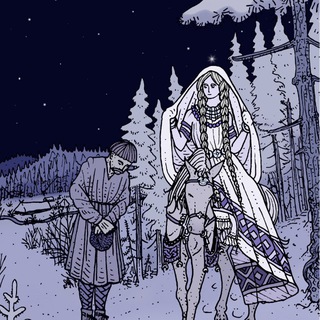
The epithet “Hold/Holda” was first documented by Burchard of worms in the 9th century “Canon Episcopi” :
"Have you believed there is some female, whom the stupid vulgar call Holda [Holdam] who is able to do a certain thing, such that those deceived by the devil affirm themselves by necessity and by command to be required to do, that is, with a crowd of demons transformed into the likeness of women, on fixed nights to be required to ride upon certain beasts, and to themselves be numbered in their company? If you have performed participation in this unbelief, you are required to do penance for one year on designated fast-days."
Here “Holdam” is used and is of note as it helps shed light on the nature of this great Teutonic Goddess and provides further evidence of her identity. Holdem like hold/holda means “generous” “lovely” “merciful”. In 1858 Dr. Adolf Helffrich had discovered a manuscript in Madrid Spain in which Friga Holdam , “ The Lovely Frigga” is mentioned.
The word Holdam can be found in several medieval manuscripts such as the Gothic Bible where Hulþs “Grace, Mercy” is mentioned in Luke 18.13 . Holda is also used to refer to a wide variety of supernatural entities throughout Teutonic peoples such as the Hulde-folk or Holden or even in reference to her own troop the Guedeholden.
Yet another title for this mighty Goddess who is known by many names.
"Have you believed there is some female, whom the stupid vulgar call Holda [Holdam] who is able to do a certain thing, such that those deceived by the devil affirm themselves by necessity and by command to be required to do, that is, with a crowd of demons transformed into the likeness of women, on fixed nights to be required to ride upon certain beasts, and to themselves be numbered in their company? If you have performed participation in this unbelief, you are required to do penance for one year on designated fast-days."
Here “Holdam” is used and is of note as it helps shed light on the nature of this great Teutonic Goddess and provides further evidence of her identity. Holdem like hold/holda means “generous” “lovely” “merciful”. In 1858 Dr. Adolf Helffrich had discovered a manuscript in Madrid Spain in which Friga Holdam , “ The Lovely Frigga” is mentioned.
The word Holdam can be found in several medieval manuscripts such as the Gothic Bible where Hulþs “Grace, Mercy” is mentioned in Luke 18.13 . Holda is also used to refer to a wide variety of supernatural entities throughout Teutonic peoples such as the Hulde-folk or Holden or even in reference to her own troop the Guedeholden.
Yet another title for this mighty Goddess who is known by many names.
⚡16❤1