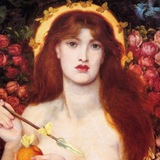
©Dante Gabriel Rossetti, Una visione di Fiammetta (the Little Flame), 1878
A sonnet by Boccaccio entitled "On his Last Sight of Fiammetta," which inspired the painting; Rossetti's translation of it, and his own poem mirroring the painting:
A sonnet by Boccaccio entitled "On his Last Sight of Fiammetta," which inspired the painting; Rossetti's translation of it, and his own poem mirroring the painting:
Behold Fiammetta, shown in Vision here.
Gloom-girt 'mid Spring-flushed apple-growth she stands;
And as she sways the branches with her hands,
Along her arm the sundered bloom falls sheer,
In separate petals shed, each like a tear;
While from the quivering bough the bird expands
His wings. And lo! thy spirit understands
Life shaken and shower'd and flown, and Death drawn near.
All stirs with change. Her garments beat the air:
The angel circling round her aureole
Shimmers in flight against the tree's grey bole:
While she, with reassuring eyes most fair,
A presage and a promise stands; as 'twere
On Death's dark storm the rainbow of the Soul.
❤🔥1
Tomas Luis De Victoria Officium hebdomanae sacrae (completo) CD1
Tomas Luis De Victoria, Officium Hebdomanae Sanctae Part 1
This magnificent office by Luis Tomas de Victoria, the interpretation of which is given here by the monks of the Santo Domingo de Silos abbey (Spain), is in my opinion the closest to the one written by this composer.
The respons and the Gospel are sung by monks of this abbey and the Escolanía of the abbey alternates with these monks. Let us remember, however, that Gregorian chant is not only an art, it is above all a prayer. Specialists in Gregorian chant immediately sense when it is monks who perform this chant and secular specialists who sing for art but whose spiritual interiority is not felt to be very present in the monks. This can be heard with the version of “Colombina” where we have the impression of hearing another work!
This service begins with the ''Pueri Hebraeorum portes ramos olivarum'' (Hebrew children carry olive branches) as an antiphon from Palm Sunday.
[ Opera ]
@Classophily
This magnificent office by Luis Tomas de Victoria, the interpretation of which is given here by the monks of the Santo Domingo de Silos abbey (Spain), is in my opinion the closest to the one written by this composer.
The respons and the Gospel are sung by monks of this abbey and the Escolanía of the abbey alternates with these monks. Let us remember, however, that Gregorian chant is not only an art, it is above all a prayer. Specialists in Gregorian chant immediately sense when it is monks who perform this chant and secular specialists who sing for art but whose spiritual interiority is not felt to be very present in the monks. This can be heard with the version of “Colombina” where we have the impression of hearing another work!
This service begins with the ''Pueri Hebraeorum portes ramos olivarum'' (Hebrew children carry olive branches) as an antiphon from Palm Sunday.
[ Opera ]
@Classophily
©Pierre-Auguste Renoir, Bouquet de printemps (Spring Bouquet), 1866, Fogg Art Museum, Harvard Art Museums, USA
For many French artists during the 1860s, the floral still life persisted as a test of pure painterly ability. This exuberant bouquet in a Japanese vase from early in Pierre-Auguste Renoir’s career attests to the artist’s engagement with past art historical traditions. Pierre-Auguste Renoir (1841—1919) addresses the ennobled Dutch practice of still life through the large scale of his canvas, while his attention to the textures and colours of the arrangement evokes the work of early eighteenth-century French painters like Antoine Watteau and François Boucher— artists he had studied as a teenager while working as a porcelain painter.
The painting also demonstrates Renoir’s development as an artist. Instead of applying the paint with a palette knife— a technique he borrowed from artists such as Courbet— Renoir adopted a freer and thinner stroke using solely a brush.
For many French artists during the 1860s, the floral still life persisted as a test of pure painterly ability. This exuberant bouquet in a Japanese vase from early in Pierre-Auguste Renoir’s career attests to the artist’s engagement with past art historical traditions. Pierre-Auguste Renoir (1841—1919) addresses the ennobled Dutch practice of still life through the large scale of his canvas, while his attention to the textures and colours of the arrangement evokes the work of early eighteenth-century French painters like Antoine Watteau and François Boucher— artists he had studied as a teenager while working as a porcelain painter.
The painting also demonstrates Renoir’s development as an artist. Instead of applying the paint with a palette knife— a technique he borrowed from artists such as Courbet— Renoir adopted a freer and thinner stroke using solely a brush.