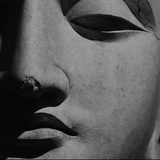
A newly unearthed round Buddha head from the Longmen Grottoes in Luoyang, Henan Province, with 38 cm high, 22 cm wide and 19 cm thick. It is estimated to be from the Tang Dynasty (7th-8th century)
❤10
Candraprabha Bodhisattva (Moonlight Bodhisattva) sculpture at Tōdai-ji, Nara.
Candraprabha is the Buddha's main interlocutor in the Candrapradīpa Sūtra (Moonlamp Sūtra). Candraprabha is associated with compassion and is recognized in mainland Asia as a deva.
Candraprabha is frequently depicted in Buddhist art, often standing gracefully on a lotus flower base with a radiant halo surrounding the figure, symbolizing purity and enlightenment
Candraprabha is the Buddha's main interlocutor in the Candrapradīpa Sūtra (Moonlamp Sūtra). Candraprabha is associated with compassion and is recognized in mainland Asia as a deva.
Candraprabha is frequently depicted in Buddhist art, often standing gracefully on a lotus flower base with a radiant halo surrounding the figure, symbolizing purity and enlightenment
❤9👍4
Kyaiktiyo Pagoda, Myanmar 🇲🇲
According to legend, the Golden Rock itself is precariously perched on a strand of Lord Buddha's hair, which prevents it from tumbling down the hill. Another legend says that it was placed by a powerful naga (serpent), a Buddha devotee.
According to legend, the Golden Rock itself is precariously perched on a strand of Lord Buddha's hair, which prevents it from tumbling down the hill. Another legend says that it was placed by a powerful naga (serpent), a Buddha devotee.
👍4❤2🥰1
Depiction of Buddha performing Twin Miracle (Yamaka-pātihāriya).
The Twin Miracle, also known as the Miracle at Savatthi, is a significant event in Buddhist tradition where the Buddha performed a miraculous display of emitting fire from the top half of his body and water from the bottom half simultaneously demonstrating his mastery over the elements. Before alternating them and expanding them to illuminate the cosmos.
The monks & laypeople are left in awe of the miraculous event!
According to the Pali version, the Buddha performed this miracle after being challenged by six rival religious teachers in the city of Savatthi.
The miracle is considered one of the Ten Indispensable Acts that all Buddhas are to perform during their lives.
The Twin Miracle, also known as the Miracle at Savatthi, is a significant event in Buddhist tradition where the Buddha performed a miraculous display of emitting fire from the top half of his body and water from the bottom half simultaneously demonstrating his mastery over the elements. Before alternating them and expanding them to illuminate the cosmos.
The monks & laypeople are left in awe of the miraculous event!
According to the Pali version, the Buddha performed this miracle after being challenged by six rival religious teachers in the city of Savatthi.
The miracle is considered one of the Ten Indispensable Acts that all Buddhas are to perform during their lives.
❤5
Psychiatrist says 'Buddhist scriptures are best remedy for modern people'
Why did a psychiatrist adopt Buddhism as the foundation of his psychological treatment?
"Buddhism is a perfect system for eliminating suffering," he said.
Jeon Hyun-soo, a psychiatrist and practitioner who has studied Buddhism for more than 40 years, believes that focusing on the present is key to overcoming life's struggles.
He recently published "A Guide to Using Buddhism" and is the founder of Buddhist psychotherapy, which integrates Buddhist principles into psychological treatment.
"The earliest Buddhist scriptures, which are closest to the words of Buddha, clearly outline ways to reduce suffering and find peace in life. For modern people suffering from distress, they serve as both a wake-up call and the best remedy."
https://www.koreatimes.co.kr/www/culture/2025/03/199_394488.html
Why did a psychiatrist adopt Buddhism as the foundation of his psychological treatment?
"Buddhism is a perfect system for eliminating suffering," he said.
Jeon Hyun-soo, a psychiatrist and practitioner who has studied Buddhism for more than 40 years, believes that focusing on the present is key to overcoming life's struggles.
He recently published "A Guide to Using Buddhism" and is the founder of Buddhist psychotherapy, which integrates Buddhist principles into psychological treatment.
"The earliest Buddhist scriptures, which are closest to the words of Buddha, clearly outline ways to reduce suffering and find peace in life. For modern people suffering from distress, they serve as both a wake-up call and the best remedy."
https://www.koreatimes.co.kr/www/culture/2025/03/199_394488.html
❤4👍2
A being who has not been your mother, your father, your brother, your sister, your son, your daughter at one time in the past is not easy to find.
Why is that? From an inconceivable beginning comes the wandering-on. A beginning point is not discernible, though beings hindered by ignorance and fettered by craving are transmigrating & wandering on.
Long have you thus experienced stress, experienced pain, experienced loss, swelling the cemeteries—enough to become disenchanted with all fabricated things, enough to become dispassionate, enough to be released.”
- Buddha, Mātu Sutta
https://www.dhammatalks.org/suttas/SN/SN15_14.html
Why is that? From an inconceivable beginning comes the wandering-on. A beginning point is not discernible, though beings hindered by ignorance and fettered by craving are transmigrating & wandering on.
Long have you thus experienced stress, experienced pain, experienced loss, swelling the cemeteries—enough to become disenchanted with all fabricated things, enough to become dispassionate, enough to be released.”
- Buddha, Mātu Sutta
https://www.dhammatalks.org/suttas/SN/SN15_14.html
❤12
Free e-Course: “Buddhism: Past, Present, and Future” by Tzu Chi Charity Foundation
Course Duration: March - December 2025.
Mode. Self-Paced
Language: English
Time engagement: around 2-5 h/week.
Deadline for enrollment: March 31
It is a self-paced online course designed to impart a core understanding of Buddhist teachings, traditions, and schools of thought, as well as their evolving cultural, social, and spiritual role in the modern world and their implications in human rights and social justice.
Each module contains approximately 18 hours of reading or video material, in addition to periodic quizzes, essay or research assignments, self-reflection assignments, and other homework.
https://global.tzuchi.org/free-e-course-buddhism-past-present-and-future
Course Duration: March - December 2025.
Mode. Self-Paced
Language: English
Time engagement: around 2-5 h/week.
Deadline for enrollment: March 31
It is a self-paced online course designed to impart a core understanding of Buddhist teachings, traditions, and schools of thought, as well as their evolving cultural, social, and spiritual role in the modern world and their implications in human rights and social justice.
Each module contains approximately 18 hours of reading or video material, in addition to periodic quizzes, essay or research assignments, self-reflection assignments, and other homework.
https://global.tzuchi.org/free-e-course-buddhism-past-present-and-future
👍3
Buddhism’s holiest site erupts in protests over Hindu ‘control’ of Maha Bodhi Temple
Protests have sprung up across India in support, including in Ladakh and Maharashtra, to call for the repeal of the Bodh Gaya Temple Act (BTA) of 1949.
Several Buddhist organisations have held rallies, from Ladakh bordering China in the north to the cities of Mumbai in the west and Mysuru in the south. Now, people are increasingly trooping to Bodh Gaya to join the main protest, said Akash Lama, general secretary of the All India Buddhist Forum (AIBF), the collective leading the campaign. India has an estimated 8.4 million Buddhist citizens, according to the country’s last census in 2011.
https://www.buddhistdoor.net/news/the-ongoing-protests-demand-greater-control-of-bodh-gaya-buddhisms-most-important-pilgrimage-site/
https://www.aljazeera.com/features/2025/3/24/buddhisms-holiest-site-erupts-in-protests-over-hindu-control-of-shrine
Protests have sprung up across India in support, including in Ladakh and Maharashtra, to call for the repeal of the Bodh Gaya Temple Act (BTA) of 1949.
Several Buddhist organisations have held rallies, from Ladakh bordering China in the north to the cities of Mumbai in the west and Mysuru in the south. Now, people are increasingly trooping to Bodh Gaya to join the main protest, said Akash Lama, general secretary of the All India Buddhist Forum (AIBF), the collective leading the campaign. India has an estimated 8.4 million Buddhist citizens, according to the country’s last census in 2011.
https://www.buddhistdoor.net/news/the-ongoing-protests-demand-greater-control-of-bodh-gaya-buddhisms-most-important-pilgrimage-site/
https://www.aljazeera.com/features/2025/3/24/buddhisms-holiest-site-erupts-in-protests-over-hindu-control-of-shrine
❤3👏3👎1