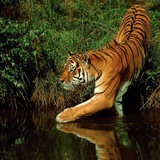
The cheetah acinonyx jubatus is the fastest animal on our planet; its speed can reach up to 130 km/h, and the cheetah accelerates to 75 km/h in less than 2 seconds. The animal needs this speed to feed itself. The cheetah belongs to the cat family - and therefore, like all cats, to the order of predators. Like all predators, the fast cheetah does not mind eating fresh meat.
It is precisely for food that he has such a huge acceleration speed, since this runner does not hunt from an ambush, he simply pursues his prey at enormous speed. The cheetah is very fast, but at the same time, it cannot maintain such speed for a long time; the maximum of such high-speed running is enough for it for two minutes. And after a run, he needs to recuperate for at least half an hour. And here it is important for him to remain unnoticed with the prey, since other predators, despite the fact that they are not so fast, are stronger and, as a rule, exceed the cheetah in size. Or they attack in a group - like hyenas, for example.
It is precisely for food that he has such a huge acceleration speed, since this runner does not hunt from an ambush, he simply pursues his prey at enormous speed. The cheetah is very fast, but at the same time, it cannot maintain such speed for a long time; the maximum of such high-speed running is enough for it for two minutes. And after a run, he needs to recuperate for at least half an hour. And here it is important for him to remain unnoticed with the prey, since other predators, despite the fact that they are not so fast, are stronger and, as a rule, exceed the cheetah in size. Or they attack in a group - like hyenas, for example.
🥰8👍5
This media is not supported in your browser
VIEW IN TELEGRAM
It turns out that rabbits can swim perfectly! 🐇
❤40😁9👍7
This media is not supported in your browser
VIEW IN TELEGRAM
Squirrels Sciurus are a genus of rodents in the squirrel family. In addition to the genus Sciurus itself, a number of representatives of the squirrel family from the genera red squirrels (Tamiasciurus), palm squirrels (Funambulus) and many others are also called squirrels. As for the genus Sciurus itself, it unites about 30 species, common in Europe, North and South America and in the temperate zone of Asia.
The genus of common squirrels is included in the tribe Sciurini along with four other genera.
It has an elongated body with a fluffy long tail, long ears, dark brown color with a white belly, sometimes gray (especially in winter). Squirrels are found everywhere except Australia.
The genus of common squirrels is included in the tribe Sciurini along with four other genera.
It has an elongated body with a fluffy long tail, long ears, dark brown color with a white belly, sometimes gray (especially in winter). Squirrels are found everywhere except Australia.
❤15👍9🥰5
Just the sight of the moose Alces alces evokes a feeling of admiration in a person. A few centuries ago, moose were worshiped, so the image of this animal is found in the sarcophagi of ancient burials, as well as in the dwellings of primitive people. Moose have always represented strength and endurance. They were often called "elk" because the shape of the elk's antlers bears some resemblance to these ancient agricultural tools.
The scientific name “elk” comes from the Old Slavonic “ols” and is associated with the red color of the fur of baby elk. Siberians simply called moose “beast.” The North American Indians were distrustful of this “beast”, so they retold the legend of the treacherous moose, but the Canadian Indians considered the moose a noble animal.
In Vyborg there is a monument to an elk who saved lost hunters at the cost of his life.
Did you know that moose are big fans of fly agarics? Interesting fact - moose droppings are used by the Swedes to produce quite valuable, environmentally friendly paper!
The scientific name “elk” comes from the Old Slavonic “ols” and is associated with the red color of the fur of baby elk. Siberians simply called moose “beast.” The North American Indians were distrustful of this “beast”, so they retold the legend of the treacherous moose, but the Canadian Indians considered the moose a noble animal.
In Vyborg there is a monument to an elk who saved lost hunters at the cost of his life.
Did you know that moose are big fans of fly agarics? Interesting fact - moose droppings are used by the Swedes to produce quite valuable, environmentally friendly paper!
❤9👍7👏1
This media is not supported in your browser
VIEW IN TELEGRAM
Teledu (hog badger) Arctonyx collaris is a unique species found in the hilly and mountainous forests of Southeast Asia. Body length up to 70 cm, weight 7-14 kg.
Although similar in size to the more familiar badgers of Europe and North America, the teledu looks completely different. In particular, it has an elongated, pig-like snout and modified teeth that point forward and are used to turn over the soil.
The pig badger is common both on the plains and in the mountains. During the day, he hides in deep burrows or other shelters. When feeding, the badger digs not only with its claws, but also with its long, movable muzzle, like a pig, which is how it earned its name. It feeds on small animals and plants.
It is listed as Vulnerable and Endangered as the species' global numbers are believed to be declining due to high levels of poaching.
Although similar in size to the more familiar badgers of Europe and North America, the teledu looks completely different. In particular, it has an elongated, pig-like snout and modified teeth that point forward and are used to turn over the soil.
The pig badger is common both on the plains and in the mountains. During the day, he hides in deep burrows or other shelters. When feeding, the badger digs not only with its claws, but also with its long, movable muzzle, like a pig, which is how it earned its name. It feeds on small animals and plants.
It is listed as Vulnerable and Endangered as the species' global numbers are believed to be declining due to high levels of poaching.
👍7❤6🥰3👏1
There are many amazing, even frightening creatures in the world. The latter include the star-nosed mole, which, if not at the top, is certainly included in the list of the most “ugly” animals on our planet. Star-nosed fish are also called star-nosed fish.
The star-nosed mole, Condylura cristata, is no ordinary mole. He not only loves to walk on the surface of the earth, but also loves to swim in the water. And the hard wool, which has a water-repellent effect, helps him in this.
The star-shaped growth on the muzzle of this animal is unique. Scientists have found that it can be called the most sensitive tactile system in the world. This organ contains more than one hundred thousand nerve endings. This figure is five times greater than the sensitivity of the human hand!
In addition, the star-shaped nose is able to perceive odors even under water. To do this, the animal releases bubbles into the water, then draws them back. According to scientists, it is these bubbles that allow the mole to smell prey in the water.
The star-nosed mole, Condylura cristata, is no ordinary mole. He not only loves to walk on the surface of the earth, but also loves to swim in the water. And the hard wool, which has a water-repellent effect, helps him in this.
The star-shaped growth on the muzzle of this animal is unique. Scientists have found that it can be called the most sensitive tactile system in the world. This organ contains more than one hundred thousand nerve endings. This figure is five times greater than the sensitivity of the human hand!
In addition, the star-shaped nose is able to perceive odors even under water. To do this, the animal releases bubbles into the water, then draws them back. According to scientists, it is these bubbles that allow the mole to smell prey in the water.
🥰6👍3
This media is not supported in your browser
VIEW IN TELEGRAM
The wild cat, Felis wiedii, looks like a toy leopard. This mustachioed predator captivates with her magnificent fur coat and bottomless, hypnotizing eyes.
The margay belongs to the subfamily of small cats and belongs to the genus Leopardus (South American cats).
The margay (or margay cat) is very similar to the ocelot, which is its closest relative. Often these cats live in the neighborhood. Their differences lie in size, body proportions and lifestyle. The ocelot is larger than the margay; it prefers terrestrial movement and hunting. The margay, although smaller, has longer legs and a tail, which gives it the opportunity to live and hunt well in the tree crown. The ocelot, margay and oncilla belong to the same genus Leopardus and are exotic inhabitants of the New World.
Female margays are slightly smaller than males. Their weight is from 2 to 3.5 kg, and the weight of males can reach 5 kg. The margay can be from 47 to 72 cm in length, not counting the tail.
The margay belongs to the subfamily of small cats and belongs to the genus Leopardus (South American cats).
The margay (or margay cat) is very similar to the ocelot, which is its closest relative. Often these cats live in the neighborhood. Their differences lie in size, body proportions and lifestyle. The ocelot is larger than the margay; it prefers terrestrial movement and hunting. The margay, although smaller, has longer legs and a tail, which gives it the opportunity to live and hunt well in the tree crown. The ocelot, margay and oncilla belong to the same genus Leopardus and are exotic inhabitants of the New World.
Female margays are slightly smaller than males. Their weight is from 2 to 3.5 kg, and the weight of males can reach 5 kg. The margay can be from 47 to 72 cm in length, not counting the tail.
❤20👍3🥰1😁1🤔1
This media is not supported in your browser
VIEW IN TELEGRAM
The bird of paradise, a regal wonder of the forests of Papua New Guinea, boasts an unusual and spectacular mating dance. The male, adorned with elaborate feathers on his head, performs an enchanting dance to attract a female.
❤22🔥3
Babyrousa is the most unusual member of the pig family. She is not at all like the pig we are used to. She has a small head, short ears, a tiny snout, an arched back and long slender legs. But the most memorable thing about her appearance is 2 pairs of large fangs, curved back. Their true purpose is still unclear. Zoologists suggest that this is just a secondary sexual characteristic of males.
The pig itself is of medium size with a body length of about 90-100 centimeters. Males are easily distinguished by their larger size and the presence of TWO pairs of fangs. The lower pair takes its usual place between the teeth of the lower jaw. But the upper one does not grow from the mouth, but sticks out right on the muzzle. In old males, their tips reach the forehead or bend 180 degrees and sometimes grow back into the skin of the snout. They reach 30-40 centimeters in length. In females, only the lower canines grow, and they are smaller in length.
This amazing pig lives in the mangrove and reed thickets of the northern part of the Indonesian island of Sulawesi.
The pig itself is of medium size with a body length of about 90-100 centimeters. Males are easily distinguished by their larger size and the presence of TWO pairs of fangs. The lower pair takes its usual place between the teeth of the lower jaw. But the upper one does not grow from the mouth, but sticks out right on the muzzle. In old males, their tips reach the forehead or bend 180 degrees and sometimes grow back into the skin of the snout. They reach 30-40 centimeters in length. In females, only the lower canines grow, and they are smaller in length.
This amazing pig lives in the mangrove and reed thickets of the northern part of the Indonesian island of Sulawesi.
❤4👍2
This media is not supported in your browser
VIEW IN TELEGRAM
The rhinoceros Rhinocerotidae is one of the iconic animals of Africa, a kind of calling card of the “Dark Continent” - it is not for nothing that it is one of the “Big Five of Africa” along with the elephant, buffalo, lion and leopard, the same five animals that in the old days were the most honorable trophies hunting safaris.
The rhinoceros has rather poor eyesight, but given its size and power, these are no longer his problems, but the problems of those around him.
But rhinoceroses’ sense of smell, on the contrary, is well developed, and it is on this that they rely most. Interestingly, the volume of the nasal cavity in rhinoceroses is larger than the volume of their brain. The hearing of these giants is also well developed; the ears of rhinoceroses are like tubes that constantly rotate, picking up even the faintest sounds.
The rhinoceros is the largest land mammal after the elephant, its length is up to 4 meters, with a height of 2 meters and a weight of up to 5 tons.
The rhinoceros has rather poor eyesight, but given its size and power, these are no longer his problems, but the problems of those around him.
But rhinoceroses’ sense of smell, on the contrary, is well developed, and it is on this that they rely most. Interestingly, the volume of the nasal cavity in rhinoceroses is larger than the volume of their brain. The hearing of these giants is also well developed; the ears of rhinoceroses are like tubes that constantly rotate, picking up even the faintest sounds.
The rhinoceros is the largest land mammal after the elephant, its length is up to 4 meters, with a height of 2 meters and a weight of up to 5 tons.
❤10👍7🔥1
Marmota bobak is one of the rather large marmots: body length up to 59 cm, tail length up to 15 cm; the weight of males that have eaten before hibernation is up to 5.7 kg.
The baybak inhabits the open spaces of Eastern Europe and Northern Kazakhstan. Now the habitat of the boibak is mosaic in nature; it has survived only where the unplowed steppe has been preserved. Living on lands occupied by vegetable and grain crops is not typical for boibak; Animals settle in such biotopes reluctantly and temporarily. They either quickly leave these crops or die.
The word “marmot” is formed using the suffix “ok” from the word “sur” borrowed from the Turkic language. The word is onomatopoeic, reminiscent of the sound made by an animal when in danger. The original Russian name is “whistle”.
In colloquial speech, the word “baibak” is used quite often. This is what they call a clumsy, baggy person, a lazy person and a sleepyhead. The long hibernation of all marmots, including boars, gave rise to the saying “sleeps like a marmot.”
The baybak inhabits the open spaces of Eastern Europe and Northern Kazakhstan. Now the habitat of the boibak is mosaic in nature; it has survived only where the unplowed steppe has been preserved. Living on lands occupied by vegetable and grain crops is not typical for boibak; Animals settle in such biotopes reluctantly and temporarily. They either quickly leave these crops or die.
The word “marmot” is formed using the suffix “ok” from the word “sur” borrowed from the Turkic language. The word is onomatopoeic, reminiscent of the sound made by an animal when in danger. The original Russian name is “whistle”.
In colloquial speech, the word “baibak” is used quite often. This is what they call a clumsy, baggy person, a lazy person and a sleepyhead. The long hibernation of all marmots, including boars, gave rise to the saying “sleeps like a marmot.”
👍11❤10🥰1
This media is not supported in your browser
VIEW IN TELEGRAM
This is power!
Elephants play a critical role in shaping the environment, particularly by uprooting trees. This behavior serves several purposes: it provides access to otherwise inaccessible foliage, branches and bark, which are important food sources, especially in times of scarcity.
In addition, by uprooting trees, elephants create open spaces, which increases habitat diversity. This is beneficial for other herbivores. Moreover, fallen trees themselves become mini-ecosystems, providing habitat and food for insects, birds and small mammals.
Thus, through this seemingly destructive action, elephants play a vital role in maintaining ecological balance, demonstrating how a keystone species can significantly influence the structure and health of their ecosystem.
Elephants play a critical role in shaping the environment, particularly by uprooting trees. This behavior serves several purposes: it provides access to otherwise inaccessible foliage, branches and bark, which are important food sources, especially in times of scarcity.
In addition, by uprooting trees, elephants create open spaces, which increases habitat diversity. This is beneficial for other herbivores. Moreover, fallen trees themselves become mini-ecosystems, providing habitat and food for insects, birds and small mammals.
Thus, through this seemingly destructive action, elephants play a vital role in maintaining ecological balance, demonstrating how a keystone species can significantly influence the structure and health of their ecosystem.
❤28👍9🔥5🤩2🥰1
Corsac Vulpes corsac is also called the steppe fox. It is believed that the name of the animal is related to the Turkic word “karsak”, which is associated with someone short, short, or short. The corsac is smaller than the arctic fox, and in appearance it is very similar to the red fox, only in reduced sizes: the body of the steppe fox rarely exceeds half a meter, and its weight does not exceed six kilograms.
The summer coat of a corsac is not at all similar to the winter one - it is rough, sparse and short. Even the tail becomes sparse and plucked. There is no longer any silveriness observed; the entire robe takes on a dirty ocher uniformity. Against the background of an unsightly summer suit, the head becomes disproportionately large, and the whole body becomes lean, distinguished by thinness and long legs.
But in winter the tail of the steppe fox is very rich, noble and magnificent. Its length can be half the body or even more, it ranges from 25 to 35 cm. When the corsac stands, its beautiful tail falls straight to the ground, touching it with its darker tip.
The summer coat of a corsac is not at all similar to the winter one - it is rough, sparse and short. Even the tail becomes sparse and plucked. There is no longer any silveriness observed; the entire robe takes on a dirty ocher uniformity. Against the background of an unsightly summer suit, the head becomes disproportionately large, and the whole body becomes lean, distinguished by thinness and long legs.
But in winter the tail of the steppe fox is very rich, noble and magnificent. Its length can be half the body or even more, it ranges from 25 to 35 cm. When the corsac stands, its beautiful tail falls straight to the ground, touching it with its darker tip.
❤18👍1🥰1
Lychee Kobus leche is a small antelope from the genus of waterbucks, its height is maximum 112 centimeters. Lychee has highly pronounced sexual dimorphism: the weight of a male can reach up to 118 kg, and a female can weigh up to 80 kg. They have practically no fat layer, since the bulk of this weight is occupied by muscles.
The horns of males can reach 92 centimeters in length; they are thin, strongly twisted and lyre-shaped. Females have no horns at all. The animal's hooves are well adapted for life in the savannah. They can easily overcome small swamps and gallop for a long time across flat terrain. Lychees do not have scent glands, but their fur, lubricated with fat, itself has an unusual odor.
Females with their offspring occupy the most humid places of the range. Males live in arid zones along the edges of the territory, at the same time protecting it - after all, they do not need water so much. Lychees are excellent swimmers. On the lower part of their legs they have special water-repellent fur, which appeared in these antelopes during the process of evolution.
The horns of males can reach 92 centimeters in length; they are thin, strongly twisted and lyre-shaped. Females have no horns at all. The animal's hooves are well adapted for life in the savannah. They can easily overcome small swamps and gallop for a long time across flat terrain. Lychees do not have scent glands, but their fur, lubricated with fat, itself has an unusual odor.
Females with their offspring occupy the most humid places of the range. Males live in arid zones along the edges of the territory, at the same time protecting it - after all, they do not need water so much. Lychees are excellent swimmers. On the lower part of their legs they have special water-repellent fur, which appeared in these antelopes during the process of evolution.
❤12🥰1