
Forwarded from American Councils for International Education
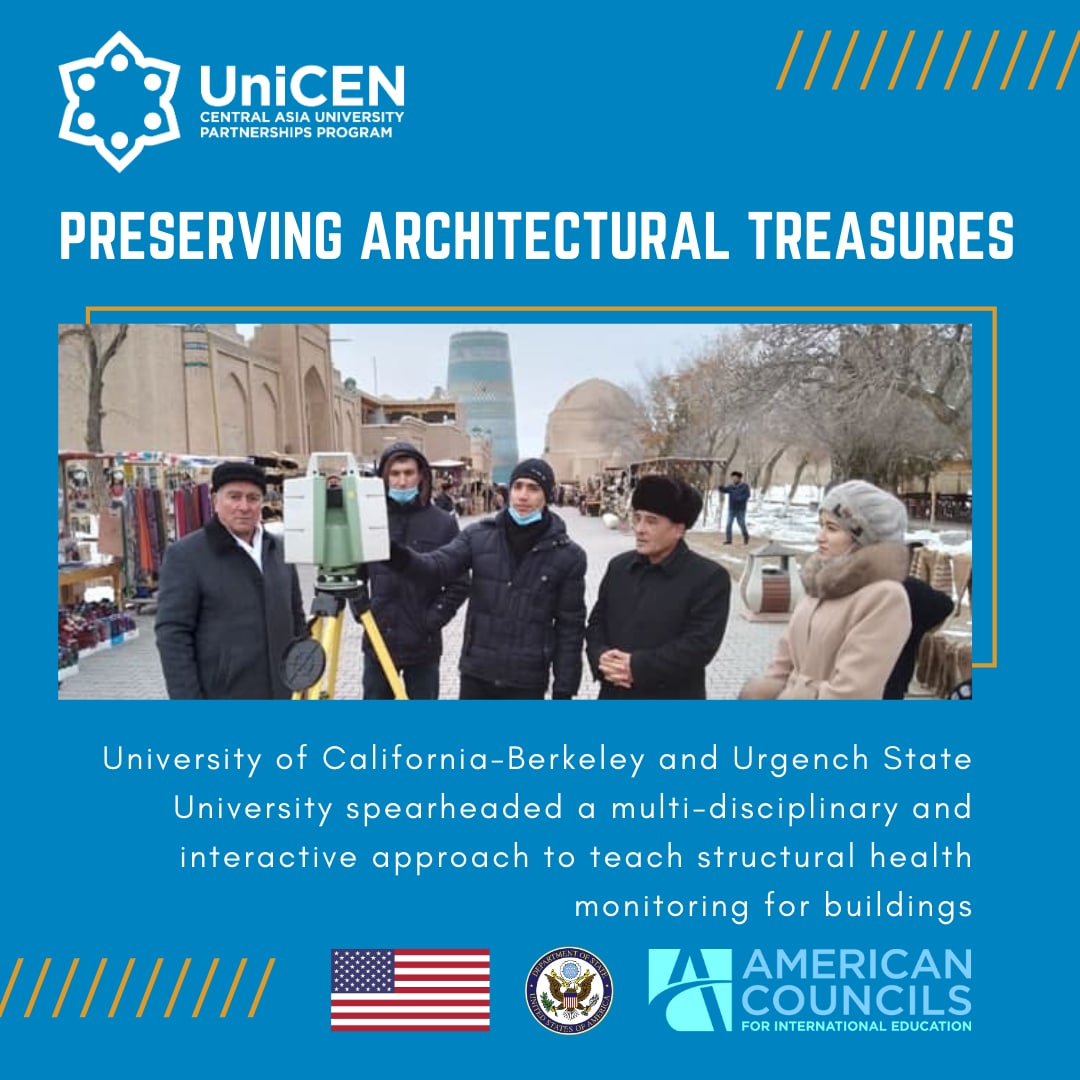
Preserving Architectural Treasures
Known for its ancient historical treasures, Uzbekistan’s tourism sector is rapidly growing as the country continues to open doors for foreign travelers. Preserving and maintaining historical landmarks is essential to ensure that future generations enjoy Uzbekistan’s architectural splendor. Through the Central Asia University Partnerships Program (UniCEN), researchers at the University of California-Berkeley and Urgench State University spearheaded a multi-disciplinary and interactive approach to teach structural health monitoring for buildings.
A team of researchers and students from University of California-Berkeley and Urgench State University selected the Juma Mosque in Ichan Kala in the historical Silk Road city of Khiva to map structural anomalies. In Fall 2020, 45 participants completed hands-on training program on laser scanning and theoretical classes conducted via Zoom to prepare them for field work. Urgench State researchers travelled to Khiva to complete the training on laser scanning at the historic site. Researchers collected and analyzed 3D data identify the most vulnerable locations of the monument.
As a next step, the team will continue hands-on training work and submit their research findings in international journals and conferences. University of California-Berkeley and Urgench State researchers plan to expand their collaboration through ongoing preparation of master's and PhD students in civil engineering.
Follow us on social media:
Instagram | Telegram | Facebook
#acglobal #internationalization #uzbekistan #ucberkeley #urgench #centralasia #globalresearch #engineeringeducation #virtualexchange #highereducation
Learn more about UniCEN: https://unicen.americancouncils.org/
Forwarded from American Councils for International Education
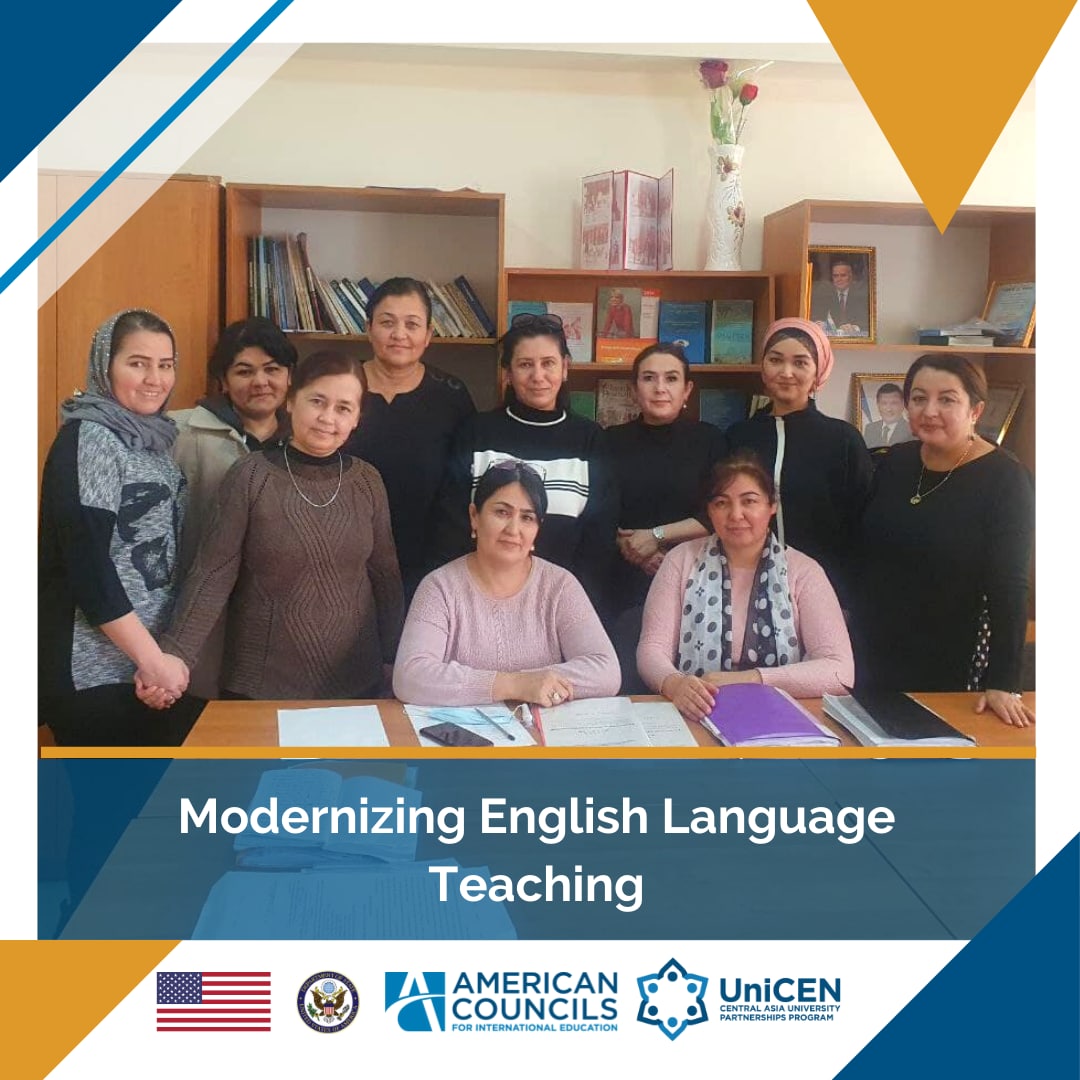
Modernizing English Language Teaching
Uzbekistan is moving forward with a policy to develop an English-speaking nation, and students demand for modernized curriculum. Through the Central Asia University Partnerships Program (UniCEN), the University of Arkansas’ Spring International Language Center and Gulistan State University are advancing teaching in English as a Foreign Language (EFL).
Working across 11 time zones, the Virtual Teacher Training Workshop for English Teachers gathered 11 EFL teachers in Gulistan to improve knowledge and ability to use current teaching methods in their classrooms. Through 35 hours of classroom instruction, Gulistan State University faculty used technology as an effective teaching tool, connected theory and practice, and applied new principles in teaching and planning. Participants gained skills in cross-cultural communications, student-centered teaching methodologies for EFL, effective planning using learning outcomes.
“The program met all my expectations because I had a great chance to communicate with a native speaker, I learned lots of techniques and methods of teaching, technology tips, facilitation skills,” says one of the Gulistan participants.
Follow us on social media:
Instagram | Telegram | Facebook
#acglobal #internationalization #uzbekistan #arkansas #gulistan #centralasia #globalresearch #TEFL #virtualexchange #highereducation
Learn more about UniCEN: https://unicen.americancouncils.org/
Forwarded from American Councils for International Education
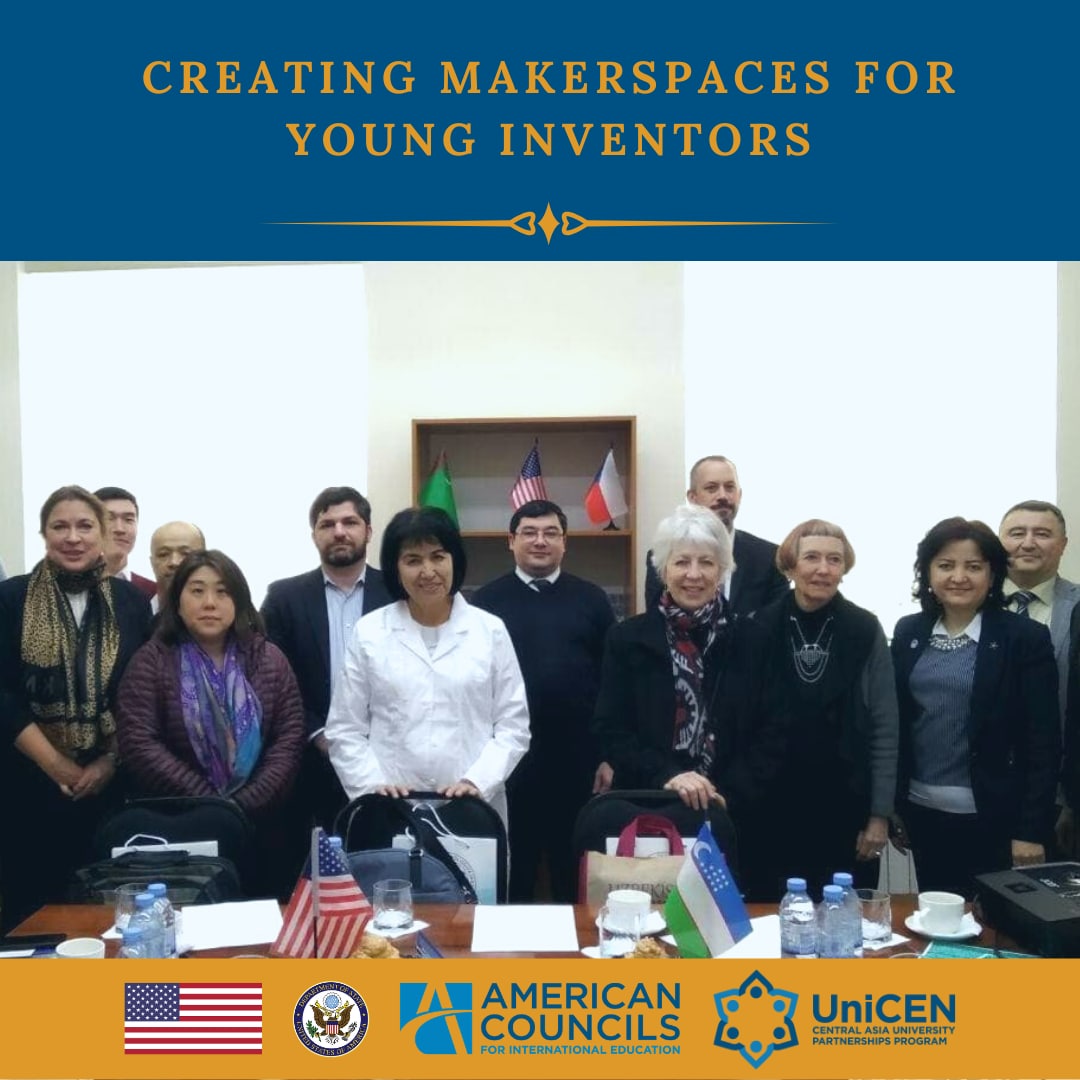
Creating Makerspaces for Young Inventors
Responding to the global COVID-19 pandemic, university-based makerspaces provide student-driven solutions for hospitals and companies. Through the Central Asia University Partnerships Program (UniCEN), faculty and administrators at the University of Wisconsin-Madison and Tashkent Chemical Technical Institute (TCTI) are establishing a new makerspace for students in science, technology, and engineering. The goal is to help prepare students build the skills of the 21st century workforce.
Dr. Lennon Rodgers, director of University of Wisconsin’s Grainger Engineering Design Innovation Lab, delivered four online workshops for staff and students at TCTI about prototyping facilities and programs in the university setting, including real-world collaboration between the university and the public and private sectors to meet global challenges.
The U.S. and Uzbek experts, along with 35 students, explored current needs to launch a makerspace at TCTI. Partners outlined a strategic plan for the development of a makerspace at TCTI, developed a mission statement, identified a lab manager and began to plan educational content. Dr. Rodgers purchased a set of electronics equipment for TCTI students and faculty to assemble and integrate. A new collaborative course on microcontrollers and electronics is planned at both institutions.
Follow us on social media:
Instagram | Telegram | Facebook
#acglobal #internationalization #uzbekistan #uwmadison #tashkentchemicaltechnicalinstitute #centralasia #globalresearch #engineeringeducation #virtualexchange #highereducation #innovation #makerspace
Learn more about UniCEN: https://unicen.americancouncils.org/
Connecting Young Social Entrepreneurs to Solve Global Challenges
Meeting UN Sustainable Development Goals requires increased international collaborations. Students at campuses around the world offer unlocked brainpower to tackle big challenges. Through the Central Asia University Partnerships Program (UniCEN), administered by American Councils for International Education and funded by the U.S. State Department through the U.S. Embassy in Tashkent, students at Lehigh University and Almaty Management University launched social entrepreneurship projects to address global grand challenges.
In early 2020, 15 students in Bethlehem, Pennsylvania and Almaty, Kazakhstan organized creative inquiry, a series of virtual dialogues to identify cross-border problems in their own communities. Guided by mentors, they discussed and shared thoughts on leadership, the importance of social impact projects, fellowships, and partnerships. By summer, students launched two social impact projects addressing air pollution and smart cities development. Working virtually, but across borders, students gained access to a series of workshops on context-appropriate design and social enterprise. Students continue to work to develop mobile apps to engage in UN sustainability actions. Meanwhile, Lehigh University’s Global Social Impact Fellowship continues to support new use-inspired research and social entrepreneurship collaborations in Almaty, Kazakhstan.
Follow us on social media:
Instagram | Telegram | Facebook
#acglobal #internationalization #kazakhstan #lehigh #almau #centralasia #globalresearch #UNsustainabledevelopmentgoals #entrepreneurship #virtualexchange #highereduction
Learn more about UniCEN: https://unicen.americancouncils.org/
Telegram
American Councils for International Education
American Councils creates opportunities that prepare individuals and institutions to succeed in an increasingly interconnected world.
Learn more:
Uzbekistan.americancouncils.org
Learn more:
Uzbekistan.americancouncils.org
Building Entrepreneurial Ecosystems
Entrepreneurship is a vehicle to accelerate economic diversification. In both the United States and Kazakhstan, universities are offering entrepreneurship opportunities for students to gain practical experience. Through the Central Asia University Partnerships Program (UniCEN), administered by American Councils for International Education and funded by the U.S. State Department through the U.S. Embassy in Tashkent, Old Dominion University in Virginia and the Innovative Eurasian University in Pavlodar are supporting entrepreneurial ecosystems around private enterprise, regional economic development, and the university.
From Norfolk, Virginia to Pavlodar, Kazakhstan the partners set out to co-create a course on international entrepreneurship. Old Dominion University (ODU) and Innovative Eurasian University (InEU) students investigated the pros and cons of marketing student-selected products and services in the international context. Working virtually in teams, students completed a brief marketing and rollout plan and presented their findings to a larger group in an online forum. Students interacted directly with like-minded entrepreneurs half-way around the world. They effectively managed the time and language differences to prepare and present their results.
Looking ahead, ODU and InEU continue to develop a textbook on improving mechanisms for supporting youth entrepreneurship in Kazakhstan, as well as share materials and documents to improve the management of InEU’s student business incubator. In the future, partners hope to sell consumer products developed by students in Pavlodar at ODU’s innovative student-run on-campus retail store in Norfolk.
Follow us on social media:
Instagram | Telegram | Facebook
#acglobal #internationalization #kazakhstan #olddominion #innovativeeurasianuniversity #centralasia #globalresearch #businesseducation #entrepreneurship #virtualexchange #highereduction
Learn more about UniCEN: https://unicen.americancouncils.org/
🇺🇿🇺🇸New dynamics of cooperation between Uzbekistan and the United States in higher education
On April 8, a meeting with the US Ambassador Extraordinary and Plenipotentiary to Uzbekistan, Mr. Daniel N. Rosenblum had been held at the Ministry of higher and secondary specialized education of Uzbekistan.
Welcoming the guest, the minister of higher and secondary specialized education A. Tashkulov noted that cooperation in the area of higher education between the two countries has been effective so far.
Collaborating on Groundwater Solutions Across Central Asia
Water management has caused severe disputes in Central Asia, due to conflicting needs and priorities between the upstream and downstream countries, thus endangering regional stability and security. Through the Central Asia University Partnerships Program (UniCEN), administered by American Councils for International Education and funded by the U.S. State Department through the U.S. Embassy in Tashkent, University of Nebraska-Lincoln and Taraz State University are building institutional capacity for sustainable groundwater in Central Asia.
In Spring 2021, researchers from University of Nebraska-Lincoln and Taraz State University gathered to discuss and provide solutions to groundwater sustainability in Central Asia, particularly in the Aral Sea region. Professors identified priority areas for collaboration: remote sensing and geographic information system (GIS) technologies for water resources management, water quality monitoring and water reuse for irrigation, and groundwater and surface water modeling.
Looking ahead, partners are planning scholar exchanges and addressing the gaps around technical and vocational education and training) program through university-industry partnerships.
Follow us on social media:
Instagram | Telegram | Facebook
#acglobal #internationalization #kazakhstan #unebraska #taraz #centralasia #globalresearch #waterresources #watermanagement #virtualexchange #highereduction
Learn more about UniCEN: https://unicen.americancouncils.org/
Telegram
American Councils for International Education
American Councils creates opportunities that prepare individuals and institutions to succeed in an increasingly interconnected world.
Learn more:
Uzbekistan.americancouncils.org
Learn more:
Uzbekistan.americancouncils.org
Introducing Green Energy Curriculum in the Heart of Eurasia
Kazakhstan's economic engine has been powered by fossil fuels, and renewable energy resources remain untapped and underutilized. Through the Central Asia University Partnerships Program (UniCEN), administered by American Councils for International Education and funded by the U.S. State Department through the U.S. Embassy in Tashkent, researchers at Michigan State University and Kazakh Agro Technical University are building capacity on renewable resources and utilization.
As a leading scientific research and education center, the Kazakh Agro Tech University (KATU) expanded its partnership activity with U.S. higher education institutions to advance training materials bioenergy curriculum, course contents, and teaching. Professors launched a 10-credit, 30-week course, “Fundamental of Technologies for Deep Processing of Raw Materials and Production of Biofuels,” which was introduced into the undergraduate program at KATU. To date, 25 students have been trained and successfully passed the second trimester examination session.
Researchers at MSU and KATU are committed to expanding their partnership through joint projects on the energy potential of biomass, renewable resource management, and agricultural resources management and utilization in Kazakhstan.
Follow us on social media:
Instagram | Telegram | Facebook
#acglobal #internationalization #kazakhstan #michiganstate #KATU #centralasia #globalresearch #renewableenergy #biofuels #virtualexchange #highereduction
Learn more about UniCEN: https://unicen.americancouncils.org/
Telegram
American Councils for International Education
American Councils creates opportunities that prepare individuals and institutions to succeed in an increasingly interconnected world.
Learn more:
Uzbekistan.americancouncils.org
Learn more:
Uzbekistan.americancouncils.org
Revamping English in STEM in the Classroom
Kazakhstan has embarked on an ambitious educational reform process to increase English skills among teachers and students by 2025. Through the U.S.-Kazakhstan University Partnerships Program administered by American Councils for International Education and funded by the U.S. Embassy in Kazakhstan, East Kazakhstan Technical University (EKTU) and University of Delaware are collaborating to improve the level of English in STEM fields.
Through University of Delaware’s English Language Institute, seventeen EKTU faculty members, doctorial students, and staff completed English language listening and speaking classes to improve their oral English proficiency, and improve teaching skills in STEM subjects in English. They learned synchronous and asynchronous online teaching pedagogies and adapted their own courses at EKTU based on experience from their U.S. partner. On May 6, EKTU hosted the certificate ceremony to recognize the achievement of participants and congratulate them with their success.
Looking ahead, the two universities plan to conduct a Science Writing Boot Camp to build and expand upon faculty's pedagogical content knowledge of their field. University of Delaware’s English Language Institute will work with EKSTU to incorporate training and theories of instruction in Second Language Acquisition for higher education.
#acglobal #internationalization #kazakhstan #UDel #EKTU #centralasia #STEM #EnglishinSTEM #virtualexchange #highereduction
Learn more about U.S.-Kazakhstan University Partnerships Program:
https://unicen.americancouncils.org/
Improving English in STEM Teaching and Curriculum
Improving the pedagogy and updating English language curriculum is a critical need for Kazakhstan’s higher education system as it continues to reform. Through the U.S.-Kazakhstan University Partnerships Program administered by American Councils for International Education and funded by the U.S. Embassy in Kazakhstan, Toraighyrov University, Pavlodar Pedagogical University, Shakarim University in Semey, and Kokshetau Abay Myrzakhmetov University and Indiana University-Purdue University-Indianapolis (IUPUI) are collaborating on modernizing curriculum and teaching skills of English department faculty members.
Starting from an exchange program and hosting a visiting scholar, IUPUI and Toraighyrov University decided to take their partnership to advanced level. The partners invited a consortium of leading English teachers from four Kazakhstani universities to deliver online modules in intercultural communication, modern instructional models, and writing techniques using cultural and linguistic comparisons.
The partner universities are looking forward to the next stages of the project to conduct in-person workshops, observe classrooms for input into teaching methods, and continue to improve pedagogy and curriculum modernization for English language.