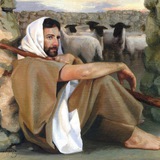
Isaiah 53:5 GNTD
[5] But because of our sins he was wounded, beaten because of the evil we did. We are healed by the punishment he suffered, made whole by the blows he received.
https://bible.com/bible/69/isa.53.5.GNTD
[5] But because of our sins he was wounded, beaten because of the evil we did. We are healed by the punishment he suffered, made whole by the blows he received.
https://bible.com/bible/69/isa.53.5.GNTD
YouVersion | The Bible App | Bible.com
Isaiah 53:5 (GNTD) - But because of our sins he was woun | YouVersion
But because of our sins he was wounded,
beaten because of the evil we did.
We are healed by the punishment he suffered,
made whole by the blows he received.
beaten because of the evil we did.
We are healed by the punishment he suffered,
made whole by the blows he received.
C. H. Spurgeon's
Evening Reading
(April 3rd)
"All we like sheep have gone astray; we have turned every one to his own way; and the Lord hath laid on Him the iniquity of us all." — Isaiah 53:6
Here a confession of sin common to all the elect people of God. They have all fallen, and therefore, in common chorus, they all say, from the first who entered heaven to the last who shall enter there, "All we like sheep have gone astray." The confession, while thus unanimous, is also special and particular: "We have turned every one to his own way." There is a peculiar sinfulness about every one of the individuals; all are sinful, but each one with some special aggravation not found in his fellow. It is the mark of genuine repentance that while it naturally associates itself with other penitents, it also takes up a position of loneliness. "We have turned every one to his own way," is a confession that each man had sinned against light peculiar to himself, or sinned with an aggravation which he could not perceive in others. This confession is unreserved; there is not a word to detract from its force, nor a syllable by way of excuse. The confession is a giving up of all pleas of self-righteousness. It is the declaration of men who are consciously guilty-guilty with aggravations, guilty without excuse: they stand with their weapons of rebellion broken in pieces, and cry, "All we like sheep have gone astray; we have turned every one to his own way." Yet we hear no dolorous wailings attending this confession of sin; for the next sentence makes it almost a song. "The Lord hath laid on Him the iniquity of us all." It is the most grievous sentence of the three, but it overflows with comfort. Strange is it that where misery was concentrated mercy reigned; where sorrow reached her climax weary souls find rest. The Saviour bruised is the healing of bruised hearts. See how the lowliest penitence gives place to assured confidence through simply gazing at Christ on the cross!
Evening Reading
(April 3rd)
"All we like sheep have gone astray; we have turned every one to his own way; and the Lord hath laid on Him the iniquity of us all." — Isaiah 53:6
Here a confession of sin common to all the elect people of God. They have all fallen, and therefore, in common chorus, they all say, from the first who entered heaven to the last who shall enter there, "All we like sheep have gone astray." The confession, while thus unanimous, is also special and particular: "We have turned every one to his own way." There is a peculiar sinfulness about every one of the individuals; all are sinful, but each one with some special aggravation not found in his fellow. It is the mark of genuine repentance that while it naturally associates itself with other penitents, it also takes up a position of loneliness. "We have turned every one to his own way," is a confession that each man had sinned against light peculiar to himself, or sinned with an aggravation which he could not perceive in others. This confession is unreserved; there is not a word to detract from its force, nor a syllable by way of excuse. The confession is a giving up of all pleas of self-righteousness. It is the declaration of men who are consciously guilty-guilty with aggravations, guilty without excuse: they stand with their weapons of rebellion broken in pieces, and cry, "All we like sheep have gone astray; we have turned every one to his own way." Yet we hear no dolorous wailings attending this confession of sin; for the next sentence makes it almost a song. "The Lord hath laid on Him the iniquity of us all." It is the most grievous sentence of the three, but it overflows with comfort. Strange is it that where misery was concentrated mercy reigned; where sorrow reached her climax weary souls find rest. The Saviour bruised is the healing of bruised hearts. See how the lowliest penitence gives place to assured confidence through simply gazing at Christ on the cross!
C. H. Spurgeon's
Morning Reading
(April 4th)
"For He hath made Him to be sin for us, who knew no sin; that we might be made the righteousness of God in Him." — 2 Corinthians 5:21
Mourning Christian! why weepest thou? Art thou mourning over thine own corruptions? Look to thy perfect Lord, and remember, thou art complete in Him; thou art in God's sight as perfect as if thou hadst never sinned; nay, more than that, the Lord our Righteousness hath put a divine garment upon thee, so that thou hast more than the righteousness of man—thou hast the righteousness of God. O Thou who art mourning by reason of inbred sin and depravity, remember, none of thy sins can condemn thee. Thou hast learned to hate sin; but thou hast learned also to know that sin is not thine—it was laid upon Christ's head. Thy standing is not in thyself—it is in Christ; thine acceptance is not in thyself, but in thy Lord; thou art as much accepted of God today, with all thy sinfulness, as thou wilt be when thou standest before His throne, free from all corruption. O, I beseech thee, lay hold on this precious thought, perfection in Christ! For thou art "complete in Him." With thy Saviour's garment on, thou art holy as the Holy one. "Who is he that condemneth? It is Christ that died, yea rather, that is risen again, who is even at the right hand of God, who also maketh intercession for us." Christian, let thy heart rejoice, for thou art "accepted in the beloved"—what hast thou to fear? Let thy face ever wear a smile; live near thy Master; live in the suburbs of the Celestial City; for soon, when thy time has come, thou shalt rise up where thy Jesus sits, and reign at His right hand; and all this because the divine Lord "was made to be sin for us, who knew no sin; that we might be made the righteousness of God in Him."
Morning Reading
(April 4th)
"For He hath made Him to be sin for us, who knew no sin; that we might be made the righteousness of God in Him." — 2 Corinthians 5:21
Mourning Christian! why weepest thou? Art thou mourning over thine own corruptions? Look to thy perfect Lord, and remember, thou art complete in Him; thou art in God's sight as perfect as if thou hadst never sinned; nay, more than that, the Lord our Righteousness hath put a divine garment upon thee, so that thou hast more than the righteousness of man—thou hast the righteousness of God. O Thou who art mourning by reason of inbred sin and depravity, remember, none of thy sins can condemn thee. Thou hast learned to hate sin; but thou hast learned also to know that sin is not thine—it was laid upon Christ's head. Thy standing is not in thyself—it is in Christ; thine acceptance is not in thyself, but in thy Lord; thou art as much accepted of God today, with all thy sinfulness, as thou wilt be when thou standest before His throne, free from all corruption. O, I beseech thee, lay hold on this precious thought, perfection in Christ! For thou art "complete in Him." With thy Saviour's garment on, thou art holy as the Holy one. "Who is he that condemneth? It is Christ that died, yea rather, that is risen again, who is even at the right hand of God, who also maketh intercession for us." Christian, let thy heart rejoice, for thou art "accepted in the beloved"—what hast thou to fear? Let thy face ever wear a smile; live near thy Master; live in the suburbs of the Celestial City; for soon, when thy time has come, thou shalt rise up where thy Jesus sits, and reign at His right hand; and all this because the divine Lord "was made to be sin for us, who knew no sin; that we might be made the righteousness of God in Him."
🔥2
1 John 3:16 GNTD
[16] This is how we know what love is: Christ gave his life for us. We too, then, ought to give our lives for others!
https://bible.com/bible/69/1jn.3.16.GNTD
[16] This is how we know what love is: Christ gave his life for us. We too, then, ought to give our lives for others!
https://bible.com/bible/69/1jn.3.16.GNTD
YouVersion | The Bible App | Bible.com
1 John 3:16 (GNTD) - This is how we know what love is: C | YouVersion
This is how we know what love is: Christ gave his life for us. We too, then, ought to give our lives for others!
C. H. Spurgeon's
Evening Reading
(April 4th)
"Come ye, and let us go up to the mountain of the Lord." — Isaiah 2:3
It is exceedingly beneficial to our souls to mount above this present evil world to something nobler and better. The cares of this world and the deceitfulness of riches are apt to choke everything good within us, and we grow fretful, desponding, perhaps proud and carnal. It is well for us to cut down these thorns and briers, for heavenly seed sown among them is not likely to yield a harvest; and where shall we find a better sickle with which to cut them down than communion with God and the things of the kingdom? In the valleys of Switzerland many of the inhabitants are deformed, and all wear a sickly appearance, for the atmosphere is charged with miasma, and is close and stagnant; but up yonder, on the mountain, you find a hardy race, who breathe the clear fresh air as it blows from the virgin snows of the Alpine summits. It would be well if the dwellers in the valley could frequently leave their abodes among the marshes and the fever mists, and inhale the bracing element upon the hills. It is to such an exploit of climbing that I invite you this evening. May the Spirit of God assist us to leave the mists of fear and the fevers of anxiety, and all the ills which gather in this valley of earth, and to ascend the mountains of anticipated joy and blessedness. May God the Holy Spirit cut the cords that keep us here below, and assist us to mount! We sit too often like chained eagles fastened to the rock, only that, unlike the eagle, we begin to love our chain, and would, perhaps, if it came really to the test, be loath to have it snapped. May God now grant us grace, if we cannot escape from the chain as to our flesh, yet to do so as to our spirits; and leaving the body, like a servant, at the foot of the hill, may our soul, like Abraham, attain the top of the mountain, there to indulge in communion with the Most High.
Evening Reading
(April 4th)
"Come ye, and let us go up to the mountain of the Lord." — Isaiah 2:3
It is exceedingly beneficial to our souls to mount above this present evil world to something nobler and better. The cares of this world and the deceitfulness of riches are apt to choke everything good within us, and we grow fretful, desponding, perhaps proud and carnal. It is well for us to cut down these thorns and briers, for heavenly seed sown among them is not likely to yield a harvest; and where shall we find a better sickle with which to cut them down than communion with God and the things of the kingdom? In the valleys of Switzerland many of the inhabitants are deformed, and all wear a sickly appearance, for the atmosphere is charged with miasma, and is close and stagnant; but up yonder, on the mountain, you find a hardy race, who breathe the clear fresh air as it blows from the virgin snows of the Alpine summits. It would be well if the dwellers in the valley could frequently leave their abodes among the marshes and the fever mists, and inhale the bracing element upon the hills. It is to such an exploit of climbing that I invite you this evening. May the Spirit of God assist us to leave the mists of fear and the fevers of anxiety, and all the ills which gather in this valley of earth, and to ascend the mountains of anticipated joy and blessedness. May God the Holy Spirit cut the cords that keep us here below, and assist us to mount! We sit too often like chained eagles fastened to the rock, only that, unlike the eagle, we begin to love our chain, and would, perhaps, if it came really to the test, be loath to have it snapped. May God now grant us grace, if we cannot escape from the chain as to our flesh, yet to do so as to our spirits; and leaving the body, like a servant, at the foot of the hill, may our soul, like Abraham, attain the top of the mountain, there to indulge in communion with the Most High.
C. H. Spurgeon's
Morning Reading
(April 5th)
"On him they laid the cross, that he might bear it after Jesus." — Luke 23:26
We see in Simon's carrying the cross a picture of the work of the Church throughout all generations; she is the cross-bearer after Jesus. Mark then, Christian, Jesus does not suffer so as to exclude your suffering. He bears a cross, not that you may escape it, but that you may endure it. Christ exempts you from sin, but not from sorrow. Remember that, and expect to suffer.
But let us comfort ourselves with this thought, that in our case, as in Simon's, it is not our cross, but Christ's cross which we carry. When you are molested for your piety; when your religion brings the trial of cruel mockings upon you, then remember it is not your cross, it is Christ's cross; and how delightful is it to carry the cross of our Lord Jesus!
You carry the cross after Him. You have blessed company; your path is marked with the footprints of your Lord. The mark of His blood-red shoulder is upon that heavy burden. 'Tis His cross, and He goes before you as a shepherd goes before his sheep. Take up your cross daily, and follow Him.
Do not forget, also, that you bear this cross in partnership. It is the opinion of some that Simon only carried one end of the cross, and not the whole of it. That is very possible; Christ may have carried the heavier part, against the transverse beam, and Simon may have borne the lighter end. Certainly it is so with you; you do but carry the light end of the cross, Christ bore the heavier end.
And remember, though Simon had to bear the cross for a very little while, it gave him lasting honour. Even so the cross we carry is only for a little while at most, and then we shall receive the crown, the glory. Surely we should love the cross, and, instead of shrinking from it, count it very dear, when it works out for us "a far more exceeding and eternal weight of glory."
Morning Reading
(April 5th)
"On him they laid the cross, that he might bear it after Jesus." — Luke 23:26
We see in Simon's carrying the cross a picture of the work of the Church throughout all generations; she is the cross-bearer after Jesus. Mark then, Christian, Jesus does not suffer so as to exclude your suffering. He bears a cross, not that you may escape it, but that you may endure it. Christ exempts you from sin, but not from sorrow. Remember that, and expect to suffer.
But let us comfort ourselves with this thought, that in our case, as in Simon's, it is not our cross, but Christ's cross which we carry. When you are molested for your piety; when your religion brings the trial of cruel mockings upon you, then remember it is not your cross, it is Christ's cross; and how delightful is it to carry the cross of our Lord Jesus!
You carry the cross after Him. You have blessed company; your path is marked with the footprints of your Lord. The mark of His blood-red shoulder is upon that heavy burden. 'Tis His cross, and He goes before you as a shepherd goes before his sheep. Take up your cross daily, and follow Him.
Do not forget, also, that you bear this cross in partnership. It is the opinion of some that Simon only carried one end of the cross, and not the whole of it. That is very possible; Christ may have carried the heavier part, against the transverse beam, and Simon may have borne the lighter end. Certainly it is so with you; you do but carry the light end of the cross, Christ bore the heavier end.
And remember, though Simon had to bear the cross for a very little while, it gave him lasting honour. Even so the cross we carry is only for a little while at most, and then we shall receive the crown, the glory. Surely we should love the cross, and, instead of shrinking from it, count it very dear, when it works out for us "a far more exceeding and eternal weight of glory."
Matthew 28:6 GNTD
[6] He is not here; he has been raised, just as he said. Come here and see the place where he was lying.
https://bible.com/bible/69/mat.28.6.GNTD
[6] He is not here; he has been raised, just as he said. Come here and see the place where he was lying.
https://bible.com/bible/69/mat.28.6.GNTD
YouVersion | The Bible App | Bible.com
Matthew 28:6 (GNTD) - He is not here; he has been raised, | YouVersion
He is not here; he has been raised, just as he said. Come here and see the place where he was lying.
❤🔥1
Psalm 70:4 KJV
[4] Let all those that seek thee rejoice and be glad in thee: And let such as love thy salvation say continually, let God be magnified.
https://bible.com/bible/1/psa.70.4.KJV
[4] Let all those that seek thee rejoice and be glad in thee: And let such as love thy salvation say continually, let God be magnified.
https://bible.com/bible/1/psa.70.4.KJV
🔥1
C. H. Spurgeon's
Evening Reading
(April 5th)
"Before honour is humility." — Proverbs 15:33
Humiliation of soul always brings a positive blessing with it. If we empty our hearts of self God will fill them with His love. He who desires close communion with Christ should remember the word of the Lord, "To this man will I look, even to him that is poor and of a contrite spirit, and trembleth at My word." Stoop if you would climb to heaven. Do we not say of Jesus, "He descended that He might ascend"? so must you. You must grow downwards, that you may grow upwards; for the sweetest fellowship with heaven is to be had by humble souls, and by them alone. God will deny no blessing to a thoroughly humbled spirit. "Blessed are the poor in spirit: for theirs is the kingdom of heaven," with all its riches and treasures. The whole exchequer of God shall be made over by deed of gift to the soul which is humble enough to be able to receive it without growing proud because of it. God blesses us all up to the full measure and extremity of what it is safe for Him to do. If you do not get a blessing, it is because it is not safe for you to have one. If our heavenly Father were to let your unhumbled spirit win a victory in His holy war, you would pilfer the crown for yourself, and meeting with a fresh enemy you would fall a victim; so that you are kept low for your own safety. When a man is sincerely humble, and never ventures to touch so much as a grain of the praise, there is scarcely any limit to what God will do for him. Humility makes us ready to be blessed by the God of all grace, and fits us to deal efficiently with our fellow men. True humility is a flower which will adorn any garden. This is a sauce with which you may season every dish of life, and you will find an improvement in every case. Whether it be prayer or praise, whether it be work or suffering, the genuine salt of humility cannot be used in excess.
Evening Reading
(April 5th)
"Before honour is humility." — Proverbs 15:33
Humiliation of soul always brings a positive blessing with it. If we empty our hearts of self God will fill them with His love. He who desires close communion with Christ should remember the word of the Lord, "To this man will I look, even to him that is poor and of a contrite spirit, and trembleth at My word." Stoop if you would climb to heaven. Do we not say of Jesus, "He descended that He might ascend"? so must you. You must grow downwards, that you may grow upwards; for the sweetest fellowship with heaven is to be had by humble souls, and by them alone. God will deny no blessing to a thoroughly humbled spirit. "Blessed are the poor in spirit: for theirs is the kingdom of heaven," with all its riches and treasures. The whole exchequer of God shall be made over by deed of gift to the soul which is humble enough to be able to receive it without growing proud because of it. God blesses us all up to the full measure and extremity of what it is safe for Him to do. If you do not get a blessing, it is because it is not safe for you to have one. If our heavenly Father were to let your unhumbled spirit win a victory in His holy war, you would pilfer the crown for yourself, and meeting with a fresh enemy you would fall a victim; so that you are kept low for your own safety. When a man is sincerely humble, and never ventures to touch so much as a grain of the praise, there is scarcely any limit to what God will do for him. Humility makes us ready to be blessed by the God of all grace, and fits us to deal efficiently with our fellow men. True humility is a flower which will adorn any garden. This is a sauce with which you may season every dish of life, and you will find an improvement in every case. Whether it be prayer or praise, whether it be work or suffering, the genuine salt of humility cannot be used in excess.
❤1
C. H. Spurgeon's
Morning Reading
(April 6th)
"Let us go forth therefore unto Him without the camp." — Hebrews 13:13
Jesus, bearing His cross, went forth to suffer without the gate. The Christian's reason for leaving the camp of the world's sin and religion is not because he loves to be singular, but because Jesus did so; and the disciple must follow his Master. Christ was "not of the world:" His life and His testimony were a constant protest against conformity with the world. Never was such overflowing affection for men as you find in Him; but still He was separate from sinners. In like manner Christ's people must "go forth unto Him." They must take their position "without the camp," as witness-bearers for the truth. They must be prepared to tread the straight and narrow path. They must have bold, unflinching, lion-like hearts, loving Christ first, and His truth next, and Christ and His truth beyond all the world. Jesus would have His people "go forth without the camp" for their own sanctification. You cannot grow in grace to any high degree while you are conformed to the world. The life of separation may be a path of sorrow, but it is the highway of safety; and though the separated life may cost you many pangs, and make every day a battle, yet it is a happy life after all. No joy can excel that of the soldier of Christ: Jesus reveals Himself so graciously, and gives such sweet refreshment, that the warrior feels more calm and peace in his daily strife than others in their hours of rest. The highway of holiness is the highway of communion. It is thus we shall hope to win the crown if we are enabled by divine grace faithfully to follow Christ "without the camp." The crown of glory will follow the cross of separation. A moment's shame will be well recompensed by eternal honour; a little while of witness-bearing will seem nothing when we are "for ever with the Lord."
Morning Reading
(April 6th)
"Let us go forth therefore unto Him without the camp." — Hebrews 13:13
Jesus, bearing His cross, went forth to suffer without the gate. The Christian's reason for leaving the camp of the world's sin and religion is not because he loves to be singular, but because Jesus did so; and the disciple must follow his Master. Christ was "not of the world:" His life and His testimony were a constant protest against conformity with the world. Never was such overflowing affection for men as you find in Him; but still He was separate from sinners. In like manner Christ's people must "go forth unto Him." They must take their position "without the camp," as witness-bearers for the truth. They must be prepared to tread the straight and narrow path. They must have bold, unflinching, lion-like hearts, loving Christ first, and His truth next, and Christ and His truth beyond all the world. Jesus would have His people "go forth without the camp" for their own sanctification. You cannot grow in grace to any high degree while you are conformed to the world. The life of separation may be a path of sorrow, but it is the highway of safety; and though the separated life may cost you many pangs, and make every day a battle, yet it is a happy life after all. No joy can excel that of the soldier of Christ: Jesus reveals Himself so graciously, and gives such sweet refreshment, that the warrior feels more calm and peace in his daily strife than others in their hours of rest. The highway of holiness is the highway of communion. It is thus we shall hope to win the crown if we are enabled by divine grace faithfully to follow Christ "without the camp." The crown of glory will follow the cross of separation. A moment's shame will be well recompensed by eternal honour; a little while of witness-bearing will seem nothing when we are "for ever with the Lord."
❤1
Matthew 28:19 KJV
[19] Go ye therefore, and teach all nations, baptizing them in the name of the Father, and of the Son, and of the Holy Ghost:
https://bible.com/bible/1/mat.28.19.KJV
[19] Go ye therefore, and teach all nations, baptizing them in the name of the Father, and of the Son, and of the Holy Ghost:
https://bible.com/bible/1/mat.28.19.KJV
YouVersion | The Bible App | Bible.com
Matthew 28:19 (KJV) - Go ye therefore, and teach all nati | YouVersion
Go ye therefore, and teach all nations, baptizing them in the name of the Father, and of the Son, and of the Holy Ghost
"You contribute nothing to your salvation except the sin that made it necessary."
Jonathan Edwards
Jonathan Edwards
❤2
C. H. Spurgeon's
Evening Reading
(April 6th)
"In the name of the Lord I will destroy them." — Psalm 118:12
Our Lord Jesus, by His death, did not purchase a right to a part of us only, but to the entire man. He contemplated in His passion the sanctification of us wholly, spirit, soul, and body; that in this triple kingdom He Himself might reign supreme without a rival. It is the business of the newborn nature which God has given to the regenerate to assert the rights of the Lord Jesus Christ. My soul, so far as thou art a child of God, thou must conquer all the rest of thyself which yet remains unblest; thou must subdue all thy powers and passions to the silver sceptre of Jesus' gracious reign, and thou must never be satisfied till He who is King by purchase becomes also King by gracious coronation, and reigns in thee supreme. Seeing, then, that sin has no right to any part of us, we go about a good and lawful warfare when we seek, in the name of God, to drive it out. O my body, thou art a member of Christ: shall I tolerate thy subjection to the prince of darkness? O my soul, Christ has suffered for thy sins, and redeemed thee with His most precious blood: shall I suffer thy memory to become a storehouse of evil, or thy passions to be firebrands of iniquity? Shall I surrender my judgment to be perverted by error, or my will to be led in fetters of iniquity? No, my soul, thou art Christ's, and sin hath no right to thee.
Be courageous concerning this, O Christian! be not dispirited, as though your spiritual enemies could never be destroyed. You are able to overcome them-not in your own strength-the weakest of them would be too much for you in that; but you can and shall overcome them through the blood of the Lamb. Do not ask, "How shall I dispossess them, for they are greater and mightier than I?" but go to the strong for strength, wait humbly upon God, and the mighty God of Jacob will surely come to the rescue, and you shall sing of victory through His grace.
Evening Reading
(April 6th)
"In the name of the Lord I will destroy them." — Psalm 118:12
Our Lord Jesus, by His death, did not purchase a right to a part of us only, but to the entire man. He contemplated in His passion the sanctification of us wholly, spirit, soul, and body; that in this triple kingdom He Himself might reign supreme without a rival. It is the business of the newborn nature which God has given to the regenerate to assert the rights of the Lord Jesus Christ. My soul, so far as thou art a child of God, thou must conquer all the rest of thyself which yet remains unblest; thou must subdue all thy powers and passions to the silver sceptre of Jesus' gracious reign, and thou must never be satisfied till He who is King by purchase becomes also King by gracious coronation, and reigns in thee supreme. Seeing, then, that sin has no right to any part of us, we go about a good and lawful warfare when we seek, in the name of God, to drive it out. O my body, thou art a member of Christ: shall I tolerate thy subjection to the prince of darkness? O my soul, Christ has suffered for thy sins, and redeemed thee with His most precious blood: shall I suffer thy memory to become a storehouse of evil, or thy passions to be firebrands of iniquity? Shall I surrender my judgment to be perverted by error, or my will to be led in fetters of iniquity? No, my soul, thou art Christ's, and sin hath no right to thee.
Be courageous concerning this, O Christian! be not dispirited, as though your spiritual enemies could never be destroyed. You are able to overcome them-not in your own strength-the weakest of them would be too much for you in that; but you can and shall overcome them through the blood of the Lamb. Do not ask, "How shall I dispossess them, for they are greater and mightier than I?" but go to the strong for strength, wait humbly upon God, and the mighty God of Jacob will surely come to the rescue, and you shall sing of victory through His grace.
C. H. Spurgeon's
Morning Reading
(April 7th)
"O ye sons of men, how long will ye turn my glory into shame?" — Psalm 4:2
An instructive writer has made a mournful list of the honours which the blinded people of Israel awarded to their long-expected King.
(1.) They gave Him a procession of honour, in which Roman legionaries, Jewish priests, men and women, took a part, He Himself bearing His cross. This is the triumph which the world awards to Him who comes to overthrow man's direst foes. Derisive shouts are His only acclamations, and cruel taunts His only paeans of praise.
(2.) They presented Him with the wine of honour. Instead of a golden cup of generous wine they offered Him the criminal's stupefying death-draught, which He refused because He would preserve an uninjured taste wherewith to taste of death; and afterwards when He cried, "I thirst," they gave Him vinegar mixed with gall, thrust to His mouth upon a sponge. Oh! wretched, detestable inhospitality to the King's Son.
(3.) He was provided with a guard of honour, who showed their esteem of Him by gambling over His garments, which they had seized as their booty. Such was the body-guard of the adored of heaven; a quaternion of brutal gamblers.
(4.) A throne of honour was found for Him upon the bloody tree; no easier place of rest would rebel men yield to their liege Lord. The cross was, in fact, the full expression of the world's feeling towards Him; "There," they seemed to say, "Thou Son of God, this is the manner in which God Himself should be treated, could we reach Him."
(5.) The title of honour was nominally "King of the Jews," but that the blinded nation distinctly repudiated, and really called Him "King of thieves," by preferring Barabbas, and by placing Jesus in the place of highest shame between two thieves. His glory was thus in all things turned into shame by the sons of men, but it shall yet gladden the eyes of saints and angels, world without end.
Morning Reading
(April 7th)
"O ye sons of men, how long will ye turn my glory into shame?" — Psalm 4:2
An instructive writer has made a mournful list of the honours which the blinded people of Israel awarded to their long-expected King.
(1.) They gave Him a procession of honour, in which Roman legionaries, Jewish priests, men and women, took a part, He Himself bearing His cross. This is the triumph which the world awards to Him who comes to overthrow man's direst foes. Derisive shouts are His only acclamations, and cruel taunts His only paeans of praise.
(2.) They presented Him with the wine of honour. Instead of a golden cup of generous wine they offered Him the criminal's stupefying death-draught, which He refused because He would preserve an uninjured taste wherewith to taste of death; and afterwards when He cried, "I thirst," they gave Him vinegar mixed with gall, thrust to His mouth upon a sponge. Oh! wretched, detestable inhospitality to the King's Son.
(3.) He was provided with a guard of honour, who showed their esteem of Him by gambling over His garments, which they had seized as their booty. Such was the body-guard of the adored of heaven; a quaternion of brutal gamblers.
(4.) A throne of honour was found for Him upon the bloody tree; no easier place of rest would rebel men yield to their liege Lord. The cross was, in fact, the full expression of the world's feeling towards Him; "There," they seemed to say, "Thou Son of God, this is the manner in which God Himself should be treated, could we reach Him."
(5.) The title of honour was nominally "King of the Jews," but that the blinded nation distinctly repudiated, and really called Him "King of thieves," by preferring Barabbas, and by placing Jesus in the place of highest shame between two thieves. His glory was thus in all things turned into shame by the sons of men, but it shall yet gladden the eyes of saints and angels, world without end.
John 5:24 KJV
[24] Verily, verily, I say unto you, He that heareth my word, and believeth on him that sent me, hath everlasting life, and shall not come into condemnation; but is passed from death unto life.
https://bible.com/bible/1/jhn.5.24.KJV
[24] Verily, verily, I say unto you, He that heareth my word, and believeth on him that sent me, hath everlasting life, and shall not come into condemnation; but is passed from death unto life.
https://bible.com/bible/1/jhn.5.24.KJV
YouVersion | The Bible App | Bible.com
John 5:24 (KJV) - Verily, verily, I say unto you, He | YouVersion
Verily, verily, I say unto you, He that heareth my word, and believeth on him that sent me, hath everlasting life, and shall not come into condemnation; but is passed from death unto life.
🔥1