Forwarded from Hammer and Vajra
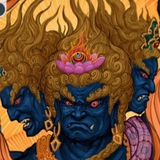
Vidyārāja
In Sanskrit vidyā (wisdom) implies esoteric Wisdom. and rāja means king. These Wisdom Kings are the direct wrathful representations of primordial Buddhas (primarily Mahāvairocana Buddha). They are the destroyers of hindrances and bring forth faith through fear, violence, and the embracement of the impermanence of death. They destroy the demonic but also enslave and use it for Tantra. They function as Iṣṭha-devatā (Tibetan Yidam) for meditation, sadhana (Sadhu) and are the devotional deities (Deva) who serve as the guru showing the devotee the way of the dharma through tantric extremes. In Japanese Buddhism, there are primarily 5 of them corresponding with 4 cardinal directions and the center. There is also an 8 form variant of the eight directions. Similar to the "Chaos" symbol or the Slavic Kolovrat. In Tibetan Buddhism, they are represented by the Heruka and represent śūnyatā (emptiness), bodhicitta (The Enlightened mind) and ultimately non-duality. Often they represent an enlightened variant of a Vedic deva. Within the primary 5 Wisdom Kings, a form or aspect of Rudra-Shiva can be seen with Acalanātha being the center/primary/leader who most represents an enlightened form of Rudra-Shiva as well as Mañjuśrī. The compassionate (non-wrathful form of Shiva) is often shown within Avalokiteśvara (The lord who looks down from above). They are worshipped through meditation upon their dharmic attributes and mantra prayers as well as Fire ritual (Homa/Goma) and libations.
Hammer and Vajra
In Sanskrit vidyā (wisdom) implies esoteric Wisdom. and rāja means king. These Wisdom Kings are the direct wrathful representations of primordial Buddhas (primarily Mahāvairocana Buddha). They are the destroyers of hindrances and bring forth faith through fear, violence, and the embracement of the impermanence of death. They destroy the demonic but also enslave and use it for Tantra. They function as Iṣṭha-devatā (Tibetan Yidam) for meditation, sadhana (Sadhu) and are the devotional deities (Deva) who serve as the guru showing the devotee the way of the dharma through tantric extremes. In Japanese Buddhism, there are primarily 5 of them corresponding with 4 cardinal directions and the center. There is also an 8 form variant of the eight directions. Similar to the "Chaos" symbol or the Slavic Kolovrat. In Tibetan Buddhism, they are represented by the Heruka and represent śūnyatā (emptiness), bodhicitta (The Enlightened mind) and ultimately non-duality. Often they represent an enlightened variant of a Vedic deva. Within the primary 5 Wisdom Kings, a form or aspect of Rudra-Shiva can be seen with Acalanātha being the center/primary/leader who most represents an enlightened form of Rudra-Shiva as well as Mañjuśrī. The compassionate (non-wrathful form of Shiva) is often shown within Avalokiteśvara (The lord who looks down from above). They are worshipped through meditation upon their dharmic attributes and mantra prayers as well as Fire ritual (Homa/Goma) and libations.
Hammer and Vajra
🔥4⚡1
Forwarded from Hammer and Vajra
Just picked up a new jacket.
Hand sewn depicting Āryācalanātha Vidyārāja (大日大聖不動明王).
🙏🏼 🔥📿🔥⚡️⚡️
Hand sewn depicting Āryācalanātha Vidyārāja (大日大聖不動明王).
🙏🏼 🔥📿🔥⚡️⚡️
🔥8
Forwarded from Hammer and Vajra
Have you completely read any of the following?
(Multiple answers are ok)
(Multiple answers are ok)
Anonymous Poll
52%
Poetic Edda
46%
Bhagavad Gita
15%
Rig Veda
44%
Bible
14%
Quran
17%
Corpus Hermeticum
32%
Plato's Republic
14%
Theogony
43%
Works of Homer (Odyssey/Iliad)
14%
Tibetan Book of the Dead
Forwarded from Vajrarastra
One of the pivotal moments for our spiritual path was acquiring a deep understanding of the tantric worldview.
When we thought we had grasped a good enough level of comprehension of the Hīnayāna and Mahāyāna, the cosmology, theology, metaphysics, and even some heavy hitting topics like Yogācāra philosophy, along came the esoteric aspects of doctrines revealed by our Gurus, and our whole notions got shattered to pieces by a vajra-mace, as it's natural for tantra to do. The Trikāya was probably the most influential of the bunch.
Prince Siddhārtha was not some random noble who opted out of his obligations with the excuse of spirituality, he was, quite literally, the earthly emanation of the inconceivable essence of reality without boundaries or limits, the Dharmakāya.
It's almost embarrassing when we reflect about this in retrospective: The mother of the Bodhisattva, Queen Maya, had a dream, or more accurately, a vision, in which a white elephant (symbol of divine royalty, see the Airavata elephant of Indra) with six white tusks entered her right side, marking the conception of Siddhārtha. Ten months later he emerged from his mother’s side, as she stood leaning against a tree, in a painless and pure birth. With his body completely formed, he took seven steps while lotus flowers sprang up in his footsteps and pointing to the earth and sky declared himself as the worthy one. The ascetic Asita, a quasi-Magi figure, analyzed the child and found in him the thirty-two marks of greatness.
Of course this wasn't "just a normal guy" like pseudo-Buddhist love to say! He was the Nirmāṇakāya incarnation of the Ādibuddha, the Bhagavān Vajradhara. The divine son of the [limitless as the] Sky Father, who, out of compassion, guides the noble beings into his mandala!
Needless to say, our religious views changed forever.
When we thought we had grasped a good enough level of comprehension of the Hīnayāna and Mahāyāna, the cosmology, theology, metaphysics, and even some heavy hitting topics like Yogācāra philosophy, along came the esoteric aspects of doctrines revealed by our Gurus, and our whole notions got shattered to pieces by a vajra-mace, as it's natural for tantra to do. The Trikāya was probably the most influential of the bunch.
Prince Siddhārtha was not some random noble who opted out of his obligations with the excuse of spirituality, he was, quite literally, the earthly emanation of the inconceivable essence of reality without boundaries or limits, the Dharmakāya.
It's almost embarrassing when we reflect about this in retrospective: The mother of the Bodhisattva, Queen Maya, had a dream, or more accurately, a vision, in which a white elephant (symbol of divine royalty, see the Airavata elephant of Indra) with six white tusks entered her right side, marking the conception of Siddhārtha. Ten months later he emerged from his mother’s side, as she stood leaning against a tree, in a painless and pure birth. With his body completely formed, he took seven steps while lotus flowers sprang up in his footsteps and pointing to the earth and sky declared himself as the worthy one. The ascetic Asita, a quasi-Magi figure, analyzed the child and found in him the thirty-two marks of greatness.
Of course this wasn't "just a normal guy" like pseudo-Buddhist love to say! He was the Nirmāṇakāya incarnation of the Ādibuddha, the Bhagavān Vajradhara. The divine son of the [limitless as the] Sky Father, who, out of compassion, guides the noble beings into his mandala!
Needless to say, our religious views changed forever.
❤5👍1🤔1
Forwarded from Vajrarastra
"Buddhadharma is so abundant, it's so rich, vast and deep, and if you insist that meditation is sitting on a cushion, you're making it so limited".
~ Dzongsar Khyentse Rinpoche, Meditation: Introduction to Buddhism
In Buddhist sources, the word bhāvanā (lit. cultivation) is used to describe those activities that lead to the development of meditative absorption.
Spiritual cultivation (bhāvanā) is the third of the three grounds for meritorious actions, alongside generosity (dāna) and ethical behaviour (sīla).
Contrary to the popular idea of meditation as simply sitting and observing the breath, bhāvanā delineates a wide array of activities: Praying, making offerings, ritual, studying scripture, debating, chanting, etc, it's all considered within the realm of spiritual cultivation.
~ Dzongsar Khyentse Rinpoche, Meditation: Introduction to Buddhism
In Buddhist sources, the word bhāvanā (lit. cultivation) is used to describe those activities that lead to the development of meditative absorption.
Spiritual cultivation (bhāvanā) is the third of the three grounds for meritorious actions, alongside generosity (dāna) and ethical behaviour (sīla).
Contrary to the popular idea of meditation as simply sitting and observing the breath, bhāvanā delineates a wide array of activities: Praying, making offerings, ritual, studying scripture, debating, chanting, etc, it's all considered within the realm of spiritual cultivation.
🔥3👍1
Forwarded from Vajrarastra
The Four-line Exercise Dedication Prayer
May this training be conductive,
To realize the unsurpassable state of Buddhahood,
And, having done so through my effort,
May I establish all beings into that very state.
May this training be conductive,
To realize the unsurpassable state of Buddhahood,
And, having done so through my effort,
May I establish all beings into that very state.