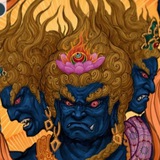
This anime's opening is extremely esoteric Buddhist-themed. Song is called Vajra Om. https://www.youtube.com/watch?v=F79FsmWJqeY
YouTube
ZENKI OPENING
LUNES DE VIDEOS ESPERO Y LES GUSTE :)
⚡3
Forwarded from Hammer and Vajra
I know how some people (myself included) feel regarding AI artwork. I'm not sure what the seed/prompt for these images were, however, the hauntingly impressive pictures of souls passing from people and into the greater as they are on their death bed, were too breathtaking to not share.
❤8
Baron von Ungern Mahakala
https://youtube.com/watch?v=0qh0vU9xpVE&si=if5K0A-CoxlBdSPU
https://youtube.com/watch?v=0qh0vU9xpVE&si=if5K0A-CoxlBdSPU
YouTube
Baron von Ungern Mahakala
The Dalai Lama of Tibet, the Great 13th, named the White Russian Baron Roman von Ungern-Sternberg, liberator of the Bogd Khan of Mongolia, an incarnation of Mahakala; the wrathful protecting deity in Tibetan Buddhism. He is a protector of dharma, known also…
👍2
Myanmar (Burma) is primarily a Theravada Buddhist country.
However, The Weizza path is an esoteric system of occult practices (such as recitation of spells, samatha and alchemy) believed to lead to life as a weizza (Burmese: ဝိဇ္ဇာ Pali: vijjā), a semi-immortal and supernatural being who awaits the appearance of the future Buddha, Maitreya (Arimeitaya).
In many ways this takes on a Tantric form with worship of the Nats (local Gods) and Saints.
Vijjā is a Pali word meaning wisdom.
In Sanskrit one will see this word as Vidya.
Interestedly enough, the worship of Nat and Maitreya is similar to how Vidyaraja (Wisdom) Kings are worshipped like Yidam in Vajrayana.
A Weizza path almost has an Aghori / Shugenjya like approach to it.
Weizzas are divided into four major orders:
• The Pyada Weizza, who work with mercury
• The Than Weizza, who work with iron
• The Se Weizza, who specializes in medicine
• The In Weizza, who specialize in yantra signs and squares
Temple of the Immovable
However, The Weizza path is an esoteric system of occult practices (such as recitation of spells, samatha and alchemy) believed to lead to life as a weizza (Burmese: ဝိဇ္ဇာ Pali: vijjā), a semi-immortal and supernatural being who awaits the appearance of the future Buddha, Maitreya (Arimeitaya).
In many ways this takes on a Tantric form with worship of the Nats (local Gods) and Saints.
Vijjā is a Pali word meaning wisdom.
In Sanskrit one will see this word as Vidya.
Interestedly enough, the worship of Nat and Maitreya is similar to how Vidyaraja (Wisdom) Kings are worshipped like Yidam in Vajrayana.
A Weizza path almost has an Aghori / Shugenjya like approach to it.
Weizzas are divided into four major orders:
• The Pyada Weizza, who work with mercury
• The Than Weizza, who work with iron
• The Se Weizza, who specializes in medicine
• The In Weizza, who specialize in yantra signs and squares
Temple of the Immovable
🔥6
Forwarded from Vajrarastra
Courtesy of Eran ud Turan
Painting from the Buddhist temple of Kalai Kafirnigan, northern Tokharistan / Bactria (in southern Tajikistan), 7th - 8th Century. Photographed at National museum of Tajikistan last spring.
Painting from the Buddhist temple of Kalai Kafirnigan, northern Tokharistan / Bactria (in southern Tajikistan), 7th - 8th Century. Photographed at National museum of Tajikistan last spring.
🔥5
Forwarded from Hammer and Vajra
Vidyārāja
In Sanskrit vidyā (wisdom) implies esoteric Wisdom. and rāja means king. These Wisdom Kings are the direct wrathful representations of primordial Buddhas (primarily Mahāvairocana Buddha). They are the destroyers of hindrances and bring forth faith through fear, violence, and the embracement of the impermanence of death. They destroy the demonic but also enslave and use it for Tantra. They function as Iṣṭha-devatā (Tibetan Yidam) for meditation, sadhana (Sadhu) and are the devotional deities (Deva) who serve as the guru showing the devotee the way of the dharma through tantric extremes. In Japanese Buddhism, there are primarily 5 of them corresponding with 4 cardinal directions and the center. There is also an 8 form variant of the eight directions. Similar to the "Chaos" symbol or the Slavic Kolovrat. In Tibetan Buddhism, they are represented by the Heruka and represent śūnyatā (emptiness), bodhicitta (The Enlightened mind) and ultimately non-duality. Often they represent an enlightened variant of a Vedic deva. Within the primary 5 Wisdom Kings, a form or aspect of Rudra-Shiva can be seen with Acalanātha being the center/primary/leader who most represents an enlightened form of Rudra-Shiva as well as Mañjuśrī. The compassionate (non-wrathful form of Shiva) is often shown within Avalokiteśvara (The lord who looks down from above). They are worshipped through meditation upon their dharmic attributes and mantra prayers as well as Fire ritual (Homa/Goma) and libations.
Hammer and Vajra
In Sanskrit vidyā (wisdom) implies esoteric Wisdom. and rāja means king. These Wisdom Kings are the direct wrathful representations of primordial Buddhas (primarily Mahāvairocana Buddha). They are the destroyers of hindrances and bring forth faith through fear, violence, and the embracement of the impermanence of death. They destroy the demonic but also enslave and use it for Tantra. They function as Iṣṭha-devatā (Tibetan Yidam) for meditation, sadhana (Sadhu) and are the devotional deities (Deva) who serve as the guru showing the devotee the way of the dharma through tantric extremes. In Japanese Buddhism, there are primarily 5 of them corresponding with 4 cardinal directions and the center. There is also an 8 form variant of the eight directions. Similar to the "Chaos" symbol or the Slavic Kolovrat. In Tibetan Buddhism, they are represented by the Heruka and represent śūnyatā (emptiness), bodhicitta (The Enlightened mind) and ultimately non-duality. Often they represent an enlightened variant of a Vedic deva. Within the primary 5 Wisdom Kings, a form or aspect of Rudra-Shiva can be seen with Acalanātha being the center/primary/leader who most represents an enlightened form of Rudra-Shiva as well as Mañjuśrī. The compassionate (non-wrathful form of Shiva) is often shown within Avalokiteśvara (The lord who looks down from above). They are worshipped through meditation upon their dharmic attributes and mantra prayers as well as Fire ritual (Homa/Goma) and libations.
Hammer and Vajra
🔥4⚡1
Forwarded from Hammer and Vajra
Just picked up a new jacket.
Hand sewn depicting Āryācalanātha Vidyārāja (大日大聖不動明王).
🙏🏼 🔥📿🔥⚡️⚡️
Hand sewn depicting Āryācalanātha Vidyārāja (大日大聖不動明王).
🙏🏼 🔥📿🔥⚡️⚡️
🔥8