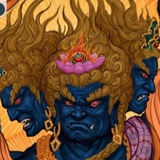
The boar as the symbol of the Dawn Goddess is an interesting interpretation. The Boar is also the symbol of the Germanic God Ing Frey / Freyr who is also associated with the Harvest, sunlight, and as progenitor establishing the tribe or bringing forth offspring. While Ostara / Eostre is the Germanic Goddess for the Dawn the Goddess Freya (the sister of Freyr) is often cross associated with the same aspects. --Temple of the Immovable.
Temple of the Immovable (Dampa Zangpo)
The boar as the symbol of the Dawn Goddess is an interesting interpretation. The Boar is also the symbol of the Germanic God Ing Frey / Freyr who is also associated with the Harvest, sunlight, and as progenitor establishing the tribe or bringing forth offspring.…
“Spelled Marīci (Sanskrit). Rays of light, the sun’s rays, said to go before the sun; mirage. A goddess, independent and sovereign, protectress against all violence and peril. In Brahmanic mythology, the personification of light, offspring of Brahmā, parent of Sūrya. Among Chinese Buddhists Marīci is represented as a female with eight arms, two of which are holding aloft emblems of sun and moon, and worshipped as goddess of light and as the guardian of all nations, whom she protects from the fury of war. She is addressed as 天后 queen of heaven, or as 斗姥 (literally “mother of the Southern Measure μλρστζ or Sagittarī), and identified with Tchundi and with Mahēśvarī, the wife of Maheśvara, and has therefore the attribute Mātrikā -- Mother of the Myriad Buddha. Taoists address her as Queen of Heaven.” Soothill also identifies Marīci with Saptakotibuddha-mātṛ (Shichikuchi Butsumo Son 七倶胝佛母尊), the fabulous mother of seven koṭīs of Buddhas (70 million Buddha). Other entrees in Soothill’s dictionary say she is known as well as Candī / Cundi 準提 / 准胝 / 尊提 or as Cundī-Guanyin 準提觀音 (a form of Kannon). In Brahmanic mythology, Candī / Cundi is a vindictive form of Hindu goddess Durgā, who can appear in the form of a wild boar."
--- William Edward Soothill via Onmarkproductions https://www.onmarkproductions.com/html/kankiten-idaten-other-tenbu.html#marishiten
--- William Edward Soothill via Onmarkproductions https://www.onmarkproductions.com/html/kankiten-idaten-other-tenbu.html#marishiten
Onmarkproductions
Kankiten, Idaten, Marishiten & Other Tenbu (Deva) in Japanese Buddhist Traditions
Kankiten, Idaten, Gigeten, Daijizaiten, & Marishiten (Marici). TENBU in Japan, Digital Dictionary of Buddhism in Japan.
Forwarded from Hammer and Vajra
"There's no samsara or nirvana, only the bliss of primordial awareness that enjoys the miraculous displays of the Dharmakāya" —- https://t.me/vajrarastra
🔥1
Forwarded from Hammer and Vajra
This is a powerful statement when grasped and understood. If more had this understanding when approaching Buddhism, or even Indo-European faith in general they would deepen their walk with the divine, and give rise to spiritual growth and potential awakening.
Forwarded from Modern Kshatriya
In Japan, Buddhism lives in harmony with hierarchical, traditional, national, and warrior concepts. Only in certain Western misconceptions is Buddhism - considered in later and corrupted forms - presented as a doctrine of universal compassion encouraging humanitarian and democratic equality.
Julius Evola, The Doctrine of Awakening
Julius Evola, The Doctrine of Awakening
Temple of the Immovable (Dampa Zangpo)
Photo
The Noble (Aryan) 8 Fold Path includes sexual acts and abusing sex.
“Right Conduct or Action: no killing (meaning Murder not protection or warfare) or injuring (intentional unwarranted assault) , no taking what is not given, no sexual misconduct, no material desires.”
This does not mean having sex is bad, or that one shouldn’t be sexual at all. However what this does mean is that abusing sex it is wrong action and not of the middle way or the Arya 8 Fold Path. Attachment to sex can be bad as attachment to all things, this ultimately which leads to obsession and distraction or divergence from the right path. Many movements today in the psychological field, educational systems, cultural pushes, corporate and governmental endorsements, are set to facilitate the growth of child grooming, sexual confusion, and abuse in general. This is Adharmic and against the precepts of the Noble 8-Fold Path. There is not balance in their acts. Anyone who claims to be a Buddhist, or Hindu, or Pagan, who is especially of the New Age, or who are of Western persuasions or flavor of these faiths, are manipulating concepts such within them (such as compassion or ahimsa) through purposeful misinterpretation to spread adharma. This should, and will be stood against. Ultimately it will be stopped and stamped out. Being against it is channeling the Dharmapala and in protection of the Dharma via the 8 Fold Path. ~ Temple of the Immovable
“Right Conduct or Action: no killing (meaning Murder not protection or warfare) or injuring (intentional unwarranted assault) , no taking what is not given, no sexual misconduct, no material desires.”
This does not mean having sex is bad, or that one shouldn’t be sexual at all. However what this does mean is that abusing sex it is wrong action and not of the middle way or the Arya 8 Fold Path. Attachment to sex can be bad as attachment to all things, this ultimately which leads to obsession and distraction or divergence from the right path. Many movements today in the psychological field, educational systems, cultural pushes, corporate and governmental endorsements, are set to facilitate the growth of child grooming, sexual confusion, and abuse in general. This is Adharmic and against the precepts of the Noble 8-Fold Path. There is not balance in their acts. Anyone who claims to be a Buddhist, or Hindu, or Pagan, who is especially of the New Age, or who are of Western persuasions or flavor of these faiths, are manipulating concepts such within them (such as compassion or ahimsa) through purposeful misinterpretation to spread adharma. This should, and will be stood against. Ultimately it will be stopped and stamped out. Being against it is channeling the Dharmapala and in protection of the Dharma via the 8 Fold Path. ~ Temple of the Immovable
Forwarded from Hammer and Vajra
Debate_on_the_Nature_of_the_Buddha,_Emptiness_and_Dharmakaya_Hammer.pdf
370.6 KB
This debate has been formatted and responded to by Hammer and Vajra.
Only the replies in this document from Hammer and Vajra reflect the views of Hammer and Vajra.
In formatting no positions or content from other participants were changed.
---- Hammer and Vajra
Only the replies in this document from Hammer and Vajra reflect the views of Hammer and Vajra.
In formatting no positions or content from other participants were changed.
---- Hammer and Vajra
Temple of the Immovable (Dampa Zangpo)
Vairocana: Emanation of Dharmakaya
Vairocana / Mahāvairocana 大日如来 (Dainichi Nyorai)
Vairocana Is the Primordial Buddha and the Dharmakaya within the Mahayana and Vajrayana understanding.
In the three bodies of the Buddha, we have the following. Nirmanakaya (Transformation or physical body) which is a Buddha / guru who is physically in the human realm. Then Sambhogakaya which is a Divine body like within the Pure Lands / Buddha Realms within the Womb Realm, such as the 5 primary Buddha that have their own realms / heavens, in the cardinal directions. (Five Jinas or Five Tathāgatas).
Lastly, we have Dharmakaya “Dharmic Body” which is the ultimate reality of Buddha nature and Sunyata, they compare this to the Supreme Brahman as depicted within Advaita Vedanta or even in some Upanishads and Bhagavad Gita. Soyen Shaku says it equates with Tathagata and Vairochana and the Buddhas such as Amitabha are expressions of or the emanations of the ultimate Dharmakaya which is more akin an understanding of “God” as would be understood in a Monist / Panentheistic sort of way.
Vairocana is the thereby the Dharmakaya. A all pervasive Buddha nature that is in everything and everything is in it. According to Soyen Shaku, when writing about Zen and Mahayana Buddhism in a way Westerners could understand, it is the closest to the understanding and concept of the God that Buddhism has. Though I would go a step further and say this can only be fully understood by a Neo Platonist, Monist, or Panentheism approach when using Western theology. Within this the Dharmakaya is more akin to the Monad / One / Narayana / Brahman, though a even a bit beyond these concepts as it is both an non-existing existence. This is because Vairocana is the embodiment of Sunyata (Emptiness) yet beyond the concept of embodying.
“Now, I, Vairocana Buddha am sitting atop a lotus pedestal; On a thousand flowers surrounding me are a thousand Sakyamuni Buddhas. Each flower supports a hundred million worlds; in each world a Sakyamuni Buddha appears. All are seated beneath a Bodhi-tree, all simultaneously attain Buddhahood. All these innumerable Buddhas have Vairocana as their original body.” - Brahmajala Sutra
In most Japanese forms of Vajrayana such as Shingon and Shugendo Vairocana is the highest concept to revere or worship.
He was revered so highly that the catholic missionary Francis Xavier equated him with the Christian God in order to convert Japanese people. He ended up using the name Dainichi Nyorai as the name for the Christian “God”.
Within the Pure Land approach often Amidah Buddha is equated as being the same as Vairocana and an interpretation of Dharmakaya.
In Chinese Buddhism he was highly worshipped as well.
In some interpretations he is considered to be the Dharmakaya of the historical Shakyamuni Buddha.
It is possible to see all 5 Wisdom Buddhas / Jinas as aspects of the same greater Dharmakaya.
His direct servant / wrathful incarnation is that of Acala / Fudo Myoo who one will notice an aspect of Shiva-Rudra. The other 5 Wisdom Kings are the wrathful Deva embodiments of each of the 5 Wisdom Buddhas. Each King has an aspect of Shiva-Rudra in their depiction and characteristic.
This would put Dharmakaya (Greater divine / Emptiness) > Mahakali / Shiva-Rudra (Also seen as Avalokiteśvara) > all other Bodhisattva and deities.
This follows the hierarchy of almost all Indo-European faiths.
Dharmakāya > Saṃbhogakāya >Five Wisdom Buddhas > Each Wisdom Buddha emanates Bodhisattvas, Dharmapālas and Gods > Nirmāṇakāya
oṃ vairocana hūṃ
Temple of the Immovable.
Vairocana Is the Primordial Buddha and the Dharmakaya within the Mahayana and Vajrayana understanding.
In the three bodies of the Buddha, we have the following. Nirmanakaya (Transformation or physical body) which is a Buddha / guru who is physically in the human realm. Then Sambhogakaya which is a Divine body like within the Pure Lands / Buddha Realms within the Womb Realm, such as the 5 primary Buddha that have their own realms / heavens, in the cardinal directions. (Five Jinas or Five Tathāgatas).
Lastly, we have Dharmakaya “Dharmic Body” which is the ultimate reality of Buddha nature and Sunyata, they compare this to the Supreme Brahman as depicted within Advaita Vedanta or even in some Upanishads and Bhagavad Gita. Soyen Shaku says it equates with Tathagata and Vairochana and the Buddhas such as Amitabha are expressions of or the emanations of the ultimate Dharmakaya which is more akin an understanding of “God” as would be understood in a Monist / Panentheistic sort of way.
Vairocana is the thereby the Dharmakaya. A all pervasive Buddha nature that is in everything and everything is in it. According to Soyen Shaku, when writing about Zen and Mahayana Buddhism in a way Westerners could understand, it is the closest to the understanding and concept of the God that Buddhism has. Though I would go a step further and say this can only be fully understood by a Neo Platonist, Monist, or Panentheism approach when using Western theology. Within this the Dharmakaya is more akin to the Monad / One / Narayana / Brahman, though a even a bit beyond these concepts as it is both an non-existing existence. This is because Vairocana is the embodiment of Sunyata (Emptiness) yet beyond the concept of embodying.
“Now, I, Vairocana Buddha am sitting atop a lotus pedestal; On a thousand flowers surrounding me are a thousand Sakyamuni Buddhas. Each flower supports a hundred million worlds; in each world a Sakyamuni Buddha appears. All are seated beneath a Bodhi-tree, all simultaneously attain Buddhahood. All these innumerable Buddhas have Vairocana as their original body.” - Brahmajala Sutra
In most Japanese forms of Vajrayana such as Shingon and Shugendo Vairocana is the highest concept to revere or worship.
He was revered so highly that the catholic missionary Francis Xavier equated him with the Christian God in order to convert Japanese people. He ended up using the name Dainichi Nyorai as the name for the Christian “God”.
Within the Pure Land approach often Amidah Buddha is equated as being the same as Vairocana and an interpretation of Dharmakaya.
In Chinese Buddhism he was highly worshipped as well.
In some interpretations he is considered to be the Dharmakaya of the historical Shakyamuni Buddha.
It is possible to see all 5 Wisdom Buddhas / Jinas as aspects of the same greater Dharmakaya.
His direct servant / wrathful incarnation is that of Acala / Fudo Myoo who one will notice an aspect of Shiva-Rudra. The other 5 Wisdom Kings are the wrathful Deva embodiments of each of the 5 Wisdom Buddhas. Each King has an aspect of Shiva-Rudra in their depiction and characteristic.
This would put Dharmakaya (Greater divine / Emptiness) > Mahakali / Shiva-Rudra (Also seen as Avalokiteśvara) > all other Bodhisattva and deities.
This follows the hierarchy of almost all Indo-European faiths.
Dharmakāya > Saṃbhogakāya >Five Wisdom Buddhas > Each Wisdom Buddha emanates Bodhisattvas, Dharmapālas and Gods > Nirmāṇakāya
oṃ vairocana hūṃ
Temple of the Immovable.
Forwarded from Egbert Moray-Falls
"Ten Onenesses [十不二門] ( jippunimon): Also, ten non-dualities. Ten principles set forth by Miao-lo (711–782) in The Annotations on “The Profound Meaning of the Lotus Sutra.” In this work, Miao-lo discusses the ten mystic principles of the theoretical teaching (first half) of the Lotus Sutra and the ten mystic principles of the essential teaching (latter half) of the sutra, which T’ien-t’ai expounded in The Profound Meaning of the Lotus Sutra, and reveals the ten onenesses. The section of Miao-lo’s work that explains this principle later became an independent work called The Ten Onenesses. In it, Miao-lo states that the concept of ten onenesses includes the ten mystic principles of both the theoretical and the essential teachings.
"The ten onenesses are as follows:
(1) The oneness of body and mind. What one observes in meditation is one mind or one thought ( ichinen), which is an indivisible whole of body and mind.
(2) The oneness of the internal and the external. Though the object of meditation is divided into two—the internal object, or the realm of one mind, a psychosomatic entity; and the external object, or the external world of physical and spiritual phenomena—these two are non-dual because one mind embodies the three truths and includes all three thousand realms.
(3) The oneness of the result of practice and the true nature of life. This means that the true nature of life, or the true aspect of all phenomena, is no different from what one ultimately attains through Buddhist practice. The true nature moves one to practice, and practice enables one to manifest the true nature.
(4) The oneness of cause and effect. “Cause” here means ordinary people, and “effect,” Buddhahood. The oneness of cause and effect means that the Buddha nature inherent in the ordinary person is the same as the Buddha nature that the Buddha has manifested.
(5) The oneness of the impure and the pure. Because ignorance or delusion and enlightenment are two expressions of the same mind and essentially one, the impure mind shrouded in ignorance is itself the pure mind that is enlightened.
(6) The oneness of life and its environment. Both the Buddha as a living being and the Buddha land as the environment exist in one mind and are therefore non-dual.
(7) The oneness of self and others. “Self” means the Buddha, who teaches, and “others” means ordinary people, who are taught and enlightened. But they are non-dual because both the Buddha and ordinary people embody the three truths and are endowed with all three thousand realms. In other words, both self (Buddhahood) and others (the nine worlds) are inherent in one mind.
(8) The oneness of thought, word, and deed. The Buddha saves people through his three categories of action—thought, speech, and behavior. These three categories of the Buddha are no different from those of ordinary people because they arise from the three thousand realms inherent in both. Moreover, these three exist in one mind as a psychosomatic whole and therefore are one.
(9) The oneness of the provisional and true teachings. The Buddha preaches the provisional teachings (the three vehicles) and the true teaching (the one vehicle) according to the people’s capacity. Because they both spring from the Buddha’s enlightened mind, however, they are non-dual.
(10) The oneness of benefits. Though people receive different benefits according to the level of the Buddha’s teaching that they practice (such as provisional and true), both the Buddha and the people ultimately enjoy the same benefit, just as plants in a field are all nourished equally by the rain."
From the Soka Gakkai Dictionary of Buddhism
"The ten onenesses are as follows:
(1) The oneness of body and mind. What one observes in meditation is one mind or one thought ( ichinen), which is an indivisible whole of body and mind.
(2) The oneness of the internal and the external. Though the object of meditation is divided into two—the internal object, or the realm of one mind, a psychosomatic entity; and the external object, or the external world of physical and spiritual phenomena—these two are non-dual because one mind embodies the three truths and includes all three thousand realms.
(3) The oneness of the result of practice and the true nature of life. This means that the true nature of life, or the true aspect of all phenomena, is no different from what one ultimately attains through Buddhist practice. The true nature moves one to practice, and practice enables one to manifest the true nature.
(4) The oneness of cause and effect. “Cause” here means ordinary people, and “effect,” Buddhahood. The oneness of cause and effect means that the Buddha nature inherent in the ordinary person is the same as the Buddha nature that the Buddha has manifested.
(5) The oneness of the impure and the pure. Because ignorance or delusion and enlightenment are two expressions of the same mind and essentially one, the impure mind shrouded in ignorance is itself the pure mind that is enlightened.
(6) The oneness of life and its environment. Both the Buddha as a living being and the Buddha land as the environment exist in one mind and are therefore non-dual.
(7) The oneness of self and others. “Self” means the Buddha, who teaches, and “others” means ordinary people, who are taught and enlightened. But they are non-dual because both the Buddha and ordinary people embody the three truths and are endowed with all three thousand realms. In other words, both self (Buddhahood) and others (the nine worlds) are inherent in one mind.
(8) The oneness of thought, word, and deed. The Buddha saves people through his three categories of action—thought, speech, and behavior. These three categories of the Buddha are no different from those of ordinary people because they arise from the three thousand realms inherent in both. Moreover, these three exist in one mind as a psychosomatic whole and therefore are one.
(9) The oneness of the provisional and true teachings. The Buddha preaches the provisional teachings (the three vehicles) and the true teaching (the one vehicle) according to the people’s capacity. Because they both spring from the Buddha’s enlightened mind, however, they are non-dual.
(10) The oneness of benefits. Though people receive different benefits according to the level of the Buddha’s teaching that they practice (such as provisional and true), both the Buddha and the people ultimately enjoy the same benefit, just as plants in a field are all nourished equally by the rain."
From the Soka Gakkai Dictionary of Buddhism
Forwarded from Hammer and Vajra
Here is some proper and well thought out critique and responses to our comments within the debate. Very pleased to see others within the same realm of thought and care for Indo-European spirituality coming together to amicable discuss dharma and spread dharmic understanding.
Forwarded from Egbert Moray-Falls
EMF's_Response_Anatman_Dharmakaya_Debate_V3_Plus_Nichiren_Essay.docx
39.1 KB
Here it is at last. May all living beings benefit.
Forwarded from Egbert Moray-Falls
The Great Telegram Anatman Debate V4.pdf
227.8 KB
A more complete version of the debate in PDF form.
Forwarded from Hammer and Vajra
The excerpt below is from Soyen Shaku’s “The God-conception of Buddhism”
This is how I see “God” (The One / Monad) within a Dharmakaya understanding via Vajrayana (also some Mahayana) Buddhism.
I think if this approach was fully understood and analyzed, expounded upon, and meditated upon. a lot of the misconception of Buddhism as well as other Indo-European faiths would begin to erode. Read for free on my Patreon.
https://www.patreon.com/posts/dharmakaya-and-64673351
This is how I see “God” (The One / Monad) within a Dharmakaya understanding via Vajrayana (also some Mahayana) Buddhism.
I think if this approach was fully understood and analyzed, expounded upon, and meditated upon. a lot of the misconception of Buddhism as well as other Indo-European faiths would begin to erode. Read for free on my Patreon.
https://www.patreon.com/posts/dharmakaya-and-64673351
👍2