
Biometric Charge Card
A system similar to credit cards that rather than charging via plastic or credit card, utilizes biometric charges.
Why: The credit card is outdated: it’s easy to forget at home and extremely easy to hack or forge.
A system similar to credit cards that rather than charging via plastic or credit card, utilizes biometric charges.
Why: The credit card is outdated: it’s easy to forget at home and extremely easy to hack or forge.
👍3❤2
Self-hosted photo storage
A cross-platform app that stores photos, encrypted. Available from all devices. For people who don't want to change their photo cloud provider every year or two.
A cross-platform app that stores photos, encrypted. Available from all devices. For people who don't want to change their photo cloud provider every year or two.
❤2👍2
Company in a e-book
The tool that creates a playbook with the company processes, flows, any other info. So employees should read it at their first working day and it will be more efficient than "here is our documentation, and there too. And there, and in the Google Docs. Also, contact John to explain you how our processes work".
The tool that creates a playbook with the company processes, flows, any other info. So employees should read it at their first working day and it will be more efficient than "here is our documentation, and there too. And there, and in the Google Docs. Also, contact John to explain you how our processes work".
❤4👍2
Audio photos
An app that allows to capture a sound when talking a photo to help memorize the moments better.
An app that allows to capture a sound when talking a photo to help memorize the moments better.
👍3❤2
A shopping list location app that sends you a reminder notification when you’re nearby a place where you can buy a list item.
👍5❤2
Map-based social network
When you travel to a new city, it’s tough to know if you have friends who live there. Current social networks don’t offer a good way to know your friends’ locations in real-time and/or aren’t very socially engaging.
When you travel to a new city, it’s tough to know if you have friends who live there. Current social networks don’t offer a good way to know your friends’ locations in real-time and/or aren’t very socially engaging.
👍3❤2
An app that randomly sends you a notification every week to take a photo within 60 seconds. The app compiles your photos into a montage.
❤2👍2
Auto suggested hashtags
Twitter should auto-suggest hashtags based on what you’re tweeting about. It can be a browser extension.
Twitter should auto-suggest hashtags based on what you’re tweeting about. It can be a browser extension.
👍3❤2
Trend: Posca
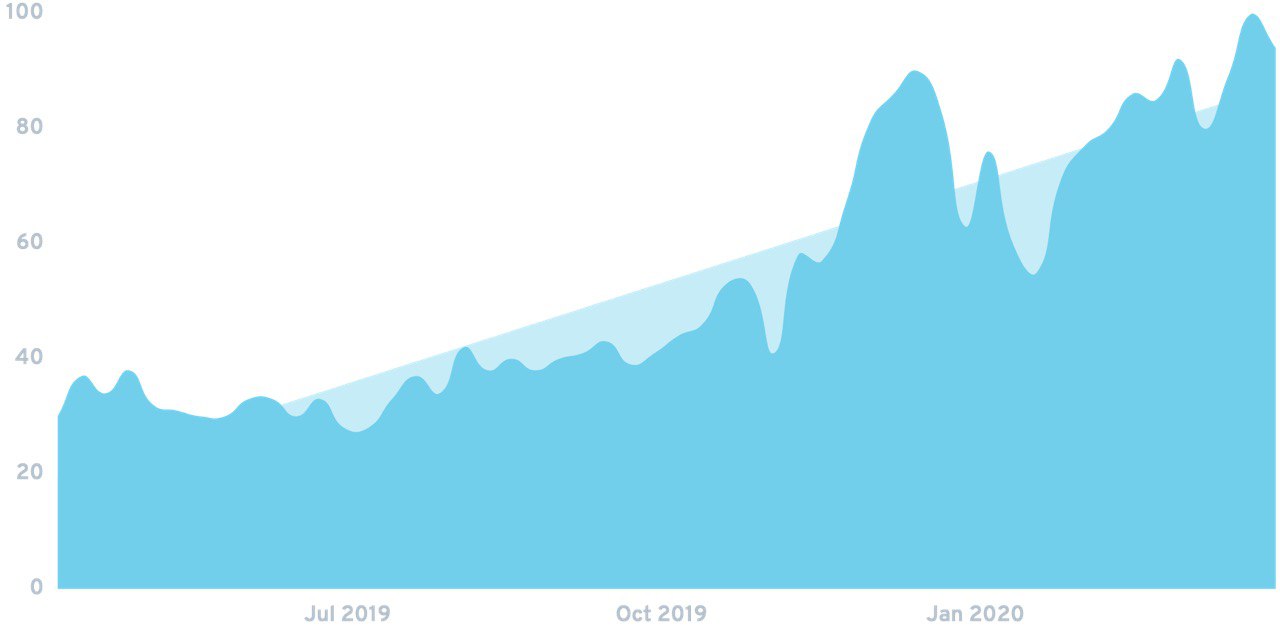
This brand of paint marker pens was already gaining momentum before coronavirus. But demand has exploded now that millions of parents are homeschooling their children every day.
Posca pens are great for kid's painting. As a bonus, they can be used on windows. And they easily wipe off of any glass surface. Perfect for the new parent turned teacher who lacks a whiteboard.
❤5👍1
Museum virtual tours
A website gathers as many virtual museum tours as possible to watch all of them online.
A website gathers as many virtual museum tours as possible to watch all of them online.
❤2👍2
Drone Dog-Walker
Not a side project, but a whole startup idea. To walk my dog, I have to go outside. A drone or robot that can automatically walk my dog. This concept would be similar to Wag (which raised $361M, was valued at $1B+, and was backed by Softbank; however, Softbank eventually parted ways in late 2019). However, instead of paying humans to walk people’s dogs, this company would use drones.
Not a side project, but a whole startup idea. To walk my dog, I have to go outside. A drone or robot that can automatically walk my dog. This concept would be similar to Wag (which raised $361M, was valued at $1B+, and was backed by Softbank; however, Softbank eventually parted ways in late 2019). However, instead of paying humans to walk people’s dogs, this company would use drones.
👍3❤2🤩1
Today’s app idea:
Is it worth to read an article?
A browser extension that shows the amount of words in an article, so you know whether it’s worth your time to read.
Is it worth to read an article?
A browser extension that shows the amount of words in an article, so you know whether it’s worth your time to read.
❤2👍2
How to brainstorm great business ideas
Part 1
It's been said that ideas don't matter, execution does. I wholeheartedly disagree. You need both to succeed, but you can only get so good at execution. A great idea gives you much more leverage.
Most people equate product ideas with business ideas. That's wrong. Your product is only one part of your business. There are at least four parts in total:
- the problem you're solving (aka the market)
- the distribution channel to reach customers
- the monetization model you use to make money
- the solution to the problem (aka your product or service)
Great business ideas are strong in all of these areas.
Problem First, Solution Last
The #1 rule is to put the problem first and the solution last. Your product/service should be the last thing you think about.
Why? Because it's the most flexible. You can build anything. But the other three aspects are constrained. You have to choose from a limited set of viable problems, channels, and models. Always start with the constraints.
#materials
❤2👍2
How to brainstorm great business ideas, part 2
If you find yourself trying to think up product ideas, then you're putting the solution first. Not only is that backwards, but it's harder! How exactly are you supposed to think up good product ideas out of thin air?
It's impossible to design a great tool for a job before you even know what the job is.
You'll make your life easier and your business ideas better if you put the solution last and the problem first.
What makes for a good problem?
The first step is to recognize a good problem when you see one.
A good problem is one that many thousands of people have. Otherwise you won't have enough customers. For indie hackers, this number doesn't need to be too big. Usually a few hundred thousand is enough. In some cases, much less.
You want these to be people you genuinely like talking to, because they'll be your customers for years. And ideally you have the same problem as them, too, so you can empathize with what they're going through.
It's best if the people who have this problem hang out together and identify as a named group. For example, "developers" or "teachers" or "NBA fans" or "YouTubers." That means they're likely to make all sorts of recommendations to each other, including product recommendations, which makes word-of-mouth growth possible for your business. It also gives you juicy channels to target, which will come into play later.
It helps if the problem is a growing one, meaning more and more people have it every year. This sets the stage for your business to grow. And you want it to be a problem that people encounter frequently, so they'll seek the solution on a regular basis.
Finally, and arguably most importantly, you want it to be a valuable problem. In other words, you want it to be a problem that people pay money to solve. Preferably lots of money.
👍4❤2
Today’s project idea:
Random knowledge chats
It’s hard to learn cool topics directly from experts (unless you listen to a podcast, which is not very interactive).
My favorite feature on Wikipedia is the “random article” button, which sends you to a random Wikipedia page. This company would take this same idea and similar to Omegle places you in a random 1:1 video conversation for 15 minute conversations for $5 each. The platform would allow you to learn random things from random people who are an expert in their subject and all you would have to do is pay them with coffee/tea/pastries. Perhaps it could be called, "Teach for a Coffee". Get rated after the end of each interaction and become more of an expert. Perhaps, eventually, the platform would create partnerships with media companies to give people a foot-in-the-door to become talking heads on programs like CNN, Fox, MSNBC, and more.
❤2👍2
Some news: Oil is almost down to $1/barrel
So, startupers, prepare your ideas to explode the market with innovative energy resources.
Why this is happening: The May contract expires tomorrow. Oil traders that still have contracts are selling at whatever price they can get because they do not (all) have the ability to take physical delivery.
Storage and refiners are not buying. The $1/barrel is a trading dynamic when there are many sellers and limited buyers.
❤2👍2
Current trend: Oximeter
Pulse oximeters are small devices that use light to measure blood O2 saturation. Like face masks and hand sanitizer, Oximeter sales have surged due to the current crisis.
Quartz reports that Oximeter sales have increased more than 5x since January. The spike is so sudden that many Amazon sellers and brick and mortar stores have run out of inventory.
Why the bump? Despite statements from the American Lung Association that Oximeters are only helpful for people with certain health conditions, people are using them as a way to self-diagnose. Or, for those that have the disease, as a way to measure lung function at home.
Oximeters are just one of many devices that people are using for the “self-care” movement, a group that monitors their health without interfacing with a health care pro.

❤5👍1💔1
Finding a problem
or How to find business problems and the ones you have
You're going to have to brainstorm. Some people recommend that you just sit around waiting for inspiration to strike. I don't. That might take years, if not forever. Be proactive.
It's hard to say where the best place to start brainstorming is, not because there are so few, but because there are so many. There are thousands of good problems out there, and practically anything can trigger you to stumble across one.
What's more important is that you recognize a good problem when you see one, and vice versa. If a problem scores poorly on the guidelines above, don't waste your time. Keep brainstorming.
For that reason, it makes sense to start with one of these guidelines in mind, and let that be your trigger. For example, since it's helpful to solve a problem that you have yourself, why not take a look at your own life and see if you can spot any problems. What worries you, exasperates you, or annoys you?
The other guidelines also work well as brainstorming triggers. Who do you like spending time with? What groups are you a part of? What are some problems you notice people solving frequently? What's something that seems to be growing into a bigger trend?
My personal favorite is to start by looking at where people are already spending lots of time and money and go from there. Money changing hands is almost always a sign that there's a valuable problem being solved.
Avoid Fatal Mistakes
Founders typically have already made one or two huge mistakes by this point. If you can avoid these, you'll be way ahead before you've even started.
Starting with a solution in mind. I've mentioned this already, but it's worth repeating. You need to be honest with yourself here, because this is sometimes subtle. If you're already attached to a particular idea for a product, technology, or set of features that you want to build, that's going to ruin your ability to find a solid problem and analyze it objectively. You've put the solution first, and it's blinding you to opportunities.
Ruling out already-solved problems.
Nothing in the guidelines above says that a good problem is one that nobody is solving. In fact, the opposite is usually true. Almost all successful businesses start by tackling problems that have popular, pre-existing, alternative solutions. Way too many founders attempt to solve unsolved problems, then get stuck. These problems are often unsolved because they're unimportant and people don't care.
Being afraid to solve high-value problems. Indie hackers in particular are notorious for only tackling cheap, low-value problems. You don't have to sell something for cheap to have a chance at success. That's backwards. It's actually harder to sell cheap things, because people care less. I've bought more cars than back scratchers in my life. It doesn't matter that you're a small, scrappy startup. I've met 2-person teams selling their software for $10,000 per year per customer. Pick a high-value problem and charge a high price.
Not having a specific customer in mind. If you can't articulate whose problem you're solving, how is your website going to articulate it? If you want to wait and see who the best customer turns out to be, that sounds a lot like a key looking for a lock. If you think your product is for everyone, it's probably for nobody. If you describe your target customer by combining a bunch of attributes (e.g. "iOS users who need to get tasks done but prefer modern, clean UIs"), that's not an actual group of people. You're just describing the features of a product you're already biased toward building.
Some of these points are a bit counterintuitive. That's why so many generations of smart-but-uninformed indie hackers are repeating the mistakes of their predecessors.
But it's simple to avoid these kinds of mistakes once you know them. It's more a more a matter of knowledge and discipline, rather than genius or hard work.
#materials
👍5❤3
Today’s business problem and the idea:
Sponsor app for J1 visa applicants
For cultural exchange students looking to get a J1 visa and work temporarily in the United States, it is difficult to find a job.
Currently, specialized agencies (known as Visa Sponsors) charge cultural exchange students anywhere from $1,500 - $10,000 for “program fees” which include, finding a job placement for the student, providing insurance for the student, and other support for the student before, during, and after their placement in the United States. However, these agencies are essentially middle-men in a system where the students and employers could talk directly if they just knew how to find each other. Generally, in this business their are so many points of contacts that students end up paying so many more fees than they need.
Thus, this business would be an app (perhaps like Tinder) where students can upload resumes, complete a job profiles, and search for jobs while employers can post job descriptions, conduct interviews remotely, and find the best students for temporary work. We would cut out one (of the many) middle-men. Our role would be to provide a stable platform for these connections to take place. Think of it like an Indeed (which sold in 2012 for $1b), ZipRecruiter, or LinkedIn for international students who want to come to the US temporarily.
👍4❤2🦄1