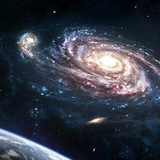
Earth, The Blue Planet, Gaia, Terra, The Big Blue Marble 🌎
No matter what you call it, it will always be home. We here at NASA are celebrating #EarthDay with you. From the depths of the oceans to the tallest peaks, from lush forests to arid deserts, our planet is full of brilliant diversity.
Earth is in the "Goldilocks Zone"; our planet's distance to the sun is ideal for liquid water to be on the surface, as we are neither too hot nor too cold. As we search among the stars for life, inspiration, and creation, we also look inward and study what makes our home planet just right to support life.
What's your favorite corner of the planet? Post an image or a selfie tagged NASA Earthling and NASA Earth, or share what you think makes our planet unique in the comments below.
No matter what you call it, it will always be home. We here at NASA are celebrating #EarthDay with you. From the depths of the oceans to the tallest peaks, from lush forests to arid deserts, our planet is full of brilliant diversity.
Earth is in the "Goldilocks Zone"; our planet's distance to the sun is ideal for liquid water to be on the surface, as we are neither too hot nor too cold. As we search among the stars for life, inspiration, and creation, we also look inward and study what makes our home planet just right to support life.
What's your favorite corner of the planet? Post an image or a selfie tagged NASA Earthling and NASA Earth, or share what you think makes our planet unique in the comments below.
👍1
This media is not supported in your browser
VIEW IN TELEGRAM
You're just too good to be true
Can't take my eyes off of you 👀
Our Perseverance Mars rover captured this sped-up video of an eclipse featuring Phobos, one of Mars' two moons. It’s the most zoomed-in, highest-frame-rate observation of a Phobos solar eclipse ever taken from the Martian surface.
Using our rovers to observe Martian eclipses gives scientists new perspectives on the subtle shifts in the moons' orbits. Intense tidal forces created by its proximity to the Red Planet, Phobos is moving very slowly towards Mars, and millions of years from now, they will collide.
Despite having its eyes in the sky, one of Perseverance’s primary objectives is looking for signs of ancient microbial life. The rover is studying and analyzing the Red Planet's regolith, rock and dust, and is the first rover to collect and cache samples.
Can't take my eyes off of you 👀
Our Perseverance Mars rover captured this sped-up video of an eclipse featuring Phobos, one of Mars' two moons. It’s the most zoomed-in, highest-frame-rate observation of a Phobos solar eclipse ever taken from the Martian surface.
Using our rovers to observe Martian eclipses gives scientists new perspectives on the subtle shifts in the moons' orbits. Intense tidal forces created by its proximity to the Red Planet, Phobos is moving very slowly towards Mars, and millions of years from now, they will collide.
Despite having its eyes in the sky, one of Perseverance’s primary objectives is looking for signs of ancient microbial life. The rover is studying and analyzing the Red Planet's regolith, rock and dust, and is the first rover to collect and cache samples.
This media is not supported in your browser
VIEW IN TELEGRAM
Four types of light = One amazing sonification!
From across the electromagnetic spectrum, data in this image is represented by music to create an interesting way of experiencing the Whirlpool Galaxy through sound.
This sonification features data from NASA's Spitzer Space Telescope (infrared), Hubble (visible), GALEX (ultraviolet), and NASA Chandra xray.
Credits: NASA/CXC/SAO/K.Arcand; Sonification: @SYSTEMSounds (M. Russo, A. Santaguida)
From across the electromagnetic spectrum, data in this image is represented by music to create an interesting way of experiencing the Whirlpool Galaxy through sound.
This sonification features data from NASA's Spitzer Space Telescope (infrared), Hubble (visible), GALEX (ultraviolet), and NASA Chandra xray.
Credits: NASA/CXC/SAO/K.Arcand; Sonification: @SYSTEMSounds (M. Russo, A. Santaguida)
About 130 million light-years away in the constellation Draco, the galaxy NGC 3147 resides.
Its winding, graceful spiral arms contain pinkish nebulae, young blue stars, and dust in silhouette.
Image credit: NASA, ESA, S. Bianchi (Università degli Studi Roma Tre, Italy) and M. Chiaberge (ESA, STScI, and JHU)
Its winding, graceful spiral arms contain pinkish nebulae, young blue stars, and dust in silhouette.
Image credit: NASA, ESA, S. Bianchi (Università degli Studi Roma Tre, Italy) and M. Chiaberge (ESA, STScI, and JHU)
This media is not supported in your browser
VIEW IN TELEGRAM
Time for a galactic quest to NGC 1300!
This majestic spiral galaxy is nearly 70 million light-years away in the constellation Eridanus. It contains pink clouds of star formation, blue clusters of young stars, and dark lanes of dust.
Image credit: NASA, ESA, and G. Bacon (STScI)
Music credit: "Digital Dreamscape," Count Zero [PRS], Atmosphere Music Ltd. [PRS], Universal Production Music
This majestic spiral galaxy is nearly 70 million light-years away in the constellation Eridanus. It contains pink clouds of star formation, blue clusters of young stars, and dark lanes of dust.
Image credit: NASA, ESA, and G. Bacon (STScI)
Music credit: "Digital Dreamscape," Count Zero [PRS], Atmosphere Music Ltd. [PRS], Universal Production Music
👍4
What better way to wrap up the first week of Galaxies Galore than with a new Hubble image?
Soak in this view of the giant elliptical galaxy UGC 10143, the brightest galaxy in a cluster full of them.
Image credits: NASA, ESA, and W. Harris (McMaster University); Image processing: G. Kober (NASA Goddard/Catholic University of America)
Soak in this view of the giant elliptical galaxy UGC 10143, the brightest galaxy in a cluster full of them.
Image credits: NASA, ESA, and W. Harris (McMaster University); Image processing: G. Kober (NASA Goddard/Catholic University of America)
This media is not supported in your browser
VIEW IN TELEGRAM
Galactic pals!
This close-knit group of five galaxies is known as Hickson Compact Group 40. You might recognize them from Hubble’s 32nd anniversary image, celebrated last month!
The group contains three spiral galaxies, along with an elliptical galaxy and a lenticular (lens-like) galaxy.
Visualization credits: Joseph DePasquale, Alyssa Pagan
Music credit: “Shine,” Max Cameron Concors, Hyperscore Productions, Universal Production Music
This close-knit group of five galaxies is known as Hickson Compact Group 40. You might recognize them from Hubble’s 32nd anniversary image, celebrated last month!
The group contains three spiral galaxies, along with an elliptical galaxy and a lenticular (lens-like) galaxy.
Visualization credits: Joseph DePasquale, Alyssa Pagan
Music credit: “Shine,” Max Cameron Concors, Hyperscore Productions, Universal Production Music
Now presenting, our first new Galaxies Galore Hubble image!
Nicknamed the Needle’s Eye Galaxy, NGC 247 is a spectacular dwarf spiral galaxy about 11 million light-years away from us.
This image zooms into the very edge of the galaxy. Below the edge of the galaxy’s disk, smaller and more distant galaxies are visible, as well as a very bright foreground star that lies between us and NGC 247.
Nicknamed the Needle’s Eye Galaxy, NGC 247 is a spectacular dwarf spiral galaxy about 11 million light-years away from us.
This image zooms into the very edge of the galaxy. Below the edge of the galaxy’s disk, smaller and more distant galaxies are visible, as well as a very bright foreground star that lies between us and NGC 247.
👍1
Hubble’s going galactic! 💫
Starting Monday, join us for #GalaxiesGalore! For the next few weeks, we’ll share never-before-seen Hubble galaxy images and explore the science behind these cosmic neighborhoods.
Starting Monday, join us for #GalaxiesGalore! For the next few weeks, we’ll share never-before-seen Hubble galaxy images and explore the science behind these cosmic neighborhoods.
Double take! 🤩
This image of M99 features data from two sets of observations made to study two entirely different astronomical phenomena.
The first set of observations aimed to explore a gap between two different varieties of cosmic explosions, novae and supernovae, whereas the second set was part of a larger Hubble project to map the connections between young stars and the clouds of cold gas from which they form.
Roughly 42 million light-years from Earth in the constellation Coma Berenices, M99 is known as a “grand design” spiral galaxy because of its well-defined and prominent spiral arms.
This image of M99 features data from two sets of observations made to study two entirely different astronomical phenomena.
The first set of observations aimed to explore a gap between two different varieties of cosmic explosions, novae and supernovae, whereas the second set was part of a larger Hubble project to map the connections between young stars and the clouds of cold gas from which they form.
Roughly 42 million light-years from Earth in the constellation Coma Berenices, M99 is known as a “grand design” spiral galaxy because of its well-defined and prominent spiral arms.
Did you know that the black hole at the heart of our Milky Way Galaxy has a leak?
This supermassive black hole, with a mass of 4.1 million Suns, looks like it still has the remnants of a blowtorch-like jet dating back several thousand years.
While Hubble hasn't photographed the jet, it has helped find evidence that it is still pushing feebly into a huge hydrogen cloud and then splattering, like the narrow stream from a hose aimed into a pile of sand.
Image credits: NASA, ESA, and Gerald Cecil (UNC-Chapel Hill); Image Processing: Joseph DePasquale (STScI)
This supermassive black hole, with a mass of 4.1 million Suns, looks like it still has the remnants of a blowtorch-like jet dating back several thousand years.
While Hubble hasn't photographed the jet, it has helped find evidence that it is still pushing feebly into a huge hydrogen cloud and then splattering, like the narrow stream from a hose aimed into a pile of sand.
Image credits: NASA, ESA, and Gerald Cecil (UNC-Chapel Hill); Image Processing: Joseph DePasquale (STScI)
This media is not supported in your browser
VIEW IN TELEGRAM
In this new sonification of the black hole in galaxy M87, three different sets of observations are represented as sound.
Hubble’s visible light image is in the middle, with X-rays from nasa chandra xray on top and radio waves from the Atacama Large Millimeter Array on the bottom.
The bright region on the left is where M87’s black hole is found, and the streak coming out of it is a jet produced by material falling onto the black hole.
Each wavelength of light is represented with a different range of audible tones. Radio waves are mapped to the lowest tones, Hubble’s data to medium tones, and X-rays detected by Chandra to the highest tones.
Hubble’s visible light image is in the middle, with X-rays from nasa chandra xray on top and radio waves from the Atacama Large Millimeter Array on the bottom.
The bright region on the left is where M87’s black hole is found, and the streak coming out of it is a jet produced by material falling onto the black hole.
Each wavelength of light is represented with a different range of audible tones. Radio waves are mapped to the lowest tones, Hubble’s data to medium tones, and X-rays detected by Chandra to the highest tones.
This cosmic "lightsaber" is actually a Herbig-Haro object named HH111.
A Herbig-Haro object forms when hot gas ejected by a newborn star collides with gas and dust around it at hundreds of miles per second: https://go.nasa.gov/3vI8eTG
A Herbig-Haro object forms when hot gas ejected by a newborn star collides with gas and dust around it at hundreds of miles per second: https://go.nasa.gov/3vI8eTG
Black holes are often described as the monsters of the universe – tearing apart stars, consuming anything that comes too close, and holding light captive. But evidence from Hubble shows a black hole in a new light: fostering, rather than suppressing, star formation.
Hubble observations of the dwarf starburst galaxy Henize 2-10 clearly show a gas outflow stretching from the black hole to a bright starbirth region, kind of like an umbilical cord, triggering the already dense cloud into forming clusters of stars.
The outflow was moving at about 1 million miles per hour, slamming into the dense gas like a garden hose hitting a pile of dirt and spreading out. Newborn star clusters dot the path of the outflow's spread, their ages also calculated by Hubble.
Hubble observations of the dwarf starburst galaxy Henize 2-10 clearly show a gas outflow stretching from the black hole to a bright starbirth region, kind of like an umbilical cord, triggering the already dense cloud into forming clusters of stars.
The outflow was moving at about 1 million miles per hour, slamming into the dense gas like a garden hose hitting a pile of dirt and spreading out. Newborn star clusters dot the path of the outflow's spread, their ages also calculated by Hubble.
👍2
Black holes are often described as the monsters of the universe – tearing apart stars, consuming anything that comes too close, and holding light captive. But evidence from Hubble shows a black hole in a new light: fostering, rather than suppressing, star formation.
Hubble observations of the dwarf starburst galaxy Henize 2-10 clearly show a gas outflow stretching from the black hole to a bright starbirth region, kind of like an umbilical cord, triggering the already dense cloud into forming clusters of stars.
The outflow was moving at about 1 million miles per hour, slamming into the dense gas like a garden hose hitting a pile of dirt and spreading out. Newborn star clusters dot the path of the outflow's spread, their ages also calculated by Hubble.
Hubble observations of the dwarf starburst galaxy Henize 2-10 clearly show a gas outflow stretching from the black hole to a bright starbirth region, kind of like an umbilical cord, triggering the already dense cloud into forming clusters of stars.
The outflow was moving at about 1 million miles per hour, slamming into the dense gas like a garden hose hitting a pile of dirt and spreading out. Newborn star clusters dot the path of the outflow's spread, their ages also calculated by Hubble.
👍1