This media is not supported in your browser
VIEW IN TELEGRAM
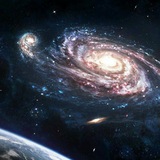
This visualization simulates the appearance of a black hole as seen on its edge, where inbound matter has collected into a thin, hot structure called an accretion disk. The black hole’s extreme gravity alters the paths of light coming from different parts of the disk, making rings of matter visible above and below. At the center lies the black hole's shadow, an area roughly twice the size of the event horizon — its point of no return.
This visualization was first published in September 2019, about six months after scientists with the Event Horizon Telescope released the first actual image of a black hole and its shadow.
This visualization was first published in September 2019, about six months after scientists with the Event Horizon Telescope released the first actual image of a black hole and its shadow.
👍1
That golden hour glow 🌞
The Earth basks in the Sun’s light as it glints off the Atlantic Ocean in this image captured from the International Space Station (@ISS) as it orbits 262 miles above.
While the football field-sized space station is a great place to gaze lovingly back to Earth, it also hosts a plethora of science and technology experiments that are continuously being conducted by crew members.
Want to gaze right back? You can watch the International Space Station pass overhead from several thousand worldwide locations. It is the third brightest object in the sky and easy to spot if you know when to look up. Visible to the naked eye, it looks like a fast-moving plane only much higher and traveling thousands of miles an hour faster! Check out spotthestation.nasa.gov to find out when it will pass over your location.
The Earth basks in the Sun’s light as it glints off the Atlantic Ocean in this image captured from the International Space Station (@ISS) as it orbits 262 miles above.
While the football field-sized space station is a great place to gaze lovingly back to Earth, it also hosts a plethora of science and technology experiments that are continuously being conducted by crew members.
Want to gaze right back? You can watch the International Space Station pass overhead from several thousand worldwide locations. It is the third brightest object in the sky and easy to spot if you know when to look up. Visible to the naked eye, it looks like a fast-moving plane only much higher and traveling thousands of miles an hour faster! Check out spotthestation.nasa.gov to find out when it will pass over your location.
The fantastic Crew 4 sets on their journey to the space station!
At 3:52 a.m. ET (7:52 UTC), four astronauts aboard the SpaceX Crew Dragon Freedom launched from NASA Kennedy atop a Falcon 9 rocket on their way to the ISS. Astronauts Astro Kjell, Astro Farmer Bob, Astro Watkins, and European Space Agency’s Samantha Cristoforetti will spend six months aboard the orbiting lab. They will conduct scientific research in areas such as medical technology, human health, and materials to benefit life on Earth—while enabling us to prepare for human exploration to the Moon and Mars.
Four Fun Facts: Crew-4 is our fourth rotational mission with SpaceX, launching four crew members, in the fourth month of the year, on a fourth-flight booster – a first for Commercial Crew and a huge accomplishment for the team and industry.
Credit: NASA/Aubrey Gemignani
At 3:52 a.m. ET (7:52 UTC), four astronauts aboard the SpaceX Crew Dragon Freedom launched from NASA Kennedy atop a Falcon 9 rocket on their way to the ISS. Astronauts Astro Kjell, Astro Farmer Bob, Astro Watkins, and European Space Agency’s Samantha Cristoforetti will spend six months aboard the orbiting lab. They will conduct scientific research in areas such as medical technology, human health, and materials to benefit life on Earth—while enabling us to prepare for human exploration to the Moon and Mars.
Four Fun Facts: Crew-4 is our fourth rotational mission with SpaceX, launching four crew members, in the fourth month of the year, on a fourth-flight booster – a first for Commercial Crew and a huge accomplishment for the team and industry.
Credit: NASA/Aubrey Gemignani
And now for something completely different...
During its 26th flight, the Ingenuity #MarsHelicopter—the first powered aircraft to fly on another world—spotted gear used by the Perseverance rover to survive its descent to the Martian surface. We've seen similar sights like this from orbit thanks to the HiRise camera on the Mars Reconnaissance Orbiter, but this is the first time we've been able to survey the scene up close, and it can teach us a lot about the forces of landing on Mars.
In surveying both the parachute that helped Perseverance land on Mars and the cone-shaped backshell that protected the rover in deep space and during its fiery descent toward the surface of the planet, Ingenuity may provide valuable information that could benefit future landings on Mars.
During its 26th flight, the Ingenuity #MarsHelicopter—the first powered aircraft to fly on another world—spotted gear used by the Perseverance rover to survive its descent to the Martian surface. We've seen similar sights like this from orbit thanks to the HiRise camera on the Mars Reconnaissance Orbiter, but this is the first time we've been able to survey the scene up close, and it can teach us a lot about the forces of landing on Mars.
In surveying both the parachute that helped Perseverance land on Mars and the cone-shaped backshell that protected the rover in deep space and during its fiery descent toward the surface of the planet, Ingenuity may provide valuable information that could benefit future landings on Mars.
👍1
This media is not supported in your browser
VIEW IN TELEGRAM
Vice President Harris called NASA astronaut Mark Vande Hei to congratulate him on his historic journey and 355 days in space.
Mark's mission and research in space helps us better understand the effects of long-duration human spaceflight as we prepare for the Artemis missions to the Moon. As head of the National Space Council, VP Harris is working on our priorities in space, including building up America's STEM workforce, addressing the climate crisis, and promoting rules and norms that govern space.
Mark's mission and research in space helps us better understand the effects of long-duration human spaceflight as we prepare for the Artemis missions to the Moon. As head of the National Space Council, VP Harris is working on our priorities in space, including building up America's STEM workforce, addressing the climate crisis, and promoting rules and norms that govern space.
Showing true millennial spirit, you captured a spectacular grouping of five galaxies, hanging out in their own corner of the universe. While groups of galaxies are not rare, typically found in the heart of huge galaxy clusters, these wallflowers prefer to do their own thing in the direction of the constellation Hydra. In about 1 billion years, they will collide and merge to form a giant elliptical galaxy.
Credit: NASA, ESA, STScI; Image Processing: Alyssa Pagan (STScI)
Credit: NASA, ESA, STScI; Image Processing: Alyssa Pagan (STScI)
Not to put Jupiter on the spot, but…
The large, dark shadow on the left side of the image was cast by Jupiter’s moon Ganymede, as @NASASolarSystem’s Juno spacecraft captured this view of Jupiter during the mission’s 40th close pass by the giant planet on Feb. 25, 2022.
Eclipses on Jupiter are more common than what we experience on Earth. For one, Jupiter has four major moons that often pass between Jupiter and the Sun. In just one week, Ganymede transits once; Europa, twice; and Io, four times. And since Jupiter’s moons orbit in a plane close to Jupiter’s orbital plane, the moon shadows are often cast upon the planet.
Citizen scientist Thomas Thomopoulos created this enhanced-color image using raw data from the JunoCam instrument. At the time the raw image was taken, the Juno spacecraft was about 44,000 miles (71,000 kilometers) above Jupiter’s cloud tops, at a latitude of about 55 degrees south, and 15 times closer than Ganymede, which orbits about 666,000 miles (1.1 million kilometers) away from Jupiter.
The large, dark shadow on the left side of the image was cast by Jupiter’s moon Ganymede, as @NASASolarSystem’s Juno spacecraft captured this view of Jupiter during the mission’s 40th close pass by the giant planet on Feb. 25, 2022.
Eclipses on Jupiter are more common than what we experience on Earth. For one, Jupiter has four major moons that often pass between Jupiter and the Sun. In just one week, Ganymede transits once; Europa, twice; and Io, four times. And since Jupiter’s moons orbit in a plane close to Jupiter’s orbital plane, the moon shadows are often cast upon the planet.
Citizen scientist Thomas Thomopoulos created this enhanced-color image using raw data from the JunoCam instrument. At the time the raw image was taken, the Juno spacecraft was about 44,000 miles (71,000 kilometers) above Jupiter’s cloud tops, at a latitude of about 55 degrees south, and 15 times closer than Ganymede, which orbits about 666,000 miles (1.1 million kilometers) away from Jupiter.
👍1
Earth, The Blue Planet, Gaia, Terra, The Big Blue Marble 🌎
No matter what you call it, it will always be home. We here at NASA are celebrating #EarthDay with you. From the depths of the oceans to the tallest peaks, from lush forests to arid deserts, our planet is full of brilliant diversity.
Earth is in the "Goldilocks Zone"; our planet's distance to the sun is ideal for liquid water to be on the surface, as we are neither too hot nor too cold. As we search among the stars for life, inspiration, and creation, we also look inward and study what makes our home planet just right to support life.
What's your favorite corner of the planet? Post an image or a selfie tagged NASA Earthling and NASA Earth, or share what you think makes our planet unique in the comments below.
No matter what you call it, it will always be home. We here at NASA are celebrating #EarthDay with you. From the depths of the oceans to the tallest peaks, from lush forests to arid deserts, our planet is full of brilliant diversity.
Earth is in the "Goldilocks Zone"; our planet's distance to the sun is ideal for liquid water to be on the surface, as we are neither too hot nor too cold. As we search among the stars for life, inspiration, and creation, we also look inward and study what makes our home planet just right to support life.
What's your favorite corner of the planet? Post an image or a selfie tagged NASA Earthling and NASA Earth, or share what you think makes our planet unique in the comments below.
👍1
This media is not supported in your browser
VIEW IN TELEGRAM
You're just too good to be true
Can't take my eyes off of you 👀
Our Perseverance Mars rover captured this sped-up video of an eclipse featuring Phobos, one of Mars' two moons. It’s the most zoomed-in, highest-frame-rate observation of a Phobos solar eclipse ever taken from the Martian surface.
Using our rovers to observe Martian eclipses gives scientists new perspectives on the subtle shifts in the moons' orbits. Intense tidal forces created by its proximity to the Red Planet, Phobos is moving very slowly towards Mars, and millions of years from now, they will collide.
Despite having its eyes in the sky, one of Perseverance’s primary objectives is looking for signs of ancient microbial life. The rover is studying and analyzing the Red Planet's regolith, rock and dust, and is the first rover to collect and cache samples.
Can't take my eyes off of you 👀
Our Perseverance Mars rover captured this sped-up video of an eclipse featuring Phobos, one of Mars' two moons. It’s the most zoomed-in, highest-frame-rate observation of a Phobos solar eclipse ever taken from the Martian surface.
Using our rovers to observe Martian eclipses gives scientists new perspectives on the subtle shifts in the moons' orbits. Intense tidal forces created by its proximity to the Red Planet, Phobos is moving very slowly towards Mars, and millions of years from now, they will collide.
Despite having its eyes in the sky, one of Perseverance’s primary objectives is looking for signs of ancient microbial life. The rover is studying and analyzing the Red Planet's regolith, rock and dust, and is the first rover to collect and cache samples.
This media is not supported in your browser
VIEW IN TELEGRAM
Four types of light = One amazing sonification!
From across the electromagnetic spectrum, data in this image is represented by music to create an interesting way of experiencing the Whirlpool Galaxy through sound.
This sonification features data from NASA's Spitzer Space Telescope (infrared), Hubble (visible), GALEX (ultraviolet), and NASA Chandra xray.
Credits: NASA/CXC/SAO/K.Arcand; Sonification: @SYSTEMSounds (M. Russo, A. Santaguida)
From across the electromagnetic spectrum, data in this image is represented by music to create an interesting way of experiencing the Whirlpool Galaxy through sound.
This sonification features data from NASA's Spitzer Space Telescope (infrared), Hubble (visible), GALEX (ultraviolet), and NASA Chandra xray.
Credits: NASA/CXC/SAO/K.Arcand; Sonification: @SYSTEMSounds (M. Russo, A. Santaguida)
About 130 million light-years away in the constellation Draco, the galaxy NGC 3147 resides.
Its winding, graceful spiral arms contain pinkish nebulae, young blue stars, and dust in silhouette.
Image credit: NASA, ESA, S. Bianchi (Università degli Studi Roma Tre, Italy) and M. Chiaberge (ESA, STScI, and JHU)
Its winding, graceful spiral arms contain pinkish nebulae, young blue stars, and dust in silhouette.
Image credit: NASA, ESA, S. Bianchi (Università degli Studi Roma Tre, Italy) and M. Chiaberge (ESA, STScI, and JHU)
This media is not supported in your browser
VIEW IN TELEGRAM
Time for a galactic quest to NGC 1300!
This majestic spiral galaxy is nearly 70 million light-years away in the constellation Eridanus. It contains pink clouds of star formation, blue clusters of young stars, and dark lanes of dust.
Image credit: NASA, ESA, and G. Bacon (STScI)
Music credit: "Digital Dreamscape," Count Zero [PRS], Atmosphere Music Ltd. [PRS], Universal Production Music
This majestic spiral galaxy is nearly 70 million light-years away in the constellation Eridanus. It contains pink clouds of star formation, blue clusters of young stars, and dark lanes of dust.
Image credit: NASA, ESA, and G. Bacon (STScI)
Music credit: "Digital Dreamscape," Count Zero [PRS], Atmosphere Music Ltd. [PRS], Universal Production Music
👍4
What better way to wrap up the first week of Galaxies Galore than with a new Hubble image?
Soak in this view of the giant elliptical galaxy UGC 10143, the brightest galaxy in a cluster full of them.
Image credits: NASA, ESA, and W. Harris (McMaster University); Image processing: G. Kober (NASA Goddard/Catholic University of America)
Soak in this view of the giant elliptical galaxy UGC 10143, the brightest galaxy in a cluster full of them.
Image credits: NASA, ESA, and W. Harris (McMaster University); Image processing: G. Kober (NASA Goddard/Catholic University of America)
This media is not supported in your browser
VIEW IN TELEGRAM
Galactic pals!
This close-knit group of five galaxies is known as Hickson Compact Group 40. You might recognize them from Hubble’s 32nd anniversary image, celebrated last month!
The group contains three spiral galaxies, along with an elliptical galaxy and a lenticular (lens-like) galaxy.
Visualization credits: Joseph DePasquale, Alyssa Pagan
Music credit: “Shine,” Max Cameron Concors, Hyperscore Productions, Universal Production Music
This close-knit group of five galaxies is known as Hickson Compact Group 40. You might recognize them from Hubble’s 32nd anniversary image, celebrated last month!
The group contains three spiral galaxies, along with an elliptical galaxy and a lenticular (lens-like) galaxy.
Visualization credits: Joseph DePasquale, Alyssa Pagan
Music credit: “Shine,” Max Cameron Concors, Hyperscore Productions, Universal Production Music
Now presenting, our first new Galaxies Galore Hubble image!
Nicknamed the Needle’s Eye Galaxy, NGC 247 is a spectacular dwarf spiral galaxy about 11 million light-years away from us.
This image zooms into the very edge of the galaxy. Below the edge of the galaxy’s disk, smaller and more distant galaxies are visible, as well as a very bright foreground star that lies between us and NGC 247.
Nicknamed the Needle’s Eye Galaxy, NGC 247 is a spectacular dwarf spiral galaxy about 11 million light-years away from us.
This image zooms into the very edge of the galaxy. Below the edge of the galaxy’s disk, smaller and more distant galaxies are visible, as well as a very bright foreground star that lies between us and NGC 247.
👍1
Hubble’s going galactic! 💫
Starting Monday, join us for #GalaxiesGalore! For the next few weeks, we’ll share never-before-seen Hubble galaxy images and explore the science behind these cosmic neighborhoods.
Starting Monday, join us for #GalaxiesGalore! For the next few weeks, we’ll share never-before-seen Hubble galaxy images and explore the science behind these cosmic neighborhoods.