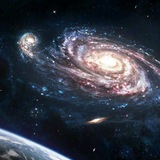
Hubble: Your friendly neighborhood space telescope!
From right here in our solar system to deep space, Hubble’s observations have lent a “helping hand” to several other missions – including preparatory work for the NASA Webb Space Telescope, which is expected to launch on December 24!
Read more at the link in our bio.
From right here in our solar system to deep space, Hubble’s observations have lent a “helping hand” to several other missions – including preparatory work for the NASA Webb Space Telescope, which is expected to launch on December 24!
Read more at the link in our bio.
Look, Ma, four cavities!
A pair of supermassive black holes could be behind a set of cosmic cavities, or bubbles, recently spotted by our orbiting NASA chandraxray observatory. The four bubbles were detected 3.9 billion light-years from Earth in a galaxy cluster, a collection of hot gas, dark matter and thousands of galaxies that is among the largest structures in the universe held together by gravity.
Many galaxy clusters have a pair of cavities, caused by a single black hole spewing out twin streams of matter from the cluster's center, but this is the first known instance of a galaxy cluster with four massive bubbles instead of two. Astronomers hypothesize that a single black hole which quickly flipped on its side could also be behind this galactic oddity.
These images show the galaxy cluster RBS 797 as seen in X-rays by Chandra, visualized here in blue and white, alongside a photo of the cluster as seen in visible light by NASA hubble.
A pair of supermassive black holes could be behind a set of cosmic cavities, or bubbles, recently spotted by our orbiting NASA chandraxray observatory. The four bubbles were detected 3.9 billion light-years from Earth in a galaxy cluster, a collection of hot gas, dark matter and thousands of galaxies that is among the largest structures in the universe held together by gravity.
Many galaxy clusters have a pair of cavities, caused by a single black hole spewing out twin streams of matter from the cluster's center, but this is the first known instance of a galaxy cluster with four massive bubbles instead of two. Astronomers hypothesize that a single black hole which quickly flipped on its side could also be behind this galactic oddity.
These images show the galaxy cluster RBS 797 as seen in X-rays by Chandra, visualized here in blue and white, alongside a photo of the cluster as seen in visible light by NASA hubble.
This media is not supported in your browser
VIEW IN TELEGRAM
Servicing Mission 3A launched in 1999 to “wake up” Hubble after the telescope switched into safe mode following the failures of four of its six gyroscopes.
Music credit: “Achieving the Impossible” by Joel Goodman [ASCAP] and Vicente Julio Ortiz Gimeno [SGAE] via Medley Lane Music [ASCAP] and Universal Production Music
Music credit: “Achieving the Impossible” by Joel Goodman [ASCAP] and Vicente Julio Ortiz Gimeno [SGAE] via Medley Lane Music [ASCAP] and Universal Production Music
We've touched the Sun!
For the first time in history, a spacecraft has entered the solar corona—the point in the Sun's atmosphere where its magnetism and gravity are strong enough to stop solar material from escaping. Our Parker Solar Probe, launched in 2018, first swooped through the Sun's corona for a short period earlier this year.
Just as landing on the Moon allowed scientists to understand how it was formed, touching the very stuff the Sun is made of will help scientists uncover critical information about our closest star and its influence on the solar system. For example, Parker Solar Probe's journey through the corona is already helping astrophysicists understand the origins of unusual zig-zags found in the solar wind that flows past Earth and planets beyond. Parker has already made ten fly-bys of the Sun and will continue to swirl ever-closer as it collects data over the next four years.
The image seen here was taken by our Solar Dynamics Observatory in March 2012, as a giant eruption of solar mate
For the first time in history, a spacecraft has entered the solar corona—the point in the Sun's atmosphere where its magnetism and gravity are strong enough to stop solar material from escaping. Our Parker Solar Probe, launched in 2018, first swooped through the Sun's corona for a short period earlier this year.
Just as landing on the Moon allowed scientists to understand how it was formed, touching the very stuff the Sun is made of will help scientists uncover critical information about our closest star and its influence on the solar system. For example, Parker Solar Probe's journey through the corona is already helping astrophysicists understand the origins of unusual zig-zags found in the solar wind that flows past Earth and planets beyond. Parker has already made ten fly-bys of the Sun and will continue to swirl ever-closer as it collects data over the next four years.
The image seen here was taken by our Solar Dynamics Observatory in March 2012, as a giant eruption of solar mate
Baby, it’s icy outside. 🧊
This icefield of the southern Andes mountains was captured by an astronaut aboard the International Space Station. The mountain peaks here reach high enough and temperatures remain cold enough year-round that permanent ice persists amid a warming world. It was significantly larger about 18,000 years ago, during the coldest phase of the last Ice Age, covering almost the entire view in this image—an enormous area considering that the present icefield is more than 100 kilometers (60 miles) long.
Glacial ice moves slowly downhill under its own weight. As it flows, it cuts valleys into the underlying rocks. There have been several ice ages in the past, and scientists now know that the lakes at the top of this image and the network of valleys (fjords) at the bottom were gouged out by the erosion of moving glacial ice when the icefields were much larger.
In a recently published survey of glaciers, scientists showed that the Patagonian icefields follow the global trend of ice melt
This icefield of the southern Andes mountains was captured by an astronaut aboard the International Space Station. The mountain peaks here reach high enough and temperatures remain cold enough year-round that permanent ice persists amid a warming world. It was significantly larger about 18,000 years ago, during the coldest phase of the last Ice Age, covering almost the entire view in this image—an enormous area considering that the present icefield is more than 100 kilometers (60 miles) long.
Glacial ice moves slowly downhill under its own weight. As it flows, it cuts valleys into the underlying rocks. There have been several ice ages in the past, and scientists now know that the lakes at the top of this image and the network of valleys (fjords) at the bottom were gouged out by the erosion of moving glacial ice when the icefields were much larger.
In a recently published survey of glaciers, scientists showed that the Patagonian icefields follow the global trend of ice melt
Outroll, outexplore, outlast!
Surviving more than 3,300 Martian days (or sols) since its landing, NASA's Curiosity rover has been trekking across Gale Crater since 2011 on its quest for signs of long-ago life on the Red Planet.
In the meanwhile, it's snapped some great pictures, too! This 360-degree selfie is a combination of 81 individual photos taken using the Mars Hand Lens Imager (MAHLI) at the end of Curiosity's robotic arm. This selfie was taken near Greenheugh Pediment, which Curiosity previously climbed in 2020; Curiosity is headed towards Maria Gordon Notch, the U-shaped opening behind the rover to the left.
Surviving more than 3,300 Martian days (or sols) since its landing, NASA's Curiosity rover has been trekking across Gale Crater since 2011 on its quest for signs of long-ago life on the Red Planet.
In the meanwhile, it's snapped some great pictures, too! This 360-degree selfie is a combination of 81 individual photos taken using the Mars Hand Lens Imager (MAHLI) at the end of Curiosity's robotic arm. This selfie was taken near Greenheugh Pediment, which Curiosity previously climbed in 2020; Curiosity is headed towards Maria Gordon Notch, the U-shaped opening behind the rover to the left.
🏠 How's that for curb appeal?
On their way back to Earth last month, our Crew-2 astronauts made a loop around the ISS in their SpaceX Crew Dragon spacecraft, taking a number of pictures which we've now assembled into this new photo album of our orbiting laboratory.
Long-time spacewatchers may be excited to see the new ISS Roll-Out Solar Array on the right side of these photos, a flexible solar panel that could provide a compact source of energy for future space missions. We've been making our home on the International Space Station for more than 20 years, working with countries around the world to study how to live in space while making life better back on Earth.
On their way back to Earth last month, our Crew-2 astronauts made a loop around the ISS in their SpaceX Crew Dragon spacecraft, taking a number of pictures which we've now assembled into this new photo album of our orbiting laboratory.
Long-time spacewatchers may be excited to see the new ISS Roll-Out Solar Array on the right side of these photos, a flexible solar panel that could provide a compact source of energy for future space missions. We've been making our home on the International Space Station for more than 20 years, working with countries around the world to study how to live in space while making life better back on Earth.
This media is not supported in your browser
VIEW IN TELEGRAM
Who’s ready for the NASA Webb Space Telescope? 🙋♀️
Like with Hubble, Webb's launch will usher in a new era of astronomy.
Webb will see beyond Hubble’s infrared vision to expand our perspective to the far reaches of the universe. Working with Webb, Hubble’s visible and ultraviolet vision will complement Webb’s infrared views.
This powerful duo will provide us with staggering cosmic vistas, the likes of which we have only imagined.
Like with Hubble, Webb's launch will usher in a new era of astronomy.
Webb will see beyond Hubble’s infrared vision to expand our perspective to the far reaches of the universe. Working with Webb, Hubble’s visible and ultraviolet vision will complement Webb’s infrared views.
This powerful duo will provide us with staggering cosmic vistas, the likes of which we have only imagined.
Now presenting… NGC 3568!
This HubbleFriday image shows a spectacular galaxy that’s about 57 million light-years from our Milky Way Galaxy in the constellation Centaurus.
Fun fact: In 2014, light from a supernova explosion within NGC 3568 reached Earth. It was discovered by amateur astronomers from the Backyard Observatory Supernova Search in New Zealand.
Find out more at the link in our bio!
Image credits: ESA/Hubble & NASA, M. Sun
This HubbleFriday image shows a spectacular galaxy that’s about 57 million light-years from our Milky Way Galaxy in the constellation Centaurus.
Fun fact: In 2014, light from a supernova explosion within NGC 3568 reached Earth. It was discovered by amateur astronomers from the Backyard Observatory Supernova Search in New Zealand.
Find out more at the link in our bio!
Image credits: ESA/Hubble & NASA, M. Sun
We can’t wait to explore the universe with NASAwebb!
Hubble has helped pave Webb’s scientific path by making preparatory observations. For example, Hubble surveyed the star cluster Westerlund 2, located about 20,000 light-years away.
One of Webb’s main goals is to observe the birth of stars and protoplanetary systems.
Using Hubble, astronomers looked for binary stars in their earliest stages of development, where they are likely to be surrounded by protoplanetary disks – disks of dense gas and dust that encircle newly formed stars and eventually form into planets.
Westerlund 2 contains many binary stars, and is a prime candidate for future Webb observations.
Webb will launch no earlier than December 24. With its powerful infrared vision, our view of the universe is about to change forever!
But don’t worry – we aren’t going anywhere! With their complementary abilities, Hubble and Webb will work together to give us a more complete understanding of our universe.
Image credits: NASA, ESA, the Hubble Herit
Hubble has helped pave Webb’s scientific path by making preparatory observations. For example, Hubble surveyed the star cluster Westerlund 2, located about 20,000 light-years away.
One of Webb’s main goals is to observe the birth of stars and protoplanetary systems.
Using Hubble, astronomers looked for binary stars in their earliest stages of development, where they are likely to be surrounded by protoplanetary disks – disks of dense gas and dust that encircle newly formed stars and eventually form into planets.
Westerlund 2 contains many binary stars, and is a prime candidate for future Webb observations.
Webb will launch no earlier than December 24. With its powerful infrared vision, our view of the universe is about to change forever!
But don’t worry – we aren’t going anywhere! With their complementary abilities, Hubble and Webb will work together to give us a more complete understanding of our universe.
Image credits: NASA, ESA, the Hubble Herit
This media is not supported in your browser
VIEW IN TELEGRAM
Servicing Mission 3A launched in 1999 to “wake up” Hubble after the telescope switched into safe mode following the failures of four of its six gyroscopes.
Music credit: “Achieving the Impossible” by Joel Goodman [ASCAP] and Vicente Julio Ortiz Gimeno [SGAE] via Medley Lane Music [ASCAP] and Universal Production Music
Music credit: “Achieving the Impossible” by Joel Goodman [ASCAP] and Vicente Julio Ortiz Gimeno [SGAE] via Medley Lane Music [ASCAP] and Universal Production Music
Hubble 🤝 Chandra
This image of the Jewel Bug Nebula contains both visible light data from Hubble and X-ray data from NASA ChandraXray, giving us a more complete (and stunning!) understanding of this cosmic object.
Image credits: X-ray: NASA/CXC/RIT/SAO/J.Kastner; Optical: NASA/ESA/AURA/STScI/Univ. Washington, B.Balick)
This image of the Jewel Bug Nebula contains both visible light data from Hubble and X-ray data from NASA ChandraXray, giving us a more complete (and stunning!) understanding of this cosmic object.
Image credits: X-ray: NASA/CXC/RIT/SAO/J.Kastner; Optical: NASA/ESA/AURA/STScI/Univ. Washington, B.Balick)
Ten years ago, Hubble showed us this “snow angel” 😇
Called S106, this star-forming region is about 2,000 light-years away and resides in a relatively isolated part of our Milky Way Galaxy.
This Hubble Classic view stretches several light-years across!
Image credits: NASA, ESA, and the Hubble Heritage Team (STScI/AURA)
Called S106, this star-forming region is about 2,000 light-years away and resides in a relatively isolated part of our Milky Way Galaxy.
This Hubble Classic view stretches several light-years across!
Image credits: NASA, ESA, and the Hubble Heritage Team (STScI/AURA)
Journey to the center of the Milky Way!
Hubble helped detect evidence that our galaxy’s central black hole has a "mini-jet" that ejects superheated material. It periodically “hiccups” as stars and gas clouds fall into it!
This image of our galactic center features Hubble data. Find out more at the link in our bio!
Image credits: NASA, ESA, and Gerald Cecil (UNC-Chapel Hill); Image Processing: Joseph DePasquale (STScI)
Hubble helped detect evidence that our galaxy’s central black hole has a "mini-jet" that ejects superheated material. It periodically “hiccups” as stars and gas clouds fall into it!
This image of our galactic center features Hubble data. Find out more at the link in our bio!
Image credits: NASA, ESA, and Gerald Cecil (UNC-Chapel Hill); Image Processing: Joseph DePasquale (STScI)
This media is not supported in your browser
VIEW IN TELEGRAM
🔴 Red Bubble 🔴
The nebula SNR 0509-67.5 (nicknamed the Red Bubble) is the result of a supernova explosion of a star!
This sphere of gas is the result of gas that’s being shocked by the expanding blast wave of the supernova. The Red Bubble is 23 light-years across and is expanding at a rate of about 11 million miles per hour (5,000 kilometers per second)!
Visualization credits: NASA, ESA, and G. Bacon, T. Borders, L. Frattare, Z. Levay, and F. Summers (STScI)
Music credits: “Hoops and Hurdles,” Jonathan Raynal [SACEM], KTSA Publishing [SACEM], Universal Production Music
The nebula SNR 0509-67.5 (nicknamed the Red Bubble) is the result of a supernova explosion of a star!
This sphere of gas is the result of gas that’s being shocked by the expanding blast wave of the supernova. The Red Bubble is 23 light-years across and is expanding at a rate of about 11 million miles per hour (5,000 kilometers per second)!
Visualization credits: NASA, ESA, and G. Bacon, T. Borders, L. Frattare, Z. Levay, and F. Summers (STScI)
Music credits: “Hoops and Hurdles,” Jonathan Raynal [SACEM], KTSA Publishing [SACEM], Universal Production Music
Happy #InternationalMountainDay! ⛰
Hubble viewed its very own celestial "Mystic Mountain" in the Carina Nebula. This three-light-year-tall pillar of gas and dust is located about 7,500 light-years away from us.
This infrared view shows reveals stars behind the gaseous veil of the nebula's wall of hydrogen, laced with dust. The foreground pillar becomes semi-transparent because infrared light from background stars penetrates through much of the dust.
And if you haven't heard: The NASA Webb Space Telescope launches later this month, and with its powerful infrared capabilities, we’ll see spectacular infrared views of our universe!
Image credits: NASA, ESA, and M. Livio and the Hubble 20th Anniversary Team (STScI)
Hubble viewed its very own celestial "Mystic Mountain" in the Carina Nebula. This three-light-year-tall pillar of gas and dust is located about 7,500 light-years away from us.
This infrared view shows reveals stars behind the gaseous veil of the nebula's wall of hydrogen, laced with dust. The foreground pillar becomes semi-transparent because infrared light from background stars penetrates through much of the dust.
And if you haven't heard: The NASA Webb Space Telescope launches later this month, and with its powerful infrared capabilities, we’ll see spectacular infrared views of our universe!
Image credits: NASA, ESA, and M. Livio and the Hubble 20th Anniversary Team (STScI)
Media is too big
VIEW IN TELEGRAM
🌌 Happy Hubble Friday!
This week’s image shows the spiral galaxy UGC 11537, which lies about 230 million light-years away.
The two foreground stars are making a cosmic photobomb, as they’re actually within our galaxy, the Milky Way. Because UGC 11537 lies close to the plane of the Milky Way, these two stars crept into the image.
Hubble captured this view in visible and infrared light using Wide Field Camera 3. Find out more at the link in our bio!
Image credits: ESA/Hubble & NASA, A. Seth
This week’s image shows the spiral galaxy UGC 11537, which lies about 230 million light-years away.
The two foreground stars are making a cosmic photobomb, as they’re actually within our galaxy, the Milky Way. Because UGC 11537 lies close to the plane of the Milky Way, these two stars crept into the image.
Hubble captured this view in visible and infrared light using Wide Field Camera 3. Find out more at the link in our bio!
Image credits: ESA/Hubble & NASA, A. Seth
This media is not supported in your browser
VIEW IN TELEGRAM
Celestial lightsaber? 👀
Not quite. This is a Herbig-Haro object, which forms when a newborn star shoots twin jets out into space – sort of like a birth announcement to the universe!
Called HH24, this object is located inside a turbulent starbirth region known as the Orion B molecular cloud complex, located 1,350 light-years away.
Visualization credits: NASA, ESA, G. Bacon, L. Frattare, Z. Levay, and F. Summers (Viz3D Team, STScI); Acknowledgment: A. Fujii, Digitized Sky Survey (DSS), Palomar/Caltech, UKSTU/AAO, T. Rector (U Alaska Anchorage), H. Schweiker (WIYN), NOAO/AURA/NSF, Gemini Observatory, C. Aspin, the Hubble Heritage/Hubble-Europe Collaboration, D. Padgett (GSFC), T. Megeath (U Toledo), and B. Reipurth (U Hawaii)
Music credit: “Beyond Limits,” Stefan Merz [GEMA], Ed.Berlin Production Music / Universal Production Music GmbH [GEMA]
Not quite. This is a Herbig-Haro object, which forms when a newborn star shoots twin jets out into space – sort of like a birth announcement to the universe!
Called HH24, this object is located inside a turbulent starbirth region known as the Orion B molecular cloud complex, located 1,350 light-years away.
Visualization credits: NASA, ESA, G. Bacon, L. Frattare, Z. Levay, and F. Summers (Viz3D Team, STScI); Acknowledgment: A. Fujii, Digitized Sky Survey (DSS), Palomar/Caltech, UKSTU/AAO, T. Rector (U Alaska Anchorage), H. Schweiker (WIYN), NOAO/AURA/NSF, Gemini Observatory, C. Aspin, the Hubble Heritage/Hubble-Europe Collaboration, D. Padgett (GSFC), T. Megeath (U Toledo), and B. Reipurth (U Hawaii)
Music credit: “Beyond Limits,” Stefan Merz [GEMA], Ed.Berlin Production Music / Universal Production Music GmbH [GEMA]
👍1
This media is not supported in your browser
VIEW IN TELEGRAM
Why can you see the Moon during the day? 🌕
Easy, because it’s there! It may seem odd to look up at the daytime sky and see the Moon but it’s perfectly natural. Planetary geologist Sarah Noble breaks it down so you know when to look up.
Easy, because it’s there! It may seem odd to look up at the daytime sky and see the Moon but it’s perfectly natural. Planetary geologist Sarah Noble breaks it down so you know when to look up.
Nestled atop an Arianespace Ariane 5 rocket, the James Webb Space Telescope rolled out to the launchpad on Dec. 23, 2021, at Europe’s Spaceport in Kourou, French Guiana. Webb will study every phase of the cosmos—from our own solar system to galaxies formed 13.5 billion years ago, just after the Big Bang. A colossal collaboration between NASA, the European Space Agency, and the Canadian Space Agency, Webb will revolutionize our understanding of the universe.
Liftoff is set for Dec. 25 at 7:20 a.m. EST (12:20 UTC)
Liftoff is set for Dec. 25 at 7:20 a.m. EST (12:20 UTC)