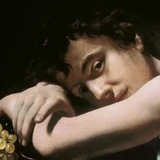
Rupert Bunny
"Summer time"
1907 #Bunny
"Summer time"
1907 #Bunny
Bunny was the first Australian to receive an honourable mention in 1890 at the Salon for the painting Tritons (1890). He also exhibited works internationally, including in Australia, America and England. Sea Idlyll, exhibited in the Royal Academy, was bought by Alfred Felton, who gave it to the National Gallery of Victoria in 1892. This was to be the first painting of Bunny's that an Australian gallery obtained.
More from this artist:
#Bunny@privateart
Boost the channel:
t.me/boost/privateart
3
Ihei Kimura
1901 - 1974
1901 - 1974
The father of candid photography in Japan and famous Leica user. After his death, the prestigious Ihei Kimura Award was established in his honor, cementing his legacy.
More from this artist:
#Kimura@privateart
Boost the channel:
t.me/boost/privateart
2
Jean-Louis Forain
"The Client"
1878 #Forain
"The Client"
1878 #Forain
This one was largely ignored when it was first shown at the Impressionist exhibition (in 1880). However now it's one of Forain’s most famous works. I like the floor.
More from this artist:
#Forain@privateart
Boost the channel:
t.me/boost/privateart
3
John Lavery
"Winston Churchill"
1915 #Lavery
"Winston Churchill"
1915 #Lavery
That was a turbulent year for Churchill: that spring he resigned as First Lord of the Admiralty after the failure of the Dardanelles campaign and quit his job
More from this artist:
#Lavery@privateart
Boost the channel:
t.me/boost/privateart
1
Arnold Genthe
"Ruth St. Denis"
1928 #Genthe
"Ruth St. Denis"
1928 #Genthe
Ruth St. Denis was one of the first American dancers to reject classical ballet and create a new form of dance based on emotion.
Together with Ted Shawn, she founded the Denishawn School, which shaped an entire generation of modern dancers, including Martha Graham, Doris Humphrey, and Charles Weidman
More from this artist:
#Genthe@privateart
Boost the channel:
t.me/boost/privateart
3
Jean-Baptiste Pillement
"A Wreck at the Rocky Seaside"
1748 #Pillement
"A Wreck at the Rocky Seaside"
1748 #Pillement
Pillement was born and died in Lyon, but had an unusually cosmopolitan career. In 1743, at the age of 15, he moved from Lyon to Paris where he was employed by Jean-Baptiste Oudry as an apprentice designer at the "Manufacture de Beauvais". In 1745 he left for Madrid, where he remained for five years. There he found employment in various cities as both a designer and painter.
In 1750, at the age of 22, he moved to Lisbon. The lure of travel compelled him to decline an offer to become court painter to King Joseph of Portugal, and he worked at Queluz for Jan Gildemeester
More from this artist:
#Pillement@privateart
Boost the channel:
t.me/boost/privateart
3
Thucydides Mosaic from Jerash
Early 3rd century AD
Early 3rd century AD
"The strong do what they can, the weak suffer what they must" - Thucydides
Athenian historian and general. His History of the Peloponnesian War recounts the fifth-century BC war between Sparta and Athens until the year 411 BC. Thucydides has been dubbed the father of "scientific history" by those who accept his claims to have applied strict standards of impartiality and evidence-gathering and analysis of cause and effect, without reference to intervention by the gods, as outlined in his introduction to his work.
Now at Pergamon Museum in Berlin
Boost the channel:
t.me/boost/privateart
2
David Cox
"Fishing off Hastings"
1812 #Cox
"Fishing off Hastings"
1812 #Cox
David Cox looked like this and was an English landscape painter, one of the most important members of the Birmingham School of landscape artists and an early precursor of Impressionism
He is considered one of the greatest English landscape painters, and a major figure of the Golden age of English watercolour.
His son David Cox the Younger was also a successful artist.
More from this artist:
#Cox@privateart
Boost the channel:
t.me/boost/privateart
2
Ernest Meissonier
"The Three Friends"
1847 #Meissonier
"The Three Friends"
1847 #Meissonier
Meissonier became known as the French Metsu, a reference to the seventeenth-century Dutch painter Gabriel Metsu, who specialised in miniature scenes of bourgeois domestic life; "grandiose history paintings did not sell as readily as smaller canvases such as landscapes or portraits, which fitted more easily onto the walls of Paris apartments". He specialised in scenes from seventeenth- and eighteenth-century life, portraying his bonshommes, or goodfellows - playing chess, smoking pipes, reading books, sitting before easels or double basses, or posing in the uniforms of musketeers or halberdiers all executed in microscopic detail. Typical examples include Halt at an Inn, owned by the Duc de Morny and The Brawl, which was owned by Queen Victoria.
More from this artist:
#Meissonier@privateart
Boost the channel:
t.me/boost/privateart
4
John Everett Millais
"The Order of Release 1746"
1852 #Millais
"The Order of Release 1746"
1852 #Millais
Here is the release of a Jacobite soldier, imprisoned by the English after the defeat of Bonnie Prince Charlie's army at the battle of Culloden in 1746. The Jacobite's wife hands an order of release to the gaoler. Millais(Sir John) based the figure of the woman on his wife, Effie.
More from this artist:
#Millais@privateart
Boost the channel:
t.me/boost/privateart
2
Lysippos
"Bust of Aristotle"
330 BC #Lysippos
"Bust of Aristotle"
330 BC #Lysippos
“The antidote for fifty enemies is one friend.”
- Aristotle
This marble portrait of the philosopher Aristotle was copied from a bronze sculpture made in the first or second century by Lysippos, who is considered to be one of the three most prolific and imitated artists of Classical Greece. So many copies were made of Lysippos’s work by his studio of assistants and by imitators, today it’s extremely difficult to identify which sculptures were actually made by the artist himself.
More from this artist:
#Lysippos@privateart
Boost the channel:
t.me/boost/privateart
13
Antonio Canova
"Monument to Maria Christina of Austria - detail"
1800 #Canova
"Monument to Maria Christina of Austria - detail"
1800 #Canova
Maria Christina, Duchess of Teschen (Maria Christina Johanna Josepha Antonia), was the fifth child of Maria Theresa of Austria and Francis I, Holy Roman Emperor.
Married in 1766 to Prince Albert of Saxony, the couple received the Duchy of Teschen, and she was appointed Governor of the Austrian Netherlands jointly with her husband during 1781–1789 and 1791–1792. After two expulsions from the Netherlands (in 1789 and 1792), she lived with her husband in Vienna until her death.
More from this artist:
#Canova@privateart
Boost the channel:
t.me/boost/privateart
3