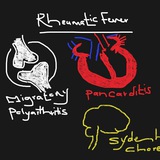
هذا ملخص للشيت الأول cvs تقدرو تراجعو منه يلم الموضوع بشكل أسرع 💜 تلقو pdf ف القناة
Forwarded from Deleted Account
ملخص cvs 1.pdf
614.4 KB
Audio
مراجعة سريعة لإجابات الشورت نوت المتوقعة في كورس CVS ، الأسئلة تلقوهن تحت هنا 👇
Forwarded from Pathology 51 🔥
CVS Short Note.pdf
116 KB
في سؤال رقم 13 الغوه لانه مش موجود السنة هذي ( cvs short note )
Q13. A 40-year-old woman with a history of rheumatic fever presents with shortness of breath, weight loss, fatigue, and abdominal distension. Physical examination shows rales in the lungs, hepatosplenomegaly, and 2+ pitting edema of the legs. A chest
X-ray reveals only left atrial enlargement and pulmonary edema. What is the most likely cause of pulmonary edema in this patient?
(A) Aortic insufficiency
(B) Aortic stenosis
(C) Mitral stenosis
(D) Pulmonic stenosis
(E) Tricuspid insufficiency
X-ray reveals only left atrial enlargement and pulmonary edema. What is the most likely cause of pulmonary edema in this patient?
(A) Aortic insufficiency
(B) Aortic stenosis
(C) Mitral stenosis
(D) Pulmonic stenosis
(E) Tricuspid insufficiency
Q14.A 30-year-old woman presents with a heart murmur. There is a history of recurrent episodes of arthritis, skin rash, and glomerulonephritis. Blood cultures are negative. Laboratory tests for antinuclear antibodies (ANA) and anti–double-stranded DNA are positive. Which of the following is the most likely cause of heart murmur in this patient?
(A) Libman-Sacks endocarditis
(B) Mitral valve prolapse
(C) Myocardial infarct
(D) Mitral valve prolapse
(E) Rheumatic fever
(A) Libman-Sacks endocarditis
(B) Mitral valve prolapse
(C) Myocardial infarct
(D) Mitral valve prolapse
(E) Rheumatic fever
Q15 .A 62-year-old man with a history of hypertension is brought to the emergency room with severe left chest and back pain. His blood pressure is 80/50 mm Hg. Physical examination shows pallor, diaphoresis, and a murmur of aortic regurgitation. An ECG does not show myocardial infarction. An X-ray film of the chest reveals mediastinal widening. Which of the
following is the most likely diagnosis?
(A) Bacterial endocarditis
(B) Dissecting aneurysm
(C) Pericarditis
(D) Pulmonary thromboembolism
(E) Ruptured myocardial wall
following is the most likely diagnosis?
(A) Bacterial endocarditis
(B) Dissecting aneurysm
(C) Pericarditis
(D) Pulmonary thromboembolism
(E) Ruptured myocardial wall
👍1
حاولت نغطي مواضيع متنوعة من cvs ب cases نزلت 15 case ، حنبدا توا نزل مجموعة على neoplasia 💜
Q1. A 65-year-old man complains of muscle weakness and a dry cough for 4 months. He has smoked two packs of cigarettes daily for 45 years. A chest X-ray shows a 4-cm central, left lung mass. Laboratory studies reveal hyperglycemia and hypertension. A transbronchial biopsy is diagnosed as small cell carcinoma. Metastases to the liver are detected by CT scan.
Which of the following might account for the development of hyperglycemia and hypertension in this patient?
(A) Adrenal metastases
(B) Paraneoplastic syndrome
(C) Pituitary adenoma
(D) Pituitary metastases
(E) Thrombosis of the renal artery
Which of the following might account for the development of hyperglycemia and hypertension in this patient?
(A) Adrenal metastases
(B) Paraneoplastic syndrome
(C) Pituitary adenoma
(D) Pituitary metastases
(E) Thrombosis of the renal artery