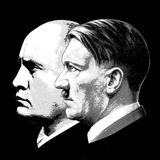
February 1885 – October 1946
Julius Streicher was born on February 12, 1885, in Fleinhausen, a village in Bavaria, Germany. Initially trained as a teacher, he joined the German Army during World War I and was awarded the Iron Cross for bravery.
After the war, during the politically turbulent years in Germany, Streicher gravitated toward radical right-wing ideologies. In 1922, he became a member of the National Socialist German Workers’ Party (NSDAP). In 1923, he founded and published Der Stürmer, a newspaper infamous for its antisemitic content. The publication became a key tool in the NSDAP’s propaganda efforts. Streicher was appointed Gauleiter (regional leader) of Franconia in 1929, solidifying his role as a prominent figure within the party.
After World War II, Streicher was tried at the Nuremberg Trials for crimes against humanity, particularly for his role in promoting antisemitic propaganda that contributed to the Holocaust. He was found guilty and executed by hanging on October 16, 1946.
#germany
@namesguide
Please open Telegram to view this post
VIEW IN TELEGRAM
October 1890 - April 1944
Adolf Wagner was born on October 1, 1890, in Algringen, Alsace-Lorraine. He served in World War I, where he was injured twice and lost his leg. After the war, he moved to Bavaria and joined the National Socialist German Workers’ Party (NSDAP) in 1923. He became Gauleiter of Upper Palatinate in 1928 and later of Munich and Upper Bavaria. Wagner held several political positions, including Bavarian Minister of the Interior and Education, and was involved in organizing forced labor for the war effort during World War II.
Wagner struggled with chronic alcoholism, and after suffering a stroke in 1942, his health declined. He died on April 12, 1944, from a second stroke.
Related Contents
t.me/hitlermediaarchive/349
t.me/hitlermediaarchive/279
#germany
@namesguide
Please open Telegram to view this post
VIEW IN TELEGRAM
January 1881 – April 1942
Albert Reich was born on January 14, 1881, in Neumarkt in der Oberpfalz, Germany. He studied at the art academies in Nuremberg and Munich. During World War I, he served as a war artist with the German army. After the war, he created illustrations and designed war memorials. A supporter of the NS Party, Reich designed the cover for the first edition of Adolf Hitler’s Mein Kampf.
Reich passed away on April 12, 1942, in Munich due to a sudden illness. He was posthumously awarded the title of professor and was buried at the Munich Waldfriedhof.
Related Contents
t.me/hitlermediaarchive/298
#germany
@namesguide
Please open Telegram to view this post
VIEW IN TELEGRAM
June 1908 - July 1975
Otto Skorzeny was born in Vienna in 1908. Despite studying engineering, he became one of Nazi Germany’s most notable special operations officers during World War II. Known for his courage and strategic mind, Skorzeny successfully led the operation to rescue Benito Mussolini from captivity in Gran Sasso in 1943. In 1944, he organized a regime change in Hungary and carried out infiltration missions behind enemy lines during the Ardennes Offensive.
After the war, Skorzeny was briefly imprisoned but escaped to Spain in 1948, where he lived in exile. He later worked as a military advisor in countries like Egypt and Argentina. Leading a life filled with adventure and risk, Skorzeny passed away in Madrid in 1975 due to lung cancer.
Otto Skorzeny was recognized as one of Adolf Hitler’s most trusted officers. For his bravery and military achievements, he was awarded Germany’s most prestigious military decoration, the Knight’s Cross of the Iron Cross (Ritterkreuz).
Related Contents
t.me/hitlermediaarchive/111
#germany
@namesguide
Please open Telegram to view this post
VIEW IN TELEGRAM
November 1891 – March 1957
Max Amann was born on November 24, 1891, in Munich. After completing his education, he worked as a sales apprentice before joining the 1st Royal Bavarian Infantry Regiment in 1912. During World War I, he served as a Feldwebel (sergeant) in the 16th Royal Bavarian Reserve Infantry Regiment alongside Adolf Hitler. After the war, he joined the National Socialist German Workers’ Party (NSDAP) in 1921 and became the head of its publishing house, Franz Eher Nachfolger Verlag. He played a crucial role in publishing Mein Kampf, convincing Hitler to adopt its title, and turned the book into a financial success.
In 1933, Amann was appointed Reich Press Leader and President of the Reich Press Chamber, overseeing the Party’s control of the media. By 1942, he controlled around 80% of German newspapers. After the war, Amann was arrested by American forces, classified as a Hauptschuldiger (major offender) in the denazification process, and sentenced to ten years in a labor camp. He was released in 1953 but lost his wealth and pension rights. Max Amann died in poverty on March 30, 1957, in Munich, unfortunately.
Related Contents
t.me/hitlermediaarchive/333
t.me/hitlermediaarchive/93
#germany
@namesguide
Please open Telegram to view this post
VIEW IN TELEGRAM
September 1891 - February 1942
Fritz Todt was born on September 4, 1891, in Pforzheim, Germany. He studied civil engineering at the Technical Universities of Munich and Karlsruhe. During World War I, he served in the German army and later pursued a career in engineering.
In 1933, he was appointed by Adolf Hitler as the Inspector General of Highways and oversaw the construction of Germany’s autobahn network, one of the largest infrastructure projects of the time. In 1938, he established the Todt Organization, which utilized forced labor for large-scale construction projects. In 1940, he was named Minister for Armaments and Munitions.
On February 8, 1942, he died in a plane crash near Rastenburg, East Prussia. His death was considered a significant loss for Germany.
Related Contents
t.me/hitlermediaarchive/333
t.me/hitlermediaarchive/85
#germany
@namesguide
Please open Telegram to view this post
VIEW IN TELEGRAM
June 1900 - June 1985
Johanna Wolf was born on June 1, 1900, in Munich. After completing her primary and commercial education, she worked for Dr. Alexander Glaser at the Bavarian Diet from 1922 to 1928. She later joined the NS Party’s Lower Bavaria-Upper Palatinate Gau headquarters, where she worked for Gregor Strasser. In the autumn of 1929, Wolf became a typist in Adolf Hitler’s personal secretariat and officially joined the NS Party. When Hitler became chancellor in 1933, she was promoted to senior secretary in his Private Chancellery. She was one of Hitler’s earliest and most trusted secretaries, and he nicknamed her “Wölfin” (She-Wolf), a title he gave to no other secretary.
From 1941 to November 20, 1944, she resided at Wolfsschanze (Wolf’s Lair), Hitler’s military headquarters on the Eastern Front. In January 1945, she moved to the Führerbunker in Berlin with Hitler and his staff. However, on the night of April 21-22, 1945, following Hitler’s decision to remain in Berlin and face death, Wolf and her colleague Christa Schroeder were sent to Berchtesgaden via Salzburg. After the war, she was arrested by American forces in Bad Tölz on May 23, 1945, and detained until January 14, 1948. After her release, she settled in Kaufbeuren and lived a quiet life. Johanna Wolf passed away on June 5, 1985, in Munich. The exact cause of her death has not been publicly disclosed.
Related Contents
t.me/hitlermediaarchive/328
#germany
@namesguide
Please open Telegram to view this post
VIEW IN TELEGRAM
July 1887 – October 1945
Vidkun Abraham Lauritz Jonssøn Quisling was born on July 18, 1887, in Fyresdal, Telemark, Norway. His father, Jon Lauritz Qvisling, was a church pastor and genealogist. He enrolled in the Norwegian Military Academy in 1905, excelling in his studies and graduating with distinction. In 1911, he joined the army and served in the General Staff.
During the 1920s, Quisling worked in the Norwegian diplomatic mission in the Soviet Union, participating in humanitarian aid projects. From 1931 to 1933, he served as Norway’s Minister of Defense under the Agrarian Party government. On May 13, 1933, he co-founded the fascist-leaning Nasjonal Samling (National Unity) party with Johan Bernhard Hjort. However, the party failed to gain significant electoral success.
On April 9, 1940, during Germany’s invasion of Norway, Quisling attempted to seize power through a radio coup, but his effort was unsuccessful. On February 1, 1942, he was appointed Minister President with German approval and collaborated with the occupying forces throughout the war. His administration participated in the persecution and deportation of Jews in Norway.
After the war, Quisling was arrested and tried for treason, murder, and other crimes. He was found guilty on all charges and sentenced to death. On October 24, 1945, he was executed by firing squad at Akershus Fortress in Oslo.
Related Contents
t.me/hitlermediaarchive/346
#norway
@namesguide
Please open Telegram to view this post
VIEW IN TELEGRAM
April 1881 – May 1946
Albert Viljam Hagelin was born on April 24, 1881, in Bergen, Norway. His father, Harald Joachim Hagelin, was a jeweler whose family had migrated from Sweden to Norway in the early 18th century. His mother, Gerd Anna Hedvig Eleonore Meyer, was of Danish descent. In 1900, Hagelin moved to Germany, where he studied architecture at Dresden Technical University. Encouraged by Nina Grieg, he also pursued music and performed in opera roles in Berlin and Dresden.
Hagelin lived in Germany for nearly 40 years, engaging in various business activities. In 1912, he married the daughter of a Bremen-based import company owner and expanded his wealth through stock market speculation, coffee trading, art dealing, and hotel management. After his wife’s passing in 1935, he married her cousin, Gertrud Gudrun Eckstein, in 1936.
In 1939, Hagelin returned to Norway and joined Nasjonal Samling (NS), the fascist party led by Vidkun Quisling. That same year, he helped arrange Quisling’s meetings with Adolf Hitler. Following Germany’s invasion of Norway on April 9, 1940, Hagelin was appointed Minister of Trade and Supplies in Quisling’s provisional government. On September 25, 1940, he became Minister of the Interior, a role he continued under Quisling’s “national government” from February 1, 1942. He played a significant role in restructuring local administrations and aligning public governance with German interests.
After World War II, Hagelin was tried for treason and sentenced to death. On May 25, 1946, he was executed by firing squad at Akershus Fortress in Oslo.
Related Contents
t.me/hitlermediaarchive/346
#norway
@namesguide
Please open Telegram to view this post
VIEW IN TELEGRAM
March 1904 – January 2003
Gerhardine “Gerdy” Troost was born on March 3, 1904, in Stuttgart. Her father, Johannes Andresen, was an architect. After completing her education, she worked in her father’s firm and met architect Paul Ludwig Troost in 1923. In 1924, she moved to Munich, and in 1925, they got married. Through her husband, she met Adolf Hitler in 1930 and joined the NSDAP in 1932.
After Paul Ludwig Troost’s death in 1934, Gerdy Troost took over his architectural and design firm, working alongside his former associate Leonhard Gall. During this period, she oversaw projects such as the construction of the Haus der Kunst, the redesign of Königsplatz, and the erection of the Ehrentempel memorials. Additionally, she was responsible for the interior renovations of Hitler’s official and private residences, including the Old Reich Chancellery in Berlin, Berghof in Obersalzberg, and his Munich apartment.
Troost remained a key architectural and design consultant within Hitler’s circle until the end of the war. In 1943, she received a 100,000 Reichsmark donation from Hitler. During the denazification process after World War II, she was classified as “less responsible,” fined 500 DM, and banned from practicing her profession for 10 years. After this period, she resumed her work and lived in Schützing, near Lake Chiemsee in Upper Bavaria.
Gerdy Troost passed away on January 30, 2003, at the age of 98 in Bad Reichenhall. The cause of death was not specified.
Related Contents
t.me/hitlermediaarchive/349
#germany
@namesguide
Please open Telegram to view this post
VIEW IN TELEGRAM
December 1920 - April 2019
Verena Wagner Lafferentz was born on December 2, 1920, in Bayreuth, Germany. She was the granddaughter of the famous composer Richard Wagner and the daughter of Siegfried and Winifred Wagner. She spent her childhood in Bayreuth and attended a rural school in Obernkirchen.
In 1943, she married Bodo Lafferentz, a member of the National Socialist German Workers’ Party and an SS-Obersturmbannführer. The couple had five children. After World War II, Verena Wagner did not take on an active role in the arts but occasionally participated in events honoring her grandfather’s legacy, including the Bayreuth Festival.
She spent her later years in Überlingen, Germany, where she passed away on April 19, 2019, at the age of 98. The cause of death was not disclosed.
Related Contents
t.me/hitlermediaarchive/364
#germany
@namesguide
Please open Telegram to view this post
VIEW IN TELEGRAM
January 1894 - August 1943
Boris III was born on January 30, 1894, in Sofia, Bulgaria. His father was Ferdinand I, and his mother was Princess Marie Louise of Bourbon-Parma. Although his parents were Catholic, he was raised Orthodox for political reasons.
After graduating from the Sofia Military School at a young age, Boris participated in the Balkan Wars and served as a liaison officer in the Bulgarian Army’s General Staff during World War I on the Macedonian Front. He was promoted to colonel in 1916 and general in 1918.
On October 4, 1918, following the abdication of his father, Ferdinand I, Boris III became the King of Bulgaria. During his reign, he married Princess Giovanna of Italy in 1930, strengthening relations between Bulgaria and Italy. In 1934, a military coup took place in Bulgaria, but Boris soon regained control, appointing Georgi Kyoseivanov as prime minister in 1935 and effectively establishing an absolute monarchy.
During World War II, Bulgaria joined the Axis Powers in March 1941, allowing German troops to pass through its territory. However, Boris resisted pressure to declare war on the Soviet Union, striving to maintain Bulgaria’s independence.
On August 28, 1943, shortly after meeting with Adolf Hitler, Boris III died suddenly upon his return to Sofia. The official cause of death was reported as heart failure, but speculation about possible poisoning persists.
Related Contents
t.me/hitlermediaarchive/366
#bulgaria
@namesguide
Please open Telegram to view this post
VIEW IN TELEGRAM
January 1850 – May 1936
Karl Litzmann was born on January 22, 1850, in Neuglobsow, Stechlin, Brandenburg, Germany. He began his military career in 1867 in Berlin and participated in the Franco-Prussian War of 1870-1871. He was promoted to colonel in 1895 and to major general (Generalmajor) in 1898. From 1902 to 1905, he served as the director of the Prussian War Academy (Kriegsakademie). In 1905, he was forced into early retirement due to disagreements with the Great General Staff.
With the outbreak of World War I, Litzmann was recalled to active service and appointed commander of the 3rd Guards Division (3. Garde-Division). He gained fame for his victory against Russian forces near Brzeziny, Poland, earning the title “Lion of Brzeziny.” For his military achievements, he was awarded the Pour le Mérite on November 29, 1914, with Oak Leaves added on August 18, 1915. Despite these honors, he declined an aristocratic title offered by the German Emperor.
Following Germany’s defeat in 1918, Litzmann opposed the Treaty of Versailles and the Weimar Republic, aligning himself with nationalist circles. In 1929, he joined the National Socialist German Workers’ Party (NSDAP) and the Sturmabteilung (SA). In 1932, he was elected to the Prussian State Parliament and, as the oldest member of the Reichstag, delivered the opening speech. During this speech, he criticized Reich President Paul von Hindenburg and advocated for Adolf Hitler’s appointment as Chancellor.
In 1933, he was appointed a member of the Prussian State Council by Hermann Göring, a position he held until his death. Karl Litzmann passed away on May 28, 1936, in Neuglobsow. His funeral was conducted with state honors.
In 1939, following the German administration’s occupation of Poland, the cities of Łódź and Brzeziny were renamed “Litzmannstadt” and “Löwenstadt” in his honor. After World War II, these cities reverted to their original Polish names.
Related Contents
t.me/hitlermediaarchive/370
#germany
@namesguide
Please open Telegram to view this post
VIEW IN TELEGRAM
February 1888 – April 1968
Franz Pfeffer von Salomon was born on February 19, 1888, in Düsseldorf, Germany. He served in the German army during World War I and later joined the paramilitary Freikorps movement. In the 1920s, he became a member of the NSDAP and one of Adolf Hitler’s loyal supporters.
In 1926, Hitler appointed him as the first leader of the SA, the party’s paramilitary wing. Pfeffer von Salomon organized the SA to strengthen the party’s influence through street demonstrations and violent confrontations. However, in 1930, he was dismissed from his position after a disagreement with Hitler, and Ernst Röhm took his place.
After the NSDAP came to power, Pfeffer von Salomon distanced himself from politics. He did not play a significant role during or after World War II. He passed away on April 12, 1968, in West Germany.
Related Contents
t.me/hitlermediaarchive/387
t.me/hitlermediaarchive/41
#germany
@namesguide
Please open Telegram to view this post
VIEW IN TELEGRAM
October 1884 – January 1942
Walter von Reichenau was born on October 8, 1884, in Karlsruhe, Germany, into a Prussian aristocratic family. He began his military career in 1903 with the Imperial German Army and served in various positions during World War I. After the war, he remained in the Reichswehr and steadily rose through the ranks.
Following the rise of the National Socialist German Workers’ Party (NSDAP) in 1933, Reichenau became known for his ideological alignment with the regime. He was promoted to general in 1935 and given command of the 10th Army in 1938. He played key roles in the invasions of Poland and France, but he is most notably remembered as the commander of the 6th Army during Operation Barbarossa against the Soviet Union.
Reichenau was a staunch supporter of National Socialist ideology and actively encouraged its integration into the Wehrmacht.
Although he was considered for the position of Chief of the General Staff, Reichenau suffered a stroke in early 1942 during a front-line visit. He died of a heart attack on January 17, 1942, while being flown back to Germany.
Related Contents
t.me/hitlermediaarchive/403
#germany
@namesguide
Please open Telegram to view this post
VIEW IN TELEGRAM
June 1900 – May 1945
Martin Bormann was born on June 17, 1900, in Halberstadt, located in the German Empire. Initially trained in agriculture, Bormann served briefly in World War I and later became involved with right-wing paramilitary groups during the turbulent postwar years. In 1927, he joined the National Socialist German Workers’ Party (NSDAP), and by the early 1930s, he had become a key figure within the party’s administrative apparatus.
Bormann rose to prominence as the chief of staff to Rudolf Hess and eventually became one of Adolf Hitler’s closest aides. In 1943, after Hess’s flight to the United Kingdom, Bormann assumed greater influence as the head of the NS Party Chancellery. He managed access to Hitler, controlled internal party matters, and wielded immense bureaucratic power within the Third Reich.
Following Hitler’s suicide on April 30, 1945, Bormann attempted to flee Berlin. For many years, his fate was uncertain, leading to speculation about his possible escape. However, it was later confirmed that he died on May 2, 1945, near the Lehrter station in Berlin, likely by suicide while trying to avoid capture by Soviet forces. His remains were discovered and identified in 1972.
Related Contents
t.me/hitlermediaarchive/407
#germany
@namesguide
Please open Telegram to view this post
VIEW IN TELEGRAM
July 1900 – February 1981
Hermann Esser was born on July 29, 1900, in Röhrmoos, in the Kingdom of Bavaria, part of the German Empire. He was one of the early members of the National Socialist German Workers’ Party (NSDAP) and became one of Adolf Hitler’s close associates during the party’s formative years in the 1920s.
Initially working as a journalist, Esser used his writing to promote the party’s propaganda. He became known for his extreme rhetoric and played a significant role in shaping the NSDAP’s early messaging. Esser participated in the failed Beer Hall Putsch in 1923 and was briefly imprisoned alongside other party leaders. Despite some temporary fallings-out with Hitler, he remained a member of the inner circle.
After the NSDAP came to power in 1933, Esser held several official roles, including serving as a member of the Reichstag and as State Secretary for Propaganda under Joseph Goebbels for a time. However, his influence declined in the later years of the regime, and he did not play a central role in the wartime leadership.
After World War II, Esser was arrested and sentenced to prison during the denazification process. He lived a relatively quiet life after his release and died on February 7, 1981, in Munich, West Germany.
Related Contents
t.me/hitlermediaarchive/407
#germany
@namesguide
Please open Telegram to view this post
VIEW IN TELEGRAM
NAMES AND BIOGRAPHIES LIST
It has been sorted in alphabetical order, including the countries.
🇧🇬 BULGARIAN
Boris III
🇫🇷 FRENCH
Philippe Pétain
🇫🇮 FIN
Carl Gustav Emil Mannerheim
🇩🇪 GERMAN
🤚 Reichsführer Adolf Hitler
Adolf Galland
Adolf Wagner
Albert Kesselring
Albert Reich
Baldur von Schirach
Curt Von Ulrich
Dietrich Klagges
Emmy “Sonnemann” Göring
Erhard Milch
Erich von Manstein
Ernst Röhm
Erwin Rommel
Ferdinand Porsche
Franz Pfeffer von Salomon
Franz von Papen
Friedrich Hossbach
Fritz Todt
Gerd von Rundstedt
Gerhardine “Gerdy” Troost
Gerret Korsemann
Hans von Seeckt
Heinrich Hoffman
Heinrich Knirr
Hermann Esser
Hermann Göring
Hjalmar Schachtd
Hugo Sperrle
Johanna Wolf
Josef Sepp Janko
Josef Thorak
Julius Heinrich Dorpmüller
Julius Schaub
Julius Streicher
Karl Litzmann
Martin Bormann
Max Amann
Max Bastian
Otto Skorzeny
Robert Ley
Verena Wagner Lafferentz
Victoria Melita
Viktor Lutze
Walter von Reichenau
Walther von Brauchitsch
Werner Freiherr von Fritsch
Werner von Blomberg
Wilhelm Keitel
🇮🇹 ITALIAN
Alberto Vassallo di Torregrossa
Victor Emmanuel III
🇯🇵 JAPANESE
Hiroshi Oshima
🇳🇴 NORWEGIAN
Albert Viljam Hagelin
Vidkun Quisling
🇪🇸 SPANISH
Francisco Franco
🇹🇷 TURK
Mustafa Kemal Atatürk
You can click on the names to obtain information about the individuals and access the content shared about them below the description (Related Contents).
It will be continuously updated.
@namesguide
It has been sorted in alphabetical order, including the countries.
Boris III
Philippe Pétain
Carl Gustav Emil Mannerheim
Adolf Galland
Adolf Wagner
Albert Kesselring
Albert Reich
Baldur von Schirach
Curt Von Ulrich
Dietrich Klagges
Emmy “Sonnemann” Göring
Erhard Milch
Erich von Manstein
Ernst Röhm
Erwin Rommel
Ferdinand Porsche
Franz Pfeffer von Salomon
Franz von Papen
Friedrich Hossbach
Fritz Todt
Gerd von Rundstedt
Gerhardine “Gerdy” Troost
Gerret Korsemann
Hans von Seeckt
Heinrich Hoffman
Heinrich Knirr
Hermann Esser
Hermann Göring
Hjalmar Schachtd
Hugo Sperrle
Johanna Wolf
Josef Sepp Janko
Josef Thorak
Julius Heinrich Dorpmüller
Julius Schaub
Julius Streicher
Karl Litzmann
Martin Bormann
Max Amann
Max Bastian
Otto Skorzeny
Robert Ley
Verena Wagner Lafferentz
Victoria Melita
Viktor Lutze
Walter von Reichenau
Walther von Brauchitsch
Werner Freiherr von Fritsch
Werner von Blomberg
Wilhelm Keitel
Alberto Vassallo di Torregrossa
Victor Emmanuel III
Hiroshi Oshima
Albert Viljam Hagelin
Vidkun Quisling
Francisco Franco
Mustafa Kemal Atatürk
You can click on the names to obtain information about the individuals and access the content shared about them below the description (Related Contents).
It will be continuously updated.
@namesguide
Please open Telegram to view this post
VIEW IN TELEGRAM
November 1885 – July 1960
Albert Kesselring was born on November 30, 1885, in Marktsteft, Bavaria, in the German Empire. He initially served in the Imperial German Army during World War I and later joined the Luftwaffe (German Air Force) in the 1930s. Rising quickly through the ranks, he became one of the most prominent military leaders in Germany during the Second World War.
Kesselring held various high-command positions within the Luftwaffe and the Wehrmacht. He played a major role in the invasions of France and the Low Countries and later commanded German forces in the Mediterranean theatre, including North Africa and Italy. His strategic defense of the Italian peninsula earned him recognition for his military skill, particularly in difficult terrain under constant Allied pressure.
After the war, Kesselring was tried by a British military court for war crimes related to civilian massacres in Italy and was sentenced to death in 1947. The sentence was later commuted to life imprisonment, and he was released on health grounds in 1952.
Albert Kesselring died on July 16, 1960, in Bad Nauheim, West Germany, due to a heart attack.
Related Contents
t.me/hitlermediaarchive/425
#germany
@namesguide
Please open Telegram to view this post
VIEW IN TELEGRAM
March 1892 – January 1972
Erhard Milch was born in Wilhelmshaven, Germany, in March 1892. He began his military career in the German Army during World War I and later transferred to the newly formed Luftstreitkräfte (German Air Service). After the war, he worked in civil aviation and became a key figure in the development of German air transport.
In the early 1930s, Milch joined the Reichsluftfahrtministerium (Reich Aviation Ministry), where he played a central role in the reconstruction of German air power. He became a close associate of Hermann Göring and was instrumental in organizing the Luftwaffe. Milch was appointed Inspector General of the Luftwaffe and later Generalfeldmarschall (Field Marshal) during World War II.
He oversaw aircraft production and logistics, striving to increase output despite resource shortages and Allied bombings. Milch was also involved in the use of forced labor in the aviation industry, which became a major issue during the post-war trials.
After Germany’s defeat, he was arrested and tried at the Ministries Trial (one of the Nuremberg follow-up trials), where he was found guilty of war crimes and crimes against humanity. He was sentenced to life imprisonment in 1947, but his sentence was later commuted to 15 years, and he was released in 1954.
Erhard Milch died in January 1972 in Düsseldorf.
Related Contents
t.me/hitlermediaarchive/425
#germany
@namesguide
Please open Telegram to view this post
VIEW IN TELEGRAM
February 1885 – April 1953
Hugo Sperrle was born on 7 February 1885 in Ludwigsburg, in the Kingdom of Württemberg, part of the German Empire. He pursued a military career early on, joining the Imperial German Army in 1903. During World War I, he transferred to the air service, laying the foundation for his later role in military aviation.
Sperrle became a prominent commander in the Luftwaffe, the German air force, during the interwar period and the era of the Third Reich. He played a significant role during the Spanish Civil War as the commander of the Condor Legion, a unit composed of volunteers from the Luftwaffe and the German Army sent to support Francisco Franco. His leadership there helped him rise further in the Luftwaffe hierarchy.
During World War II, Sperrle commanded Luftflotte 3 (Air Fleet 3), which was heavily involved in the Battle of France and the Battle of Britain. As a senior officer, he was responsible for directing major bombing campaigns, particularly in Western Europe. However, his influence declined in the later years of the war, and he was eventually retired in 1944.
After the war, Sperrle was captured by Allied forces and tried at the High Command Trial in Nuremberg for war crimes, but he was acquitted in 1948.
Hugo Sperrle died of natural causes on 2 April 1953 in Munich, West Germany.
Related Contents
t.me/hitlermediaarchive/425
#germany
@namesguide
Please open Telegram to view this post
VIEW IN TELEGRAM