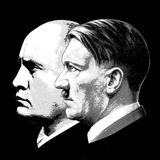
April 1889 - April 1945
“Führer und Reichskanzler”
Adolf Hitler was born in April 1889 in Braunau am Inn, a border town in Austria-Hungary (now Austria). He spent most of his youth in Linz and later moved to Vienna, where he developed an early interest in German nationalism, architecture, and art. In 1913, he relocated to Munich and enlisted in the Bavarian Army at the outbreak of World War I. He served as a frontline messenger, was wounded twice, and received several decorations, including the Iron Cross, Second and First Class.
After the war, he became politically active in Munich and joined the German Workers’ Party in 1919. He soon rose to leadership and rebranded it as the National Socialist German Workers’ Party (NSDAP). His rhetorical skills and ideological messaging gained a wide following. In 1923, he led an unsuccessful coup in Munich, known as the Beer Hall Putsch, and was imprisoned. During his incarceration, he dictated Mein Kampf, in which he outlined his views on politics, state structure, and Germany’s future.
Following his release, Hitler focused on building the NSDAP into a broad-based political movement. During the economic and political instability of the late 1920s and early 1930s, the party gained significant electoral support. On January 30, 1933, Hitler was appointed Chancellor of Germany. After the passing of the Enabling Act in March 1933, he consolidated power and established a one-party authoritarian regime. Following President Paul von Hindenburg’s death in 1934, Hitler merged the presidency with the chancellorship, assuming the title Führer und Reichskanzler.
In foreign policy, his government prioritized rearmament, territorial expansion, and the reassertion of German influence in Europe. This included the reoccupation of the Rhineland (1936), the annexation of Austria (1938), and the incorporation of the Sudetenland and later all of Czechoslovakia (1938–1939). On September 1, 1939, Germany invaded Poland, leading to the outbreak of World War II. Hitler directed military and strategic operations during the conflict and maintained a dominant role in decision-making throughout.
As the war turned against Germany, Hitler remained in Berlin. In April 1945, with Soviet forces surrounding the city, he took his own life in the Führerbunker beneath the Reich Chancellery. His death on April 30, 1945, marked the end of his leadership and was followed by Germany’s unconditional surrender on May 8, 1945.
#germany #führer
@NamesGuide
Please open Telegram to view this post
VIEW IN TELEGRAM
August 1883 - March 1958
Max Bastian was born on August 28, 1883, in Spandau, Germany. He began his naval career in 1902 by joining the Kaiserliche Marine (Imperial Navy). During World War I, he served in various roles and later transitioned to the Reichsmarine (German Navy) after the war. In 1933, he was promoted to the rank of Konteradmiral (Rear Admiral). From 1939 to 1944, he served as the president of the Reichskriegsgericht (Reich Military Court). He passed away on March 11, 1958, in Wilhelmshaven, Germany. However, the cause of his death remains unspecified in available sources.
Related Contents
t.me/hitlermediaarchive/202
#germany
@namesguide
Please open Telegram to view this post
VIEW IN TELEGRAM
November 1891 - October 1944
“The Desert Fox”
Erwin Rommel was born on November 15, 1891, in Heidenheim, Germany. He earned recognition during World War I for his tactical brilliance, receiving the Iron Cross. In World War II, he commanded the 7th Panzer Division in France and later the Afrika Korps, earning the nickname “Desert Fox” for his strategic success in North Africa. Implicated in the failed July 20, 1944, assassination attempt on Hitler, he was forced to commit suicide on October 14, 1944.
Related Contents
t.me/hitlermediaarchive/103
t.me/hitlermediaarchive/203
#germany
@namesguide
Please open Telegram to view this post
VIEW IN TELEGRAM
November 1905 - June 2001
Sepp Janko, born on November 9, 1905, in Tisza Kálmánfalva (now Serbia), was a Danube Swabian leader. Educated in law in Austria, he became chairman of the Danube Swabian German Cultural Association in 1939, advocating for the rights of German minorities in Yugoslavia. During Germany’s 1941 occupation, he aligned the community with German authorities and organized recruits for the German Army.
After the war, Janko fled to Germany, avoiding prosecution, and later settled in West Germany as a political refugee. He maintained ties with the Danube Swabian diaspora. Janko died of natural causes on June 25, 2001, in Innsbruck, Germany.
Related Contents
t.me/hitlermediaarchive/207
#austriahungary
@namesguide
Please open Telegram to view this post
VIEW IN TELEGRAM
October 1881 – October 1948
Walther von Brauchitsch was born on October 4, 1881, in Berlin, Germany. Coming from an aristocratic Prussian military family, Brauchitsch pursued a military career and joined the German Imperial Army as a young officer. During World War I, he served in various roles, honing his strategic skills. In the post-war period, he continued his service in the Reichswehr, the army of the Weimar Republic.
In 1938, he was appointed Commander-in-Chief of the German Army (Heer) by Adolf Hitler. During his tenure, he played a strategic role in significant World War II operations, including the invasion of Poland and the fall of France. However, following the failures of the German military during the Barbarossa campaign against the Soviet Union in 1941, Brauchitsch clashed with Hitler and was dismissed from his position in December of the same year.
After the war, Brauchitsch was arrested by British forces on charges of war crimes. However, before he could stand trial at the Nuremberg Trials, he died of a heart attack on October 18, 1948, in Hamburg.
Brauchitsch remains a controversial figure in German military history, remembered for both his achievements and his criticized decisions.
Related Contents
t.me/hitlermediaarchive/208
t.me/hitlermediaarchive/197
#germany
@namesguide
Please open Telegram to view this post
VIEW IN TELEGRAM
September 1885 – December 1957
Heinrich Hoffmann was born on September 12, 1885, in Fürth, Germany. He began his photography career working in a studio and quickly gained recognition for his skills. A turning point in his career came in the 1920s when he met Adolf Hitler. Hoffmann became Hitler’s personal photographer, and his photographs played a significant role in National Socialist propaganda, making him a prominent figure in NS Germany.
After the war, he was tried for his role in the National Socialist regime and sentenced to prison. Released in 1950, he led a quieter life thereafter. Heinrich Hoffmann passed away on December 15, 1957, in Munich due to heart failure. His photography career and political associations have made him a controversial figure in history.
#germany
@namesguide
Please open Telegram to view this post
VIEW IN TELEGRAM
April 1895 – November 1958
Gerret Korsemann was born on April 24, 1895, in Braunschweig, Germany. During World War I, he served in the German Army and continued his career in the police force after the war. In the 1930s, he joined the National Socialist German Workers’ Party (NSDAP) and quickly rose through the ranks of the SS and police. By 1936, he had achieved the rank of SS-Oberführer and held various roles as a police commander in different regions.
During World War II, Korsemann was responsible for security and police operations. After the war, he was interrogated and served a brief prison sentence due to his affiliations with the NS regime.
Gerret Korsemann passed away on November 5, 1958, in Braunschweig, due to a heart attack.
Related Contents
t.me/hitlermediaarchive/215
#germany
@namesguide
Please open Telegram to view this post
VIEW IN TELEGRAM
December 1890 – May 1943
Viktor Lutze was born on December 28, 1890, in Bevergern, Germany. He served in the German Army during World War I and was awarded the Iron Cross for his service. After the war, he joined the National Socialist German Workers’ Party (NSDAP) and became a prominent member of the Sturmabteilung (SA). Lutze played a key role in organizing the SA in the Hanover and Braunschweig regions.
In 1934, following the Night of the Long Knives, Lutze was appointed Chief of the SA, succeeding Ernst Röhm. Under his leadership, the SA’s role was significantly reduced as it lost much of its political influence to other NS organizations.
Lutze died on May 2, 1943, from injuries sustained in a car accident near Potsdam. He was buried with a state funeral, reflecting his high-ranking position within the NS regime.
Related Contents
t.me/hitlermediaarchive/215
t.me/hitlermediaarchive/172
#germany
@namesguide
Please open Telegram to view this post
VIEW IN TELEGRAM
November 1887 – June 1934
Ernst Röhm was born on November 28, 1887, in Munich, Germany. He pursued a military career and served as an officer in the Bavarian Army during World War I, where he was wounded multiple times and decorated with the Iron Cross. After the war, he became involved in far-right politics and was one of the early members of the National Socialist German Workers’ Party (NSDAP).
Röhm was instrumental in the formation and leadership of the Sturmabteilung (SA), the paramilitary wing of the NSDAP. As Chief of Staff of the SA, he played a key role in its expansion, turning it into a significant force within Germany. However, tensions arose between Röhm and other leaders within the NS regime, including Adolf Hitler, due to differing visions for the future of the SA and the party.
On June 30, 1934, during the Night of the Long Knives, Röhm was arrested and executed in Munich as part of a purge against SA leadership. His death marked the end of the SA’s political prominence.
Related Contents
t.me/hitlermediaarchive/215
t.me/hitlermediaarchive/92
#germany
@namesguide
Please open Telegram to view this post
VIEW IN TELEGRAM
January 1893 - October 1946
Hermann Göring was born on January 12, 1893, in Rosenheim, Germany. He pursued a military career and served as a fighter pilot during World War I, becoming one of Germany’s most decorated air aces. After the war, he joined the National Socialist German Workers’ Party (NSDAP) in 1922 and quickly rose to prominence within the party.
Göring played a key role in the consolidation of power following Adolf Hitler’s rise to Chancellor in 1933. He was appointed Minister President of Prussia and oversaw the establishment of the Gestapo. As the head of the Four-Year Plan, Göring was responsible for directing Germany’s wartime economy. In addition, he served as the Supreme Commander of the Luftwaffe (German Air Force) during World War II.
Following Germany’s defeat in 1945, Göring was captured by Allied forces and tried at the Nuremberg Trials, where he was found guilty of war crimes and crimes against humanity. He was sentenced to death but committed suicide by cyanide poisoning on October 15, 1946, just hours before his scheduled execution.
Related Contents
t.me/hitlermediaarchive/425
t.me/hitlermediaarchive/260
t.me/hitlermediaarchive/259
t.me/hitlermediaarchive/238
t.me/hitlermediaarchive/215
t.me/hitlermediaarchive/154
t.me/hitlermediaarchive/148
t.me/hitlermediaarchive/99
t.me/hitlermediaarchive/66
t.me/hitlermediaarchive/43
#germany
@namesguide
Please open Telegram to view this post
VIEW IN TELEGRAM
June 1876 –February 1946)
Curt von Ulrich was born on June 20, 1876, in Zerbst, Germany. He pursued a career in administration and law, eventually becoming a prominent civil servant. During his career, von Ulrich held various administrative positions, focusing on regional governance and public administration. He became particularly notable as the president of the Prussian Province of Saxony, where he oversaw local government affairs during a tumultuous period in German history.
Following the end of World War II, von Ulrich, like many other German officials, faced scrutiny for his activities during the NS period. However, his death on February 16, 1946, in Dresden, Germany, due to natural causes, occurred before any formal proceedings could take place.
Related Contents
t.me/hitlermediaarchive/215
#germany
@namesguide
Please open Telegram to view this post
VIEW IN TELEGRAM
February 1891 – November 1971
Dietrich Klagges was born on February 1, 1891, in Herringsen, Germany. He began his career as a teacher but later became involved in politics. In the early 1930s, Klagges joined the National Socialist German Workers’ Party (NSDAP) and quickly rose to prominence within the party. He was appointed as the State Minister for the Interior and Education of the Free State of Braunschweig, where he played a significant role in implementing the party’s policies at the regional level.
One of his notable actions was facilitating Adolf Hitler’s acquisition of German citizenship in 1932, which enabled Hitler to run for political office. Klagges remained in his position throughout the NS period and became one of the prominent regional leaders.
After World War II, Klagges was arrested and tried for his activities during the NS regime. He was sentenced to imprisonment but was released in 1957. Dietrich Klagges died on November 12, 1971, in Bad Harzburg, Germany, from natural causes.
Related Contents
t.me/hitlermediaarchive/215
#germany
@namesguide
Please open Telegram to view this post
VIEW IN TELEGRAM
March 1912 - February 1996
Adolf Galland was born on March 19, 1912, in the village of Westerholt in the Westphalia region of Germany. With a passion for aviation from a young age, Galland completed his flight training and joined the German Air Force (Luftwaffe) in 1935. He gained valuable experience during the Spanish Civil War as part of the Condor Legion.
During World War II, Galland became one of the leading fighter pilots of the Luftwaffe. Flying the Messerschmitt Bf 109, he quickly rose to fame with his remarkable performance in combat. He achieved at least 104 aerial victories, making him one of the most renowned fighter aces of the war. In 1941, he was appointed General of the Fighter Arm (General der Jagdflieger), a position he held until 1945.
After the war, Galland was briefly held as a prisoner of war by the British. Upon his release, he worked in the civilian aviation industry. He also served as a military advisor in Argentina for a period before returning to West Germany, where he continued his involvement in aviation.
Adolf Galland passed away on February 9, 1996, in Remagen, Germany, at the age of 83 due to lung cancer. His wartime achievements and career made him a prominent figure in the history of aviation.
Related Contents
t.me/hitlermediaarchive/218
#germany
@namesguide
Please open Telegram to view this post
VIEW IN TELEGRAM
March 1893 - June 1973
Emmy Sonnemann was born on March 24, 1893, in Hamburg, Germany. Coming from a family with an interest in the arts, she developed a passion for theater and opera at an early age. After completing her education, she pursued a professional career as an opera singer and became a recognized performer of her time.
In 1935, she married Hermann Göring, one of the leading figures of the NS Party. Their marriage gained significant public attention during NS Germany, and Emmy was referred to as the “First Lady of the Reich,” a symbolic title stemming from Adolf Hitler’s unmarried status.
Following the fall of the NS regime and Hermann Göring’s trial and death, Emmy lived a secluded life away from public view. She passed away on June 8, 1973, in Munich, Germany, due to natural causes.
Related Contents
t.me/hitlermediaarchive/238
#germany
@namesguide
Please open Telegram to view this post
VIEW IN TELEGRAM
May 1907 - August 1974
Baldur von Schirach was born on May 9, 1907, in Berlin. A member of an aristocratic family, Schirach was introduced to nationalist ideas at a young age and joined the National Socialist German Workers’ Party (NSDAP) in 1925.
In 1931, he was appointed leader of the NSDAP’s youth organizations and officially became the head of the Hitler Youth in 1933. In 1940, he left this position to serve as Gauleiter of Vienna, where he played a role in the deportation and persecution of Austria’s Jewish population.
After the war, he was tried at the Nuremberg International Military Tribunal and sentenced to 20 years in prison for crimes against humanity. Following his release, he died of a heart attack on August 8, 1974, in Kröv.
Related Contents
t.me/hitlermediaarchive/261
t.me/hitlermediaarchive/93
#germany
@namesguide
Please open Telegram to view this post
VIEW IN TELEGRAM
September 1878 - March 1946
Werner von Blomberg was born on September 2, 1878, in the town of Stargard, Germany. He began his military career during the German Empire era and joined the Prussian General Staff in 1907, honing his military expertise. During World War I, he served on the Western Front and was awarded several medals for his bravery.
After the war, Blomberg joined Germany’s Reichswehr and continued to rise through the ranks throughout the 1920s. In 1933, Adolf Hitler appointed him as Minister of Defense, where he played a significant role in rebuilding the military forces of the National Socialist regime. Blomberg was instrumental in the establishment of the Wehrmacht. However, in 1938, he was forced to resign from his position due to a personal scandal and retired from public life.
At the end of the war, Blomberg was included in Allied war crimes investigations. While awaiting trial, he died of cancer on March 14, 1946, in Nuremberg.
Related Contents
t.me/hitlermediaarchive/453
t.me/hitlermediaarchive/263
t.me/hitlermediaarchive/77
#germany
@namesguide
Please open Telegram to view this post
VIEW IN TELEGRAM
February 1885 – October 1946
Julius Streicher was born on February 12, 1885, in Fleinhausen, a village in Bavaria, Germany. Initially trained as a teacher, he joined the German Army during World War I and was awarded the Iron Cross for bravery.
After the war, during the politically turbulent years in Germany, Streicher gravitated toward radical right-wing ideologies. In 1922, he became a member of the National Socialist German Workers’ Party (NSDAP). In 1923, he founded and published Der Stürmer, a newspaper infamous for its antisemitic content. The publication became a key tool in the NSDAP’s propaganda efforts. Streicher was appointed Gauleiter (regional leader) of Franconia in 1929, solidifying his role as a prominent figure within the party.
After World War II, Streicher was tried at the Nuremberg Trials for crimes against humanity, particularly for his role in promoting antisemitic propaganda that contributed to the Holocaust. He was found guilty and executed by hanging on October 16, 1946.
#germany
@namesguide
Please open Telegram to view this post
VIEW IN TELEGRAM