
Leetcode 2021-04-24
🟡 377.combination-sum-iv
1️⃣ Tags
#dynamic-programming
2️⃣ Description
Given an array of distinct integers
The answer is guaranteed to fit in a 32-bit integer.
3️⃣ Example
🟡 377.combination-sum-iv
1️⃣ Tags
#dynamic-programming
2️⃣ Description
Given an array of distinct integers
nums and a target integer target, return the number of possible combinations that add up to target.The answer is guaranteed to fit in a 32-bit integer.
3️⃣ Example
Input: nums = [1,2,3], target = 4
Output: 7
Explanation:
The possible combination ways are:
(1, 1, 1, 1)
(1, 1, 2)
(1, 2, 1)
(1, 3)
(2, 1, 1)
(2, 2)
(3, 1)
Note that different sequences are counted as different combinations.
Leetcode 2021-04-25
🟢 897.increasing-order-search-tree
1️⃣ Tags
#tree #depth-first-search #recursion
2️⃣ Description
Given the
3️⃣ Example
🟢 897.increasing-order-search-tree
1️⃣ Tags
#tree #depth-first-search #recursion
2️⃣ Description
Given the
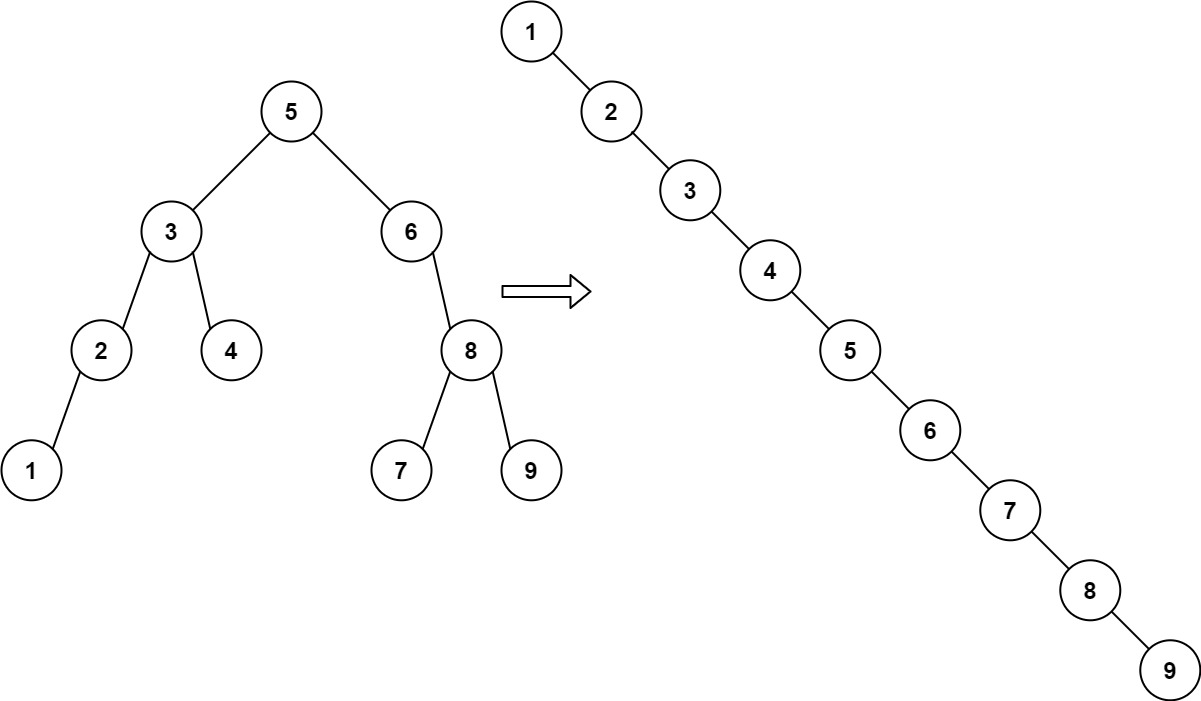
root of a binary search tree, rearrange the tree in in-order so that the leftmost node in the tree is now the root of the tree, and every node has no left child and only one right child.3️⃣ Example
Input: root = [5,3,6,2,4,null,8,1,null,null,null,7,9]
Output: [1,null,2,null,3,null,4,null,5,null,6,null,7,null,8,null,9]
Leetcode 2021-04-26
🟡 1011.capacity-to-ship-packages-within-d-days
1️⃣ Tags
#array #binary-search
2️⃣ Description
A conveyor belt has packages that must be shipped from one port to another within
The ith package on the conveyor belt has a weight of
Return the least weight capacity of the ship that will result in all the packages on the conveyor belt being shipped within
3️⃣ Example
🟡 1011.capacity-to-ship-packages-within-d-days
1️⃣ Tags
#array #binary-search
2️⃣ Description
A conveyor belt has packages that must be shipped from one port to another within
D days.The ith package on the conveyor belt has a weight of
weights[i]. Each day, we load the ship with packages on the conveyor belt (in the order given by weights). We may not load more weight than the maximum weight capacity of the ship.Return the least weight capacity of the ship that will result in all the packages on the conveyor belt being shipped within
D days.3️⃣ Example
Input: weights = [1,2,3,4,5,6,7,8,9,10], D = 5
Output: 15
Explanation: A ship capacity of 15 is the minimum to ship all the packages in 5 days like this:
1st day: 1, 2, 3, 4, 5
2nd day: 6, 7
3rd day: 8
4th day: 9
5th day: 10

Note that the cargo must be shipped in the order given, so using a ship of capacity 14 and splitting the packages into parts like (2, 3, 4, 5), (1, 6, 7), (8), (9), (10) is not allowed.
Leetcode 2021-04-27
🟢 938.range-sum-of-bst
1️⃣ Tags
#tree #depth-first-search #recursion
2️⃣ Description
Given the
3️⃣ Example
🟢 938.range-sum-of-bst
1️⃣ Tags
#tree #depth-first-search #recursion
2️⃣ Description
Given the
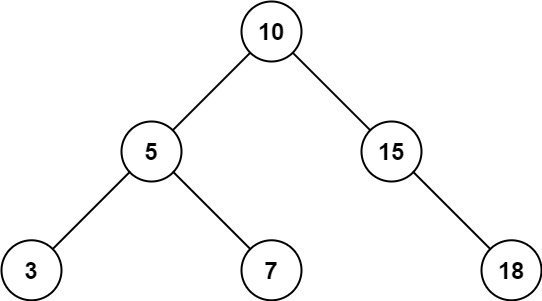
root node of a binary search tree, return the sum of values of all nodes with a value in the range [low, high].3️⃣ Example
Input: root = [10,5,15,3,7,null,18], low = 7, high = 15
Output: 32
Leetcode 2021-04-28
🟡 633.sum-of-square-numbers
1️⃣ Tags
#math
2️⃣ Description
Given a non-negative integer
3️⃣ Example
🟡 633.sum-of-square-numbers
1️⃣ Tags
#math
2️⃣ Description
Given a non-negative integer
c, decide whether there're two integers a and b such that a2 + b2 = c.3️⃣ Example
Input: c = 5
Output: true
Explanation: 1 * 1 + 2 * 2 = 5
Leetcode 2021-04-29
🔴 403.frog-jump
1️⃣ Tags
#dynamic-programming
2️⃣ Description
A frog is crossing a river. The river is divided into some number of units, and at each unit, there may or may not exist a stone. The frog can jump on a stone, but it must not jump into the water.
Given a list of
If the frog's last jump was
3️⃣ Example
🔴 403.frog-jump
1️⃣ Tags
#dynamic-programming
2️⃣ Description
A frog is crossing a river. The river is divided into some number of units, and at each unit, there may or may not exist a stone. The frog can jump on a stone, but it must not jump into the water.
Given a list of
stones' positions (in units) in sorted ascending order, determine if the frog can cross the river by landing on the last stone. Initially, the frog is on the first stone and assumes the first jump must be 1 unit.If the frog's last jump was
k units, its next jump must be either k - 1, k, or k + 1 units. The frog can only jump in the forward direction.3️⃣ Example
Input: stones = [0,1,3,5,6,8,12,17]
Output: true
Explanation: The frog can jump to the last stone by jumping 1 unit to the 2nd stone, then 2 units to the 3rd stone, then 2 units to the 4th stone, then 3 units to the 6th stone, 4 units to the 7th stone, and 5 units to the 8th stone.
Leetcode 2021-04-30
🟡 137.single-number-ii
1️⃣ Tags
#bit-manipulation
2️⃣ Description
Given an integer array
3️⃣ Example
🟡 137.single-number-ii
1️⃣ Tags
#bit-manipulation
2️⃣ Description
Given an integer array
nums where every element appears three times except for one, which appears exactly once. Find the single element and return it.3️⃣ Example
Input: nums = [2,2,3,2]
Output: 3
Leetcode 2021-05-01
🟢 690.employee-importance
1️⃣ Tags
#hash_table #depth_first_search #breadth_first_search
2️⃣ Description
You are given a data structure of employee information, which includes the employee's unique id, their importance value and their direct subordinates' id.
For example, employee 1 is the leader of employee 2, and employee 2 is the leader of employee 3. They have importance value 15, 10 and 5, respectively. Then employee 1 has a data structure like [1, 15, [2]], and employee 2 has [2, 10, [3]], and employee 3 has [3, 5, []]. Note that although employee 3 is also a subordinate of employee 1, the relationship is not direct.
Now given the employee information of a company, and an employee id, you need to return the total importance value of this employee and all their subordinates.
3️⃣ Example
🟢 690.employee-importance
1️⃣ Tags
#hash_table #depth_first_search #breadth_first_search
2️⃣ Description
You are given a data structure of employee information, which includes the employee's unique id, their importance value and their direct subordinates' id.
For example, employee 1 is the leader of employee 2, and employee 2 is the leader of employee 3. They have importance value 15, 10 and 5, respectively. Then employee 1 has a data structure like [1, 15, [2]], and employee 2 has [2, 10, [3]], and employee 3 has [3, 5, []]. Note that although employee 3 is also a subordinate of employee 1, the relationship is not direct.
Now given the employee information of a company, and an employee id, you need to return the total importance value of this employee and all their subordinates.
3️⃣ Example
Input: [[1, 5, [2, 3]], [2, 3, []], [3, 3, []]], 1
Output: 11
Explanation:
Employee 1 has importance value 5, and he has two direct subordinates: employee 2 and employee 3. They both have importance value 3. So the total importance value of employee 1 is 5 + 3 + 3 = 11.
Leetcode 2021-05-02
🟡 554.brick-wall
1️⃣ Tags
#hash_table
2️⃣ Description
There is a rectangular brick wall in front of you with
Draw a vertical line from the top to the bottom and cross the least bricks. If your line goes through the edge of a brick, then the brick is not considered as crossed. You cannot draw a line just along one of the two vertical edges of the wall, in which case the line will obviously cross no bricks.
Given the 2D array
3️⃣ Example
🟡 554.brick-wall
1️⃣ Tags
#hash_table
2️⃣ Description
There is a rectangular brick wall in front of you with
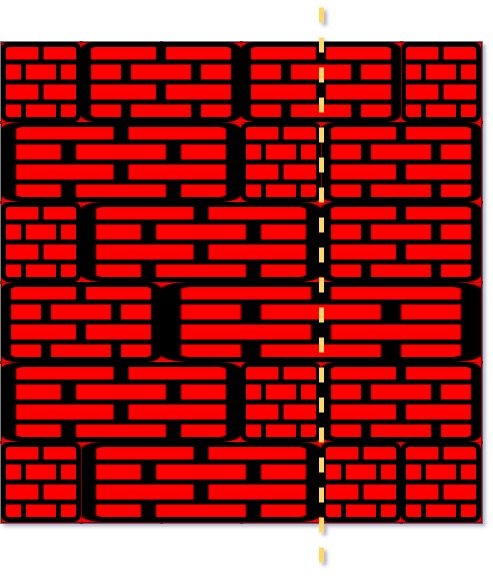
n rows of bricks. The ith row has some number of bricks each of the same height (i.e., one unit) but they can be of different widths. The total width of each row is the same.Draw a vertical line from the top to the bottom and cross the least bricks. If your line goes through the edge of a brick, then the brick is not considered as crossed. You cannot draw a line just along one of the two vertical edges of the wall, in which case the line will obviously cross no bricks.
Given the 2D array
wall that contains the information about the wall, return the minimum number of crossed bricks after drawing such a vertical line.3️⃣ Example
Input: wall = [[1,2,2,1],[3,1,2],[1,3,2],[2,4],[3,1,2],[1,3,1,1]]
Output: 2
Leetcode 2021-05-03
🟢 7.reverse-integer
1️⃣ Tags
#math
2️⃣ Description
Given a signed 32-bit integer
Assume the environment does not allow you to store 64-bit integers (signed or unsigned).
3️⃣ Example
🟢 7.reverse-integer
1️⃣ Tags
#math
2️⃣ Description
Given a signed 32-bit integer
x, return x with its digits reversed. If reversing x causes the value to go outside the signed 32-bit integer range [-231, 231 - 1], then return 0.Assume the environment does not allow you to store 64-bit integers (signed or unsigned).
3️⃣ Example
Input: x = 123
Output: 321
Leetcode 2021-05-04
🔴 1473.paint-house-iii
1️⃣ Tags
#dynamic_programming
2️⃣ Description
There is a row of
A neighborhood is a maximal group of continuous houses that are painted with the same color.
For example:
Given an array
Return the minimum cost of painting all the remaining houses in such a way that there are exactly
3️⃣ Example
🔴 1473.paint-house-iii
1️⃣ Tags
#dynamic_programming
2️⃣ Description
There is a row of
m houses in a small city, each house must be painted with one of the n colors (labeled from 1 to n), some houses that have been painted last summer should not be painted again.A neighborhood is a maximal group of continuous houses that are painted with the same color.
For example:
houses = [1,2,2,3,3,2,1,1] contains 5 neighborhoods [{1}, {2,2}, {3,3}, {2}, {1,1}].Given an array
houses, an m x n matrix cost and an integer target where:houses[i]: is the color of the house i, and 0 if the house is not painted yet.cost[i][j]: is the cost of paint the house i with the color j + 1.Return the minimum cost of painting all the remaining houses in such a way that there are exactly
target neighborhoods. If it is not possible, return -1.3️⃣ Example
Input: houses = [0,0,0,0,0], cost = [[1,10],[10,1],[10,1],[1,10],[5,1]], m = 5, n = 2, target = 3
Output: 9
Explanation: Paint houses of this way [1,2,2,1,1]
This array contains target = 3 neighborhoods, [{1}, {2,2}, {1,1}].
Cost of paint all houses (1 + 1 + 1 + 1 + 5) = 9.
Leetcode 2021-05-05
🟡 740.delete-and-earn
1️⃣ Tags
#dynamic_programming
2️⃣ Description
Given an array
In each operation, you pick any
You start with
3️⃣ Example
🟡 740.delete-and-earn
1️⃣ Tags
#dynamic_programming
2️⃣ Description
Given an array
nums of integers, you can perform operations on the array.In each operation, you pick any
nums[i] and delete it to earn nums[i] points. After, you must delete every element equal to nums[i] - 1 or nums[i] + 1.You start with
0 points. Return the maximum number of points you can earn by applying such operations.3️⃣ Example
Input: nums = [3,4,2]
Output: 6
Explanation: Delete 4 to earn 4 points, consequently 3 is also deleted.
Then, delete 2 to earn 2 points.
6 total points are earned.
Leetcode 2021-05-06
🟢 1720.decode-xored-array
1️⃣ Tags
#bit_manipulation
2️⃣ Description
There is a hidden integer array
It was encoded into another integer array
You are given the
Return the original array
3️⃣ Example
🟢 1720.decode-xored-array
1️⃣ Tags
#bit_manipulation
2️⃣ Description
There is a hidden integer array
arr that consists of n non-negative integers.It was encoded into another integer array
encoded of length n - 1, such that encoded[i] = arr[i] XOR arr[i + 1]. For example, if arr = [1,0,2,1], then encoded = [1,2,3].You are given the
encoded array. You are also given an integer first, that is the first element of arr, i.e. arr[0].Return the original array
arr. It can be proved that the answer exists and is unique.3️⃣ Example
Input: encoded = [1,2,3], first = 1
Output: [1,0,2,1]
Explanation: If arr = [1,0,2,1], then first = 1 and encoded = [1 XOR 0, 0 XOR 2, 2 XOR 1] = [1,2,3]
Leetcode 2021-05-07
🟢 1486.xor-operation-in-an-array
1️⃣ Tags
#array #bit_manipulation
2️⃣ Description
Given an integer
Define an array
Return the bitwise XOR of all elements of
3️⃣ Example
🟢 1486.xor-operation-in-an-array
1️⃣ Tags
#array #bit_manipulation
2️⃣ Description
Given an integer
n and an integer start.Define an array
nums where nums[i] = start + 2*i (0-indexed) and n == nums.length.Return the bitwise XOR of all elements of
nums.3️⃣ Example
Input: n = 5, start = 0
Output: 8
Explanation: Array nums is equal to [0, 2, 4, 6, 8] where (0 ^ 2 ^ 4 ^ 6 ^ 8) = 8.
Where "^" corresponds to bitwise XOR operator.
Leetcode 2021-05-08
🔴 1723.find-minimum-time-to-finish-all-jobs
1️⃣ Tags
#backtracking #recursion
2️⃣ Description
You are given an integer array
There are
Return the minimum possible maximum working time of any assignment.
3️⃣ Example
🔴 1723.find-minimum-time-to-finish-all-jobs
1️⃣ Tags
#backtracking #recursion
2️⃣ Description
You are given an integer array
jobs, where jobs[i] is the amount of time it takes to complete the ith job.There are
k workers that you can assign jobs to. Each job should be assigned to exactly one worker. The working time of a worker is the sum of the time it takes to complete all jobs assigned to them. Your goal is to devise an optimal assignment such that the maximum working time of any worker is minimized.Return the minimum possible maximum working time of any assignment.
3️⃣ Example
Input: jobs = [3,2,3], k = 3
Output: 3
Explanation: By assigning each person one job, the maximum time is 3.
Leetcode 2021-05-09
🟡 1482.minimum-number-of-days-to-make-m-bouquets
1️⃣ Tags
#array #binary_search
2️⃣ Description
Given an integer array
We need to make
The garden consists of
Return the minimum number of days you need to wait to be able to make
3️⃣ Example
🟡 1482.minimum-number-of-days-to-make-m-bouquets
1️⃣ Tags
#array #binary_search
2️⃣ Description
Given an integer array
bloomDay, an integer m and an integer k.We need to make
m bouquets. To make a bouquet, you need to use k adjacent flowers from the garden.The garden consists of
n flowers, the ith flower will bloom in the bloomDay[i] and then can be used in exactly one bouquet.Return the minimum number of days you need to wait to be able to make
m bouquets from the garden. If it is impossible to make m bouquets return -1.3️⃣ Example
Input: bloomDay = [1,10,3,10,2], m = 3, k = 1
Output: 3
Explanation: Let's see what happened in the first three days. x means flower bloomed and _ means flower didn't bloom in the garden.
We need 3 bouquets each should contain 1 flower.
After day 1: [x, _, _, _, _]   // we can only make one bouquet.
After day 2: [x, _, _, _, x]   // we can only make two bouquets.
After day 3: [x, _, x, _, x]   // we can make 3 bouquets. The answer is 3.
Leetcode 2021-05-10
🟢 872.leaf-similar-trees
1️⃣ Tags
#tree #depth_first_search
2️⃣ Description
Consider all the leaves of a binary tree, from left to right order, the values of those leaves form a leaf value sequence.
For example, in the given tree above, the leaf value sequence is
Two binary trees are considered leaf-similar if their leaf value sequence is the same.
Return
3️⃣ Example
🟢 872.leaf-similar-trees
1️⃣ Tags
#tree #depth_first_search
2️⃣ Description
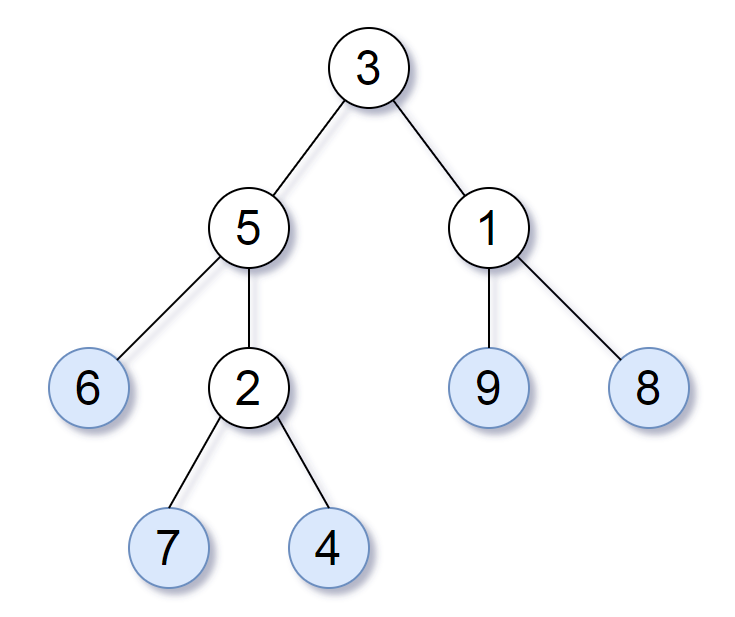
Consider all the leaves of a binary tree, from left to right order, the values of those leaves form a leaf value sequence.
For example, in the given tree above, the leaf value sequence is
(6, 7, 4, 9, 8).Two binary trees are considered leaf-similar if their leaf value sequence is the same.
Return
true if and only if the two given trees with head nodes root1 and root2 are leaf-similar.3️⃣ Example
Input: root1 = [3,5,1,6,2,9,8,null,null,7,4], root2 = [3,5,1,6,7,4,2,null,null,null,null,null,null,9,8]
Output: true
Leetcode 2021-05-11
🟡 1734.decode-xored-permutation
1️⃣ Tags
#bit_manipulation
2️⃣ Description
There is an integer array
It was encoded into another integer array
Given the
3️⃣ Example
🟡 1734.decode-xored-permutation
1️⃣ Tags
#bit_manipulation
2️⃣ Description
There is an integer array
perm that is a permutation of the first n positive integers, where n is always odd.It was encoded into another integer array
encoded of length n - 1, such that encoded[i] = perm[i] XOR perm[i + 1]. For example, if perm = [1,3,2], then encoded = [2,1].Given the
encoded array, return the original array perm. It is guaranteed that the answer exists and is unique.3️⃣ Example
Input: encoded = [3,1]
Output: [1,2,3]
Explanation: If perm = [1,2,3], then encoded = [1 XOR 2,2 XOR 3] = [3,1]
Leetcode 2021-05-12
🟡 1310.xor-queries-of-a-subarray
1️⃣ Tags
#bit_manipulation
2️⃣ Description
3️⃣ Example
🟡 1310.xor-queries-of-a-subarray
1️⃣ Tags
#bit_manipulation
2️⃣ Description
3️⃣ Example
Input: arr = [1,3,4,8], queries = [[0,1],[1,2],[0,3],[3,3]]
Output: [2,7,14,8]
Explanation:
The binary representation of the elements in the array are:
1 = 0001
3 = 0011
4 = 0100
8 = 1000
The XOR values for queries are:
[0,1] = 1 xor 3 = 2
[1,2] = 3 xor 4 = 7
[0,3] = 1 xor 3 xor 4 xor 8 = 14
[3,3] = 8
Leetcode 2021-05-13
🔴 1269.number-of-ways-to-stay-in-the-same-place-after-some-steps
1️⃣ Tags
#dynamic_programming
2️⃣ Description
You have a pointer at index
Given two integers
Since the answer may be too large, return it modulo
3️⃣ Example
🔴 1269.number-of-ways-to-stay-in-the-same-place-after-some-steps
1️⃣ Tags
#dynamic_programming
2️⃣ Description
You have a pointer at index
0 in an array of size arrLen. At each step, you can move 1 position to the left, 1 position to the right in the array or stay in the same place (The pointer should not be placed outside the array at any time).Given two integers
steps and arrLen, return the number of ways such that your pointer still at index 0 after exactly steps steps.Since the answer may be too large, return it modulo
10^9 + 7.3️⃣ Example
Input: steps = 3, arrLen = 2
Output: 4
Explanation: There are 4 differents ways to stay at index 0 after 3 steps.
Right, Left, Stay
Stay, Right, Left
Right, Stay, Left
Stay, Stay, Stay