
Why is Deep Learning Important?
Deep learning is a powerful tool to make prediction an actionable result. Deep learning excels in pattern discovery (unsupervised learning) and knowledge-based prediction. Big data is the fuel for deep learning. When both are combined, an organization can reap unprecedented results in term of productivity, sales, management, and innovation.
Deep learning can outperform traditional method. For instance, deep learning algorithms are 41% more accurate than machine learning algorithm in image classification, 27 % more accurate in facial recognition and 25% in voice recognition.
Deep learning is a powerful tool to make prediction an actionable result. Deep learning excels in pattern discovery (unsupervised learning) and knowledge-based prediction. Big data is the fuel for deep learning. When both are combined, an organization can reap unprecedented results in term of productivity, sales, management, and innovation.
Deep learning can outperform traditional method. For instance, deep learning algorithms are 41% more accurate than machine learning algorithm in image classification, 27 % more accurate in facial recognition and 25% in voice recognition.
👍1
Limitations of deep learning
Now in this Neural network tutorial, we will learn about limitations of Deep Learning:
Data labeling
Most current AI models are trained through “supervised learning.” It means that humans must label and categorize the underlying data, which can be a sizable and error-prone chore. For example, companies developing self-driving-car technologies are hiring hundreds of people to manually annotate hours of video feeds from prototype vehicles to help train these systems.
Obtain huge training datasets
It has been shown that simple deep learning techniques like CNN can, in some cases, imitate the knowledge of experts in medicine and other fields. The current wave of machine learning, however, requires training data sets that are not only labeled but also sufficiently broad and universal.
Deep-learning methods required thousands of observations for models to become relatively good at classification tasks and, in some cases, millions for them to perform at the level of humans. Without surprise, deep learning is famous in giant tech companies; they are using big data to accumulate petabytes of data. It allows them to create an impressive and highly accurate deep learning model.
Explain a problem
Large and complex models can be hard to explain, in human terms. For instance, why a particular decision was obtained. It is one reason that acceptance of some AI tools are slow in application areas where interpretability is useful or indeed required.
Furthermore, as the application of AI expands, regulatory requirements could also drive the need for more explainable AI models.
Now in this Neural network tutorial, we will learn about limitations of Deep Learning:
Data labeling
Most current AI models are trained through “supervised learning.” It means that humans must label and categorize the underlying data, which can be a sizable and error-prone chore. For example, companies developing self-driving-car technologies are hiring hundreds of people to manually annotate hours of video feeds from prototype vehicles to help train these systems.
Obtain huge training datasets
It has been shown that simple deep learning techniques like CNN can, in some cases, imitate the knowledge of experts in medicine and other fields. The current wave of machine learning, however, requires training data sets that are not only labeled but also sufficiently broad and universal.
Deep-learning methods required thousands of observations for models to become relatively good at classification tasks and, in some cases, millions for them to perform at the level of humans. Without surprise, deep learning is famous in giant tech companies; they are using big data to accumulate petabytes of data. It allows them to create an impressive and highly accurate deep learning model.
Explain a problem
Large and complex models can be hard to explain, in human terms. For instance, why a particular decision was obtained. It is one reason that acceptance of some AI tools are slow in application areas where interpretability is useful or indeed required.
Furthermore, as the application of AI expands, regulatory requirements could also drive the need for more explainable AI models.
❤2👍1
Summary
Deep Learning Overview: Deep learning is the new state-of-the-art for artificial intelligence. Deep learning architecture is composed of an input layer, hidden layers, and an output layer. The word deep means there are more than two fully connected layers.
There is a vast amount of neural networks, where each architecture is designed to perform a given task. For instance, CNN works very well with pictures, RNN provides impressive results with time series and text analysis.
Deep learning is now active in different fields, from finance to marketing, supply chain, and marketing. Big firms are the first one to use deep learning because they have already a large pool of data. Deep learning requires to have an extensive training dataset.
Deep Learning Overview: Deep learning is the new state-of-the-art for artificial intelligence. Deep learning architecture is composed of an input layer, hidden layers, and an output layer. The word deep means there are more than two fully connected layers.
There is a vast amount of neural networks, where each architecture is designed to perform a given task. For instance, CNN works very well with pictures, RNN provides impressive results with time series and text analysis.
Deep learning is now active in different fields, from finance to marketing, supply chain, and marketing. Big firms are the first one to use deep learning because they have already a large pool of data. Deep learning requires to have an extensive training dataset.
👍4
The next subfield will be Natural Language Processing.
As usual it will be posted in sections over the next few days to ensure everyone understands.
As usual it will be posted in sections over the next few days to ensure everyone understands.
Some of the NLP Concepts that will addressed includes :
✅What is Natural Language Processing?
✅History of NLP
✅How Does NLP Work?
✅Components of NLP
✅NLP and Writing Systems
✅How to Implement NLP
✅What is Natural Language Processing?
✅History of NLP
✅How Does NLP Work?
✅Components of NLP
✅NLP and Writing Systems
✅How to Implement NLP
👍6
We'll begin with the first section of NLP tomorrow at around 4PM (IST)
Natural Language Processing Tutorial: What is NLP? Examples
What is Natural Language Processing?
Natural Language Processing (NLP) is a branch of AI that helps computers to understand, interpret and manipulate human languages like English or Hindi to analyze and derive it’s meaning. NLP helps developers to organize and structure knowledge to perform tasks like translation, summarization, named entity recognition, relationship extraction, speech recognition, topic segmentation, etc.
What is Natural Language Processing?
Natural Language Processing (NLP) is a branch of AI that helps computers to understand, interpret and manipulate human languages like English or Hindi to analyze and derive it’s meaning. NLP helps developers to organize and structure knowledge to perform tasks like translation, summarization, named entity recognition, relationship extraction, speech recognition, topic segmentation, etc.
👍3
History of NLP
Here, is are important events in the history of Natural Language Processing:
1950- NLP started when Alan Turing published an article called “Machine and Intelligence.”
1950- Attempts to automate translation between Russian and English
1960- The work of Chomsky and others on formal language theory and generative syntax
1990- Probabilistic and data-driven models had become quite standard
2000- A Large amount of spoken and textual data become available
Next in this NLP tutorial, we will learn How NLP works.
Here, is are important events in the history of Natural Language Processing:
1950- NLP started when Alan Turing published an article called “Machine and Intelligence.”
1950- Attempts to automate translation between Russian and English
1960- The work of Chomsky and others on formal language theory and generative syntax
1990- Probabilistic and data-driven models had become quite standard
2000- A Large amount of spoken and textual data become available
Next in this NLP tutorial, we will learn How NLP works.
👍4❤1
How Does NLP Work?
Before we learn how NLP works, let’s understand how humans use language-
Every day, we say thousand of a word that other people interpret to do countless things. We, consider it as a simple communication, but we all know that words run much deeper than that. There is always some context that we derive from what we say and how we say it., NLP in Artificial Intelligence never focuses on voice modulation; it does draw on contextual patterns.
Before we learn how NLP works, let’s understand how humans use language-
Every day, we say thousand of a word that other people interpret to do countless things. We, consider it as a simple communication, but we all know that words run much deeper than that. There is always some context that we derive from what we say and how we say it., NLP in Artificial Intelligence never focuses on voice modulation; it does draw on contextual patterns.
👍2
Example:
Man is to woman as king is to __________?
Meaning (king) – meaning (man) + meaning ( woman)=?
The answer is-  queen
Here, we can easily co-relate because man is male gender and woman is female gender. In the same way, the king is masculine gender, and its female gender is queen.
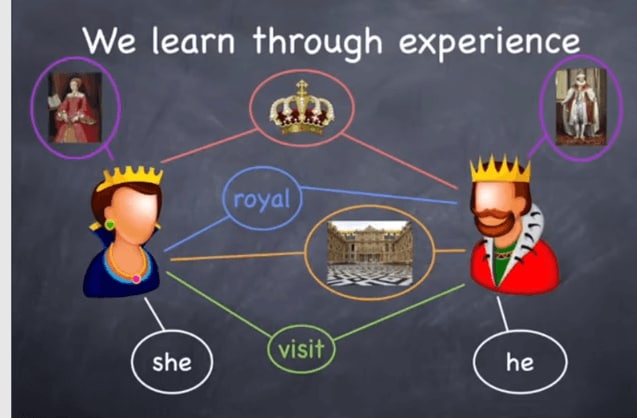
The answer is we learn this thinks through experience. However, here the main question is that how computer know about the same?
We need to provide enough data for Machines to learn through experience. We can feed details like
Her Majesty the Queen.
The Queen’s speech during the State visit
The crown of Queen Elizabeth
The Queens’s Mother
The queen is generous.
With above examples the machine understands the entity Queen.
The machine creates word vectors as below. A word vector is built using surrounding words.
We need to provide enough data for Machines to learn through experience. We can feed details like
Her Majesty the Queen.
The Queen’s speech during the State visit
The crown of Queen Elizabeth
The Queens’s Mother
The queen is generous.
With above examples the machine understands the entity Queen.
The machine creates word vectors as below. A word vector is built using surrounding words.

👍4🔥1
The machine creates these vectors
As it learns from multiple datasets
Use Machine learning (e.g., Deep Learning algorithms)
A word vector is built using surrounding words.
Here is the formula:
Meaning (king) – meaning (man) + meaning (woman)=?
This amounts to performing simple algebraic operations on word vectors:
Vector ( king) – vector (man) + vector (woman)= vector(?)
To which the machine answers queen.
Next in this Natural language processing tutorial, we will learn about Components of NLP some other time.
As it learns from multiple datasets
Use Machine learning (e.g., Deep Learning algorithms)
A word vector is built using surrounding words.
Here is the formula:
Meaning (king) – meaning (man) + meaning (woman)=?
This amounts to performing simple algebraic operations on word vectors:
Vector ( king) – vector (man) + vector (woman)= vector(?)
To which the machine answers queen.
Next in this Natural language processing tutorial, we will learn about Components of NLP some other time.
👍3❤2