
Next time we'll look at the types of Deep Learning Networks
Types of Deep Learning Networks
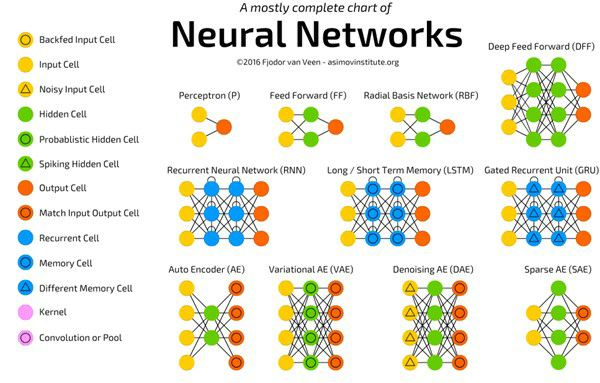
Now in this Deep Neural network tutorial, we will learn about types of Deep Learning Networks:
Now in this Deep Neural network tutorial, we will learn about types of Deep Learning Networks:
👍1
Feed-forward neural networks
The simplest type of artificial neural network. With this type of architecture, information flows in only one direction, forward. It means, the information’s flows starts at the input layer, goes to the “hidden” layers, and end at the output layer. The network
does not have a loop. Information stops at the output layers.
The simplest type of artificial neural network. With this type of architecture, information flows in only one direction, forward. It means, the information’s flows starts at the input layer, goes to the “hidden” layers, and end at the output layer. The network
does not have a loop. Information stops at the output layers.
❤1👍1
Recurrent neural networks (RNNs)
RNN is a multi-layered neural network that can store information in context nodes, allowing it to learn data sequences and output a number or another sequence. In simple words, it is an Artificial neural networks whose connections between neurons include loops. RNNs are well suited for processing sequences of inputs.
RNN is a multi-layered neural network that can store information in context nodes, allowing it to learn data sequences and output a number or another sequence. In simple words, it is an Artificial neural networks whose connections between neurons include loops. RNNs are well suited for processing sequences of inputs.

👍1
For Example, if the task is to predict the next word in the sentence “Do you want a…………?
The RNN neurons will receive a signal that point to the start of the sentence.
The network receives the word “Do” as an input and produces a vector of the number. This vector is fed back to the neuron to provide a memory to the network. This stage helps the network to remember it received “Do” and it received it in the first position.
The network will similarly proceed to the next words. It takes the word “you” and “want.” The state of the neurons is updated upon receiving each word.
The final stage occurs after receiving the word “a.” The neural network will provide a probability for each English word that can be used to complete the sentence. A well-trained RNN probably assigns a high probability to “café,” “drink,” “burger,” etc.
The network receives the word “Do” as an input and produces a vector of the number. This vector is fed back to the neuron to provide a memory to the network. This stage helps the network to remember it received “Do” and it received it in the first position.
The network will similarly proceed to the next words. It takes the word “you” and “want.” The state of the neurons is updated upon receiving each word.
The final stage occurs after receiving the word “a.” The neural network will provide a probability for each English word that can be used to complete the sentence. A well-trained RNN probably assigns a high probability to “café,” “drink,” “burger,” etc.
Common uses of RNN
Help securities traders to generate analytic reports
Detect abnormalities in the contract of financial statement
Detect fraudulent credit-card transaction
Provide a caption for images
Power chatbots
The standard uses of RNN occur when the practitioners are working with time-series data or sequences (e.g., audio recordings or text).
Help securities traders to generate analytic reports
Detect abnormalities in the contract of financial statement
Detect fraudulent credit-card transaction
Provide a caption for images
Power chatbots
The standard uses of RNN occur when the practitioners are working with time-series data or sequences (e.g., audio recordings or text).
Convolutional neural networks (CNN)
CNN is a multi-layered neural network with a unique architecture designed to extract increasingly complex features of the data at each layer to determine the output. CNN’s are well suited for perceptual tasks.
CNN is a multi-layered neural network with a unique architecture designed to extract increasingly complex features of the data at each layer to determine the output. CNN’s are well suited for perceptual tasks.

👍1
CNN is mostly used when there is an unstructured data set (e.g., images) and the practitioners need to extract information from it.
For instance, if the task is to predict an image caption:
The CNN receives an image of let’s say a cat, this image, in computer term, is a collection of the pixel. Generally, one layer for the greyscale picture and three layers for a color picture.
During the feature learning (i.e., hidden layers), the network will identify unique features, for instance, the tail of the cat, the ear, etc.
When the network thoroughly learned how to recognize a picture, it can provide a probability for each image it knows. The label with the highest probability will become the prediction of the network.
For instance, if the task is to predict an image caption:
The CNN receives an image of let’s say a cat, this image, in computer term, is a collection of the pixel. Generally, one layer for the greyscale picture and three layers for a color picture.
During the feature learning (i.e., hidden layers), the network will identify unique features, for instance, the tail of the cat, the ear, etc.
When the network thoroughly learned how to recognize a picture, it can provide a probability for each image it knows. The label with the highest probability will become the prediction of the network.
Reinforcement Learning
Reinforcement learning is a subfield of machine learning in which systems are trained by receiving virtual “rewards” or “punishments,” essentially learning by trial and error. Google’s DeepMind has used reinforcement learning to beat a human champion in the Go games. Reinforcement learning is also used in video games to improve the gaming experience by providing smarter bots.
One of the most famous algorithms are:
Q-learning
Deep Q network
State-Action-Reward-State-Action (SARSA)
Deep Deterministic Policy Gradient (DDPG)
Reinforcement learning is a subfield of machine learning in which systems are trained by receiving virtual “rewards” or “punishments,” essentially learning by trial and error. Google’s DeepMind has used reinforcement learning to beat a human champion in the Go games. Reinforcement learning is also used in video games to improve the gaming experience by providing smarter bots.
One of the most famous algorithms are:
Q-learning
Deep Q network
State-Action-Reward-State-Action (SARSA)
Deep Deterministic Policy Gradient (DDPG)
Examples of deep learning applications
Now in this Deep learning for beginners tutorial, let’s learn about Deep Learning applications:
AI in Finance:
The financial technology sector has already started using AI to save time, reduce costs, and add value. Deep learning is changing the lending industry by using more robust credit scoring. Credit decision-makers can use AI for robust credit lending applications to achieve faster, more accurate risk assessment, using machine intelligence to factor in the character and capacity of applicants.
Underwrite is a Fintech company providing an AI solution for credit makers companies. underwrite.ai uses AI to detect which applicant is more likely to pay back a loan. Their approach radically outperforms traditional methods.
AI in HR:
Under Armour, a sportswear company revolutionizes hiring and modernizes the candidate experience with the help of AI. In fact, Under Armour Reduces hiring time for its retail stores by 35%. Under Armour faced a growing popularity interest back in 2012. They had, on average, 30000 resumes a month. Reading all of those applications and begin to start the screening and interview process was taking too long. The lengthy process to get people hired and on-boarded impacted Under Armour’s ability to have their retail stores fully staffed, ramped and ready to operate.
At that time, Under Armour had all of the ‘must have’ HR technology in place such as transactional solutions for sourcing, applying, tracking and onboarding but those tools weren’t useful enough. Under armour choose HireVue, an AI provider for HR solution, for both on-demand and live interviews. The results were bluffing; they managed to decrease by 35% the time to fill. In return, the hired higher quality staffs.
AI in Marketing:
AI is a valuable tool for customer service management and personalization challenges. Improved speech recognition in call-center management and call routing as a result of the application of AI techniques allows a more seamless experience for customers.
For example, deep-learning analysis of audio allows systems to assess a customer’s emotional tone. If the customer is responding poorly to the AI chatbot, the system can be rerouted the conversation to real, human operators that take over the issue.
Apart from the three Deep learning examples above, AI is widely used in other sectors/industries.
Now in this Deep learning for beginners tutorial, let’s learn about Deep Learning applications:
AI in Finance:
The financial technology sector has already started using AI to save time, reduce costs, and add value. Deep learning is changing the lending industry by using more robust credit scoring. Credit decision-makers can use AI for robust credit lending applications to achieve faster, more accurate risk assessment, using machine intelligence to factor in the character and capacity of applicants.
Underwrite is a Fintech company providing an AI solution for credit makers companies. underwrite.ai uses AI to detect which applicant is more likely to pay back a loan. Their approach radically outperforms traditional methods.
AI in HR:
Under Armour, a sportswear company revolutionizes hiring and modernizes the candidate experience with the help of AI. In fact, Under Armour Reduces hiring time for its retail stores by 35%. Under Armour faced a growing popularity interest back in 2012. They had, on average, 30000 resumes a month. Reading all of those applications and begin to start the screening and interview process was taking too long. The lengthy process to get people hired and on-boarded impacted Under Armour’s ability to have their retail stores fully staffed, ramped and ready to operate.
At that time, Under Armour had all of the ‘must have’ HR technology in place such as transactional solutions for sourcing, applying, tracking and onboarding but those tools weren’t useful enough. Under armour choose HireVue, an AI provider for HR solution, for both on-demand and live interviews. The results were bluffing; they managed to decrease by 35% the time to fill. In return, the hired higher quality staffs.
AI in Marketing:
AI is a valuable tool for customer service management and personalization challenges. Improved speech recognition in call-center management and call routing as a result of the application of AI techniques allows a more seamless experience for customers.
For example, deep-learning analysis of audio allows systems to assess a customer’s emotional tone. If the customer is responding poorly to the AI chatbot, the system can be rerouted the conversation to real, human operators that take over the issue.
Apart from the three Deep learning examples above, AI is widely used in other sectors/industries.
❤1👍1
Next time we'll look at the importance and limitations of deep learning
Why is Deep Learning Important?
Deep learning is a powerful tool to make prediction an actionable result. Deep learning excels in pattern discovery (unsupervised learning) and knowledge-based prediction. Big data is the fuel for deep learning. When both are combined, an organization can reap unprecedented results in term of productivity, sales, management, and innovation.
Deep learning can outperform traditional method. For instance, deep learning algorithms are 41% more accurate than machine learning algorithm in image classification, 27 % more accurate in facial recognition and 25% in voice recognition.
Deep learning is a powerful tool to make prediction an actionable result. Deep learning excels in pattern discovery (unsupervised learning) and knowledge-based prediction. Big data is the fuel for deep learning. When both are combined, an organization can reap unprecedented results in term of productivity, sales, management, and innovation.
Deep learning can outperform traditional method. For instance, deep learning algorithms are 41% more accurate than machine learning algorithm in image classification, 27 % more accurate in facial recognition and 25% in voice recognition.
👍1
Limitations of deep learning
Now in this Neural network tutorial, we will learn about limitations of Deep Learning:
Data labeling
Most current AI models are trained through “supervised learning.” It means that humans must label and categorize the underlying data, which can be a sizable and error-prone chore. For example, companies developing self-driving-car technologies are hiring hundreds of people to manually annotate hours of video feeds from prototype vehicles to help train these systems.
Obtain huge training datasets
It has been shown that simple deep learning techniques like CNN can, in some cases, imitate the knowledge of experts in medicine and other fields. The current wave of machine learning, however, requires training data sets that are not only labeled but also sufficiently broad and universal.
Deep-learning methods required thousands of observations for models to become relatively good at classification tasks and, in some cases, millions for them to perform at the level of humans. Without surprise, deep learning is famous in giant tech companies; they are using big data to accumulate petabytes of data. It allows them to create an impressive and highly accurate deep learning model.
Explain a problem
Large and complex models can be hard to explain, in human terms. For instance, why a particular decision was obtained. It is one reason that acceptance of some AI tools are slow in application areas where interpretability is useful or indeed required.
Furthermore, as the application of AI expands, regulatory requirements could also drive the need for more explainable AI models.
Now in this Neural network tutorial, we will learn about limitations of Deep Learning:
Data labeling
Most current AI models are trained through “supervised learning.” It means that humans must label and categorize the underlying data, which can be a sizable and error-prone chore. For example, companies developing self-driving-car technologies are hiring hundreds of people to manually annotate hours of video feeds from prototype vehicles to help train these systems.
Obtain huge training datasets
It has been shown that simple deep learning techniques like CNN can, in some cases, imitate the knowledge of experts in medicine and other fields. The current wave of machine learning, however, requires training data sets that are not only labeled but also sufficiently broad and universal.
Deep-learning methods required thousands of observations for models to become relatively good at classification tasks and, in some cases, millions for them to perform at the level of humans. Without surprise, deep learning is famous in giant tech companies; they are using big data to accumulate petabytes of data. It allows them to create an impressive and highly accurate deep learning model.
Explain a problem
Large and complex models can be hard to explain, in human terms. For instance, why a particular decision was obtained. It is one reason that acceptance of some AI tools are slow in application areas where interpretability is useful or indeed required.
Furthermore, as the application of AI expands, regulatory requirements could also drive the need for more explainable AI models.
❤2👍1
Summary
Deep Learning Overview: Deep learning is the new state-of-the-art for artificial intelligence. Deep learning architecture is composed of an input layer, hidden layers, and an output layer. The word deep means there are more than two fully connected layers.
There is a vast amount of neural networks, where each architecture is designed to perform a given task. For instance, CNN works very well with pictures, RNN provides impressive results with time series and text analysis.
Deep learning is now active in different fields, from finance to marketing, supply chain, and marketing. Big firms are the first one to use deep learning because they have already a large pool of data. Deep learning requires to have an extensive training dataset.
Deep Learning Overview: Deep learning is the new state-of-the-art for artificial intelligence. Deep learning architecture is composed of an input layer, hidden layers, and an output layer. The word deep means there are more than two fully connected layers.
There is a vast amount of neural networks, where each architecture is designed to perform a given task. For instance, CNN works very well with pictures, RNN provides impressive results with time series and text analysis.
Deep learning is now active in different fields, from finance to marketing, supply chain, and marketing. Big firms are the first one to use deep learning because they have already a large pool of data. Deep learning requires to have an extensive training dataset.
👍4
The next subfield will be Natural Language Processing.
As usual it will be posted in sections over the next few days to ensure everyone understands.
As usual it will be posted in sections over the next few days to ensure everyone understands.
Some of the NLP Concepts that will addressed includes :
✅What is Natural Language Processing?
✅History of NLP
✅How Does NLP Work?
✅Components of NLP
✅NLP and Writing Systems
✅How to Implement NLP
✅What is Natural Language Processing?
✅History of NLP
✅How Does NLP Work?
✅Components of NLP
✅NLP and Writing Systems
✅How to Implement NLP
👍6