
What's Next ?
Anonymous Poll
61%
Deep Learning
17%
Natural Language Processing
9%
Expert Systems
4%
Fuzzy Logic
9%
Let's take a short break 😅
👍2👎1
Dear @learn_programming_coding Subscribers,
Please Take A Second To Unmute this channel. It will support us a lot!
And also,
Try and be interactive with the posts in this channel by reacting to posts
That's why I made all reactions available
It helps decide what contents I should prioritize to and which ones I shouldn't
Thank you 😊
Please Take A Second To Unmute this channel. It will support us a lot!
And also,
Try and be interactive with the posts in this channel by reacting to posts
That's why I made all reactions available
It helps decide what contents I should prioritize to and which ones I shouldn't
Thank you 😊
We'll begin with the first part of deep learning tomorrow
Deep Learning Tutorial for Beginners: Neural Network Basics
What is Deep Learning?
Deep Learning is a computer software that mimics the network of neurons in a brain. It is a subset of machine learning based on artificial neural networks with representation learning. It is called deep learning because it makes use of deep neural networks. This learning can be supervised, semi-supervised or unsupervised.
Deep learning algorithms are constructed with connected layers.
The first layer is called the Input Layer
The last layer is called the Output Layer
All layers in between are called Hidden Layers. The word deep means the network join neurons in more than two layers.
Deep Learning is a computer software that mimics the network of neurons in a brain. It is a subset of machine learning based on artificial neural networks with representation learning. It is called deep learning because it makes use of deep neural networks. This learning can be supervised, semi-supervised or unsupervised.
Deep learning algorithms are constructed with connected layers.
The first layer is called the Input Layer
The last layer is called the Output Layer
All layers in between are called Hidden Layers. The word deep means the network join neurons in more than two layers.
What is Deep Learning?
Each Hidden layer is composed of neurons. The neurons are connected to each other. The neuron will process and then propagate the input signal it receives the layer above it. The strength of the signal given the neuron in the next layer depends on the weight, bias and activation function.
The network consumes large amounts of input data and operates them through multiple layers; the network can learn increasingly complex features of the data at each layer.
Each Hidden layer is composed of neurons. The neurons are connected to each other. The neuron will process and then propagate the input signal it receives the layer above it. The strength of the signal given the neuron in the next layer depends on the weight, bias and activation function.
The network consumes large amounts of input data and operates them through multiple layers; the network can learn increasingly complex features of the data at each layer.
👍2
Deep learning Process
A deep neural network provides state-of-the-art accuracy in many tasks, from object detection to speech recognition. They can learn automatically, without predefined knowledge explicitly coded by the programmers.
A deep neural network provides state-of-the-art accuracy in many tasks, from object detection to speech recognition. They can learn automatically, without predefined knowledge explicitly coded by the programmers.
To grasp the idea of deep learning, imagine a family, with an infant and parents. The toddler points objects with his little finger and always says the word ‘cat.’ As his parents are concerned about his education, they keep telling him ‘Yes, that is a cat’ or ‘No, that is not a cat.’ The infant persists in pointing objects but becomes more accurate with ‘cats.’ The little kid, deep down, does not know why he can say it is a cat or not. He has just learned how to hierarchies complex features coming up with a cat by looking at the pet overall and continue to focus on details such as the tails or the nose before to make up his mind.
A neural network works quite the same. Each layer represents a deeper level of knowledge, i.e., the hierarchy of knowledge. A neural network with four layers will learn more complex feature than with two layers.
A neural network works quite the same. Each layer represents a deeper level of knowledge, i.e., the hierarchy of knowledge. A neural network with four layers will learn more complex feature than with two layers.
The learning occurs in two phases:
First Phase: The first phase consists of applying a nonlinear transformation of the input and create a statistical model as output.
Second Phase: The second phase aims at improving the model with a mathematical method known as derivative.
The neural network repeats these two phases hundreds to thousands of times until it has reached a tolerable level of accuracy. The repeat of this two-phase is called an iteration.
To give a Deep learning example, take a look at the motion below, the model is trying to learn how to dance. After 10 minutes of training, the model does not know how to dance, and it looks like a scribble.
First Phase: The first phase consists of applying a nonlinear transformation of the input and create a statistical model as output.
Second Phase: The second phase aims at improving the model with a mathematical method known as derivative.
The neural network repeats these two phases hundreds to thousands of times until it has reached a tolerable level of accuracy. The repeat of this two-phase is called an iteration.
To give a Deep learning example, take a look at the motion below, the model is trying to learn how to dance. After 10 minutes of training, the model does not know how to dance, and it looks like a scribble.
👍1
After 48 hours of learning, the computer masters the art of dancing.
Classification of Neural Networks
Shallow neural network: The Shallow neural network has only one hidden layer between the input and output.
Deep neural network: Deep neural networks have more than one layer. For instance, Google LeNet model for image recognition counts 22 layers.
Nowadays, deep learning is used in many ways like a driverless car, mobile phone, Google Search Engine, Fraud detection, TV, and so on.
Shallow neural network: The Shallow neural network has only one hidden layer between the input and output.
Deep neural network: Deep neural networks have more than one layer. For instance, Google LeNet model for image recognition counts 22 layers.
Nowadays, deep learning is used in many ways like a driverless car, mobile phone, Google Search Engine, Fraud detection, TV, and so on.
Next time we'll look at the types of Deep Learning Networks
Types of Deep Learning Networks
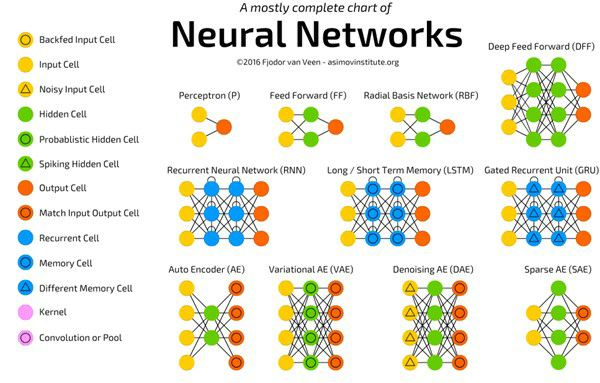
Now in this Deep Neural network tutorial, we will learn about types of Deep Learning Networks:
Now in this Deep Neural network tutorial, we will learn about types of Deep Learning Networks:
👍1
Feed-forward neural networks
The simplest type of artificial neural network. With this type of architecture, information flows in only one direction, forward. It means, the information’s flows starts at the input layer, goes to the “hidden” layers, and end at the output layer. The network
does not have a loop. Information stops at the output layers.
The simplest type of artificial neural network. With this type of architecture, information flows in only one direction, forward. It means, the information’s flows starts at the input layer, goes to the “hidden” layers, and end at the output layer. The network
does not have a loop. Information stops at the output layers.
❤1👍1
Recurrent neural networks (RNNs)
RNN is a multi-layered neural network that can store information in context nodes, allowing it to learn data sequences and output a number or another sequence. In simple words, it is an Artificial neural networks whose connections between neurons include loops. RNNs are well suited for processing sequences of inputs.
RNN is a multi-layered neural network that can store information in context nodes, allowing it to learn data sequences and output a number or another sequence. In simple words, it is an Artificial neural networks whose connections between neurons include loops. RNNs are well suited for processing sequences of inputs.

👍1
For Example, if the task is to predict the next word in the sentence “Do you want a…………?
The RNN neurons will receive a signal that point to the start of the sentence.
The network receives the word “Do” as an input and produces a vector of the number. This vector is fed back to the neuron to provide a memory to the network. This stage helps the network to remember it received “Do” and it received it in the first position.
The network will similarly proceed to the next words. It takes the word “you” and “want.” The state of the neurons is updated upon receiving each word.
The final stage occurs after receiving the word “a.” The neural network will provide a probability for each English word that can be used to complete the sentence. A well-trained RNN probably assigns a high probability to “café,” “drink,” “burger,” etc.
The network receives the word “Do” as an input and produces a vector of the number. This vector is fed back to the neuron to provide a memory to the network. This stage helps the network to remember it received “Do” and it received it in the first position.
The network will similarly proceed to the next words. It takes the word “you” and “want.” The state of the neurons is updated upon receiving each word.
The final stage occurs after receiving the word “a.” The neural network will provide a probability for each English word that can be used to complete the sentence. A well-trained RNN probably assigns a high probability to “café,” “drink,” “burger,” etc.