
About this item
🤚Now, battle in Style with Shadow's razor-sharp Edgy design and 7-colour Rainbow lighting with breathing effect.
🤚It has a gaming sensor for precise and fast-tracking with 4-levels of DPI adjustments(1200, 1800, 2400 & 3600) that won't let you down in the hour of your need.
🤚Made of Gaming Grade materials with 6-buttons tested for more than 7-million clicks, so we are here for a long term commitment, are you? Note: The side buttons on the mouse are non programmable and can be used as Forward and backward buttons.
🤚Comes with a 1.8 Metre long and durable braided cable with an EMI suppressor to cancel out noise in Data Transmission.
https://amzn.to/3nkiQ6f
🤚Now, battle in Style with Shadow's razor-sharp Edgy design and 7-colour Rainbow lighting with breathing effect.
🤚It has a gaming sensor for precise and fast-tracking with 4-levels of DPI adjustments(1200, 1800, 2400 & 3600) that won't let you down in the hour of your need.
🤚Made of Gaming Grade materials with 6-buttons tested for more than 7-million clicks, so we are here for a long term commitment, are you? Note: The side buttons on the mouse are non programmable and can be used as Forward and backward buttons.
🤚Comes with a 1.8 Metre long and durable braided cable with an EMI suppressor to cancel out noise in Data Transmission.
https://amzn.to/3nkiQ6f
👍1
This media is not supported in your browser
VIEW IN TELEGRAM
How does Machine Learning Work?
Now in this Machine learning basics for beginners tutorial, we will learn how Machine Learning (ML) works:
Machine learning is the brain where all the learning takes place. The way the machine learns is similar to the human being. Humans learn from experience. The more we know, the more easily we can predict. By analogy, when we face an unknown situation, the likelihood of success is lower than the known situation. Machines are trained the same. To make an accurate prediction, the machine sees an example. When we give the machine a similar example, it can figure out the outcome. However, like a human, if its feed a previously unseen example, the machine has difficulties to predict.
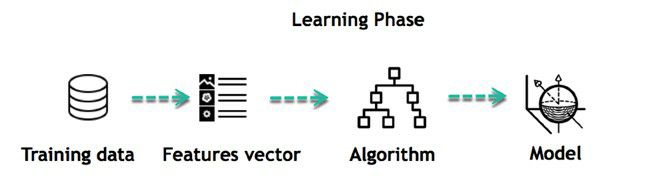
The core objective of machine learning is the learning and inference. First of all, the machine learns through the discovery of patterns. This discovery is made thanks to the data. One crucial part of the data scientist is to choose carefully which data to provide to the machine. The list of attributes used to solve a problem is called a feature vector. You can think of a feature vector as a subset of data that is used to tackle a problem.
The machine uses some fancy algorithms to simplify the reality and transform this discovery into a model. Therefore, the learning stage is used to describe the data and summarize it into a model.
Now in this Machine learning basics for beginners tutorial, we will learn how Machine Learning (ML) works:
Machine learning is the brain where all the learning takes place. The way the machine learns is similar to the human being. Humans learn from experience. The more we know, the more easily we can predict. By analogy, when we face an unknown situation, the likelihood of success is lower than the known situation. Machines are trained the same. To make an accurate prediction, the machine sees an example. When we give the machine a similar example, it can figure out the outcome. However, like a human, if its feed a previously unseen example, the machine has difficulties to predict.
The core objective of machine learning is the learning and inference. First of all, the machine learns through the discovery of patterns. This discovery is made thanks to the data. One crucial part of the data scientist is to choose carefully which data to provide to the machine. The list of attributes used to solve a problem is called a feature vector. You can think of a feature vector as a subset of data that is used to tackle a problem.
The machine uses some fancy algorithms to simplify the reality and transform this discovery into a model. Therefore, the learning stage is used to describe the data and summarize it into a model.
👍2
For instance, the machine is trying to understand the relationship between the wage of an individual and the likelihood to go to a fancy restaurant. It turns out the machine finds a positive relationship between wage and going to a high-end restaurant: This is the model
Inferring
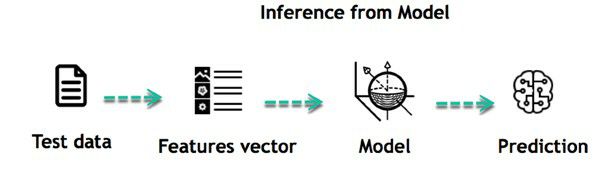
When the model is built, it is possible to test how powerful it is on never-seen-before data. The new data are transformed into a features vector, go through the model and give a prediction. This is all the beautiful part of machine learning. There is no need to update the rules or train again the model. You can use the model previously trained to make inference on new data.
When the model is built, it is possible to test how powerful it is on never-seen-before data. The new data are transformed into a features vector, go through the model and give a prediction. This is all the beautiful part of machine learning. There is no need to update the rules or train again the model. You can use the model previously trained to make inference on new data.
The life of Machine Learning programs is straightforward and can be summarized in the following points:
Define a question
Collect data
Visualize data
Train algorithm
Test the Algorithm
Collect feedback
Refine the algorithm
Loop 4-7 until the results are satisfying
Use the model to make a prediction
Once the algorithm gets good at drawing the right conclusions, it applies that knowledge to new sets of data.
Define a question
Collect data
Visualize data
Train algorithm
Test the Algorithm
Collect feedback
Refine the algorithm
Loop 4-7 until the results are satisfying
Use the model to make a prediction
Once the algorithm gets good at drawing the right conclusions, it applies that knowledge to new sets of data.
Machine Learning Algorithms and Where they are Used?
Now in this Machine learning tutorial for beginners, we will learn where Machine Learning (ML) algorithms are used:
Now in this Machine learning tutorial for beginners, we will learn where Machine Learning (ML) algorithms are used:
Machine learning can be grouped into two broad learning tasks: Supervised and Unsupervised. There are many other algorithms
Supervised learning
An algorithm uses training data and feedback from humans to learn the relationship of given inputs to a given output. For instance, a practitioner can use marketing expense and weather forecast as input data to predict the sales of cans.
You can use supervised learning when the output data is known. The algorithm will predict new data.
There are two categories of supervised learning:
🔰 Classification task
🔰 Regression task
Classification
Imagine you want to predict the gender of a customer for a commercial. You will start gathering data on the height, weight, job, salary, purchasing basket, etc. from your customer database. You know the gender of each of your customer, it can only be male or female. The objective of the classifier will be to assign a probability of being a male or a female (i.e., the label) based on the information (i.e., features you have collected). When the model learned how to recognize male or female, you can use new data to make a prediction. For instance, you just got new information from an unknown customer, and you want to know if it is a male or female. If the classifier predicts male = 70%, it means the algorithm is sure at 70% that this customer is a male, and 30% it is a female.
The label can be of two or more classes. The above Machine learning example has only two classes, but if a classifier needs to predict object, it has dozens of classes (e.g., glass, table, shoes, etc. each object represents a class)
Regression
When the output is a continuous value, the task is a regression. For instance, a financial analyst may need to forecast the value of a stock based on a range of feature like equity, previous stock performances, macroeconomics index. The system will be trained to estimate the price of the stocks with the lowest possible error.
An algorithm uses training data and feedback from humans to learn the relationship of given inputs to a given output. For instance, a practitioner can use marketing expense and weather forecast as input data to predict the sales of cans.
You can use supervised learning when the output data is known. The algorithm will predict new data.
There are two categories of supervised learning:
🔰 Classification task
🔰 Regression task
Classification
Imagine you want to predict the gender of a customer for a commercial. You will start gathering data on the height, weight, job, salary, purchasing basket, etc. from your customer database. You know the gender of each of your customer, it can only be male or female. The objective of the classifier will be to assign a probability of being a male or a female (i.e., the label) based on the information (i.e., features you have collected). When the model learned how to recognize male or female, you can use new data to make a prediction. For instance, you just got new information from an unknown customer, and you want to know if it is a male or female. If the classifier predicts male = 70%, it means the algorithm is sure at 70% that this customer is a male, and 30% it is a female.
The label can be of two or more classes. The above Machine learning example has only two classes, but if a classifier needs to predict object, it has dozens of classes (e.g., glass, table, shoes, etc. each object represents a class)
Regression
When the output is a continuous value, the task is a regression. For instance, a financial analyst may need to forecast the value of a stock based on a range of feature like equity, previous stock performances, macroeconomics index. The system will be trained to estimate the price of the stocks with the lowest possible error.
Algorithm
Linear regression
Description
Finds a way to correlate each feature to the output to help predict future values.
Type
Regression
Linear regression
Description
Finds a way to correlate each feature to the output to help predict future values.
Type
Regression
Algorithm
Logistic regression
Description
Extension of linear regression that’s used for classification tasks. The output variable 3is binary (e.g., only black or white) rather than continuous (e.g., an infinite list of potential colors)
Type
Classification
Logistic regression
Description
Extension of linear regression that’s used for classification tasks. The output variable 3is binary (e.g., only black or white) rather than continuous (e.g., an infinite list of potential colors)
Type
Classification
Algorithm
Decision tree
Description
Highly interpretable classification or regression model that splits data-feature values into branches at decision nodes (e.g., if a feature is a color, each possible color becomes a new branch) until a final decision output is made
Type
Regression
Classification
Decision tree
Description
Highly interpretable classification or regression model that splits data-feature values into branches at decision nodes (e.g., if a feature is a color, each possible color becomes a new branch) until a final decision output is made
Type
Regression
Classification
Algorithm
Naive Bayes
Description
The Bayesian method is a classification method that makes use of the Bayesian theorem. The theorem updates the prior knowledge of an event with the independent probability of each feature that can affect the event.
Type
Regression
Classification
Naive Bayes
Description
The Bayesian method is a classification method that makes use of the Bayesian theorem. The theorem updates the prior knowledge of an event with the independent probability of each feature that can affect the event.
Type
Regression
Classification
Algorithm
Support vector machine
Description
Support Vector Machine, or SVM, is typically used for the classification task.
SVM algorithm finds a hyperplane that optimally divided the classes. It is best used with a non-linear solver.
Type
Regression (not very common)
Classification
Support vector machine
Description
Support Vector Machine, or SVM, is typically used for the classification task.
SVM algorithm finds a hyperplane that optimally divided the classes. It is best used with a non-linear solver.
Type
Regression (not very common)
Classification
❤1
Algorithm
Random forest
Description
The algorithm is built upon a decision tree to improve the accuracy drastically. Random forest generates many times simple decision trees and uses the ‘majority vote’ method to decide on which label to return. For the classification task, the final prediction will be the one with the most vote; while for the regression task, the average prediction of all the trees is the final prediction.
Type
Regression
Classification
Random forest
Description
The algorithm is built upon a decision tree to improve the accuracy drastically. Random forest generates many times simple decision trees and uses the ‘majority vote’ method to decide on which label to return. For the classification task, the final prediction will be the one with the most vote; while for the regression task, the average prediction of all the trees is the final prediction.
Type
Regression
Classification
Algorithm
AdaBoost
Description
Classification or regression technique that uses a multitude of models to come up with a decision but weighs them based on their accuracy in predicting the outcome
Type
Regression
Classification
AdaBoost
Description
Classification or regression technique that uses a multitude of models to come up with a decision but weighs them based on their accuracy in predicting the outcome
Type
Regression
Classification