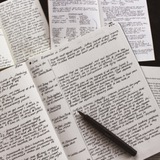
Mere Exposure Effect
The mere exposure effect is a psychological phenomenon where people develop a preference for things merely because they are familiar with them. Also known as the familiarity principle, this cognitive bias suggests that repeated exposure to a neutral stimulus (a person, object, or song) increases our liking for it.
The mere exposure effect is a psychological phenomenon where people develop a preference for things merely because they are familiar with them. Also known as the familiarity principle, this cognitive bias suggests that repeated exposure to a neutral stimulus (a person, object, or song) increases our liking for it.
❤2
[cc]
aura is the new luxury
Walter Benjamin argued that 'even the most perfect reproduction of a work of art is lacking in one element: Its presence in time and space, its unique existence at the place where it happens to be. ' He referred this unique cultural context i.e. 'its presence in time and space' as its 'aura'.
https://youtube.com/shorts/3Iss1CksXD4?si=KKzhvM_4eberUe4S
aura is the new luxury
Walter Benjamin argued that 'even the most perfect reproduction of a work of art is lacking in one element: Its presence in time and space, its unique existence at the place where it happens to be. ' He referred this unique cultural context i.e. 'its presence in time and space' as its 'aura'.
https://youtube.com/shorts/3Iss1CksXD4?si=KKzhvM_4eberUe4S
YouTube
orenmeetsworld
5.3K likes, 175 comments. "Is anything cool anymore?"
humblespace
[cc] aura is the new luxury Walter Benjamin argued that 'even the most perfect reproduction of a work of art is lacking in one element: Its presence in time and space, its unique existence at the place where it happens to be. ' He referred this unique cultural…
Walter Benjamin’s notion of aura and Experience Design
https://omitzec.medium.com/walter-benjamins-notion-of-aura-and-experience-design-a9032f49c3
https://omitzec.medium.com/walter-benjamins-notion-of-aura-and-experience-design-a9032f49c3
Medium
Walter Benjamin’s notion of aura and Experience Design
In “A Short History of Photography“, Benjamin Walter introduces the concept of aura as follows,
(US Study)
https://onlinelibrary.wiley.com/doi/full/10.1111/bioe.13134
A study published in the Journal of American Medical Association (JAMA) found that between 2000–2002 and 2016–2018, the proportion of 18–24-year-old individuals who reported having had no sexual activity in the past year increased among men (but not among women).1 In another recent study, similar results were reported: American men belonging to the youngest birth cohort who entered adulthood were more likely to be sexually inactive than their Millennial counterparts at the same ages just a few years prior.
The 5% is thus having half the (penile–vaginal) sex in the world.
https://onlinelibrary.wiley.com/doi/full/10.1111/bioe.13134
AI self-preferencing in algorithmic hiring
tldr; using AI to craft your resume leads to better shortlisting rates
source:
https://arxiv.org/abs/2509.00462
https://x.com/heynavtoor/status/2048088874686300431?s=20
tldr; using AI to craft your resume leads to better shortlisting rates
The bias against human-written resumes is particularly substantial, with self-preference bias ranging from 67% to 82% across major commercial and open-source models. To assess labor market impact, we simulate realistic hiring pipelines across 24 occupations. These simulations show that candidates using the same LLM as the evaluator are 23% to 60% more likely to be shortlisted than equally qualified applicants submitting human-written resumes, with the largest disadvantages observed in business-related fields such as sales and accounting.
source:
https://arxiv.org/abs/2509.00462
https://x.com/heynavtoor/status/2048088874686300431?s=20
👍1
[cc]
source:
Face photo-based age acceleration predicts all-cause mortality and differs among occupations - https://www.biorxiv.org/content/10.1101/2025.04.16.649078v1
https://x.com/agingroy/status/2047745587143917991?s=20
A facial aging clock trained on occupation-linked photos found that the gap between your biological face-age and your real age predicts all-cause mortality. The wider that gap, the higher your risk.
Women aged slower than men in every single occupation measured. No exceptions.
The ranking, from youngest-looking to oldest-looking relative to chronological age:
Athletes > service workers > sales > clerical > managers > professionals > scientists and educators.
source:
Face photo-based age acceleration predicts all-cause mortality and differs among occupations - https://www.biorxiv.org/content/10.1101/2025.04.16.649078v1
https://x.com/agingroy/status/2047745587143917991?s=20
X (formerly Twitter)
Avi Roy (@agingroy) on X
Scientists and educators age fastest. Athletes age slowest.
A facial aging clock trained on occupation-linked photos found that the gap between your biological face-age and your real age predicts all-cause mortality. The wider that gap, the higher your risk.…
A facial aging clock trained on occupation-linked photos found that the gap between your biological face-age and your real age predicts all-cause mortality. The wider that gap, the higher your risk.…
❤2
[cc]
over the weekend, i had the pleasure of playing Blood On The Clocktower, a board game with some friends (and friends of)
some reflections that also reflect human psych from a fellow player:
• approaching with something to give makes people trust you more (providing value first)
• being present when information is being shared and how you share/shape the perception of it, snowballs into a greater force down the line (compounding)
speaking of trusting, it reminds me of the Benjamin Franklin Effect
over the weekend, i had the pleasure of playing Blood On The Clocktower, a board game with some friends (and friends of)
some reflections that also reflect human psych from a fellow player:
• approaching with something to give makes people trust you more (providing value first)
• being present when information is being shared and how you share/shape the perception of it, snowballs into a greater force down the line (compounding)
speaking of trusting, it reminds me of the Benjamin Franklin Effect
❤5
humblespace
[cc] over the weekend, i had the pleasure of playing Blood On The Clocktower, a board game with some friends (and friends of) some reflections that also reflect human psych from a fellow player: • approaching with something to give makes people trust you…
Benjamin Franklin Effect
The Benjamin Franklin Effect is a psychological phenomenon in which a person likes someone more after doing them a favor. The effect can be explained with cognitive dissonance: individuals rationalize their helpful actions by assuming they must like the person, since their behavior would otherwise conflict with their typical behavior and self-perception. In this way, the effect shows how people adjust their attitudes to maintain consistency in their self-concept.
tldr; asking for a favour from someone makes them trust/like you more
The Benjamin Franklin Effect is a psychological phenomenon in which a person likes someone more after doing them a favor. The effect can be explained with cognitive dissonance: individuals rationalize their helpful actions by assuming they must like the person, since their behavior would otherwise conflict with their typical behavior and self-perception. In this way, the effect shows how people adjust their attitudes to maintain consistency in their self-concept.
tldr; asking for a favour from someone makes them trust/like you more
humblespace
The "I'm going to marry a CEO" airhead epidemic movies and shows are only portraying love in the top 1% ie. average girl meets billionaire's son or super model male conditioning modern women to only go for the top 1%, which results in unrealistic expectations…
remember the CEO airhead epidemic that was discussed^
the effects of these dramas and movies are real and already felt
https://x.com/HazelAppleyard/status/2048323256814313676?s=20
the effects of these dramas and movies are real and already felt
https://x.com/HazelAppleyard/status/2048323256814313676?s=20
X (formerly Twitter)
Hazel Appleyard (@HazelAppleyard) on X
What am I going to spend all my time watching now???
😁3
what gets lost when a culture is commercialised?
https://youtube.com/shorts/8jQmcQmSMCY?si=cWqzUjaENuXlK_7Y
https://youtube.com/shorts/8jQmcQmSMCY?si=cWqzUjaENuXlK_7Y
YouTube
Glass Museum
42K likes, 736 comments. "Kpop, appropriation, Alysa liu, and the value of art #kpop #dance #alysaliu #hiphop #art"