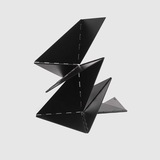
Ettore Sottsass Jr.
Metafore
1972-1979
“Sottsass was questioning the act of building as well as the underpinnings of industrial culture. He then abandoned this artistic production to focus on writing and design. His “constructions” are a sort of “study of the language of architecture” (Barbara Radice), on the link between oneself and the physical environment. These temporary structures are composed of humble and fragile elements, bits of string, wood, ribbons, leaves, rocks, bits of clothing, etc., referring to the precariousness of things.
Sottsass wrote: “I felt a deep necessity to visit deserted places, mountains, to establish a new physical relationship with the cosmos, which is the only environment there is, precisely because it cannot be measured, anticipated, controlled or known...”
[x]
Metafore
1972-1979
“Sottsass was questioning the act of building as well as the underpinnings of industrial culture. He then abandoned this artistic production to focus on writing and design. His “constructions” are a sort of “study of the language of architecture” (Barbara Radice), on the link between oneself and the physical environment. These temporary structures are composed of humble and fragile elements, bits of string, wood, ribbons, leaves, rocks, bits of clothing, etc., referring to the precariousness of things.
Sottsass wrote: “I felt a deep necessity to visit deserted places, mountains, to establish a new physical relationship with the cosmos, which is the only environment there is, precisely because it cannot be measured, anticipated, controlled or known...”
[x]
❤6🥰1
❤9
Gruppo T exhibition at Galleria Pater with Lucio Fontana
Alfio Di Bella
Milan, 1960
“…the Group T (so called referring to the concept of time, as a new variable of becoming in a space-time dimension that fully involves the user), while relying on a collectivist idea of the artistic work that led to the proposition of works with the signature "Gruppo T", never completely dissociated production from individual personalities as it did elsewhere for other groups who chose to sign their works only and exclusively behind a sign. For more than a decade the works and actions of Group T have raised the problem of the habitability of the work (environment-work) and its interaction with the spectator, becoming the pioneers of operating modes then gained in the next decade.”
[x]
Alfio Di Bella
Milan, 1960
“…the Group T (so called referring to the concept of time, as a new variable of becoming in a space-time dimension that fully involves the user), while relying on a collectivist idea of the artistic work that led to the proposition of works with the signature "Gruppo T", never completely dissociated production from individual personalities as it did elsewhere for other groups who chose to sign their works only and exclusively behind a sign. For more than a decade the works and actions of Group T have raised the problem of the habitability of the work (environment-work) and its interaction with the spectator, becoming the pioneers of operating modes then gained in the next decade.”
[x]
❤2
Jørn Utzon
Espansiva
Hellebæk, Denmark
1969
“The Espansiva system was designed to offer the user complete freedom of choice for planning their building as well as for extending and altering it at any time. […]
Each type of module configuration has different circulation within its larger composition. This allows the compositions to both inform and be informed by the configurations intended use. This flexibility of purpose was Utzon’s main concept while designing Espansiva.”
[x]
Espansiva
Hellebæk, Denmark
1969
“The Espansiva system was designed to offer the user complete freedom of choice for planning their building as well as for extending and altering it at any time. […]
Each type of module configuration has different circulation within its larger composition. This allows the compositions to both inform and be informed by the configurations intended use. This flexibility of purpose was Utzon’s main concept while designing Espansiva.”
[x]
❤3👍2