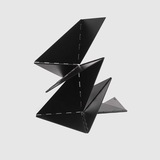
What did I do?
Seminated the night, as though
there could be others, more nocturnal than
this one.
Bird flight, stone flight, a thousand
described routes. Glances, purloined and plucked. The sea,
tasted, drunk away, dreamed away. An hour
soul-eclipsed. The next, an autumn light,
offered up to a blind
feeling which came that way. Others, many,
with no place but their own heavy centres: glimpsed and avoided.
Foundlings, stars,
black, full of language: named after an oath which silence annulled.
And once (when? that too is forgotten):
felt the barb
where my pulse dared the counter-beat.
Paul Celan, All Souls, trans. Michael Hamburger, from Poetry (December 1971)
Seminated the night, as though
there could be others, more nocturnal than
this one.
Bird flight, stone flight, a thousand
described routes. Glances, purloined and plucked. The sea,
tasted, drunk away, dreamed away. An hour
soul-eclipsed. The next, an autumn light,
offered up to a blind
feeling which came that way. Others, many,
with no place but their own heavy centres: glimpsed and avoided.
Foundlings, stars,
black, full of language: named after an oath which silence annulled.
And once (when? that too is forgotten):
felt the barb
where my pulse dared the counter-beat.
Paul Celan, All Souls, trans. Michael Hamburger, from Poetry (December 1971)
❤2
The School of Valparaíso
The Open City of Amereida
Ritoque, Chile
1969
“The Open City of Amereida is one of the most singular experiences of 20th century Latin American architecture. It is a heterogeneous group of more than forty constructions –including open spaces (agoras), workshops, living spaces (hospederías and cubículas), places of worship and sculptures– located in a beautiful landscape in Ritoque, Chile, facing the Pacific Ocean. These buildings have all been particularly designed in a participatory process (in ronda), without a predefined shape, by a community of professors and students of the Pontificia Universidad Católica de Valparaíso inspired by symbolism, Dadaism, surrealism and the Situationist International, among other artistic protest movements of the 1960s. In Open City, this human group brings life, work and study together, assigning a poetic significance to architecture”
[x]
The Open City of Amereida
Ritoque, Chile
1969
“The Open City of Amereida is one of the most singular experiences of 20th century Latin American architecture. It is a heterogeneous group of more than forty constructions –including open spaces (agoras), workshops, living spaces (hospederías and cubículas), places of worship and sculptures– located in a beautiful landscape in Ritoque, Chile, facing the Pacific Ocean. These buildings have all been particularly designed in a participatory process (in ronda), without a predefined shape, by a community of professors and students of the Pontificia Universidad Católica de Valparaíso inspired by symbolism, Dadaism, surrealism and the Situationist International, among other artistic protest movements of the 1960s. In Open City, this human group brings life, work and study together, assigning a poetic significance to architecture”
[x]
❤2
Sol Lewitt
from Six Geometric Figures in Superimposed Pairs
1977
from Six Geometric Figures in Superimposed Pairs
1977
❤3
“…Though Andy Goldsworthy has made enormous and relatively durable works such as those in Grizedale Forest (AR September 1985), some of his sculptures are tiny, even inconspicuous, and the vast majority - like those described above - are ephemeral. For most of us they exist only second hand in photographs. Originals lodge only in the memory of the artist, and maybe of a few fortunate others. Some sculptures are so ephemeral - such as rainbowed splashes, or loose clusters of thrown sticks - that they can be appreciated fully only in a prolonged instant frozen on film.”
— Peter Buchanan, The nature of Andy Goldsworthy, for The Architectural Review
[x]
— Peter Buchanan, The nature of Andy Goldsworthy, for The Architectural Review
[x]
❤4