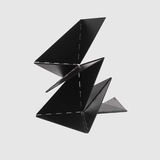
Bridget Riley
Uneasy Centre and related studies
Published by Hazlitt Holland-Hibbert
2016
Uneasy Centre and related studies
Published by Hazlitt Holland-Hibbert
2016
❤5
“[O]nly engagement and mix-up with the world, attractions and repulsions, crossings and obstructions, captures and losses, seizures and relinquishments.
My hands, my legs, my throat, my postures, my bearing, my gestures, my expressions, my airs, the timber of my voice, the whole pragmatics of the body, as one might call it, without exception everything on the surface of my skin and of what I can cover or decorate it with, all this exposes, announces, declares, addresses something: ways of coming near or going away, forces of attraction and repulsion, tensions for taking or leaving, for swallowing or rejecting. Mohammed Khaïr-Eddine writes: “This is how my skin becomes its own theatre”, and he continues: “This explains why the actor or the simple speaker is moved by pulsations, the original signification of which is unknown to him or her”. In all its ways of opening and closing, of placing and displacing itself, of disposing and imposing itself, and of fleeing, the body engages a drama which is not at all “personal” or “subjective” but each time a singular dramatization of its singular detachment among other bodies – as it is projected with them in the cosmos.”
Jean-Luc Nancy, Body-Theatre
My hands, my legs, my throat, my postures, my bearing, my gestures, my expressions, my airs, the timber of my voice, the whole pragmatics of the body, as one might call it, without exception everything on the surface of my skin and of what I can cover or decorate it with, all this exposes, announces, declares, addresses something: ways of coming near or going away, forces of attraction and repulsion, tensions for taking or leaving, for swallowing or rejecting. Mohammed Khaïr-Eddine writes: “This is how my skin becomes its own theatre”, and he continues: “This explains why the actor or the simple speaker is moved by pulsations, the original signification of which is unknown to him or her”. In all its ways of opening and closing, of placing and displacing itself, of disposing and imposing itself, and of fleeing, the body engages a drama which is not at all “personal” or “subjective” but each time a singular dramatization of its singular detachment among other bodies – as it is projected with them in the cosmos.”
Jean-Luc Nancy, Body-Theatre
❤4
I'm not in a hurry. In a hurry for what?
The sun and moon aren't in a hurry; they're right.
To hurry is to suppose we can overtake our legs
Or leap over our shadow.
No, I'm not in a hurry.
If I stretch out my arm, I'll reach exactly as far as my arm reaches
And not half an inch farther.
I touch where my finger touches, not where I think.
I can only sit down where I am.
This sounds ridiculous, like all absolutely true truths,
But what's really ridiculous is how we're always thinking of something else,
And we're always outside it, because we're here.
Fernando Pessoa, from A Little Larger Than the Entire Universe: Selected Poems, translated by Richard Zenith
The sun and moon aren't in a hurry; they're right.
To hurry is to suppose we can overtake our legs
Or leap over our shadow.
No, I'm not in a hurry.
If I stretch out my arm, I'll reach exactly as far as my arm reaches
And not half an inch farther.
I touch where my finger touches, not where I think.
I can only sit down where I am.
This sounds ridiculous, like all absolutely true truths,
But what's really ridiculous is how we're always thinking of something else,
And we're always outside it, because we're here.
Fernando Pessoa, from A Little Larger Than the Entire Universe: Selected Poems, translated by Richard Zenith
🎉5
“Shackled
between Gold and Forgetting:
Night.
Both grabbed for her.
Both she let have their way.
Lay,
you too now lay down what wants to a-
rise at dawn along with the days:
the word, star-overflown,
sea-drenched.
To each, the word.
To each the word that sang to him,
when the pack jumped him from behind—
To each the word, that sang to him and froze.
To her, to night,
the star-overflown, the sea-drenched,
to her, the word silence won,
whose blood did not curdle when the poison fang
pierced its syllables.
To her, the word silence won.”
Paul Celan, from “Argumentum e Silentio", trans. Pierre Joris
between Gold and Forgetting:
Night.
Both grabbed for her.
Both she let have their way.
Lay,
you too now lay down what wants to a-
rise at dawn along with the days:
the word, star-overflown,
sea-drenched.
To each, the word.
To each the word that sang to him,
when the pack jumped him from behind—
To each the word, that sang to him and froze.
To her, to night,
the star-overflown, the sea-drenched,
to her, the word silence won,
whose blood did not curdle when the poison fang
pierced its syllables.
To her, the word silence won.”
Paul Celan, from “Argumentum e Silentio", trans. Pierre Joris
❤6