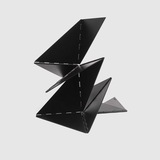
Arp: Graphik, Klipstein & Kornfeld, Bern, 1959 [Leo de Goede Books]
Logistics runs the globe, runs after the earth and the logisticality that has developed as a capacity on this earth. Logistics extends, expands, accumulates the space and time of a capitalism driven across the earth by the algorithmic zero-one/one-two beat. And by doing so it forces upon the earth, the world. If logisticality is the resident capacity to live on the earth, logistics is the regulation of that capacity in the service of making the world, the zero-one, one-two world that pursues the general antagonism of life on earth. The world is posed as the way to live on the earth as the individual is posed as the way to live in the world. To live in the world as an individual is therefore to be logistic, and to be logistic is to settle into a rhythm that kills, […] Logistical capitalism seeks total access to your language, total translation, total transparency, total value from your words. And then it seeks more.
Fred Moten & Stefano Harney, All Incomplete
Fred Moten & Stefano Harney, All Incomplete
Baudrillard has pushed this logic even further to draw attention to the overload of information provided by the media which now confront us with an endless flow of fascinating images and simulations...In this hyperreality the real and the imaginary are confused and aesthetic fascination is everywhere so that ‘a kind of non-intentional parody hovers over everything, of technical simulating, of indefinable fame to which is attached an aesthetic pleasure’. For Baudrillard art ceases to be a separate enclaved reality; it enters into production and reproduction so that everything ‘even if it be the everyday and banal reality, falls by this token under the sign of art, and becomes aesthetic’. The end of the real and the end of art moves us into a hyperreality in which the secret discovered by Surrealism becomes more widespread and generalized.
—Mike Featherstone, Consumer Culture and Postmodernism
—Mike Featherstone, Consumer Culture and Postmodernism
I am on the edge of the crowd, at the periphery; but I belong to it, I am attached to it by one of my extremities, a hand or foot. I know that the periphery is the only place I can be, that I would die if I let myself be drawn into the center of the fray, but just as certainly if I let go of the crowd. This is not an easy position to stay in, it is even very difficult to hold, for these beings are in constant motion and their movements are unpredictable and follow no rhythm. They swirl, go north, then suddenly east; none of the individuals in the crowd remains in the same place in relation to the others. So I too am in perpetual motion; all this demands a high level of tension, but it gives me a feeling of violent, almost vertiginous, happiness.
Gilles Deleuze and Félix Guattari, A Thousand Plateaus
Gilles Deleuze and Félix Guattari, A Thousand Plateaus