Hacking Articles Tips Tricks Videos Tutorials
Photo
Hacking on Medium
HOW I HACKED INTO A HOTEL WEBSITE’S DATABASE
https://cdn-images-1.medium.com/max/1126/1*QfodFufgcnS9OdxKJRW_0w.png
SIMPLE SQL INJECTION
Continue reading on Medium »
___________________________
@hacking_Attack
@Hacking_Video
HOW I HACKED INTO A HOTEL WEBSITE’S DATABASE
https://cdn-images-1.medium.com/max/1126/1*QfodFufgcnS9OdxKJRW_0w.png
SIMPLE SQL INJECTION
Continue reading on Medium »
___________________________
@hacking_Attack
@Hacking_Video
Medium
HOW I HACKED INTO A HOTEL WEBSITE’S DATABASE
SIMPLE SQL INJECTION
Hacking Articles Tips Tricks Videos Tutorials
Photo
Hacking on Medium
EE.UU. Anuncia una nueva directiva de seguridad después del hack a oleoductos críticos.
https://cdn-images-1.medium.com/max/1600/0*eMdM5njJVvDGnwkK.jpg
PUBLICADO EN 27 MAYO, 2021 POR EHACKING
Continue reading on Medium »
___________________________
@hacking_Attack
@Hacking_Video
EE.UU. Anuncia una nueva directiva de seguridad después del hack a oleoductos críticos.
https://cdn-images-1.medium.com/max/1600/0*eMdM5njJVvDGnwkK.jpg
PUBLICADO EN 27 MAYO, 2021 POR EHACKING
Continue reading on Medium »
___________________________
@hacking_Attack
@Hacking_Video
Medium
EE.UU. Anuncia una nueva directiva de seguridad después del hack a oleoductos críticos.
PUBLICADO EN 27 MAYO, 2021 POR EHACKING
Hacking Articles Tips Tricks Videos Tutorials
Photo
Hacking on Medium
CC: Pen Testing WriteUp — TryHackMe
https://cdn-images-1.medium.com/max/1024/0*5q3VzUY5gGtHjvzO
Continue reading on Medium »
___________________________
@hacking_Attack
@Hacking_Video
CC: Pen Testing WriteUp — TryHackMe
https://cdn-images-1.medium.com/max/1024/0*5q3VzUY5gGtHjvzO
Continue reading on Medium »
___________________________
@hacking_Attack
@Hacking_Video
Medium
CC: Pen Testing WriteUp — TryHackMe
The idea behind this room is to provide an introduction to various tools and concepts commonly encountered in penetration testing. This task will take you through selecting and setting options for…
Hacking Articles Tips Tricks Videos Tutorials
Photo
Hacking on Medium
TryHackMe Writeup: KENOBI.
https://cdn-images-1.medium.com/max/1920/1*7uNJ7S6T_Bf9y7tsjqKpng.png
ENUMERATION:
Continue reading on Medium »
___________________________
@hacking_Attack
@Hacking_Video
TryHackMe Writeup: KENOBI.
https://cdn-images-1.medium.com/max/1920/1*7uNJ7S6T_Bf9y7tsjqKpng.png
ENUMERATION:
Continue reading on Medium »
___________________________
@hacking_Attack
@Hacking_Video
Medium
TryHackMe Writeup: KENOBI.
ENUMERATION:
Hacking Articles Tips Tricks Videos Tutorials
Photo
Hacking on Medium
How to get Started in Cyber Security?
https://cdn-images-1.medium.com/max/600/1*tyzEQRZorAtRgr0pHqfa0A.jpeg
Cyberattacks are happening all the time, meaning that keeping software, hardware, and data safe and secure is more important than ever.
Continue reading on Medium »
___________________________
@hacking_Attack
@Hacking_Video
How to get Started in Cyber Security?
https://cdn-images-1.medium.com/max/600/1*tyzEQRZorAtRgr0pHqfa0A.jpeg
Cyberattacks are happening all the time, meaning that keeping software, hardware, and data safe and secure is more important than ever.
Continue reading on Medium »
___________________________
@hacking_Attack
@Hacking_Video
Medium
How to get Started in Cyber Security?
Cyberattacks are happening all the time, meaning that keeping software, hardware, and data safe and secure is more important than ever.
Hacking Articles Tips Tricks Videos Tutorials
Photo
Hacking on Medium
Bug Bounty Methodology V3.0: Hunt like a rat
https://cdn-images-1.medium.com/max/1532/1*WD6Z0zQqHjOnZxUX3hyZkA.png
Over time i ran into some issues when i was following other people’s methodologies. I was testing like my mentors and my hero’s but it…
Continue reading on Medium »
___________________________
@hacking_Attack
@Hacking_Video
Bug Bounty Methodology V3.0: Hunt like a rat
https://cdn-images-1.medium.com/max/1532/1*WD6Z0zQqHjOnZxUX3hyZkA.png
Over time i ran into some issues when i was following other people’s methodologies. I was testing like my mentors and my hero’s but it…
Continue reading on Medium »
___________________________
@hacking_Attack
@Hacking_Video
Medium
Bug Bounty Methodology V3.0: Hunt like a rat
Over time i ran into some issues when i was following other people’s methodologies. I was testing like my mentors and my hero’s but it…
Web App Pen Testing - Learning SQL Injection
https://www.reddit.com/r/Pentesting/comments/nmawn4/web_app_pen_testing_learning_sql_injection/
<!-- SC_OFF -->Hello Everyone, I'm on my journey to become a web app pen tester and I have started with the Portswigger Web Security Academy which I'm finding incredibly useful so far. I have started on the SQL injection topic and I've just started looking at blind SQL injection and its the first time where I have relied heavily on hints/solutions to assist me in completing the labs. What I'm struggling with is the many extra variables you may potentially have to include in order to be successful. So my question is how would you know whether to use URL encoding vs concatenation vs a comment trailer or even a combination of these? Is it simply trial and error or is there a set pattern you should always try when discovering a potential injectable field? Some examples below. Lab example with double concatenation encased in quotes TrackingId=xyz'||(SELECT ' ')||' Lab example with concatenation and comment trailer TrackingId=x'||pg_sleep(10)-- Lab example with some URL encoding and + TrackingId=x'%3BSELECT+CASE+WHEN+(1=1)+THEN+pg_sleep(10)+ELSE+pg_sleep(0)+END-- At the moment these labs feel impossible without these hints/walkthroughs so any advice would be greatly appreciated. Thanks in advance :) <!-- SC_ON --> submitted by /u/lewis20188 (https://www.reddit.com/user/lewis20188)
[link] (https://www.reddit.com/r/Pentesting/comments/nmawn4/web_app_pen_testing_learning_sql_injection/) [comments] (https://www.reddit.com/r/Pentesting/comments/nmawn4/web_app_pen_testing_learning_sql_injection/)
https://www.reddit.com/r/Pentesting/comments/nmawn4/web_app_pen_testing_learning_sql_injection/
<!-- SC_OFF -->Hello Everyone, I'm on my journey to become a web app pen tester and I have started with the Portswigger Web Security Academy which I'm finding incredibly useful so far. I have started on the SQL injection topic and I've just started looking at blind SQL injection and its the first time where I have relied heavily on hints/solutions to assist me in completing the labs. What I'm struggling with is the many extra variables you may potentially have to include in order to be successful. So my question is how would you know whether to use URL encoding vs concatenation vs a comment trailer or even a combination of these? Is it simply trial and error or is there a set pattern you should always try when discovering a potential injectable field? Some examples below. Lab example with double concatenation encased in quotes TrackingId=xyz'||(SELECT ' ')||' Lab example with concatenation and comment trailer TrackingId=x'||pg_sleep(10)-- Lab example with some URL encoding and + TrackingId=x'%3BSELECT+CASE+WHEN+(1=1)+THEN+pg_sleep(10)+ELSE+pg_sleep(0)+END-- At the moment these labs feel impossible without these hints/walkthroughs so any advice would be greatly appreciated. Thanks in advance :) <!-- SC_ON --> submitted by /u/lewis20188 (https://www.reddit.com/user/lewis20188)
[link] (https://www.reddit.com/r/Pentesting/comments/nmawn4/web_app_pen_testing_learning_sql_injection/) [comments] (https://www.reddit.com/r/Pentesting/comments/nmawn4/web_app_pen_testing_learning_sql_injection/)
Bug Bounty Methodology V3.0: Hunt like a rat
https://thexssrat.medium.com/bug-bounty-methodology-v3-0-hunt-like-a-rat-9e030fc54363?source=rss------bug_bounty-5
___________________________
@hacking_Attack
@Hacking_Video
https://thexssrat.medium.com/bug-bounty-methodology-v3-0-hunt-like-a-rat-9e030fc54363?source=rss------bug_bounty-5
___________________________
@hacking_Attack
@Hacking_Video
Medium
Bug Bounty Methodology V3.0: Hunt like a rat
Over time i ran into some issues when i was following other people’s methodologies. I was testing like my mentors and my hero’s but it…
Over time i ran into some issues when i was following other people’s methodologies. I was testing like my mentors and my hero’s but it…Continue reading on Medium » (https://thexssrat.medium.com/bug-bounty-methodology-v3-0-hunt-like-a-rat-9e030fc54363?source=rss------bug_bounty-5)
___________________________
@hacking_Attack
@Hacking_Video
___________________________
@hacking_Attack
@Hacking_Video
Medium
Bug Bounty Methodology V3.0: Hunt like a rat
Over time i ran into some issues when i was following other people’s methodologies. I was testing like my mentors and my hero’s but it…
Hacking Articles Tips Tricks Videos Tutorials
Photo
hacking: security in practice
Demo for Mr. Beast's Self Updating Thumbnail Hack
https://external-preview.redd.it/Zj-byydGu0QD2Ijxe2jVSU2FwRFAiw86iAvg_rjm0io.jpg?width=320&crop=smart&auto=webp&s=04019f1fe1a7655152291c2626f9471e9d65d402 submitted by /u/EmergencyCloud2080
[link] [comments]
___________________________
@hacking_Attack
@Hacking_Video
Demo for Mr. Beast's Self Updating Thumbnail Hack
https://external-preview.redd.it/Zj-byydGu0QD2Ijxe2jVSU2FwRFAiw86iAvg_rjm0io.jpg?width=320&crop=smart&auto=webp&s=04019f1fe1a7655152291c2626f9471e9d65d402 submitted by /u/EmergencyCloud2080
[link] [comments]
___________________________
@hacking_Attack
@Hacking_Video
reddit
r/hacking - Demo for Mr. Beast's Self Updating Thumbnail Hack
0 votes and 0 comments so far on Reddit
Enterprise Scale Threat Hunting: C2 Beacon Detection with Unsupervised ML and KQL — Part 2
https://www.reddit.com/r/redteamsec/comments/nmhys3/enterprise_scale_threat_hunting_c2_beacon/
submitted by /u/dmchell (https://www.reddit.com/user/dmchell)
[link] (https://mergene.medium.com/enterprise-scale-threat-hunting-network-beacon-detection-with-unsupervised-ml-and-kql-part-2-bff46cfc1e7e) [comments] (https://www.reddit.com/r/redteamsec/comments/nmhys3/enterprise_scale_threat_hunting_c2_beacon/)
___________________________
@hacking_Attack
@Hacking_Video
https://www.reddit.com/r/redteamsec/comments/nmhys3/enterprise_scale_threat_hunting_c2_beacon/
submitted by /u/dmchell (https://www.reddit.com/user/dmchell)
[link] (https://mergene.medium.com/enterprise-scale-threat-hunting-network-beacon-detection-with-unsupervised-ml-and-kql-part-2-bff46cfc1e7e) [comments] (https://www.reddit.com/r/redteamsec/comments/nmhys3/enterprise_scale_threat_hunting_c2_beacon/)
___________________________
@hacking_Attack
@Hacking_Video
reddit
Enterprise Scale Threat Hunting: C2 Beacon Detection with...
Posted in r/redteamsec by u/dmchell • 1 point and 0 comments
BHIS | Getting Started in Pentesting The Cloud: Azure | Beau Bullock (1-Hour)
https://www.reddit.com/r/redteamsec/comments/nmhze0/bhis_getting_started_in_pentesting_the_cloud/
submitted by /u/dmchell (https://www.reddit.com/user/dmchell)
[link] (https://youtu.be/fCbVMWvncuw) [comments] (https://www.reddit.com/r/redteamsec/comments/nmhze0/bhis_getting_started_in_pentesting_the_cloud/)
___________________________
@hacking_Attack
@Hacking_Video
https://www.reddit.com/r/redteamsec/comments/nmhze0/bhis_getting_started_in_pentesting_the_cloud/
submitted by /u/dmchell (https://www.reddit.com/user/dmchell)
[link] (https://youtu.be/fCbVMWvncuw) [comments] (https://www.reddit.com/r/redteamsec/comments/nmhze0/bhis_getting_started_in_pentesting_the_cloud/)
___________________________
@hacking_Attack
@Hacking_Video
reddit
BHIS | Getting Started in Pentesting The Cloud: Azure | Beau...
Posted in r/redteamsec by u/dmchell • 1 point and 0 comments
Hacking Articles Tips Tricks Videos Tutorials
Photo
Black Hat Ethical Hacking
Pulse Secure VPNs Get Quick Fix for Critical RCE
https://www.blackhatethicalhacking.com/wp-content/uploads/2017/11/black-hat-locks-and-electronics.jpg Pulse Secure VPNs Get Quick Fix for Critical RCEPost Views: 160
Reading Time: 1 Minute
Pulse Secure has issued a workaround for a critical remote-code execution (RCE) vulnerability in its Pulse Connect Secure (PCS) VPNs that may allow an unauthenticated, remote attacker to execute code as a user with root privileges.
Pulse Secure’s parent company, Ivanti, issued an out-of-band advisory on May 14. The company explained that this high-severity bug – identified as CVE-2021-22908 and rated CVSS 8.5 – affects Pulse Connect Secure versions 9.0Rx and 9.1Rx.
“Buffer Overflow in Windows File Resource Profiles in 9.X allows a remote authenticated user with privileges to browse SMB shares to execute arbitrary code as the root user,” according to the advisory. “As of version 9.1R3, this permission is not enabled by default.”
The CERT Coordination Center issued a report about the vulnerability, explaining that the problem stems from a buffer overflow vulnerability in the PCS gateway. CERT/CC explained that the gateway’s ability to connect to Windows file shares through a number of CGI endpoints could be leveraged to carry out an attack.
“When specifying a long server name for some SMB operations, the
See Also: 100M Android Users Hit By Rampant Cloud Leaks There’s currently no practical solution to this problem, at least not that CERT/CC is aware of, according to Will Dormann, who both discovered the vulnerability and wrote up the CERT/CC report. He offered two workarounds: Fix No. 1: Apply XML WorkaroundPulse Secure has published a quick fix: a Workaround-2105.xml file with a mitigation to protect against the vulnerability. “Importing this XML workaround will activate the protections immediately,” according to Dormann’s report, and “does not require any downtime for the VPN system.
The workaround blocks requests that match these URI patterns:
The workaround will block the ability to use Windows File Share Browser.
See Also: Offensive Security Tool: Snallygaster Fix No. 2: Set a Windows File Access PolicyDormann said that a PCS system that started as 9.1R2 or earlier will retain the default Initial File Browsing Policy of Allow for
A PCS policy that explicitly allows
___________________________
@hacking_Attack
@Hacking_Video
Pulse Secure VPNs Get Quick Fix for Critical RCE
https://www.blackhatethicalhacking.com/wp-content/uploads/2017/11/black-hat-locks-and-electronics.jpg Pulse Secure VPNs Get Quick Fix for Critical RCEPost Views: 160
Reading Time: 1 Minute
Pulse Secure has issued a workaround for a critical remote-code execution (RCE) vulnerability in its Pulse Connect Secure (PCS) VPNs that may allow an unauthenticated, remote attacker to execute code as a user with root privileges.
Pulse Secure’s parent company, Ivanti, issued an out-of-band advisory on May 14. The company explained that this high-severity bug – identified as CVE-2021-22908 and rated CVSS 8.5 – affects Pulse Connect Secure versions 9.0Rx and 9.1Rx.
“Buffer Overflow in Windows File Resource Profiles in 9.X allows a remote authenticated user with privileges to browse SMB shares to execute arbitrary code as the root user,” according to the advisory. “As of version 9.1R3, this permission is not enabled by default.”
The CERT Coordination Center issued a report about the vulnerability, explaining that the problem stems from a buffer overflow vulnerability in the PCS gateway. CERT/CC explained that the gateway’s ability to connect to Windows file shares through a number of CGI endpoints could be leveraged to carry out an attack.
“When specifying a long server name for some SMB operations, the
smbcltapplication may crash due to either a stack buffer overflow or a heap buffer overflow, depending on how long of a server name is specified,” CERT/CC noted. PCS 9.1R11.4 systems are vulnerable: CERT/CC said that it’s managed to trigger the vulnerability by targeting the CGI script /dana/fb/smb/wnf.cgi, although “Other CGI endpoints may also trigger the vulnerable code.”See Also: 100M Android Users Hit By Rampant Cloud Leaks There’s currently no practical solution to this problem, at least not that CERT/CC is aware of, according to Will Dormann, who both discovered the vulnerability and wrote up the CERT/CC report. He offered two workarounds: Fix No. 1: Apply XML WorkaroundPulse Secure has published a quick fix: a Workaround-2105.xml file with a mitigation to protect against the vulnerability. “Importing this XML workaround will activate the protections immediately,” according to Dormann’s report, and “does not require any downtime for the VPN system.
The workaround blocks requests that match these URI patterns:
^/+dana/+fb/+smb^/+dana-cached/+fb/+smbDormann advised users to note that Workaround-2105.xmlwill automatically deactivate the mitigations applied by an earlier workaround, Workaround-2104.xml. That makes it “imperative that a PCS system is running 9.1R11.4 before applying the Workaround-2105.xmlmitigation,” he said, to ensure that the vulnerabilities outlined in SA44784 aren’t reintroduced as the result of applying the workaround.The workaround will block the ability to use Windows File Share Browser.
See Also: Offensive Security Tool: Snallygaster Fix No. 2: Set a Windows File Access PolicyDormann said that a PCS system that started as 9.1R2 or earlier will retain the default Initial File Browsing Policy of Allow for
\\*SMB connections, which will expose this vulnerability. He advised users to check out the administrative page for the PCS, at Users -> Resource Policies -> Windows File Access Policiesto view current SMB policy.A PCS policy that explicitly allows
\\*or otherwise “may allow users to initiate connections to arbitrary SMB server names,” Dormann advised, telling users to “configure the PCS to Deny connections to such resources to minimize [...]___________________________
@hacking_Attack
@Hacking_Video
Hacking Articles Tips Tricks Videos Tutorials
Photo
Black Hat Ethical Hacking
PDF Feature ‘Certified’ Widely Vulnerable to Attack
https://www.blackhatethicalhacking.com/wp-content/uploads/2017/11/black-hat-locks-and-electronics.jpg PDF Feature ‘Certified’ Widely Vulnerable to AttackPost Views: 161
Reading Time: 1 Minute
Certified portable document format (PDF) files are used to securely sign agreements between two parties while keeping the contents’ integrity protected, but a new report found the security protections on most certified PDF applications were inadequate and left organizations exposed to a number of attacks.
Researchers from Ruhr University Bochum explained certified PDFs use two specific signatures to authenticate the document, an Approval signature and a Certification signature. Certification signatures are the more flexible and made to handle complicated agreements between multiple parties and allow some changes to the document within a set of parameters while still maintaining its validity.
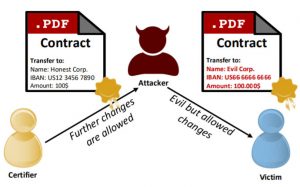
Unsurprisingly, Certified signatures are where the team found vulnerabilities to two specific novel attacks they dubbed, “Evil Annotation” (EAA) and “Sneaky Signature” (SSA). Both allow an attacker to overlay malicious content (PDF) on top of the certified information without showing any signs it was altered. Novel Certified PDF Attacks EAAs display malicious content in the document’s annotations and then sends it on with its digital signature intact. SSAs add malicious content over legitimate content in the PDF itself.
The team said the results of its evaluation of the 26 most popular PDF applications were “alarming.”
See Also: Pulse Secure VPNs Get Quick Fix for Critical RCE “In only 2 cases, we could not find a vulnerability; 15 viewers were vulnerable to EAA, 8 to SSA, including Adobe, Foxit, and LibreOffice,” the report said. “We additionally analyzed the standard-compliant implementation of PDF certification applications and found issues in 11 of them.”
Adobe had an additional flaw that allowed certified documents to execute JavaScript code, opening these users to code in injection attacks.
https://media.threatpost.com/wp-content/uploads/sites/103/2021/05/26161319/Evil-Annotation-PDF-Research_10-300x187.jpg “For example, a high-level JavaScript can call an arbitrary URL without user confirmation to deanonymize a user. Our research reveals that such code is also executed if it is added as an allowed incremental update. We are the first to reveal that this behavior allows attackers to directly embed malicious code into a certified document.
The team said it disclosed their findings to the appropriate vendors and provided a comprehensive vulnerability report, including exploits, to CERT-Bund (BSI). The report also lists the specific certified PDF security flaws found in each application.
“Adobe, Foxit, and LibreOffice responded quickly and provided patches for late 2020 (CVE-2020-35931) or early 2021 (CVE2021-28545, CVE-2021-28546),” the report said. “Adobe fixed the code injection vulnerability in early Nov. 2020 within a patch outside the regular update cycle (CVE-2020-24432). Currently, we participate in the standardization process via the German National Organization for Standardization (DIN) and the International Organization for Standardization (ISO) to address the reported attacks in the next PDF specification.”
See Also: Offensive Security Tool: Snallygaster Stopping Certified PDF AttacksTo fend off Evil Annotation Attacks, the researchers recommend admins prohibit three particularly risky annotations that allow text or images to be added to a certified PDF, “FreeText, Stamp and Redact.”
Sneaky Signatures can be blocked by reducing permissions, but that is not a guarantee SSAs won’t g[...]
___________________________
@hacking_Attack
@Hacking_Video
PDF Feature ‘Certified’ Widely Vulnerable to Attack
https://www.blackhatethicalhacking.com/wp-content/uploads/2017/11/black-hat-locks-and-electronics.jpg PDF Feature ‘Certified’ Widely Vulnerable to AttackPost Views: 161
Reading Time: 1 Minute
Certified portable document format (PDF) files are used to securely sign agreements between two parties while keeping the contents’ integrity protected, but a new report found the security protections on most certified PDF applications were inadequate and left organizations exposed to a number of attacks.
Researchers from Ruhr University Bochum explained certified PDFs use two specific signatures to authenticate the document, an Approval signature and a Certification signature. Certification signatures are the more flexible and made to handle complicated agreements between multiple parties and allow some changes to the document within a set of parameters while still maintaining its validity.
Unsurprisingly, Certified signatures are where the team found vulnerabilities to two specific novel attacks they dubbed, “Evil Annotation” (EAA) and “Sneaky Signature” (SSA). Both allow an attacker to overlay malicious content (PDF) on top of the certified information without showing any signs it was altered. Novel Certified PDF Attacks EAAs display malicious content in the document’s annotations and then sends it on with its digital signature intact. SSAs add malicious content over legitimate content in the PDF itself.
The team said the results of its evaluation of the 26 most popular PDF applications were “alarming.”
See Also: Pulse Secure VPNs Get Quick Fix for Critical RCE “In only 2 cases, we could not find a vulnerability; 15 viewers were vulnerable to EAA, 8 to SSA, including Adobe, Foxit, and LibreOffice,” the report said. “We additionally analyzed the standard-compliant implementation of PDF certification applications and found issues in 11 of them.”
Adobe had an additional flaw that allowed certified documents to execute JavaScript code, opening these users to code in injection attacks.
https://media.threatpost.com/wp-content/uploads/sites/103/2021/05/26161319/Evil-Annotation-PDF-Research_10-300x187.jpg “For example, a high-level JavaScript can call an arbitrary URL without user confirmation to deanonymize a user. Our research reveals that such code is also executed if it is added as an allowed incremental update. We are the first to reveal that this behavior allows attackers to directly embed malicious code into a certified document.
The team said it disclosed their findings to the appropriate vendors and provided a comprehensive vulnerability report, including exploits, to CERT-Bund (BSI). The report also lists the specific certified PDF security flaws found in each application.
“Adobe, Foxit, and LibreOffice responded quickly and provided patches for late 2020 (CVE-2020-35931) or early 2021 (CVE2021-28545, CVE-2021-28546),” the report said. “Adobe fixed the code injection vulnerability in early Nov. 2020 within a patch outside the regular update cycle (CVE-2020-24432). Currently, we participate in the standardization process via the German National Organization for Standardization (DIN) and the International Organization for Standardization (ISO) to address the reported attacks in the next PDF specification.”
See Also: Offensive Security Tool: Snallygaster Stopping Certified PDF AttacksTo fend off Evil Annotation Attacks, the researchers recommend admins prohibit three particularly risky annotations that allow text or images to be added to a certified PDF, “FreeText, Stamp and Redact.”
Sneaky Signatures can be blocked by reducing permissions, but that is not a guarantee SSAs won’t g[...]
___________________________
@hacking_Attack
@Hacking_Video