
Verady and Thomson Reuters Collaborates to Develop Tool for Compliance in Crypto Taxes
As blockchain and cryptocurrency trading has been increasing its wings in every industry, there is a growing demand for regulations, especially in the United States, where a high level of discrepancies can be observed in the cryptocurrency transactions.
Atlanta based crypto auditing firm Verady, in collaboration with media giant Thomson Reuters has thus developed a software tool “Virtual Currency Organizer” for crypto- taxation to bring the cryptocurrency industry under tax regime.
Owing to the non-clarity in tax-related regulations for cryptocurrency transactions, Verady’s blockchain-powered tax return tool is a boon to regulate the cryptocurrency bracket.
At the backdrop of recently restructured financial policies in the US, a chaotic environment can be witnessed in the crypto-related businesses and among the taxpayers.
Various financial regulatory authorities differ in their outlook on crypto tax-related matters. The Department of Treasury recognizes cryptocurrencies as a currency, whereas the IRS classifies cryptos as property. The CFTC treats them as a commodity.
Verady tapped in this loopholes in the crypto standards and has invented the technological framework for tax compliance in crypto space for tracking and reporting of cryptocurrency transactions. The collaboration is aimed at addressing the needs of the customer’s crypto business and providing them reliable solutions for more ease in tax return filings.
Kell Canty recently confirmed the collaboration news on twitter. He tweeted that they have collaborated with Thomson Reuters to develop a tool that will help for crypto tax returns with digital asset management.

TenX Makes Crypto Spending Convenient & Secure
As cryptocurrencies and blockchain technology are becoming mainstream in the industrial arena, more and more people are turning their heads towards this new age technology arena. It is not new for entities launching their products with a lucrative ICO promising massive returns to the investors. This has been a normal scene in the crypto marketspace in the past few years. Though the market is flooded with projects to invest in, only a few of them manage to survive for a long time by winning the trust of the investors and giving them their aspired returns.
One such promising blockchain-pegged digital platform is TenX, which makes crypto spending convenient, secure, and instant. The Singapore-based Fintech firm renders the investors with a golden opportunity to employ their digital holdings for their day to day operations at ease by providing a debit card payment system.
About TenX Wallet
Crypto wallets play an important role in the manifestation of trading activities as they help the investors to enjoy hassle-free trading at their convenience. The TenX wallet allows the owners to send and receive digital currencies at any time and from anywhere. Where on other wallet networks, the owners have to wait for days to receive the funds, the TenX wallet owners receive their funds on the next business day itself. By allowing instant digital currency swaps into fiat currencies, the platform has become a hot-shot solution for people to use for carrying out their everyday activities.
Prominent features of the TenX Wallet
Sending and receiving of cryptocurrencies is easy and is performed in a user-friendly manner.
One can keep track of all the transactions performed through the wallet in real-time as well as later in the transaction history feature. Notifications are sent to the owners as and when the transactions are executed.
The use of 2-factor authentication helps to keep the digital holdings and accounts of the owners secured at all times.
About TenX Card
TenX Card is one of the most important and popular products of the TenX community. The card helps the investors to use their assets as per their choice. TenX cards are supported by Visa, the leading payment processing network in the world, which makes the crypto cards eliminate the issues related to scalability. All one has to do is fill in their TenX wallets with their favorite digital currencies and they are good to go for spending them anywhere and anytime. At present, the TenX cards support BTC and ETH coins only, though, the platform is adamant about including more currencies in the near future.
The owners of the TenX cards can spend their assets to purchase anything of their choice by withdrawing their holdings from any ATM around the world. To ensure the highest security standards, the card can be locked and unlocked at the choice of the owner. The release of TenX cards has boosted crypto mass adoption in a big way.
The Steps To Follow
Download the TenX wallet app and create an account by setting up the 2-Factor authentication.
Put in cryptocurrencies into your wallet and place an order for the TenX card on the app.
Go shopping with your card.
Animoca Brands Optimistic About Success of NFTs as Microsoft Enters the Space
The cryptocurrency arena has always been an ardent supporter of new technological advancements, products, and pedagogies. Talking about the recent trend getting popularity in the space are the Non-fungible tokens or NFTs, which have become a hot-shot solution for the big players of the industry. What dragged the attention of the crypto enthusiasts towards NFTs was the super success of the renowned blockchain-based game, CryptoKitties. Launched in 2017, CryptoKitties has been a pioneer in promoting the concept of NFTs in a big way.
Before moving any further, let’s understand the meaning of non-fungible tokens. In simple terms, NFTs are a unique type of cryptographic tokens that are symbolic of a special asset and so are non-interchangeable. They ensure the highest standards of authenticity, ownership, and trust offered by blockchain. Last year saw a surge in the adoption of NFTs and the launch of NFT projects by multinational firms along with big investors.
The globally reputed firm, Animoca Brands Corporation Ltd., has recently bragged about the success of non-fungible tokens. The company is confident that soon NFTs will become mainstream offerings as biggies like Microsoft are showing trust in NFTs. Microsoft backed Azure platform launching its native non-fungible tokens program named “Azure Heroes.” The project aims to provide aid to the technical community members from various fields.
Recently, Stryking, the firm owned and managed by Animoca, auctioned the official FC Bayern Munich “Christmas 2019 Edition” NFTs clubbed in a bundle of seven offerings. The auction pooled in a whopping sum of 240.9649 ether, which is equivalent to the US $31,100.
Also, the firm has kickstarted the auctions for the FC Bayern Munich New year 2020 Edition Legendary Player Cards for its community. The process will end on January 6, 2020. The two special edition player cards earned during the two auctions will allow the owners to indulge in selling or trading of the cards as per their convenience.
Coinme Streamlines Transactions Through Bitcoin ATMs and Kiosks
Cryptocurrencies have come a long way since their inception in the industrial domain in 2008 during the time of recession. When Bitcoin was launched in the market, there were high speculations that the currency would not be able to survive for long in the industry and the era of cryptocurrencies would end in a short span of time. Interestingly, with the passage of time, situations began to favor the crypto community as more and more people started showing trust in its advanced technology. Presently, Bitcoin stands tall as one of the strongest cryptocurrencies available in the market-leading the way for other digital coins and tokens.
A major development was witnessed in the crypto arena when globally operating business houses, renowned industrialists, and big investors began putting their funds and expertise in strengthening the crypto community through projects and product offerings. With an intention to make cryptocurrencies more approachable and popular, Bitcoin ATMs were introduced in the market. These digital machines operate as a kiosk that allows investors to purchase Bitcoin via hard cash or through debit cards. A certain Bitcoin ATMs also allow the traders to sell off their Bitcoin holdings in return of cash.
These ATM kiosks work in a similar fashion like the traditional ATMs but not completely as they are connected to crypto exchanges and not bank accounts. This allows users to purchase and sell Bitcoin offerings at their convenience.
At present, the crypto industry has an array of companies that are providing Bitcoin ATM machines to customers. One such prominent name in this regard is Coinme that was the first Bitcoin ATM firm to obtain a license in the USA. Launched in 2014, the platform shines as one of the most trusted ATM providers in the world allowing transactions worth millions of dollars on a daily basis. Coinme provides an integrated network of Bitcoin ATMs, digital wallet and private client services for entities as well as individuals across the world. The ATM network of Coinme is spread to seven states in America including California, Kansas, Texas, Washington, etc.
Coinme ensures to offer the highest security standards to its customers. All the ATMs have a customer service number where any person can call to initiate their first Bitcoin purchase. In January, Coinme collaborated with Coinstar, an exchange platform that converts digital coins into cash. The move was to make cryptocurrencies a payment solution for the day to day operations of people worldwide.
Recently in December 2019, Coinme became the biggest network in the Dallas/Ft. Worth area by adding support to over 90 Bitcoin purchase points at Coinstar kiosks in Albertsons and Tom Thumb supermarkets. The crucial step helped Coinme to strengthen its network operations in the United States further.
Conclusion
Bitcoin ATMs have played a major role in achieving the goal of mass adoption of cryptocurrencies. These digital machines help the customers to liquidate their crypto holdings against cash to carry on with their everyday transactions in a convenient manner. Coinme and its secured ATM services have bridged the gap between the investors and their assets. The firm aims to further proliferate into the market and establish ATMs in many other areas around the world in the near future.

Bitcoin Predictions in 2019: Were They Plausible?
It is natural for experts to make predictions and people end up praising those whose predictions go right. But, if someone’s calculation misses the mark by huge amounts, they will definitely be detested. When it comes to crypto markets, they have been performing in a volatile manner. Crypto industry has become prone to variations and fluctuations. It has become a mammoth task for anyone to foresee what is likely to unravel in the time to come.
Two years ago, the cryptocurrency market registered a bull run like never seen before. During that period, major cryptocurrencies including Bitcoin managed to break all previous records and create a new one of sort. Bitcoin hit the $20,000 mark and no one anticipated this rise in the market. The price continued its rising spree and raised people’s expectations to a new high. People become millionaires overnight as a result of investment in Bitcoin and they were called Bitcoin Millionaire by mainstream media.
Amid the rising trend in Bitcoin prices, almost everyone had a new desire for purchasing Bitcoin for which a new term was coined as “Digital Gold.” Even Wall Street players began displaying a keen interest in Bitcoin. But, to everyone’s disappointment, the hype built around Bitcoin soon came to an end as the price of Bitcoin slumped soon. The headlines in leading newspapers soon changed from Bitcoin surging to Bitcoin crashing.
The prices of Bitcoin began falling at the beginning of the year 2018, but the hopes for yet another remarkable bull run did not die. A large number of investors were still highly hopeful and kept their fingers crossed in the hope that there would be a change of fortunes. The investors thought that things would change for the better by the end of 2018. But, investors’ hopes dashed and Bitcoin continued to remain low throughout the year. As 2018 was coming to an end, the Cryptocurrency ended the last day of the year with a value of $3,691.86.
Interestingly, 2019 kick-started with a moderate uptrend of Bitcoin when the coin traded at around $4,000. A strong bullish move started appearing by mid-2019 when Bitcoin reached $8,500 and then skyrocketed to $13,796 on June 26. As the bulls made their presence felt, the crypto community started making exceptional predictions, resulting in tremendous expectations from Bitcoin.
Sadly, the second half of the year started experiencing a moderate downtrend with Bitcoin falling to $9,000-$10,000. The downtrend continued further and Bitcoin ended the year at around $7,500, thereby proving all predictions wrong.
Let’s have a look at some interesting forecasts made throughout 2019.
German bank BayernLB: It is quite rare to witness bank speaking in favor of Bitcoin’s price rise. Germany’s state-owned bank BayernLB had forecast a massive rise for crypto. The bank said, “If the May 2020 stock-to-flow ratio for Bitcoin is factored into the model, a vertiginous price of around USD 90,000 emerges. This would imply that the forthcoming halving effect has hardly been priced into the current Bitcoin price of approximately USD 8,000.”

Securitize Offers Global Solutions for Compliant Digital Securities
Securitize offers trusted worldwide solutions for developing and managing compliant digital securities. Securitize is a full-stack technology and services platform with strong features and provides specialized tools for issuers and investors. Furthermore, the Securitize platform permits the clients to handle their digital securities from a convenient dashboard.
Features
Securitize is a technology provider for the issuance of security tokens. The firm is based in San Francisco and has raised more than 30 million dollars to date and has offered the technology for more than ten regulated assets to be issued through blockchain.
Several Securitize backed digital securities are trading globally on public marketplaces and many more are yet to come in the foreseeable future.
Securitize’s innovational DS Protocol has the maximum adoption rate in the business and empowers seamless, fully compliant trading over various markets simultaneously.
Also, the firm has launched the latest version, 3.0 of its platform, which includes a control panel to assist clients with issuing and managing the lifecycle of digital securities.
The Securitize platform has managed and issued over 135 million dollars worth of digital securities, which includes Blockchain Capital, SPiCE VC, Aspencoin, Science Blockchain and several more.
Securitize Issuance Platform
The Securitize issuance platform can be explained as a proven, full-stack technology solution meant for digital securities. Each component has been created based on the customer’s needs, which makes the Securitize platform the best solution available today in the market.
Features
Investor Onboarding
Credit Card Processing
Investor Dashboard for Lifecycle Management
Optional Two Factor Authentication for Investors
Document Signing
KYC/AML Accreditation Qualification
Fund and Payout in Fiat and Crypto
Multi-Blockchain support, including Ethereum (ERC-20 Compliant) and Tezos
Issuer Admin Console
Real-Time Cap Table
Raise Performance Indicators
Dedicated Customer Support
Multiple Issuance Management
Investor Limits Enforcement
FATCA Information
Tax Reporting
KYB and Support for Registered Offerings in EU
Partnership with BUIDL
Japan’s blockchain technology consultancy firm BUIDL, was acquired by Security token platform Securitize to expand its company’s influence and operations in Asia. The Japanese consulting and development firm acquired by Securitize is focused on distributed ledger technology known as BUIDL.
Established in late 2018, BUIDL provides support to various security token projects located in Japan. The organization says its income has been developing steadily and has obtained a large market share, since its platform launch.
Wrap up
The Securitize compliance protocol and platform offers a full-stack solution for managing and issuing security tokens (digital securities). Securitize’s innovative global solutions for managing and creating compliant digital securities are already doing well in the marketplaces, which is opening the way for modernizing the capital markets. Keeping our fingers crossed, we need to wait and see how its latest innovations and features shape the future.

SCB Bank Collaborates With Ripple To Launch SCB Easy Mobile App
Taking pride in being Thailand’s oldest and one of the most leading banking institutions, the Siam Commercial Bank (SCB) has broadcasted the news about the launch of a digitalized mobile application, SCB Easy. The app will be powered by the expertise of the Ripple network and will help in facilitating quick and economical cross-border payments.
Arthit Sriumporn, the SVP of Siam Commercial Bank, took the stage of Ripple’s popular crypto community gathering event, Swell 2019, to unveil SCB Easy project. The event took place in Singapore and was graced by the presence of the world’s most renowned leaders of the financial and technology arena. The leader took the opportunity to share his views on the expert services Ripple and SCB have been providing to their millions of customers worldwide.
The leader performed a demo test of the SCB Easy app at the Swell gathering. The money sent through the app was received by the recipient’s bank account within a mere 40 seconds. The product has been designed to cater to the requirements of the customers who want to enjoy instant and low-cost cross-border payments in a secured and trusted ecosystem. According to a survey conducted by PwC, nearly 67% of Thailand’s population uses mobile payment apps for transferring funds. This popularized trend of using payment apps encouraged SCB to develop its own mobile app that will run on the Ripple network. SCB Easy is likely to strengthen the customer base of the bank by providing a user-friendly environment.
“It is so difficult to send and receive money today. People must physically go to a bank branch, fill out long and complicated forms and wait for payments to be received—with no transparency. With our service, their loved ones from abroad can transfer payment and receive money immediately,” quoted Sriumporn.
In 2020, SCB is planning to proliferate into different regions by expanding its operational channels in countries like Cambodia, Laos, Myanmar, and Vietnam.
“Imagine you are a tourist coming to Thailand, and you can use your home country mobile application to scan for payment and eliminate the need to exchange for local currency. You can use your mobile app, scan the QR payment and receive goods right away,” added Sriumporn.
The bank has also teamed up with Ripple to provide cross-border EMVCo QR payments. The new mobile app will help the bank customers to enjoy micro-payment services as well.

Paytm Unveils All-in-One QR Solution For Merchants
Paytm, the leading e-commerce payment system and digital wallet firm hailing from India, has announced the launch of a consolidated QR payment solution for merchants. The product that has been branded as the “All-in-One” QR solution will offer a user-friendly experience to the merchant clients of the firm by allowing them to manage their payments in a convenient manner.
According to the latest reports, the new QR solution will render the merchants with a golden opportunity to accept any number of payments made through the Paytm wallet, RuPay cards, or from any of the UPI based payment apps for free of cost or 0% charges. The decision is followed by the recent announcement of the Indian government to eliminate the Merchant Discount Rate (MDR) on any digital transaction made via RuPay credit cards or UPI QR codes.
“At the forefront of the payment revolution, we are very proud to launch an encompassing All-in-One QR for businesses. The Paytm All-in-One QR is a must-have business tool as it is only payment QR that allows merchants to accept payments from Paytm wallet, all UPI apps, and cards. I am sure this QR will accelerate the Digital India mission and make more financial services available to the underserved,” said Vijay Shekhar Sharma, the Founder CEO of Paytm.
The merchants operating on the Paytm network will be given the facility to order personalized QR codes from the merchandise store on the “Paytm for Business” app. These new QR codes will have an identity symbol of the particular merchant such as their names, business logos, or pictures, thereby ensuring ease of operations with the digital payments network. Paytm has established itself as a strong digital payments service provider, counting for a strong customer base of over 10 million people. With the All-in-One QR code, the merchant network aspires to expand its network to 25 million in the next year.
Interestingly, the Zero MDR decision of the government has created a lot of fuss in the community. MDR is a rate charged to a merchant by a bank for providing payment processing services on debit and credit card transactions. Where the cost had to be borne by the customers earlier, it shall now be paid by the issuing banks. The reports suggest that with the removal of MDR charges, the Reserve Bank of India will be shelling out nearly INR18 billion to banks in 2020.
Tesla’s Price Touched the Ace Point on Wall Street at $556
Analyst Bill Selesky from Argus Research has raised his price target on Tesla from 396 USD to 556 USD recently. This has come after Tesla’s better than expected Q4 performance. As per Bill, the decent increment of deliveries by Tesla in the Q4 is the reason for the recent hike of target price. This recent hike made by Bill turns him into the biggest bull among all major analysts.
Bill said, “We are raising our 2020 EPS estimate to $5.96 from $4.40 to reflect improved economies of scale in 2020 production and delivery results and a better-than-expected ramp-up of vehicles produced at the Shanghai factory in China.”
Tesla’s Q4 details
Tesla announced that in the last quarter of 2019, it had manufactured 104,891 vehicles that is a record in itself. It has made deliveries of 112,000 vehicles in the same period. In total, Tesla has made deliveries of 367,500 vehicles that are almost 50% above 2018 deliveries.
Argus Research has also increased the 2020 EPS estimate from 4.40 USD to 5.96 USD. This has become so due to an expected higher production from the Shanghai factory. The 2020 consensus estimate on EPS stands at 5.58 USD.
Bill also said that he would expect Tesla to witness growth in other segments like energy generation. Recently, Tesla started delivering Model 3 cars from its Shanghai factory. Shanghai factory is Tesla’s first project outside the U.S. This factory became operational well ahead of its deadline. The hype over the Shanghai factory is justified as China is the second-largest electrical vehicle market in the world.
The share value of Tesla has ballooned up by two times in the last six months and its market cap has been able to match that of many legacy automakers like General Motors and Ford. Another small firm named Elazar Advisors has set the highest price for Tesla’s share at 734 USD.

Republic Opens Doors for Fundraising and Investment for Startup Projects
The cryptocurrency arena has gained a lot of popularity over the years, which has eventually led to major participation from investors in the industry. The marketspace is flooded with startup projects which enter the sector to gain the trust of the investors to pool in funds from them for the successful execution of their projects.
Are you someone who always wanted to invest in a startup but stopped because of the legal complexities involved therein? This fear restrains a major section of society from investing in a startup. Investing in a startup entails a suite of procedures which are needed to be followed before making the big investment in any concerned project. In May 2016, the United States Securities and Exchange Commission launched Title III of the JOBS Act, which allowed a major section of the US population to make investments in startups. To simplify the process of fundraising and investment in a startup, a team of dedicated professionals started a regulated crowdfunding platform, Republic. The platform was founded by alumni of AngelList, the world’s biggest digital investment solution for accredited investors. The funding portal and the broker-dealers of Republic are registered under the United States Securities and Exchange Commission and are members of FINRA.
Republic offers a complete stack of fundraising offerings in the crypto industry and strives to democratize startup fundraising and to invest in the global parlance. The expert team of the platform delivers the best services to the customers who come from their long experience in online fundraising, business, law, community building, investment, etc.
The major problems faced by startups
Funding is an inevitable part of the success route for a startup. A startup trying to pool in funds for its operations has to face several hurdles. However, with the launch of the Republic, these cumbersome processes became simplified and user-friendly in a big way.
The deployment of the collected funds often becomes quite confusing for a startup as different team members try to employ the funds in their areas of interest. Making a decision about prioritizing a particular area becomes difficult in such chaotic situations.
Building a team that would lead the startup to the ladder of success is also a challenging task for the new entrants.
Deciding the customer acquisition cost is a major concern for startups as it is of utmost importance to attract more and more customers at a minimal cost.
Startups struggle to build a sense of trust in the minds of the customers towards their products.
The selection of the right investors is also an important challenge for any startup to become successful in the long run.
The role of the Republic in strengthening startup funding
Republic offers an array of efficient tools and instruments which help in achieving your aimed fundraising goals.
By adopting the mechanics of the Republic platform, one gets exposed to a large user base, which helps in increasing the popularity of the startup project. The platform aids in selling the products, building connections with VCs, and increased attention from the press.
The Republic community consists of more than 250,000 experts, including angel investors, influencers, and connectors. These investors help in popularizing the startup through their sources, provide guidance in their field of interest, and help in maintaining contacts with their connections.
The tools offered by the Republic platform helps efficiently in managing the investors. Also, the Crowd SAFE feature is VC-approved and so it puts in no effect on the present or future funding rounds.
A startup firm can enjoy the benefits of the Republic at an affordable fee, including 6% cash + 2% of the securities sold.

Prediqt is a Global decentralized network to exchange personal data for its true value to solve the trust problem in personal data aggregation
✴️ BENEFITS FOR BUSINESS
1️⃣ Companies will realize higher participation rates for their consumer insight studies
2️⃣ Better quality data will be available given the better matched incentives provided to data providers
3️⃣ Windfall data security given the decentralized database solutions used by the platform
4️⃣ More in depth insight provided as consumers are compensated for providing the data
✴️ BENEFITS FOR CONSUMERS
1️⃣ Better compensation for the data they provide
2️⃣ More engaging with ways to provide their data
3️⃣ Quick payments that are safely transacted through blockchain
4️⃣ Increased privacy protection through our blockchain’s decentralized platform
✴️ We’ve built a platform with access to 50+ million consumers globally. Clients can access these consumers through our APIs. For consumers, we offer the flexibility for them to exchange their personal data and insight for the value they deserve. Multinational companies like Nielsen, Survey Monkey, Euromonitor, Ipsos and Duracell are already leveraging data from PREDIQT blockchain.
➡️ Join over 90 thousand members who are already earning from PREDIQT today. Download the app here. https://play.google.com/store/apps/details?id=com.prediqt.panelist
➡️ PREDIQT will launch its IEO at Latoken in February 2020, to participate, please visit here https://exchange.latoken.com/ieo/PQT and get whitelisted
Join our community to keep posted on the latest update:
✅ Telegram: https://t.me/prediqtio
Google Play
Prediqt - Survey Cash App - Apps on Google Play
Make Money and Earn Rewards App Survey
Bitcoin Cash Goes through a Price Correction; May Touch $340 Soon
Bitcoin Cash seems to have been affected the most by the mild bearish trend of the market. Over the last 24 hours, it has been down by 5.29%, and it also has given multiple shocks to its intraday traders. However, the value is still maintained above 320 USD.
Bitcoin Cash Price Analysis
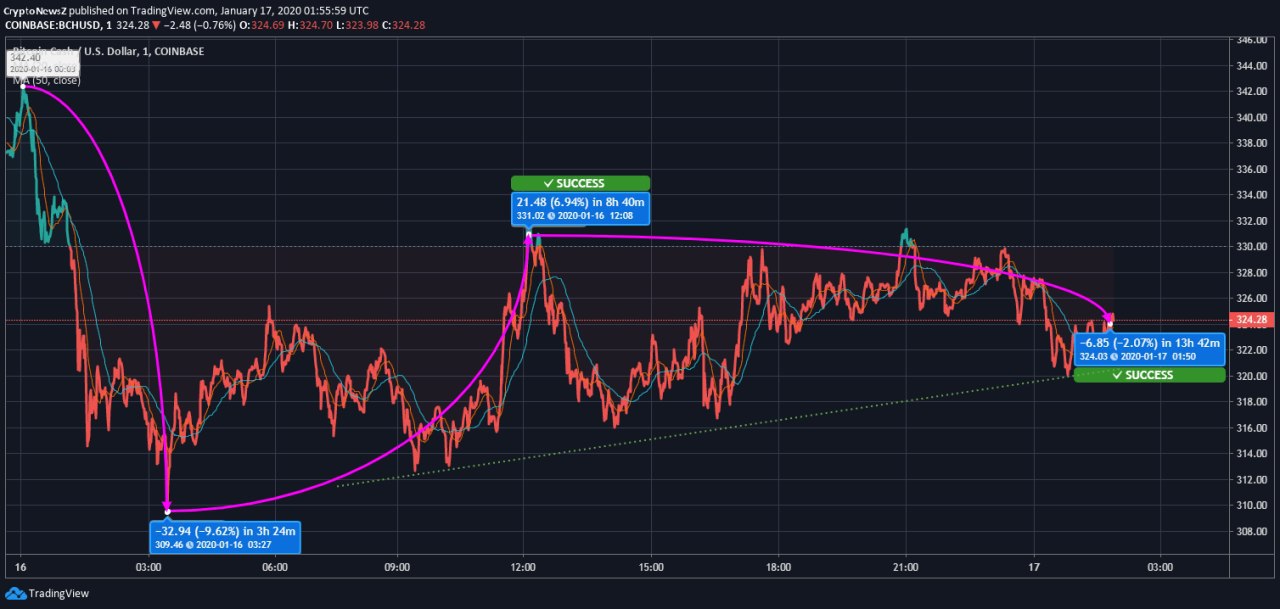
At the starting of the day, the BCH price was above $340. Its first major swing started at 00:03 UTC, and over the next 3 hours and 24 minutes, the coin lost 9.62% value. This swing pushed the price from $342.4 to $309.46. It was followed by a price recovery to the extent of 6.94%. This recovery helped Bitcoin Cash price to get back to $331.02. Since then, the coin failed to make any major upward movement. By 01:50 UTC, BCH lost 2.07% value to touch $324.03.
MA ($323.81). The recent downside correction seems temporary. It will soon bounce back. We expect the next resistance of the BCH coin to come around $340.96. However, investors need to be cautious of the intraday price shifts.
Resistance and Support Levels
R1: $340.96, R2: $355.94 and R3: $370.64
S1: $311.28, S2: $296.58 and S3: $281.6
Ex-Google Pay Execs Manage to Raise $13.2M For a Neo-Banking Platform
Sujith Narayanan and Sumit Gwalani, the two co-founders of leading payment settlement app Google Pay in India have announced that their startup epiFi has secured a massive amount of $13.2 million through the Seed financial round. The two prominent executives of the Google Pay India team are gearing up to launch a neo-banking solution in the country by pooling in the funds and support from leading VC funding platforms.
According to the reports released on Monday, the funding round was led by Sequoia India and Ribbit Capital. The event also saw the participation of Brazilian neo-banking giant Nubank’s founder David Velez, creator of payments startup CRED Kunal Shah, and VC fund Hillhouse Capital. The round valued the eight-month-old startup firm, epiFi for a whopping $50 million worth.
The neo-banking solution has been designed to cater to the requirements of the tech-savvy generation in the best possible way, said Narayanan. The project will help the investors to understand their spending routines and will act as a guide to help them earn lucrative profits by making intelligent investments. He quoted that “When we were building Google Tez, we realized that a consumer’s financial journey extends beyond digital payments. They want insurance, lending, investment opportunities, and multiple products.” Narayanan said that their revolutionary app will be launched in a few months.
Sumit Gwalani, who works as the co-founder and the chief product and technology officer in epiFi has served as director of product management at Google India.
“Their vision to reimagine consumer banking, by providing a modern banking product with epiFi, has the potential to bring a step function change in experience for digitally-savvy consumers,” said Shailesh Lakhani, managing director of Sequoia Capital India.
The past few years have seen major participation from startups and Silicon Valley firms in the Indian territory focused on the strengthening of digital financial services providing solutions and projects. Last year saw a stunning 1 billion worth digital transactions being carried upon by more than 100 million users in India. Startups like NiYo and RazorPay serve as neo-banks and offer features like corporate credit cards, automatic recurring payouts, etc. Factually, a majority of neo-banks or alternative banks operating in South Asia cater to the requirements of startups and business platforms rather than individuals.

South Korean Firms Use Blockchain Technology To Safeguard Online Gaming
Leading tech startup Bloom Technology and game studio Bluside have announced the news about their collaboration focused on employing the expertise of blockchain technology to the new Kingdom Under Fire game. The two reputed South Korea-based firms have teamed up to infuse blockchain technology into the online game system to counter hacker attacks. Launched in the early 2000s, the Kingdom Under Fire game is quite popular amongst the masses. This popularity led to the release of its sequel named Kingdom Under Fire 2 in 2019.
According to the latest reports, the two companies will put in their joint efforts in complex yet strategically important areas like security and payment settlement by bringing in the unprecedented features of blockchain technology. The team of Bloom Technology stated during an interaction that the world of online gaming reels under an array of threats and vulnerabilities. These potential risks include denial-of-service attacks or attempts to disrupt traffic of a server, etc.
The team is confident that blockchain technology can be a perfect solution to cater to such risks capable of hampering the gaming ecosystem. “Unlike previous blockchain solutions, our technology does not negatively affect game services in terms of computing power and hard-disk capacity. Through collaboration with Bluside, we will find a new business model down the road,” stated Lee Sang-youn, the honorable CEO of Bloom Technology.
Bloom Technology has built a new technological solution called Locus Chain to boost up the speed of the transaction processing on the blockchain network. The firm conducted a public test last year, which revealed that the platform was capable of processing transactions within the fraction of a second.

Kadena Unveils Highly-Anticipated Public Blockchain Network
Kadena, which takes pride in being the first blockchain technology firm curated by JP Morgan’s Blockchain center for Excellence, has announced the news about the successful launch of its public blockchain network. The launch of the Kadena blockchain comprises of full transactions along with the capacity to write smart contracts. The public blockchain is the first to operate as a shared Proof of Work Layer 1 network solution.
Right after the kickstart of the genesis mining in October 2019, Kadena crossed the mark of successful mining of two million blocks at hash rates reaching a whopping 40 TH/S rate. The inclusion of the new features has strengthened the Kadena’s hybrid blockchain platform which at present offers interoperability, scalability, and security to the clients spread across various industrial domains such as finance, healthcare, and insurance.
Kadena’s hybrid blockchain allows interoperability via Pact, Kadena’s open-source, Turing-incomplete smart contract language with Formal Authentication feature. Pact helps the developers and enterprises to enjoy secured and legible transactions. The language allows the developers to code complex contracts at ease while allowing the execution of multi-party trading activities.
“Despite blockchain having immense potential, our experience building JP Morgan’s first blockchain showed us its limitations. Launching a fully functional hybrid blockchain which seamlessly integrates a public chain with a private network is a significant step forward in reimagining what applications can do on-chain,” stated Stuart Popejoy, the Founder and President of Kadena.
Kadena offers the developers the only public blockchain network that is production-ready for smart contracts using its efficient Proof of Work consensus protocol. The mechanism helps in catering to the scalability issues concerning Bitcoin and the security issues related to Ethereum in a big way.
Founder and CEO Will Martino shared excitement about the launch stating that “We’ve solved the scaling challenges of Bitcoin with parallel Proof of Work chains while addressing the security issues of Ethereum with Pact. Today’s launch of our public blockchain with smart contract transactions, which completes our hybrid platform, advances mainstream adoption. We’re excited to see how Kadena’s blockchain will empower entrepreneurs and enterprises to bring in Economics 2.0.”
The gone 2019 witnessed some pathbreaking achievements and accomplishments by the Kadena community. The firm made an announcement that leading blockchain networks like Cosmos and Polkadot are gearing up to lend support to the Pact smart contract language. Another milestone achieved by Kadena was the listing of the Kadena Kuro on AWS Marketplace and Azure Marketplace.
Bitcoin and Altcoins Might be Gearing For Another Lift-Off
☄️Bitcoin price could accelerate once it breaks the USD 8,850 resistance.
☄️Ethereum is rising towards USD 172 and XRP could attempt to surpass USD 0.242.
☄️Golem (GNT) and KMD rallied more than 25% today.
After testing the USD 8,550 support, bitcoin price started a decent increase. BTC/USD traded above USD 8,650 and USD 8,700, but it must climb above the USD 8,850 resistance level to continue higher. The next key hurdles are near USD 9,150 and USD 9,250.
Similarly, most major altcoins are slowly rising towards major resistances, including ethereum, XRP, litecoin, bitcoin cash, BNB, EOS, TRX, ADA, and XLM. ETH/USD is approaching the USD 170 and USD 172 resistance levels. Besides, XRP/USD might soon test the USD 0.240 and USD 0.242 resistance levels.
Bitcoin price
In the past few hours (09:00 UTC), bitcoin price remained well bid above the USD 8,550 support level. BTC/USD climbed above the USD 8,650 resistance and it is trading above the USD 8,700 level. On the upside, an initial resistance is near the USD 8,800 and USD 8,850 levels. A close above the USD 8,850 level could start a strong rise towards the USD 9,150 and USD 9,250 levels in the coming sessions.
If bitcoin struggles to climb above the USD 8,850 resistance, the bears are likely to aim a downside break below the USD 8,550 and USD 8,500 support levels.
Ethereum price
Ethereum price settled above the USD 165 level and it is slowly rising towards the USD 170 level. ETH/USD must surpass the USD 172 area to continue higher. The next major resistance is at USD 178, above which the price might test USD 185 or USD 188.
On the downside, an initial support is near the USD 165 level. The main support is near the USD 160 area, below which there is a risk or a larger decline towards the USD 152 area.
Bitcoin cash, litecoin and XRP price
Bitcoin cash price is rising again and it is now trading above the USD 340 level. If BCH/USD settles above the USD 350 resistance, it could even accelerate above the USD 365 resistance. The next major hurdle for the bulls is near the USD 380 level. The main supports on the downside are USD 330 and USD 325.
Litecoin is recovering from the USD 55.50 support level. LTC/USD is approaching the USD 58.50 resistance, above which the bulls could attempt more upsides above the USD 60.00 level. The next set of resistances is near the USD 62.20 level.
XRP price settled above the USD 0.232 pivot level and it is slowly rising. XRP/USD is trading above the USD 0.235 level and it seems like the bulls may soon attempt to push the price above USD 0.240 and USD 0.242. If they fail, there is a risk of a downside break below the USD 0.232 support area.
Other altcoins market today
In the past three sessions, a few small capitalization altcoins gained more than 6%, including GNT, KMD, QNT, SNX, AE, MAID, CKB, SOLVE, BCN, ETC and OMG. Out of these, GNT is up more than 28% and LMD gained nearly 26%.
To sum up, bitcoin price is slowly climbing higher towards a major breakout resistance at USD 8,850. If the bulls succeed, BTC/USD is likely to resume its uptrend and rise towards USD 9,250 or even USD 9,500 in the near term.
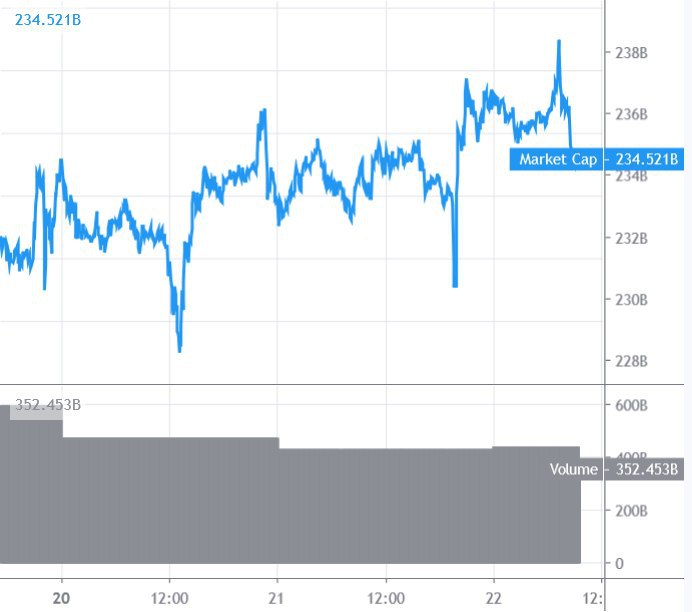
Total market capitalization:
Binance to Fuel Competition in P2P Crypto Trading Market
Major crypto exchange Binance now aims to find more merchants for its a peer-to-peer (P2P) crypto trading platform in an attempt to meet “growing demand.”
The company launched a global peer-to-peer (P2P) merchant program, encouraging merchants to use the exchange as a way of providing payments through fiat currencies and earn revenue by doing so.
“When we first launched our P2P trading services last October, we carefully selected merchants to protect users’ interest,” Binance CEO Changpeng Zhao said, adding that “In the past quarter, there has been increasing growth in trading volumes on Binance P2P platform, and we have constantly received requests for more fiat-to-crypto access from our global community.” This week, Binance announced its support for Vietnamese Dong (VND) on its P2P trading platform.
The CEO did not provide any numbers about the P2P trading on their platform.
The greatest threat facing P2P platforms is often nefarious users. Because there is no centralized governance system, black hat merchants and traders can often take widespread advantage of the naive.
For protection, the company has created an unspecified elimination mechanism for poor merchants. While not explicit, it appears that eliminated merchants would be unable to participate in future P2P solutions that the company offers.

Libra’s Miseries Continue as Vodafone Quits Libra Association
Mark Zuckerberg’s ambitious Libra Project has been in the headlines ever since it was launched in June 2019, however, not necessarily for the right reasons. The project has gained more criticism than support globally, right from the Americas to Europe. The US Congress, Senate, and even President Donald Trump have lashed out Facebook with heavy criticism, with Trump even warning the social media giant of grave consequences. Following the unveiling of the Libra stablecoin, there was unrest in the Libra camp as reports of initial backers leaving the project emerged. PayPal was confirmed to be the first in line, and soon after, five other members of the Libra Foundation left amid troubled times.
There hasn’t been a great start to 2020 also since Vodafone has decided to leave the Libra Foundation as well. Vodafone declared on Tuesday that it was no longer a part of the Libra’s governing council, and has decided to move away from the infamous project. Other major names to leave Libra are eBay, MasterCard, VISA, and Booking Holdings.
Speaking to the media, Vodafone spokesperson said that the company would divert the resources reserved for Libra towards the in-house digital payments service M-Pesa. The spokespersons added,
“We have said from the outset that Vodafone’s desire is to make a genuine contribution to extending financial inclusion. We remain fully committed to that goal.”
The credibility of Facebook got severely hit after the Cambridge Analytica fiasco, which exposed the company’s dubious data privacy policies. Despite Libra’s head stating that users don’t need to trust Facebook to trust Libra, the situation doesn’t seem to be improving anytime soon. The government has come down heavily on Facebook, and the Libra Foundation members don’t want to risk their businesses. Though there’s no specific reason given from other exiting members, VISA has confirmed that regulatory expectations were the reason it distanced itself from Libra.

RBI vs. Crypto: Supreme Court of India – January 22, 2020
Based on a directive circulated by the Reserve Bank of India (RBI), cryptocurrency has long been considered banned in India. Well, not anymore.
In a surprising turn of events, on Day 2 of the hearing, the central bank responded to a writ petition filed by the Internet and Mobile Association of India (IAMAI) by admitting that it does not have the power to ‘absolutely prohibit’ crypto activities in India.
RBI further clarified that while crypto was not banned in the country, it ringfenced; meaning, it was segregated from financial institutions like banks so as to protect them from risks associated with the trading of digital currencies.
According to RBI, these risks involved reputational, financial, legal, and operational threats such as those stemming from acts of terror financing and money laundering carried out through the use of cryptocurrencies like Bitcoin.
In an affidavit submitted to the Supreme Court, RBI added that: “Any possible avenues which facilitate anonymous cross-border fund transfer have to be acted upon swiftly and stringently dealt with. It is an admitted fact that VCs Virtual Currencies have been used to purchase illegal and illicit goods ranging from guns and ammunition to drugs.”
As the court case enters its third day of litigation, Counsel for both RBI and IAMAI have resumed intense arguments regarding the feasibility and merits of digital currencies as well as the need for a regulation governing the space.
Legal counsel for IAMAI, Advocate Ashim Sood, opened arguments by stating that while risks existed, proportionate measures could be implemented to mitigate them. Sood provided a comparison of cryptocurrencies and air mile schemes, reasoning that crypto acts similar to air miles, which can be redeemed in exchange for goods and services (e.g., hotel stays and vacations). Although crypto can be encashed – unlike air miles – both follow similar economic principles and can be purchased against legal tender.
Sood further contended that with the rapidly changing world of finance, exchange businesses that are entirely dependent on banking channels available would suffer if crypto activity in the country was banned or discouraged.
Sood argued that as a medium of exchange, cryptocurrencies could only be regulated through government legislation. Although RBI could prohibit transactions under Sections 6(1) A – 6(1) O, it had no authority to encourage or discourage certain forms of economic activity, let alone to ban particular banking channels entirely.
RBI Counsel, Advocate Shyam Dewan, began arguments defending the agency’s actions by reiterating that RBI’s mandate was to maintain financial stability in the country and ensure that the domestic economic needs were being met. Any act taken under this purview would, therefore, be deemed perfectly within its domain.
Furthermore, RBI stated that its decision to prevent banking entities from engaging in Crypto related economic activities was taken after extensive deliberations. It sought inputs from its’ internal Inter-Regulatory Committee as well as the governmental Inter-Disciplinary Committee and the Inter-Ministerial Committee (IMC).
As evidenced by the IMC meeting reports, cryptocurrencies were viewed as highly volatile entities that hold the potential to destabilize markets and thereby jeopardize the ecosystem of formally regulated payment structures as well as cross border transactions.
Dewan added that RBI continued to view Crypto as a digitized system of payment rather than a technology or goods as opposing Counsel had suggested earlier. He contended that Cryptocurrencies were not considered equivalent to legal tender anywhere in the world. Since they are backed by peer-to-peer trust and consensus-based algorithms rather than the government, they could not be compared to fiat currencies either.
Six Central Banks Form Alliance to Pursue Research on Digital Currency
Six leading banks belonging to the Central Bank group have formed an alliance to work together to assess the potential for central bank digital currency (CBDC) in their respective jurisdictions. These banks include the Bank of England, Bank of Canada, Bank of Japan, European Central Bank, Sveriges Riksbank (Sweden), Swiss National Bank as well as the Bank for International Settlements (BIS).
All these major institutions have prior expertise in investigating the likely advantages and detriments of digital currency. The CBDC working group will facilitate collaboration in the area of digital currency development and encourage the sharing of previous research and trials conducted.
A press release by the Bank of England added:
“The group will assess CBDC use cases; economic, functional, and technical design choices, including cross-border interoperability; and the sharing of knowledge on emerging technologies. It will closely coordinate with the relevant institutions and forums – in particular, the Financial Stability Board and the Committee on Payments and Market Infrastructures (CPMI).”
The group will be led by the Head of BIS’ Innovation Hub, Benoît Cœuré, and the Deputy Governor of the Bank of England and chair of the Committee on Payments and Market Infrastructure, Jon Cunliffe. It will comprise of several other senior associates working on digital currencies from the member banking institutions.
The group is a result of efforts by Christine Lagarde, who has pushed the European Central Bank to dedicate significant resources to studying the merits of CBDC. Lagarde has emphasized that banks must strive to stay ahead of the curve when it comes to cryptocurrencies to emerge at the forefront of the swiftly shifting financial atmosphere.
While the creation of the group demonstrates that central banks are moving forward in their research on the costs and benefits of digital currencies at the global level, some key exclusions from the list cannot be ignored. Despite having significant expertise in the space, banks such as the People’s Bank of China, the Monetary Authority of Singapore, and the Bank of Thailand remain conspicuously absent from the group.

deVere Group CEO Urges WEF Delegates To Make Investment In Fintech
Nigel Green, the founder and CEO of the world’s highly acclaimed independent global financial consultancy providing firm deVere Group, has made an appeal to the delegates of the World Economic Forum meet urging them to commit investments in fintech.
The globally renowned financial gathering, the World Economic Forum, is celebrating its 50th edition in the beautiful Swiss mountain resort of Davos. The event has witnessed the presence of the most elite world leaders, CEOs, academics, influencers, and celebrities from around the world. To take advantage of the presence of the best industrial minds under one roof, Nigel urged the fellow delegates to make 2020 a year of big and bold commitments for the fintech industry.
Mr. Green stated that “As it celebrates its landmark 50th year, the World Economic Forum 2020 has the opportunity to champion and enhance the transformation of business, which has been dubbed the ‘Fourth Industrial Revolution.’ We’re living through a pivotal moment in history in which increased and advancing technology is monumentally and profoundly changing the way we live, do business, and interact with one another.”
The leader mentioned the transition happening in the financial services sector which eventually serves as the base for the trade and commerce industry. He laid emphasis on the role of financial technology or fintech in leveraging the seismic shifts occurring in the global economy. He stated that mobile banking and investment apps, peer-to-peer lending, digital currencies, crowdfunding, etc. are all major advancements shaping and revolutionizing the financial sector.
“The momentum and energy of this evolution now needs to be harnessed by delegates in Davos. They need to commit to fintech by using their time, energy and resources for its research and development for three principal, positive reasons,” added Mr. Green.
Mr. Green highlighted various benefits of fintech during his interaction at Davos. He bragged that an investment in fintech will give a boost to global financial inclusion and will help in providing financial services to underdeveloped communities. Fintech allows firms to diversify their operational capacities, reduce costs, and helps in meeting the regulatory requirements. The investment in fintech helps in making financial services easily accessible.
“Davos 2020 is the ideal forum in which to unite the best political and business leaders to galvanise the positive potential of the fintech revolution. With a slowing global economy, it is an opportunity that the world cannot afford to miss,” concluded deVere’s spearhead.