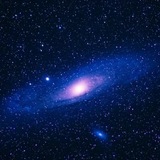
🌌 A Hidden Neutron Star Collision
NASA missions have discovered a rare collision between two neutron stars inside a tiny, faint galaxy—about 4.7 billion light-years away, embedded in a vast stream of gas.
Neutron stars are extremely dense remnants of massive stars. When two of them collide, they produce a powerful gamma-ray burst (GRB), and through nuclear reactions, heavy elements like gold and platinum are formed.
This unusual location may explain two mysteries:
why some gamma-ray bursts appear far from galaxies,
and how heavy elements are found in distant stars.
✨ A “collision within a collision”—first galaxies collided,
eventually leading to this explosive event.
Credit : NASA
NASA missions have discovered a rare collision between two neutron stars inside a tiny, faint galaxy—about 4.7 billion light-years away, embedded in a vast stream of gas.
Neutron stars are extremely dense remnants of massive stars. When two of them collide, they produce a powerful gamma-ray burst (GRB), and through nuclear reactions, heavy elements like gold and platinum are formed.
This unusual location may explain two mysteries:
why some gamma-ray bursts appear far from galaxies,
and how heavy elements are found in distant stars.
✨ A “collision within a collision”—first galaxies collided,
eventually leading to this explosive event.
Credit : NASA
❤3👍1🔥1
✨From the Sun to the Stars
The Journey Beyond the Solar System
Interstellar space begins beyond the Sun’s heliosphere — a vast bubble of plasma created by the solar wind that extends far beyond the planets.
To reach it takes decades.
Voyager 1 traveled about 11 billion miles and took 35 years to cross this boundary in 2012.
Voyager 2 followed in 2018 after a 41-year journey, using gravity assists from giant planets to gain speed.
These spacecraft didn’t travel in a straight line.
They toured Jupiter, Saturn — and in Voyager 2’s case, Uranus and Neptune — using planetary gravity to escape the Sun’s pull.
Today, they no longer take pictures.
Their cameras were turned off in 1990 to save power.
Instead, they “listen” — detecting plasma waves in interstellar space.
Even in near-total silence,
space still carries signals… if you know how to listen.
✨ Humanity has already stepped beyond the Solar System.
The Journey Beyond the Solar System
Interstellar space begins beyond the Sun’s heliosphere — a vast bubble of plasma created by the solar wind that extends far beyond the planets.
To reach it takes decades.
Voyager 1 traveled about 11 billion miles and took 35 years to cross this boundary in 2012.
Voyager 2 followed in 2018 after a 41-year journey, using gravity assists from giant planets to gain speed.
These spacecraft didn’t travel in a straight line.
They toured Jupiter, Saturn — and in Voyager 2’s case, Uranus and Neptune — using planetary gravity to escape the Sun’s pull.
Today, they no longer take pictures.
Their cameras were turned off in 1990 to save power.
Instead, they “listen” — detecting plasma waves in interstellar space.
Even in near-total silence,
space still carries signals… if you know how to listen.
✨ Humanity has already stepped beyond the Solar System.
❤3👍1🔥1
Visitors & Escape from the Solar System 🌌
Interstellar Objects and the Edge of Escape
In 2017, something extraordinary entered our Solar System:
‘Oumuamua — the first confirmed visitor from another star system.
Its steep trajectory showed it wasn’t bound to the Sun.
It passed through once… and is now leaving forever.
Unlike typical comets, it showed no clear tail.
It was elongated (under 800 meters), moving extremely fast, and tumbling through space.
Scientists still don’t know exactly what it was.
But it proved something important:
✨ Objects from other stars can reach us.
Credit : NASA
Interstellar Objects and the Edge of Escape
In 2017, something extraordinary entered our Solar System:
‘Oumuamua — the first confirmed visitor from another star system.
Its steep trajectory showed it wasn’t bound to the Sun.
It passed through once… and is now leaving forever.
Unlike typical comets, it showed no clear tail.
It was elongated (under 800 meters), moving extremely fast, and tumbling through space.
Scientists still don’t know exactly what it was.
But it proved something important:
✨ Objects from other stars can reach us.
Credit : NASA
❤3👍1
This media is not supported in your browser
VIEW IN TELEGRAM
Reaching interstellar space is extremely difficult.🌌
Most spacecraft never leave the Solar System — they are designed to orbit or land on planets.
To escape, a probe must reach escape velocity, breaking free from the Sun’s gravity.
Even powerful rockets are not enough alone.
Voyager missions used a rare alignment of planets (once every ~176 years)
to gain speed through gravity assists, hopping from one planet to another.
Other spacecraft are also on their way outward:
Pioneer 10 & 11, now silent, drifting like ghost ships.
New Horizons, moving toward interstellar space after Pluto.
✨ Leaving the Solar System is not just distance…
it is a battle against gravity, time, and the limits of technology.
Credit: NASA
Most spacecraft never leave the Solar System — they are designed to orbit or land on planets.
To escape, a probe must reach escape velocity, breaking free from the Sun’s gravity.
Even powerful rockets are not enough alone.
Voyager missions used a rare alignment of planets (once every ~176 years)
to gain speed through gravity assists, hopping from one planet to another.
Other spacecraft are also on their way outward:
Pioneer 10 & 11, now silent, drifting like ghost ships.
New Horizons, moving toward interstellar space after Pluto.
✨ Leaving the Solar System is not just distance…
it is a battle against gravity, time, and the limits of technology.
Credit: NASA
❤2👍1
🌌 Beyond the Voyagers
Voyager 1 and 2 are still exploring after nearly 50 years.
They’ve crossed into interstellar space—but haven’t fully left the Solar System yet.
The true boundary lies far beyond, in the distant Oort Cloud, which may take hundreds of years to reach.
In the far future, the Voyagers will pass near other stars—
then continue drifting through the Milky Way as silent ambassadors of Earth, carrying the Golden Record.
Today, scientists are already planning the next step:
missions like IBEX and IMAP are mapping the edge of our Solar System from closer distances.
✨ The journey beyond the stars has only just begun.
Credit : NASA
Voyager 1 and 2 are still exploring after nearly 50 years.
They’ve crossed into interstellar space—but haven’t fully left the Solar System yet.
The true boundary lies far beyond, in the distant Oort Cloud, which may take hundreds of years to reach.
In the far future, the Voyagers will pass near other stars—
then continue drifting through the Milky Way as silent ambassadors of Earth, carrying the Golden Record.
Today, scientists are already planning the next step:
missions like IBEX and IMAP are mapping the edge of our Solar System from closer distances.
✨ The journey beyond the stars has only just begun.
Credit : NASA
❤2👍1
This media is not supported in your browser
VIEW IN TELEGRAM
🌌 The Kuiper Belt: The Edge of Our Solar System
Beyond Neptune lies a vast, hidden region called the Kuiper Belt — a distant ring of icy worlds left over from the birth of the Solar System.
It stretches billions of miles from the Sun and is home to objects like Pluto and many smaller, frozen bodies.
These objects have remained almost unchanged for 4.6 billion years,
making them some of the most ancient and untouched materials we can study.
Hubble has identified small targets here that New Horizons could visit —
offering a rare chance to explore these primordial worlds up close.
✨ At the edge of our Solar System…
time is almost frozen.
Credit: NASA, ESA, G. Bacon (STScI)
Beyond Neptune lies a vast, hidden region called the Kuiper Belt — a distant ring of icy worlds left over from the birth of the Solar System.
It stretches billions of miles from the Sun and is home to objects like Pluto and many smaller, frozen bodies.
These objects have remained almost unchanged for 4.6 billion years,
making them some of the most ancient and untouched materials we can study.
Hubble has identified small targets here that New Horizons could visit —
offering a rare chance to explore these primordial worlds up close.
✨ At the edge of our Solar System…
time is almost frozen.
Credit: NASA, ESA, G. Bacon (STScI)
❤3👍2🔥1🤔1
This media is not supported in your browser
VIEW IN TELEGRAM
Crab Nebula is still expanding… even after 1000 years. 🌌
Hubble revisited the Crab Nebula after 25 years and revealed something incredible:
this supernova remnant is still expanding at 3.4 million miles per hour, powered by a spinning neutron star at its core.
For the first time, we can clearly see how it has evolved over time—proving the universe is not static, but constantly changing.
✨ Even after a millennium… the explosion is still alive.
Credit: NASA
Hubble revisited the Crab Nebula after 25 years and revealed something incredible:
this supernova remnant is still expanding at 3.4 million miles per hour, powered by a spinning neutron star at its core.
For the first time, we can clearly see how it has evolved over time—proving the universe is not static, but constantly changing.
✨ Even after a millennium… the explosion is still alive.
Credit: NASA
❤2
This media is not supported in your browser
VIEW IN TELEGRAM
Messier 58 — A galaxy in motion 🌌
Hubble captured this spiral galaxy using infrared, visible, and ultraviolet light.
This combined view reveals star-forming regions, newborn stars, and the gas and dust shaping the galaxy—showing that galaxies are constantly evolving.
Credit : NASA
Hubble captured this spiral galaxy using infrared, visible, and ultraviolet light.
This combined view reveals star-forming regions, newborn stars, and the gas and dust shaping the galaxy—showing that galaxies are constantly evolving.
Credit : NASA
❤2🤯1
This media is not supported in your browser
VIEW IN TELEGRAM
Our Milky Way — Our cosmic home 🌌
The Milky Way is a spiral galaxy over 100,000 light-years wide.
Our solar system sits halfway out in one of its spiral arms and takes about 240 million years to orbit it once.
From Earth, it appears as a faint glowing band across the night sky.
We’re part of a small cosmic family called the Local Group, alongside over 50 galaxies — including Andromeda.
The Milky Way is a spiral galaxy over 100,000 light-years wide.
Our solar system sits halfway out in one of its spiral arms and takes about 240 million years to orbit it once.
From Earth, it appears as a faint glowing band across the night sky.
We’re part of a small cosmic family called the Local Group, alongside over 50 galaxies — including Andromeda.
❤3🥰1
Messier 101 — Into the heart of a galaxy 🌌
A stunning combined view from Hubble and James Webb zooms into the core of the Pinwheel Galaxy (M101), about 25 million light-years away.
Hubble reveals stars and structure, while Webb uncovers glowing dust and complex carbon molecules shaping the galaxy’s evolution.
Part of Hubble’s Messier Marathon 2026.
Credit : NASA
A stunning combined view from Hubble and James Webb zooms into the core of the Pinwheel Galaxy (M101), about 25 million light-years away.
Hubble reveals stars and structure, while Webb uncovers glowing dust and complex carbon molecules shaping the galaxy’s evolution.
Part of Hubble’s Messier Marathon 2026.
Credit : NASA
❤2👏1
This media is not supported in your browser
VIEW IN TELEGRAM
Cranium Nebula — A “brain” in space 🧠✨
What looks like a brain is actually a dying star shedding its outer layers into space.
Webb reveals two views:
✨ Near-infrared shows stars and distant galaxies
✨ Mid-infrared highlights glowing cosmic dust
The star’s fate depends on its mass:
It may explode as a supernova — or fade into a dense white dwarf.
Credit : NASA/ESA
What looks like a brain is actually a dying star shedding its outer layers into space.
Webb reveals two views:
✨ Near-infrared shows stars and distant galaxies
✨ Mid-infrared highlights glowing cosmic dust
The star’s fate depends on its mass:
It may explode as a supernova — or fade into a dense white dwarf.
Credit : NASA/ESA
❤2🔥1
X-ray Dot — A missing link in black hole evolution 🌌
A newly discovered “X-ray dot” may reveal the true nature of mysterious “little red dots” seen in the early Universe.
These distant objects (~12 billion light-years away) are thought to be growing supermassive black holes hidden inside dense gas clouds.
Unlike others, this one emits X-rays — suggesting a transition phase where the black hole begins to break through its surrounding gas.
This could be the first direct evidence of how supermassive black holes grow and emerge.
✨ A hidden phase… finally becoming visible.
Credit : NASA
A newly discovered “X-ray dot” may reveal the true nature of mysterious “little red dots” seen in the early Universe.
These distant objects (~12 billion light-years away) are thought to be growing supermassive black holes hidden inside dense gas clouds.
Unlike others, this one emits X-rays — suggesting a transition phase where the black hole begins to break through its surrounding gas.
This could be the first direct evidence of how supermassive black holes grow and emerge.
✨ A hidden phase… finally becoming visible.
Credit : NASA
❤3👍2👏1
Starry Spiral in a Familiar Neighbourhood 🌌
A dazzling spiral galaxy, NGC 3137, lies about 53 million light-years away. Seen in stunning detail by Hubble, it reveals bright blue star clusters and glowing red gas clouds—signs of active star formation.
This galaxy is part of a group similar to our Local Group, offering clues about how galaxies like the Milky Way evolve. At its core sits a supermassive black hole about 60 million times the mass of the Sun.
Hubble is studying such galaxies to understand the full cycle of stellar life—from newborn stars to ancient ones.
Credit: NASA/ESA Hubble
A dazzling spiral galaxy, NGC 3137, lies about 53 million light-years away. Seen in stunning detail by Hubble, it reveals bright blue star clusters and glowing red gas clouds—signs of active star formation.
This galaxy is part of a group similar to our Local Group, offering clues about how galaxies like the Milky Way evolve. At its core sits a supermassive black hole about 60 million times the mass of the Sun.
Hubble is studying such galaxies to understand the full cycle of stellar life—from newborn stars to ancient ones.
Credit: NASA/ESA Hubble
❤4👍1🔥1
This media is not supported in your browser
VIEW IN TELEGRAM
Orion Nebula 🌌
A stellar nursery about 1,500 light-years away.
Chandra reveals young stars in X-rays, while Webb shows the gas and dust forming new ones.
✨ Where new stars are born.
Credit: NASA, ESA
A stellar nursery about 1,500 light-years away.
Chandra reveals young stars in X-rays, while Webb shows the gas and dust forming new ones.
✨ Where new stars are born.
Credit: NASA, ESA
❤3👍2👌1