NASA Telescopes Spot Surprisingly Mature Cluster in Early Universe
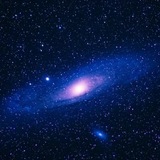
Astronomers using NASA’s Chandra X-ray Observatory and the James Webb Space Telescope discovered a massive protocluster called JADES-1 in the early universe. Located about 12.7 billion light-years away, it contains dozens of young galaxies and has a mass of around 20 trillion Suns. This finding suggests that galaxy clusters may have formed much earlier than previously thought.
Credit: NASA / ESA / JWST
Astronomers using NASA’s Chandra X-ray Observatory and the James Webb Space Telescope discovered a massive protocluster called JADES-1 in the early universe. Located about 12.7 billion light-years away, it contains dozens of young galaxies and has a mass of around 20 trillion Suns. This finding suggests that galaxy clusters may have formed much earlier than previously thought.
Credit: NASA / ESA / JWST
❤2
NASA’s James Webb Space Telescope revealed new details about the supermassive black hole at the center of the Circinus Galaxy. Surrounded by a thick ring of gas and dust, this hidden region shines brightly in infrared light, helping scientists better understand how black holes interact with their surroundings.
Credit: NASA / ESA / JWST
Credit: NASA / ESA / JWST
👍4
Stellar jet in Sh2-284 (NIRCam image)
The James Webb Space Telescope captured a massive stellar jet in the Milky Way’s Sh2-284 region. This stream of plasma, launched by a young star, stretches about 8 light-years across — showing that more massive stars create larger, more powerful jets.
Credit: NASA / ESA / CSA / JWST
The James Webb Space Telescope captured a massive stellar jet in the Milky Way’s Sh2-284 region. This stream of plasma, launched by a young star, stretches about 8 light-years across — showing that more massive stars create larger, more powerful jets.
Credit: NASA / ESA / CSA / JWST
👍2❤1
For the first time in over 50 years, humans are heading back toward the Moon.
NASA’s Artemis II mission launched on April 1, 2026, carrying four astronauts aboard the Orion spacecraft. After a series of precise orbital maneuvers around Earth, the crew performed a powerful burn that sent them beyond Earth’s orbit — into deep space.
This marks a historic return to human lunar exploration, opening the door to a new era of space travel.
Credit : Nasa
NASA’s Artemis II mission launched on April 1, 2026, carrying four astronauts aboard the Orion spacecraft. After a series of precise orbital maneuvers around Earth, the crew performed a powerful burn that sent them beyond Earth’s orbit — into deep space.
This marks a historic return to human lunar exploration, opening the door to a new era of space travel.
Credit : Nasa
👍2
🌕 Artemis II – Flight Day 6
On Flight Day 6, Artemis II reaches one of its most critical moments — the lunar flyby.
As the spacecraft passes behind the Moon, communication with Earth is temporarily lost, leaving the crew completely alone in deep space for about 40 minutes.
A moment of silence…
A moment of isolation…
A moment of history.
Humanity is once again orbiting the Moon.
Credit : Nasa
On Flight Day 6, Artemis II reaches one of its most critical moments — the lunar flyby.
As the spacecraft passes behind the Moon, communication with Earth is temporarily lost, leaving the crew completely alone in deep space for about 40 minutes.
A moment of silence…
A moment of isolation…
A moment of history.
Humanity is once again orbiting the Moon.
Credit : Nasa
👍3❤1
This media is not supported in your browser
VIEW IN TELEGRAM
This is the deepest X-ray image ever of the Tarantula Nebula (30 Doradus) , a massive star-forming region.
Located 160,000 light-years away, it reveals how stars are born using combined data from Webb, Hubble, Chandra, and ALMA.
This is where stars are born…
and where the universe keeps beginning again.
Credit: Nasa
Located 160,000 light-years away, it reveals how stars are born using combined data from Webb, Hubble, Chandra, and ALMA.
This is where stars are born…
and where the universe keeps beginning again.
Credit: Nasa
❤2