This media is not supported in your browser
VIEW IN TELEGRAM
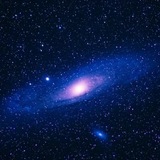
Messier 58 — A galaxy in motion 🌌
Hubble captured this spiral galaxy using infrared, visible, and ultraviolet light.
This combined view reveals star-forming regions, newborn stars, and the gas and dust shaping the galaxy—showing that galaxies are constantly evolving.
Credit : NASA
Hubble captured this spiral galaxy using infrared, visible, and ultraviolet light.
This combined view reveals star-forming regions, newborn stars, and the gas and dust shaping the galaxy—showing that galaxies are constantly evolving.
Credit : NASA
❤2🤯1
This media is not supported in your browser
VIEW IN TELEGRAM
Our Milky Way — Our cosmic home 🌌
The Milky Way is a spiral galaxy over 100,000 light-years wide.
Our solar system sits halfway out in one of its spiral arms and takes about 240 million years to orbit it once.
From Earth, it appears as a faint glowing band across the night sky.
We’re part of a small cosmic family called the Local Group, alongside over 50 galaxies — including Andromeda.
The Milky Way is a spiral galaxy over 100,000 light-years wide.
Our solar system sits halfway out in one of its spiral arms and takes about 240 million years to orbit it once.
From Earth, it appears as a faint glowing band across the night sky.
We’re part of a small cosmic family called the Local Group, alongside over 50 galaxies — including Andromeda.
❤3🥰1
Messier 101 — Into the heart of a galaxy 🌌
A stunning combined view from Hubble and James Webb zooms into the core of the Pinwheel Galaxy (M101), about 25 million light-years away.
Hubble reveals stars and structure, while Webb uncovers glowing dust and complex carbon molecules shaping the galaxy’s evolution.
Part of Hubble’s Messier Marathon 2026.
Credit : NASA
A stunning combined view from Hubble and James Webb zooms into the core of the Pinwheel Galaxy (M101), about 25 million light-years away.
Hubble reveals stars and structure, while Webb uncovers glowing dust and complex carbon molecules shaping the galaxy’s evolution.
Part of Hubble’s Messier Marathon 2026.
Credit : NASA
❤2👏1
This media is not supported in your browser
VIEW IN TELEGRAM
Cranium Nebula — A “brain” in space 🧠✨
What looks like a brain is actually a dying star shedding its outer layers into space.
Webb reveals two views:
✨ Near-infrared shows stars and distant galaxies
✨ Mid-infrared highlights glowing cosmic dust
The star’s fate depends on its mass:
It may explode as a supernova — or fade into a dense white dwarf.
Credit : NASA/ESA
What looks like a brain is actually a dying star shedding its outer layers into space.
Webb reveals two views:
✨ Near-infrared shows stars and distant galaxies
✨ Mid-infrared highlights glowing cosmic dust
The star’s fate depends on its mass:
It may explode as a supernova — or fade into a dense white dwarf.
Credit : NASA/ESA
❤2🔥1
X-ray Dot — A missing link in black hole evolution 🌌
A newly discovered “X-ray dot” may reveal the true nature of mysterious “little red dots” seen in the early Universe.
These distant objects (~12 billion light-years away) are thought to be growing supermassive black holes hidden inside dense gas clouds.
Unlike others, this one emits X-rays — suggesting a transition phase where the black hole begins to break through its surrounding gas.
This could be the first direct evidence of how supermassive black holes grow and emerge.
✨ A hidden phase… finally becoming visible.
Credit : NASA
A newly discovered “X-ray dot” may reveal the true nature of mysterious “little red dots” seen in the early Universe.
These distant objects (~12 billion light-years away) are thought to be growing supermassive black holes hidden inside dense gas clouds.
Unlike others, this one emits X-rays — suggesting a transition phase where the black hole begins to break through its surrounding gas.
This could be the first direct evidence of how supermassive black holes grow and emerge.
✨ A hidden phase… finally becoming visible.
Credit : NASA
❤3👍2👏1
Starry Spiral in a Familiar Neighbourhood 🌌
A dazzling spiral galaxy, NGC 3137, lies about 53 million light-years away. Seen in stunning detail by Hubble, it reveals bright blue star clusters and glowing red gas clouds—signs of active star formation.
This galaxy is part of a group similar to our Local Group, offering clues about how galaxies like the Milky Way evolve. At its core sits a supermassive black hole about 60 million times the mass of the Sun.
Hubble is studying such galaxies to understand the full cycle of stellar life—from newborn stars to ancient ones.
Credit: NASA/ESA Hubble
A dazzling spiral galaxy, NGC 3137, lies about 53 million light-years away. Seen in stunning detail by Hubble, it reveals bright blue star clusters and glowing red gas clouds—signs of active star formation.
This galaxy is part of a group similar to our Local Group, offering clues about how galaxies like the Milky Way evolve. At its core sits a supermassive black hole about 60 million times the mass of the Sun.
Hubble is studying such galaxies to understand the full cycle of stellar life—from newborn stars to ancient ones.
Credit: NASA/ESA Hubble
❤4👍1🔥1
This media is not supported in your browser
VIEW IN TELEGRAM
Orion Nebula 🌌
A stellar nursery about 1,500 light-years away.
Chandra reveals young stars in X-rays, while Webb shows the gas and dust forming new ones.
✨ Where new stars are born.
Credit: NASA, ESA
A stellar nursery about 1,500 light-years away.
Chandra reveals young stars in X-rays, while Webb shows the gas and dust forming new ones.
✨ Where new stars are born.
Credit: NASA, ESA
❤3👍2👌1
This media is not supported in your browser
VIEW IN TELEGRAM
Crab Nebula 🌌
The remains of a supernova seen in 1054, 6,500 light-years away.
A spinning neutron star powers this glowing cosmic structure.
✨ A cosmic lighthouse in the dark.
Credit: NASA/CXC/SAO, NASA/STScI
The remains of a supernova seen in 1054, 6,500 light-years away.
A spinning neutron star powers this glowing cosmic structure.
✨ A cosmic lighthouse in the dark.
Credit: NASA/CXC/SAO, NASA/STScI
❤3👌2👍1🔥1
This media is not supported in your browser
VIEW IN TELEGRAM
✨The quiet chaos of the universe
NGC 604 🌌
A vast stellar nursery shaped by powerful winds from young, hot stars.
Gas and dust are carved into glowing cavities and cosmic bubbles.
✨ Stars sculpt their own birthplace.
Credit: NASA, ESA, CSA, STScI
NGC 604 🌌
A vast stellar nursery shaped by powerful winds from young, hot stars.
Gas and dust are carved into glowing cavities and cosmic bubbles.
✨ Stars sculpt their own birthplace.
Credit: NASA, ESA, CSA, STScI
❤1
This media is not supported in your browser
VIEW IN TELEGRAM
✨ A spiral lost in light
NGC 4254 — a luminous spiral galaxy where millions of stars shimmer in blue, while glowing dust traces the hidden structure between them.
Captured by the James Webb Space Telescope, revealing the quiet beauty of cosmic design.
✨ A galaxy breathing in silence.
Credit: NASA, ESA, CSA, STScI
NGC 4254 — a luminous spiral galaxy where millions of stars shimmer in blue, while glowing dust traces the hidden structure between them.
Captured by the James Webb Space Telescope, revealing the quiet beauty of cosmic design.
✨ A galaxy breathing in silence.
Credit: NASA, ESA, CSA, STScI
❤1
This media is not supported in your browser
VIEW IN TELEGRAM
✨ The echo of a dying star
Cassiopeia A — the glowing remains of a powerful stellar explosion.
Webb reveals intricate filaments and expanding shells of gas, shaped by the final moments of a massive star.
✨ A silent explosion still unfolding.
Credit: NASA, ESA, CSA, STScI
Cassiopeia A — the glowing remains of a powerful stellar explosion.
Webb reveals intricate filaments and expanding shells of gas, shaped by the final moments of a massive star.
✨ A silent explosion still unfolding.
Credit: NASA, ESA, CSA, STScI
❤2