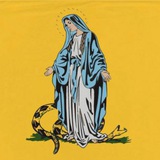
Dank Papistry
Photo
I will write a long essay on TLM snobbery at some point in the future, do stay posted but the long and short of it will be “Don’t make an idol of tradition”.
🖕1
Forwarded from Sensible Catholicism
The refusal to take sides on great moral issues is itself a decision. It is a silent acquiescence to evil. The tragedy of our time is that those who still believe in honesty lack fire and conviction, while those who believe in dishonesty are full of passionate conviction.
- Venerable Fulton J. Sheen
The Catholic Church teaches that all non - Catholic religions are false. There is only one true Church, outside of which no one can be saved. This is Catholic dogma.
Pope St. Gregory the Great, 590-604: “The holy universal Church teaches that it is not possible to worship God truly except in her and asserts that all who are outside of her will not be saved.”
All of the other religions belong to the Devil. This is the teaching of Jesus Christ, the Catholic Church and Sacred Scripture. See 1 Cor. 10:20 and Psalm 95:5. Anyone who shows esteem for non-Christian religions, or regards them as good or deserving of respect, denies Jesus Christ and is an apostate.
Pope Pius XI, Mortalium Animos (# 10): “So, Venerable Brethren, it is clear why this Apostolic See has never allowed its subjects to take part in the assemblies of non - Catholics…”
Pope St. Gregory the Great, 590-604: “The holy universal Church teaches that it is not possible to worship God truly except in her and asserts that all who are outside of her will not be saved.”
All of the other religions belong to the Devil. This is the teaching of Jesus Christ, the Catholic Church and Sacred Scripture. See 1 Cor. 10:20 and Psalm 95:5. Anyone who shows esteem for non-Christian religions, or regards them as good or deserving of respect, denies Jesus Christ and is an apostate.
Pope Pius XI, Mortalium Animos (# 10): “So, Venerable Brethren, it is clear why this Apostolic See has never allowed its subjects to take part in the assemblies of non - Catholics…”
🤯1
Catholic doctrine tells us that the primary duty of charity does not lie in the toleration of false ideas, however sincere they may be, nor in the theoretical or practical indifference towards the errors and vices in which we see our brethren plunged, but in the zeal for their intellectual and moral improvement as well as for their material well-being. Catholic doctrine further tells us that love for our neighbour flows from our love for God, Who is Father to all, and goal of the whole human family; and in Jesus Christ whose members we are, to the point that in doing good to others we are doing good to Jesus Christ Himself. Any other kind of love is sheer illusion, sterile and fleeting.
(St. Pius X)
(St. Pius X)
Forwarded from Christianists (III)
AUGUST 28, FEAST OF SAINT AUGUSTINE
Saint Augustine was born in 354 at Tagaste in Africa. He was brought up in the Christian faith but did not receive baptism, result of the practice, common in the first centuries, of deferring it until adulthood. An ambitious schoolboy of brilliant talents and violent passions, he early lost both his faith and his innocence. He pursued with ardor the study of philosophy. He taught grammar, rhetoric and literature for nine years in his native town of Tagaste, and in Carthage. He persisted in his irregular life and doctrinal errors until he was thirty-two. Then one day, stung to the heart by the account of some sudden conversions, he cried out, "The unlearned rise and storm heaven, and we, with all our learning, for lack of courage lie inert!" The great heart of this future bishop was already evident.
Christianists
Saint Augustine was born in 354 at Tagaste in Africa. He was brought up in the Christian faith but did not receive baptism, result of the practice, common in the first centuries, of deferring it until adulthood. An ambitious schoolboy of brilliant talents and violent passions, he early lost both his faith and his innocence. He pursued with ardor the study of philosophy. He taught grammar, rhetoric and literature for nine years in his native town of Tagaste, and in Carthage. He persisted in his irregular life and doctrinal errors until he was thirty-two. Then one day, stung to the heart by the account of some sudden conversions, he cried out, "The unlearned rise and storm heaven, and we, with all our learning, for lack of courage lie inert!" The great heart of this future bishop was already evident.
Christianists
Forwarded from Heathens Begone (Pérez)
Comparison between Eve and Mary. Eve was the mother of all mankind, according to the flesh: Mary is the spiritual mother of all the faithful. Both entered life without the stain of sin, and in a state of grace; but Eve lost grace, while Mary, on the contrary, preserved it and increased it by corresponding with it. Eve thoughtlessly allowed herself to be deceived by the devil, without asking herself whether it were a good or an evil spirit who spoke through the serpent; but Mary pondered, and asked herself whether the salutation of the angel came from God or not. Eve conversed with the devil, for the ruin of man: Mary with Gabriel, for the salvation of man. Eve sinned by unbelief: while Mary believed the wonderful message which God sent. Eve sinned by pride, wishing to be as God: Mary was humble, calling herself the handmaid of the Lord. Eve was disobedient to God: Mary gave herself over entirely to His will. Eve consented to sin: Mary to God’s will. Eve, by her pride, degraded herself, and brought sin and death on all mankind: Mary, by her humility, was herself exalted, and through her Divine Son gave grace and life to the world. As far as she could, Mary paid the debt owed by Eve to the human race. Eve was the mother of the curse: Mary of the blessing. She is the true mother of the living, the new and better Eve. These striking contrasts are, of course, the result not of accident, but of the action of the mysterious wisdom and counsel of God, and they teach us to value God’s merciful Providence.