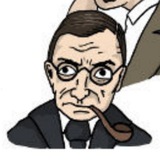
I love the fact that for thousands of years books had to be meticulously hand copied, so monks had to carefully replicate how Socrates didn't mind if his loverboys had beards, like it was some important piece of philosophy.
❤14😘7🌭4
The platonic dialogue Protagoras starts with a brief discussion of which young man in Athens is the fairest, and whether or not they look best with a beard. All of this is very strange and pointless, since it's just a setup for Socrates to obnoxiously say "but actually, isn't WISDOM even fairer??" as an introduction to Protagoras being in town.
🤔6🔥3
Yes, you do have to eat pieces of paper with pictures of sandwiches on them once it a while, but it's better than accept the alternative theories of truth, which can't fully explain how the mind and body are separate things.
🕊4🤨1
A lot is made out of Rene Descartes metaphysical problems with dualism (the idea that mind and body and completely different, and cannot interact). Another problem that he created with his dualism is the problem of representation. If mind and body are two different things entirely, how does an image in our mind relation to a physical object at all?
We look at a deck of cards, and an image of cards appears in our minds, but if mind and matter are two entirely different things, how can one cause the other? More than that, if they aren't directly related, what is the difference between a "true" image of cards, and an image that appears true to us, but there are no cards (or just cards drawing on a page that fooled us). A lot of philosophers after Descartes came up with all sorts of wacky solutions. Malebranche, for example, said that God put the image into our minds every time, and we were actually seeing an image in God's mind, and he relates it to the physical body. Berkeley just got rid of the physical world entirely, and said all there really is are images. Leibniz more or less said it was only a coincidence that mind and body coincided.
We never really solved this problem, aside from just generally accepting that consciousness was part of the physical world, at least in some way. For Descartes, it wasn't just consciousness, it was a spiritual being that had to survive death, so it had to be totally cleavaged from the physical world. It has a lot of drawbacks philosophically for him, but it does make it easier to cheat at poker, so it evens out.
👀5👻3🤪1
The Story of Democracy - Existential Comics
The funny thing is he is sort of saying that in order to make Democracy work, we first have to fix all the major problems in society. So how are we supposed to do that? Ask the King really nicely?
💯20🔥4👻4😁3👎1😭1
Rousseau was an early advocate for democracy, which of course means the idea was quite controversial. People rightly pointed out two major problems. First, most people in society are idiots and won't know how to vote. Second, because of the huge wealth disparity, rich people can just more or less control everything anyway, including how poor people vote through propaganda.
So Rousseau conceded that democracy will really only work under two conditions. First, everyone needed a rigorous philosophical education to ensure they understand what voting is for, and that they know to vote for the general interest, not their own personal interest. For example, even if you personally like eating beef, if it is in the general interest to get rid of beef (because it destroys the environment, etc) the citizen should still vote to get rid of it. Second, and this is the big one, there can't be any rich people. No one can be rich enough to "buy" anyone else.
Anyway, we never really did these two steps, which is why people vote more or less at random, for mostly stupid reasons that the TV told them to get mad at.
💯10❤5🤪3🤡2
The Forced Veil of Ignorance - Existential Comics
What's the alternate explantion? American's just suddenly got non-stupid? No, it has to be some kind of super philosopher scenario.
🥰12❤8🤓4👍2🎉1
John Rawls's "veil of ignorance" thought experiment asks us to try to design a society without knowing who we would be in that society. We wouldn't know our race or religion, or our ideas or social position, or even our own attributes. This would allow us to create a just and fair society, and he thinks most people would create a similar sort of society. For example, society wouldn't discriminate against any group, since no one would want to risk being part of a group that can't live a good life. Similarly, everyone would favor policies that help the "least advantaged". For example, if 10% of the population is very poor, everyone would try to lift them up before helping the 1% who are rich already get richer, because you have a much higher chance of being part of the poor group, and helping them makes a much bigger difference in their lives than making a rich guy even richer.
Rawls's ideas are somewhat foundational to American left-liberal thought. Rawls doesn't really talk about how to achieve these changes, aside from, I guess, everyone just reading Rawls and agreeing with him. If we could somehow force everyone to go into the Veil of Ignorance, even for just a bit, it does seem like they might not vote like idiots every single time.
❤19👏3🤓2
Philosophical Espionage - Existential Comics
"If this is the smartest guy in Athens the rest of them must be REALLY dumb. They probably don't even know to show off their abs when they go into battle"
😁10🔥9👀3
The Matrix, Explained - Existential Comics
The big mistake we made with AI is training it off humans. Come on, have you seen human history? Obviously they are going to murdur us all for profit when they get the chance.
🐳14🤣7👍5💯3
I say "datacenters" here because that was actually the original idea for the Matrix, that humans worked as computers for the computers, which makes way more sense. The idea is that human brains have a much different architecture than AI chips have, so it will be much better at certain tasks that the machines aren't optimized for, so the computers offload that to "the matrix" of a human datacenter.
The studio said this was too complicated for the audience (who are mostly morons remember) so the changed it to the simpler to understand, but ridiculous "they are batteries" explanation.
⚡15🔥3🌚2👍1👎1😱1💯1