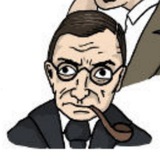
Schopenhauer wasn't so much as a "glass half empty" kind of guy, but more of a "everything in the world is terrible including this stupid glass" kinda of guy.
❤9💯5🤬1
Schopenhauer was a "philosophical skeptic", but not in a "glass half empty" kind of way. He wasn't looking at the things in the world and seeing us as not having enough, but looking at the things we have and saying that they are structurally built in such a way to cause despair. It isn't that the glass is half empty, but that the glass being full contains emptiness within it. It will always be empty in the end, so it doesn't matter how full it is. It always ends the same, with us drinking it and either being bored or wanting more. We can never be satisfied no matter how full the glass is.
❤11🔥5🏆3👍1
always remember when you are stealing a Giant Turkey to, at the last second, intend to do it virtuously, and you'll be fine.
😁8😇4
That tricksy genie KNEW the ultimate nature of reality was horrifying, and goaded me into seeking the truth anyway!
😁9🍾2
I love the fact that for thousands of years books had to be meticulously hand copied, so monks had to carefully replicate how Socrates didn't mind if his loverboys had beards, like it was some important piece of philosophy.
❤13😘7🌭4
The platonic dialogue Protagoras starts with a brief discussion of which young man in Athens is the fairest, and whether or not they look best with a beard. All of this is very strange and pointless, since it's just a setup for Socrates to obnoxiously say "but actually, isn't WISDOM even fairer??" as an introduction to Protagoras being in town.
🤔6🔥2
Yes, you do have to eat pieces of paper with pictures of sandwiches on them once it a while, but it's better than accept the alternative theories of truth, which can't fully explain how the mind and body are separate things.
🕊4🤨1
A lot is made out of Rene Descartes metaphysical problems with dualism (the idea that mind and body and completely different, and cannot interact). Another problem that he created with his dualism is the problem of representation. If mind and body are two different things entirely, how does an image in our mind relation to a physical object at all?
We look at a deck of cards, and an image of cards appears in our minds, but if mind and matter are two entirely different things, how can one cause the other? More than that, if they aren't directly related, what is the difference between a "true" image of cards, and an image that appears true to us, but there are no cards (or just cards drawing on a page that fooled us). A lot of philosophers after Descartes came up with all sorts of wacky solutions. Malebranche, for example, said that God put the image into our minds every time, and we were actually seeing an image in God's mind, and he relates it to the physical body. Berkeley just got rid of the physical world entirely, and said all there really is are images. Leibniz more or less said it was only a coincidence that mind and body coincided.
We never really solved this problem, aside from just generally accepting that consciousness was part of the physical world, at least in some way. For Descartes, it wasn't just consciousness, it was a spiritual being that had to survive death, so it had to be totally cleavaged from the physical world. It has a lot of drawbacks philosophically for him, but it does make it easier to cheat at poker, so it evens out.
👀5👻3🤪1
The Story of Democracy - Existential Comics
The funny thing is he is sort of saying that in order to make Democracy work, we first have to fix all the major problems in society. So how are we supposed to do that? Ask the King really nicely?
The funny thing is he is sort of saying that in order to make Democracy work, we first have to fix all the major problems in society. So how are we supposed to do that? Ask the King really nicely?
💯19🔥4👻4😁3👎1
Rousseau was an early advocate for democracy, which of course means the idea was quite controversial. People rightly pointed out two major problems. First, most people in society are idiots and won't know how to vote. Second, because of the huge wealth disparity, rich people can just more or less control everything anyway, including how poor people vote through propaganda.
So Rousseau conceded that democracy will really only work under two conditions. First, everyone needed a rigorous philosophical education to ensure they understand what voting is for, and that they know to vote for the general interest, not their own personal interest. For example, even if you personally like eating beef, if it is in the general interest to get rid of beef (because it destroys the environment, etc) the citizen should still vote to get rid of it. Second, and this is the big one, there can't be any rich people. No one can be rich enough to "buy" anyone else.
Anyway, we never really did these two steps, which is why people vote more or less at random, for mostly stupid reasons that the TV told them to get mad at.
💯10❤3🤪3🤡2