
Forwarded from AI News Daily
---
Two major signals from the hedge fund world:
• Bill Ackman is launching a ~$5B IPO to secure permanent capital
• Bobby Jain is shutting down external fundraising to operate under Millennium Management
👉 The industry structure is shifting.
---
Ackman is moving toward a permanent capital model:
• ~$30B AUM
• ~$20B fee-paying
• IPO expected to raise ~$5B
👉 Goal:
Invest long-term without redemption pressure
This reflects a broader trend:
→ funds want *stable, sticky capital*
---
Instead of scaling independently, Jain is:
• returning external capital
• managing money exclusively for Millennium
👉 Translation:
even top managers struggle to compete alone
---
The hedge fund industry is becoming:
• more expensive (talent + tech + data)
• more competitive (dominated by giants like Citadel and Millennium)
• more institutionalized
👉 Scale is now a *requirement*, not an advantage
---
We are moving from:
• independent hedge funds
→ to platform-based investing ecosystems
Where:
• large firms provide infrastructure
• smaller managers plug into the system
---
📝 In brief
The hedge fund world is consolidating.
👉 Big players get bigger
👉 Smaller players either adapt or disappear
And capital is becoming more centralized and long-term.
---
#Finance #HedgeFunds #Investing #Markets #IPO
Please open Telegram to view this post
VIEW IN TELEGRAM
Forwarded from AI News Daily
The video explores a scenario where Tim Cook could step down as CEO of Apple — and why this would matter far beyond the company itself.
Apple isn’t just another company.
It is:
• one of the largest companies in the world
• a major driver of indices like the S&P 500
• a core holding for global investors
👉 A leadership change could trigger market-wide reactions
The concern is not immediate collapse
but uncertainty.
Markets rely heavily on:
• predictable leadership
• consistent strategy
• long-term vision
👉 A transition introduces doubt about:
• innovation pipeline
• AI strategy
• future growth
If something like this happens, focus shifts to:
• Who replaces the CEO
• Whether strategy changes
• How markets react in the short term
Historically:
👉 large tech CEO exits often create volatility
Mega-cap companies like Apple are no longer just businesses
they are systemically important assets
→ Changes at the top can ripple across:
• indices
• ETFs
• global portfolios
📝 In brief
A CEO change at Apple wouldn’t just be corporate news.
👉 It would be a macro event
Because when the biggest company moves,
the whole market feels it.
#Apple #Markets #Tech #Investing #Macro
Please open Telegram to view this post
VIEW IN TELEGRAM
YouTube
An Unknown Engineer is Apple's New CEO
Visit https://brilliant.org/coldfusion for 20% off a premium subscription.
Tim Cook has been at the helm of Apple since the passing of Steve Jobs in 2011. He's now stepping down from the lead role to be replaced by a little known mechanical engineer, John…
Tim Cook has been at the helm of Apple since the passing of Steve Jobs in 2011. He's now stepping down from the lead role to be replaced by a little known mechanical engineer, John…
The video explains a critical but often ignored trend:
👉 people are having fewer children worldwide
🧠 The core idea
This is not just a social issue
it’s a major macroeconomic shift.
Lower birth rates mean:
• fewer workers in the future
• slower economic growth
• increasing pressure on pension systems
Modern economies rely on population growth.
If population declines:
• consumption slows
• labor shortages increase
• productivity must compensate
👉 Without growth, long-term GDP trends weaken
Aging societies create:
• higher public spending (healthcare, pensions)
• lower tax revenues
• rising debt pressure
This is already visible in countries like Japan and parts of Europe.
The biggest economic challenge of the next decades may not be:
• inflation
• interest rates
• or geopolitics
👉 but demographics
📝 In brief
Fewer children today =
👉 weaker economies tomorrow
And unlike market cycles,
this trend is slow, structural, and hard to reverse.
#Macro #Demographics #Economics #Markets #Finance
Please open Telegram to view this post
VIEW IN TELEGRAM
YouTube
Why are we having fewer children? | In Case You Missed It
If fewer people have children... what happens next?
Across the globe birth rates are falling, populations are ageing and debates about parenthood have become intensely divisive.
In this video, we set out to understand why parenthood might no longer feel…
Across the globe birth rates are falling, populations are ageing and debates about parenthood have become intensely divisive.
In this video, we set out to understand why parenthood might no longer feel…
---
Four tech giants, Alphabet, Amazon, Meta, and Microsoft, just reported earnings, and one theme dominates: AI.
---
• Meta
Raised full-year capex to $125B–$145B, well above expectations → shares fell after hours
• Alphabet
Beat revenue expectations (~$94.7B vs ~$91.6B expected)
• Amazon
Cloud growth strongest in 3+ years, but capex jumped to $44.2B
• Microsoft
Azure revenue grew ~39%, slightly above expectations
---
AI is reshaping the economics of Big Tech:
• massive infrastructure buildout
• rising cloud demand
• increasing dependence on AI workloads
👉 Growth is strong but so are costs
---
Markets are reacting to:
• rising capital expenditures
• uncertain return timelines
• pressure on margins
👉 Even strong earnings can trigger stock declines
---
This is not just earnings season
it’s an AI arms race
Companies are spending aggressively today
to dominate tomorrow’s infrastructure
---
📝 In brief
Big Tech is scaling AI at full speed
👉 demand is real
👉 revenues are growing
👉 but costs are exploding
The key question now:
👉 when does AI turn into sustained profit?
---
#Markets #AI #BigTech #Earnings #Investing
Please open Telegram to view this post
VIEW IN TELEGRAM
Bloomberg.com
Microsoft Projects ‘Modest’ Cloud Acceleration Amid AI Jitters
Microsoft Corp. said cloud computing revenue and spending on AI infrastructure will accelerate this year, a bid to convince investors that its huge bets on artificial intelligence are poised to pay off.
❤1
---
A new finance video breaks down a scenario many investors fear:
what actually happens if the U.S. economy enters a serious downturn.
---
A crash is not just “stocks going down.”
It usually spreads through the economy in stages:
• consumer spending slows
• companies cut costs
• unemployment rises
• credit becomes tighter
• markets reprice risk
👉 The real danger is when financial stress moves from Wall Street into the real economy.
---
In a major downturn, markets immediately look to the Federal Reserve.
Investors expect:
• rate cuts
• liquidity support
• emergency lending tools
But if inflation is still high, the Fed has less room to act.
That is the hard part:
👉 fighting recession and inflation at the same time.
---
During crashes, weak companies get exposed.
Debt becomes harder to refinance, speculative assets sell off first, and cash flow becomes more important than growth stories.
The market shifts from:
*“How fast can this grow?”*
to
**“Can this survive?”**
#Finance #Markets #Economy #Recession #Investing
Please open Telegram to view this post
VIEW IN TELEGRAM
YouTube
What Actually Happens if the U.S. Economy Crashes
Head to https://betterhelp.com/invisiblehand for 10% off your first month of therapy with our paid partner, BetterHelp. Make your mental health and growth a positive focus this year
🚨 We're Hiring! If you like economics and want to be part of the creative…
🚨 We're Hiring! If you like economics and want to be part of the creative…
🔥2🎉2👍1💯1
A new leak suggests Google is working on an advanced AI assistant called Cosmo, designed to go beyond chat and operate across apps and services.
Unlike traditional assistants, Cosmo is expected to:
• connect multiple apps and services
• maintain context across tasks
• perform multi-step actions autonomously
👉 Think less “assistant”
👉 more operating layer for your digital life
Current assistants:
• answer questions
• execute simple commands
Cosmo’s direction:
• plan tasks
• move between apps
• complete workflows
👉 This is the shift toward AI agents
Google is not alone:
• OpenAI → agent-based systems
• Anthropic → tool-using models
• Microsoft → copilots across products
👉 The race is no longer about chatbots
👉 it’s about who controls the interface to everything
If successful, systems like Cosmo could:
• replace traditional app navigation
• centralize user interaction into one AI layer
• reduce the need for multiple apps entirely
#AI #Google #AIAgents #Automation #Tech
Please open Telegram to view this post
VIEW IN TELEGRAM
9to5Google
Google releases experimental ‘COSMO’ AI assistant app on Play Store [U]
Yesterday, Google published “COSMO,” an “experimental AI assistant application for Android devices” on the Play Store.
❤1
💸 Why Your Cost of Living Is Not Going Back to “Normal”
Patrick Boyle’s latest video focuses on a brutal but important economic reality: even when inflation slows down, prices usually do not return to where they were before.
That is the part many people misunderstand.
Inflation going from 8% to 2% does not mean life becomes cheap again. It means prices are still rising, just more slowly. The previous price increases remain embedded in rent, groceries, insurance, services, restaurants, and daily expenses.
📉 Lower inflation ≠ lower prices.
This is why many people still feel poorer even after official inflation numbers improve.
The deeper issue is that wages often recover slowly, while essential costs adjust quickly and rarely reverse. Housing, food, energy, healthcare, transportation, and insurance became structurally more expensive after the pandemic inflation shock. In many countries, real wages are now recovering, but OECD data still shows that in half of OECD countries real wages remained below early-2021 levels as of Q1 2025.
So the “cost of living crisis” is not only about inflation today. It is about the permanent price level left behind by past inflation.
Light deep dive:
There are three layers to the problem.
1️⃣ First, prices are sticky. Companies are usually quicker to raise prices than to cut them. Once consumers accept a new price level, businesses have little incentive to reverse it unless demand collapses or competition forces them.
2️⃣ Second, essential goods hit harder. A 20% increase in luxury goods is optional. A 20% increase in rent, food, energy, or insurance directly reduces disposable income.
3️⃣ Third, asset owners and wage earners experience inflation differently. People who own property, stocks, or businesses may see nominal wealth rise. People relying mainly on wages feel the pressure first, because their income adjusts later and often incompletely.
➡️ The result is a strange economy where headline indicators can look stable while households still feel squeezed.
The big takeaway:
Inflation can come down.
Interest rates can stabilize.
Markets can recover.
But unless wages grow faster than prices for long enough, the standard of living does not fully recover.
That is why the cost of living debate is becoming one of the most important economic issues of the decade.
Source:
📱 Patrick Boyle
Supporting data:
🔗 OECD real wages recovering but still below early-2021 levels in half of OECD countries
🔗 IMF global inflation trend and macroeconomic outlook
🔗 World Bank cost of living pressures remain elevated in several economies
Patrick Boyle’s latest video focuses on a brutal but important economic reality: even when inflation slows down, prices usually do not return to where they were before.
That is the part many people misunderstand.
Inflation going from 8% to 2% does not mean life becomes cheap again. It means prices are still rising, just more slowly. The previous price increases remain embedded in rent, groceries, insurance, services, restaurants, and daily expenses.
This is why many people still feel poorer even after official inflation numbers improve.
The deeper issue is that wages often recover slowly, while essential costs adjust quickly and rarely reverse. Housing, food, energy, healthcare, transportation, and insurance became structurally more expensive after the pandemic inflation shock. In many countries, real wages are now recovering, but OECD data still shows that in half of OECD countries real wages remained below early-2021 levels as of Q1 2025.
So the “cost of living crisis” is not only about inflation today. It is about the permanent price level left behind by past inflation.
Light deep dive:
There are three layers to the problem.
The big takeaway:
The economy may “normalize” statistically, but your personal budget may not.
Inflation can come down.
Interest rates can stabilize.
Markets can recover.
But unless wages grow faster than prices for long enough, the standard of living does not fully recover.
That is why the cost of living debate is becoming one of the most important economic issues of the decade.
Source:
Supporting data:
Please open Telegram to view this post
VIEW IN TELEGRAM
YouTube
Is Inflation About to Get Much Worse?
🚀 Streamline your entire business with Odoo — the all-in-one, easy-to-use ERP platform that centralizes, automates, and scales your operations from sales and accounting to inventory and eCommerce 📈⚙️. Try out Odoo for 15 days (no credit card required) 👉🏻…
❤1
Forwarded from Finance facts 💼
What does GDP stand for?
Anonymous Quiz
76%
Gross Domestic Product
13%
Gross Demand Pricing
7%
General Domestic Profit
5%
Global Debt Position
This week is relatively light early on due to multiple global holidays, but key US macro data later in the week could drive markets — especially around growth, labor, and inflation.
🧠 Early week: low liquidity, central bank focus
Monday–Tuesday are impacted by holidays across major economies (Japan, China, UK), meaning:
👉 thinner trading volumes
👉 potentially higher volatility on low activity
The main early catalyst:
• 🇦🇺 RBA Rate Decision
Expected at 4.35% (vs 4.10%)
👉 Signals continued tightening bias
📊 Midweek: growth & demand signals (US)
Markets will focus on services and labor demand:
• Services PMI / ISM Services
→ Expected stable (~51–54 range)
👉 Indicates moderate expansion
• JOLTS Job Openings
→ Slight decline expected
👉 Cooling labor demand
• ADP Employment (Wed)
→ Expected ~90K (vs 62K prior)
👉 Early signal for payrolls
🛢 Energy market check
• Crude Oil Inventories (Wed)
👉 Key for oil price direction and inflation expectations
📉 Late week: labor market in focus (KEY EVENT)
Friday is the most important day:
• Nonfarm Payrolls (NFP)
→ Expected: 73K (vs 178K prior)
👉 Significant slowdown
• Unemployment Rate
→ Expected: 4.3% (stable)
• Wage Growth (MoM)
→ Expected: 0.3% (vs 0.2%)
👉 Markets will watch the balance between:
• slowing job growth
• still-solid wages
💡 Key insight
This week is about one question:
👉 Is the US labor market cooling enough to justify rate cuts?
• Weak jobs → bullish for markets (rate cuts)
• Strong wages → inflation risk remains
📝 In brief
• Early week → low liquidity
• Midweek → growth + demand signals
• Friday → critical labor market data
👉 Expect volatility around NFP
#Macro #EconomicCalendar #NFP #Markets #Finance
Please open Telegram to view this post
VIEW IN TELEGRAM
👍2
Please open Telegram to view this post
VIEW IN TELEGRAM
🛢The End of the Petro-Dollar?💵
For decades, the petrodollar has been one of the biggest pillars of U.S. financial power 🇺🇸
The basic idea was simple:
🌍 Oil was mostly priced and traded in U.S. dollars.
🏦 Oil-exporting countries earned dollars.
📈 Those dollars were often recycled into U.S. financial assets, especially Treasuries.
That created constant global demand for the dollar.
If a country wanted oil, it needed dollars.
If oil exporters earned dollars, they often reinvested them into U.S. markets.
That cycle helped strengthen the dollar’s role as the world’s reserve currency.
But now, that system is under pressure⚠️
🇨🇳 China is pushing more trade in yuan.
🇷🇺 Russia is avoiding dollar-based payment systems.
🧱 BRICS countries are discussing alternative settlement mechanisms.
🛢 Gulf countries are selling more energy to Asia.
🇺🇸 And the U.S. is now far less dependent on Middle Eastern oil than it was in the 1970s.
So the question is not:
“Will the dollar collapse tomorrow?” ❌
That is too simplistic.
The real question is:
“Is the global financial system slowly becoming more multipolar?” 🌐
🔍 Light deep dive:
The petrodollar system was never just about oil.
It was about power.
🛢 Energy trade supported dollar demand.
💵 Dollar demand supported U.S. borrowing capacity.
🏛 U.S. borrowing capacity supported military and geopolitical influence.
🌍 That influence reinforced the global role of the dollar.
It was a self-reinforcing loop 🔁
But loops can weaken.
If more countries settle trade in local currencies, if oil exporters diversify their reserves, and if geopolitical rivals build alternative payment rails, the dollar may remain dominant while gradually losing some of its monopoly power.
That is the key distinction.
The dollar does not need to “die” for the petrodollar system to weaken.
It only needs to become less central.
📊 For investors, this matters because a weaker petrodollar structure could affect:
• demand for U.S. Treasuries 🏦
• long-term U.S. borrowing costs 📈
• commodity pricing 🛢
• emerging market currency strategy 🌍
• geopolitical risk premiums ⚔️
• gold and alternative reserve assets 🥇
• the role of China and the yuan in global trade 🇨🇳
The most realistic scenario is not a sudden collapse.
More dollar trade.
More yuan trade.
More bilateral settlements.
More gold accumulation.
More financial blocs.
The world may be moving from one dominant monetary empire to a messier, multipolar system 🌐
And that could be one of the biggest macro shifts of the next decade.
Source video:
📱 The End Of The Petro-Dollar
Additional sources:
🔗 Council on Foreign Relations — Petrodollars: Myth and Reality
🔗 Atlantic Council — Is the end of the petrodollar near?
🔗 Investopedia — Petrodollars and the U.S. Dollar
#️⃣ #️⃣ #️⃣
#Finance #Economics #Petrodollar #USDollar #Oil #Macro #Geopolitics #BRICS #China #Gold #Treasuries #GlobalMarkets #Investing
For decades, the petrodollar has been one of the biggest pillars of U.S. financial power 🇺🇸
The basic idea was simple:
🌍 Oil was mostly priced and traded in U.S. dollars.
🏦 Oil-exporting countries earned dollars.
That created constant global demand for the dollar.
If a country wanted oil, it needed dollars.
If oil exporters earned dollars, they often reinvested them into U.S. markets.
That cycle helped strengthen the dollar’s role as the world’s reserve currency.
But now, that system is under pressure
🇨🇳 China is pushing more trade in yuan.
🇷🇺 Russia is avoiding dollar-based payment systems.
🧱 BRICS countries are discussing alternative settlement mechanisms.
🛢 Gulf countries are selling more energy to Asia.
🇺🇸 And the U.S. is now far less dependent on Middle Eastern oil than it was in the 1970s.
So the question is not:
“Will the dollar collapse tomorrow?” ❌
That is too simplistic.
The real question is:
“Is the global financial system slowly becoming more multipolar?” 🌐
The petrodollar system was never just about oil.
It was about power.
🛢 Energy trade supported dollar demand.
💵 Dollar demand supported U.S. borrowing capacity.
🏛 U.S. borrowing capacity supported military and geopolitical influence.
🌍 That influence reinforced the global role of the dollar.
It was a self-reinforcing loop 🔁
But loops can weaken.
If more countries settle trade in local currencies, if oil exporters diversify their reserves, and if geopolitical rivals build alternative payment rails, the dollar may remain dominant while gradually losing some of its monopoly power.
That is the key distinction.
The dollar does not need to “die” for the petrodollar system to weaken.
It only needs to become less central.
📊 For investors, this matters because a weaker petrodollar structure could affect:
• demand for U.S. Treasuries 🏦
• long-term U.S. borrowing costs 📈
• commodity pricing 🛢
• emerging market currency strategy 🌍
• geopolitical risk premiums ⚔️
• gold and alternative reserve assets 🥇
• the role of China and the yuan in global trade 🇨🇳
The most realistic scenario is not a sudden collapse.
It is fragmentation 🧩
More dollar trade.
More yuan trade.
More bilateral settlements.
More gold accumulation.
More financial blocs.
The world may be moving from one dominant monetary empire to a messier, multipolar system 🌐
And that could be one of the biggest macro shifts of the next decade.
Source video:
Additional sources:
#Finance #Economics #Petrodollar #USDollar #Oil #Macro #Geopolitics #BRICS #China #Gold #Treasuries #GlobalMarkets #Investing
Please open Telegram to view this post
VIEW IN TELEGRAM
YouTube
The End Of The Petro-Dollar
UAE Leaves OPEC, China Wins
► Go to https://ground.news/jikh to access world-wide perspectives in one place, compare coverage, and stay fully informed on our economy and more. Subscribe for 40% off unlimited access through my link
► Premium Membership (extra…
► Go to https://ground.news/jikh to access world-wide perspectives in one place, compare coverage, and stay fully informed on our economy and more. Subscribe for 40% off unlimited access through my link
► Premium Membership (extra…
❤6🔥2👏2👍1🎉1
Germany is facing a demographic collapse that threatens its status as one of the world's richest nations. For over 55 years, fertility rates have remained below the replacement level, currently sitting at 1.4 children per woman.
This isn't just about "fewer people" it's a fundamental shift in population composition. By 2026, Germany has become one of the oldest countries globally, with a median age over 45. Almost 40% of the population is over 50, while only 1 in 8 is a child under 14.
The "generational contract" is tearing up: the systems built for a young, growing workforce cannot simply be downscaled to support a rapidly aging society.
The "Baby Boomer" mismanagement has left younger generations (Millennials and Gen Z) with an impossible math problem. By 2036, 13 million boomers will retire, leaving millions of jobs unfilled and a shrinking tax base to fund the welfare state.
Germany’s "pay-as-you-go" pension system is hitting a breaking point. In the 1960s, there were five workers for every retiree; by the 2030s, that ratio will drop to 2:1.
Currently, the federal government already spends roughly 25% of its annual tax revenue just to plug holes in the pension system more than it spends on education, infrastructure, and defense combined.
This creates a massive redistribution of wealth from the young and working to the old and retired, leaving little capital for investments that could help young families, such as affordable housing or childcare.
Young Germans face some of the highest tax burdens in the world (up to 50%), making it nearly impossible to save for their own future or afford homes in metropolitan areas where housing supply is far behind demand.
While immigration has delayed the crash, it is not a permanent solution. To keep the population stable, Germany would need a constant influx of new immigrants, but birth rates are crashing globally.
The world is "running out of young people," meaning competition for workers will intensify. Furthermore, immigrants' birth rates tend to align with the local population within two generations, meaning they too will eventually require a new generation of workers to support their retirement.
Solving this crisis requires "intensely unpopular" political choices: shifting funds from the wealthy elderly to young families. Without radical change, the German welfare state and living standards are on a path toward a significant decline.
#Germany #Demographics #Economy #FutureOfWork #PensionCrisis #GlobalTrends #SocialCollapse #Europe #Economics #PopulationCrash
Please open Telegram to view this post
VIEW IN TELEGRAM
YouTube
GERMANY IS OVER
Do you have a balanced news diet? Go to https://ground.news/nutshell to see reporting from a variety of sources and perspectives around the world. Subscribe for 40% off their unlimited access Vantage plan through our link.
Support independent science and…
Support independent science and…
❤5👍4🔥4🎉4💯4
🔵 Cross Promotion 🔵
➖➖➖➖➖➖➖➖
📢 Revolutionary Talk </>
ℹ️ Geopolitical News channel
👉 @Revolutionary_Talk
📢 🔰 GCI Sikar™ 🔰
ℹ️ Lectur
👉 @GCI_CLC_Allen_PCP_Sikar_Lectures
📢 Aᴍᴏʀ ᴇɴᴛᴇʀᴛᴀɪɴᴍᴇɴᴛ™️
ℹ️ Stream all movies and series
👉 @allmovies_site
📢 Positive vibes
ℹ️ ❤️Positive QuOtes❤️
👉 @positivevibes_s
📢 🍳 The Flavor Corner
ℹ️ Delicious recepies
👉 @best_recepies
📢 🤍 𝐇𝐞𝐚𝐫𝐭 𝐓𝐨𝐮𝐜𝐡 !! मोहब्बत शायरी 🌸
ℹ️ मोहब्बत शायरी
👉 @Shayari_Expert
📢 Hoops Hype Room 🏀
ℹ️ Basketball channel
👉 @basket_updates
📢 Your Inner voice
ℹ️ Think smarter, stress less, win🚀
👉 @life_changing_quote
📢 CricFreak
ℹ️ Latest Cricket Updates
👉 @cricfreakk
📢 𝐃𝐀𝐈𝐋𝐘 𝐂𝐔𝐑𝐑𝐄𝐍𝐓 𝐄𝐕𝐄𝐍𝐓𝐒
ℹ️ Daily National & International News
👉 @dailycurrentevents
📢 🔮PULSE
ℹ️ Viral videoss😍
👉 @pulse_viral
#free #ads #boost
➖➖➖➖➖➖➖➖
➖➖➖➖➖➖➖➖
📢 Revolutionary Talk </>
ℹ️ Geopolitical News channel
👉 @Revolutionary_Talk
📢 🔰 GCI Sikar™ 🔰
ℹ️ Lectur
👉 @GCI_CLC_Allen_PCP_Sikar_Lectures
📢 Aᴍᴏʀ ᴇɴᴛᴇʀᴛᴀɪɴᴍᴇɴᴛ™️
ℹ️ Stream all movies and series
👉 @allmovies_site
📢 Positive vibes
ℹ️ ❤️Positive QuOtes❤️
👉 @positivevibes_s
📢 🍳 The Flavor Corner
ℹ️ Delicious recepies
👉 @best_recepies
📢 🤍 𝐇𝐞𝐚𝐫𝐭 𝐓𝐨𝐮𝐜𝐡 !! मोहब्बत शायरी 🌸
ℹ️ मोहब्बत शायरी
👉 @Shayari_Expert
📢 Hoops Hype Room 🏀
ℹ️ Basketball channel
👉 @basket_updates
📢 Your Inner voice
ℹ️ Think smarter, stress less, win🚀
👉 @life_changing_quote
📢 CricFreak
ℹ️ Latest Cricket Updates
👉 @cricfreakk
📢 𝐃𝐀𝐈𝐋𝐘 𝐂𝐔𝐑𝐑𝐄𝐍𝐓 𝐄𝐕𝐄𝐍𝐓𝐒
ℹ️ Daily National & International News
👉 @dailycurrentevents
📢 🔮PULSE
ℹ️ Viral videoss😍
👉 @pulse_viral
#free #ads #boost
➖➖➖➖➖➖➖➖
🔵 Cross Promotion 🔵
➖➖➖➖➖➖➖➖
📢 Aᴍᴏʀ ᴇɴᴛᴇʀᴛᴀɪɴᴍᴇɴᴛ™️
ℹ️ Stream all movies and series
👉 @allmovies_site
📢 🔰 GCI Sikar™ 🔰
ℹ️ Lectur
👉 @GCI_CLC_Allen_PCP_Sikar_Lectures
📢 Revolutionary Talk </>
ℹ️ Geopolitical News channel
👉 @Revolutionary_Talk
📢 🔮PULSE
ℹ️ Viral videoss😍
👉 @pulse_viral
📢 𝐃𝐀𝐈𝐋𝐘 𝐂𝐔𝐑𝐑𝐄𝐍𝐓 𝐄𝐕𝐄𝐍𝐓𝐒
ℹ️ Daily National & International News
👉 @dailycurrentevents
📢 Your Inner voice
ℹ️ Think smarter, stress less, win🚀
👉 @life_changing_quote
📢 Hoops Hype Room 🏀
ℹ️ Basketball channel
👉 @basket_updates
📢 🤍 𝐇𝐞𝐚𝐫𝐭 𝐓𝐨𝐮𝐜𝐡 !! मोहब्बत शायरी 🌸
ℹ️ मोहब्बत शायरी
👉 @Shayari_Expert
📢 🍳 The Flavor Corner
ℹ️ Delicious recepies
👉 @best_recepies
📢 Positive vibes
ℹ️ ❤️Positive QuOtes❤️
👉 @positivevibes_s
#free #ads #boost
➖➖➖➖➖➖➖➖
➖➖➖➖➖➖➖➖
📢 Aᴍᴏʀ ᴇɴᴛᴇʀᴛᴀɪɴᴍᴇɴᴛ™️
ℹ️ Stream all movies and series
👉 @allmovies_site
📢 🔰 GCI Sikar™ 🔰
ℹ️ Lectur
👉 @GCI_CLC_Allen_PCP_Sikar_Lectures
📢 Revolutionary Talk </>
ℹ️ Geopolitical News channel
👉 @Revolutionary_Talk
📢 🔮PULSE
ℹ️ Viral videoss😍
👉 @pulse_viral
📢 𝐃𝐀𝐈𝐋𝐘 𝐂𝐔𝐑𝐑𝐄𝐍𝐓 𝐄𝐕𝐄𝐍𝐓𝐒
ℹ️ Daily National & International News
👉 @dailycurrentevents
📢 Your Inner voice
ℹ️ Think smarter, stress less, win🚀
👉 @life_changing_quote
📢 Hoops Hype Room 🏀
ℹ️ Basketball channel
👉 @basket_updates
📢 🤍 𝐇𝐞𝐚𝐫𝐭 𝐓𝐨𝐮𝐜𝐡 !! मोहब्बत शायरी 🌸
ℹ️ मोहब्बत शायरी
👉 @Shayari_Expert
📢 🍳 The Flavor Corner
ℹ️ Delicious recepies
👉 @best_recepies
📢 Positive vibes
ℹ️ ❤️Positive QuOtes❤️
👉 @positivevibes_s
#free #ads #boost
➖➖➖➖➖➖➖➖
🍏 Apple Eyes Intel & Samsung for Future Chip Supply
Apple is reportedly in early-stage talks with Intel and Samsung to potentially supply main processors for its devices.
This would be a major strategic shift.
For years, Apple has relied heavily on TSMC for its most advanced chips. But rising geopolitical risk around Taiwan, trade tensions, and AI-driven chip bottlenecks are forcing Big Tech to rethink supply chains.
Why it matters:
• Apple could reduce dependence on Taiwan
• Intel and Samsung could gain one of the world’s most valuable chip customers
• The move would support US and South Korean semiconductor manufacturing
• It may strengthen Intel’s comeback narrative after years of execution problems
Intel shares jumped sharply after the news, showing how powerful an Apple partnership could be for investor sentiment.
Still, the talks are preliminary. No orders have been placed yet, and Apple could still walk away.
📌 Market takeaway:
This is not just about Apple. It is about the next phase of the global semiconductor war: AI demand, supply-chain security, and geopolitical hedging.
Source: Bloomberg
#️⃣ #️⃣ #️⃣
#Apple #Intel #Samsung #TSMC #Semiconductors #AIChips #BigTech #StockMarket #Investing #Finance
Apple is reportedly in early-stage talks with Intel and Samsung to potentially supply main processors for its devices.
This would be a major strategic shift.
For years, Apple has relied heavily on TSMC for its most advanced chips. But rising geopolitical risk around Taiwan, trade tensions, and AI-driven chip bottlenecks are forcing Big Tech to rethink supply chains.
Why it matters:
• Apple could reduce dependence on Taiwan
• Intel and Samsung could gain one of the world’s most valuable chip customers
• The move would support US and South Korean semiconductor manufacturing
• It may strengthen Intel’s comeback narrative after years of execution problems
Intel shares jumped sharply after the news, showing how powerful an Apple partnership could be for investor sentiment.
Still, the talks are preliminary. No orders have been placed yet, and Apple could still walk away.
This is not just about Apple. It is about the next phase of the global semiconductor war: AI demand, supply-chain security, and geopolitical hedging.
Source: Bloomberg
#Apple #Intel #Samsung #TSMC #Semiconductors #AIChips #BigTech #StockMarket #Investing #Finance
Please open Telegram to view this post
VIEW IN TELEGRAM
The Daily Upside
Apple Flirts With Adding Intel, Samsung into Main Chip Supply Chain
Apple’s supply chain and manufacturing dependencies have turned problematic in the age of tariffs and friend-shoring.
👍5👏4💯4❤3🔥3🎉2
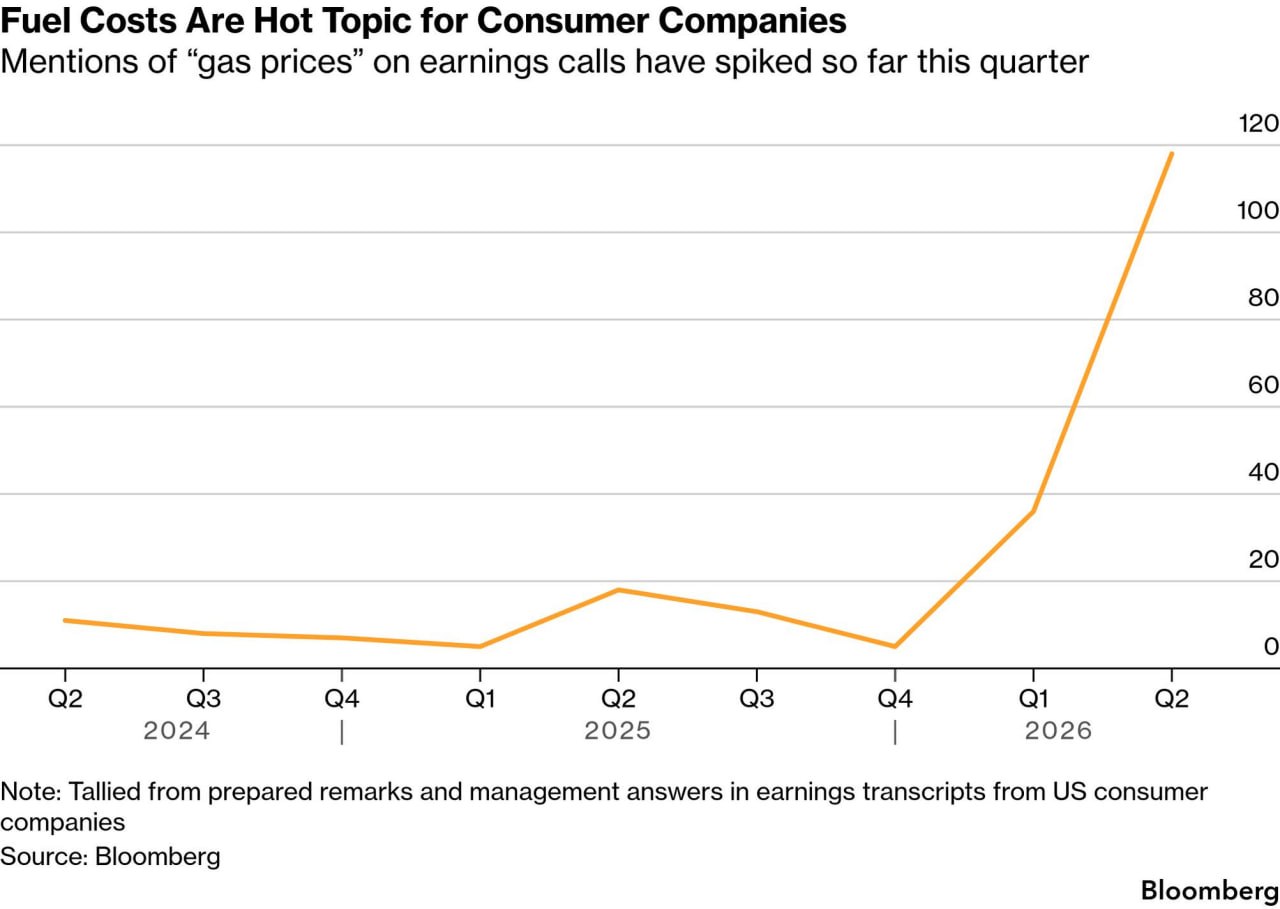
⛽️Iran War Sends Gas Prices to 2022 Highs
The economic impact of the Iran war is now hitting American consumers directly at the pump.
US gasoline prices have climbed to around $4.56 per gallon, the highest level since July 2022, according to AAA data reported by Investopedia. Prices have risen for 15 consecutive days, jumping roughly 54 cents since April 22.
The pressure is not just on drivers.
Higher fuel costs act like a hidden tax on the economy: consumers spend more on gas, leaving less money for restaurants, retail, travel, and discretionary purchases.
📌 Why it matters:
• Higher gas prices can weaken consumer spending
• Transport and logistics costs may rise
• Inflation pressure could remain sticky
• Businesses dependent on discretionary spending may feel the squeeze
• Oil and energy stocks could benefit, while consumer-facing sectors face pressure
The conflict is also affecting global oil markets and shipping risk, especially around the Strait of Hormuz, one of the world’s most important energy chokepoints. AP reported fresh military tensions involving Iranian attacks on US Navy ships in the Strait of Hormuz, adding another layer of risk to energy markets.
📉 Market takeaway:
This is bigger than expensive gas.
If energy prices stay elevated, the Iran war could become a macro problem: weaker consumption, higher inflation, and more pressure on businesses already dealing with affordability concerns.
Source: Bloomberg
#️⃣ #️⃣ #️⃣
#Finance #Oil #GasPrices #IranWar #EnergyMarkets #Inflation #StockMarket #Economy #Investing #Macro
The economic impact of the Iran war is now hitting American consumers directly at the pump.
US gasoline prices have climbed to around $4.56 per gallon, the highest level since July 2022, according to AAA data reported by Investopedia. Prices have risen for 15 consecutive days, jumping roughly 54 cents since April 22.
The pressure is not just on drivers.
Higher fuel costs act like a hidden tax on the economy: consumers spend more on gas, leaving less money for restaurants, retail, travel, and discretionary purchases.
• Higher gas prices can weaken consumer spending
• Transport and logistics costs may rise
• Inflation pressure could remain sticky
• Businesses dependent on discretionary spending may feel the squeeze
• Oil and energy stocks could benefit, while consumer-facing sectors face pressure
The conflict is also affecting global oil markets and shipping risk, especially around the Strait of Hormuz, one of the world’s most important energy chokepoints. AP reported fresh military tensions involving Iranian attacks on US Navy ships in the Strait of Hormuz, adding another layer of risk to energy markets.
This is bigger than expensive gas.
If energy prices stay elevated, the Iran war could become a macro problem: weaker consumption, higher inflation, and more pressure on businesses already dealing with affordability concerns.
Source: Bloomberg
#Finance #Oil #GasPrices #IranWar #EnergyMarkets #Inflation #StockMarket #Economy #Investing #Macro
Please open Telegram to view this post
VIEW IN TELEGRAM
👏7🔥5❤3🎉3💯3👍1
For years, society promised that degrees and office jobs meant long-term security.
Now AI is beginning to challenge that assumption at scale.
The first wave is hitting:
📞 customer service
⚖️ legal support work
📊 junior finance roles
💻 entry-level coding
📑 administrative tasks
📈 consulting research work
Many companies are no longer asking:
“How do we hire more juniors?”
They’re asking:
“How many humans do we still need?”
A growing number of firms are using AI to automate:
• report generation
• document analysis
• customer interactions
• internal research
• data processing
• coding assistance
The biggest structural problem may not even be layoffs themselves.
It’s the collapse of the career ladder.
If AI removes junior and internship-level positions:
Unlike previous automation waves that mainly affected physical labor, this one directly targets cognitive and office-based work including jobs traditionally considered “safe.”
At the same time, AI will likely create entirely new industries and roles.
But transitions of this scale are rarely smooth.
The next few years could redefine:
🎓 higher education value
🏢 corporate hiring models
💼 white-collar employment
📉 wage structures
🌍 economic inequality
The question is no longer whether AI will affect white-collar work.
It’s how fast institutions can adapt before millions of careers are disrupted.
🎥 Source discussed:
How AI is Causing a White Collar Purge
#AI #Jobs #Economy #Automation #Finance #Technology #Careers #FutureOfWork #Layoffs #ArtificialIntelligence
Please open Telegram to view this post
VIEW IN TELEGRAM
YouTube
How AI is Causing a White Collar Purge
A generation was told that degrees meant security. Now those same jobs are disappearing, fast.
From finance and law to tech and consulting, AI is quietly replacing the very roles that once defined white-collar careers. Entry-level positions are vanishing…
From finance and law to tech and consulting, AI is quietly replacing the very roles that once defined white-collar careers. Entry-level positions are vanishing…
❤13💯10🎉7🔥6👍5👏3
Rising oil prices are putting pressure on low-cost carriers like JetBlue and Frontier, according to Bloomberg and Deutsche Bank analyst Michael Linenberg.
Higher fuel costs + weaker demand from budget-conscious travelers could lead to:
• more airline partnerships
• joint ventures
• possible mergers
👉🏻 The low-cost airline sector is becoming increasingly difficult to sustain independently as energy prices rise.
#Markets #Airlines #Oil #Finance
Please open Telegram to view this post
VIEW IN TELEGRAM
Bloomberg.com
Low-Cost Airlines ‘Ripe’ For Mergers, Deutsche Bank Analyst Says
The US airline industry is primed for a new round of mergers as low-cost carriers are squeezed by the oil-price spike, according to Deutsche Bank analyst Michael Linenberg.
👏6🎉6💯6❤5👍5🔥5